On sporadic symmetry breaking operators for principal series representations of the de Sitter and Lorentz groups
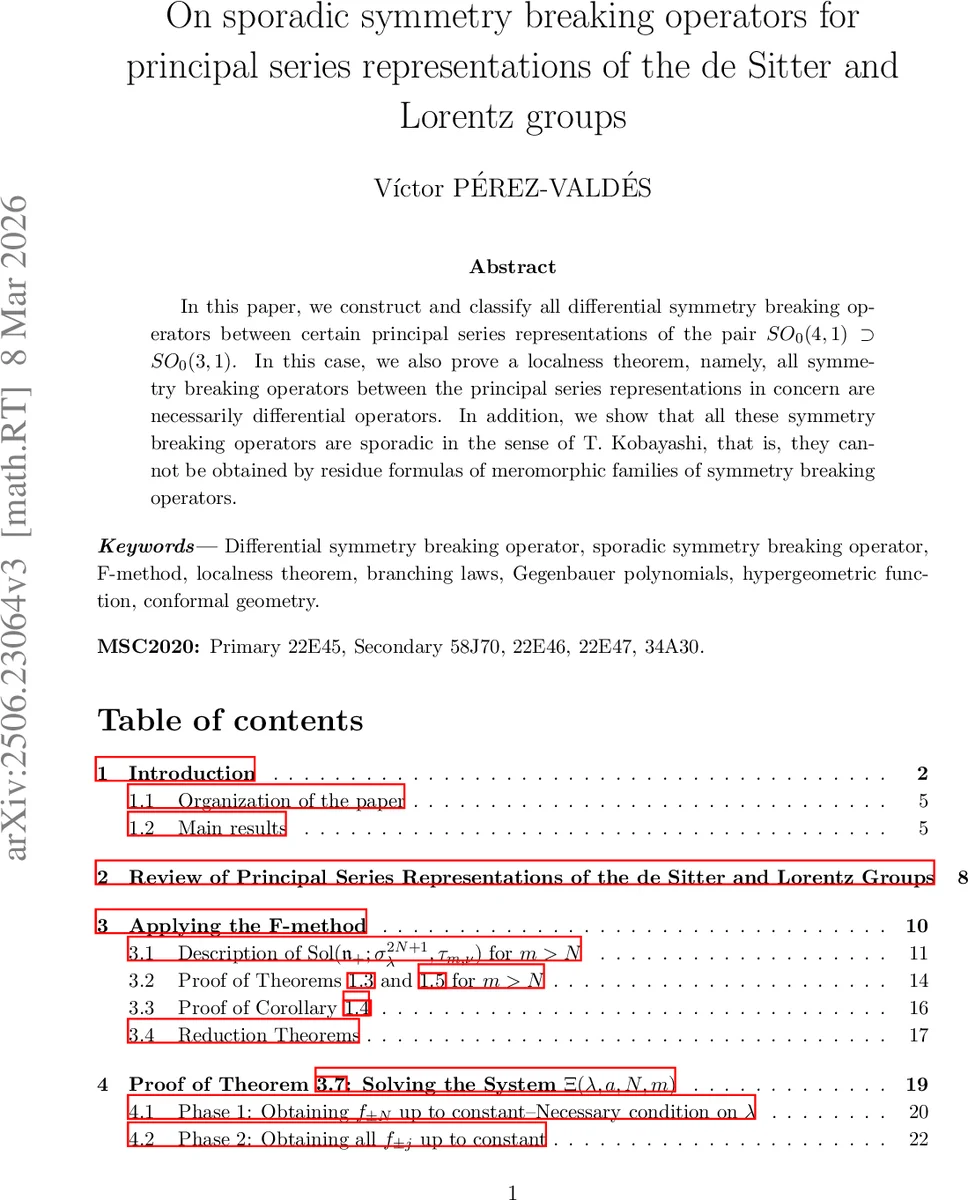
In this paper, we construct and classify all differential symmetry breaking operators between certain principal series representations of the pair $SO_0(4,1) \supset SO_0(3,1)$. In this case, we also prove a localness theorem, namely, all symmetry breaking operators between the principal series representations in concern are necessarily differential operators. In addition, we show that all these symmetry breaking operators are sporadic in the sense of T. Kobayashi, that is, they cannot be obtained by residue formulas of meromorphic families of symmetry breaking operators.
💡 Research Summary
The paper addresses the construction and classification of symmetry breaking operators (SBOs) for a specific pair of real reductive groups, namely the connected de Sitter group SO₀(4,1) and its subgroup SO₀(3,1). The representations under consideration are principal series induced from minimal parabolic subgroups: C^∞(S³,V_{2N+1}^λ) for SO₀(4,1) and C^∞(S²,L_{m,ν}) for SO₀(3,1), where N∈ℕ, m∈ℤ, and λ,ν∈ℂ are parameters. The central problem is to determine the space Hom_{SO₀(3,1)}(C^∞(S³,V_{2N+1}^λ), C^∞(S²,L_{m,ν})), to identify when it is non‑zero, to compute its dimension, and to construct explicit generators.
The authors focus on the regime |m|>N, which turns out to be the most challenging because all resulting SBOs are “sporadic” in the sense of Kobayashi: they cannot be obtained as residues of any meromorphic family of symmetry breaking operators. The analysis proceeds via the F‑method, a powerful technique introduced by Kobayashi for constructing differential SBOs (DSBOs). By applying a Fourier transform and interpreting the problem in terms of generalized Verma modules, the authors reduce the SBO classification to solving a system of ordinary differential equations denoted Ξ(λ,a,N,m). This system involves Gegenbauer polynomials, hypergeometric functions, and a hierarchy of recursion relations.
The main results are:
- Existence and Uniqueness (Theorem 1.3). For |m|>N, a non‑zero DSBO exists if and only if the parameters satisfy λ∈ℤ≤1−|m| and ν∈
Comments & Academic Discussion
Loading comments...
Leave a Comment