Black hole solutions surrounded by an anisotropic fluid in a Kalb--Ramond two--form background
We investigate static, spherically symmetric black hole spacetimes induced by the spontaneous Lorentz symmetry breaking of a Kalb--Ramond (KR) two-form field non--minimally coupled to gravity, coexisting with an anisotropic fluid. By adopting a gener…
Authors: Y. Sekhmani, A. Al-Badawi, Mohsen Fathi
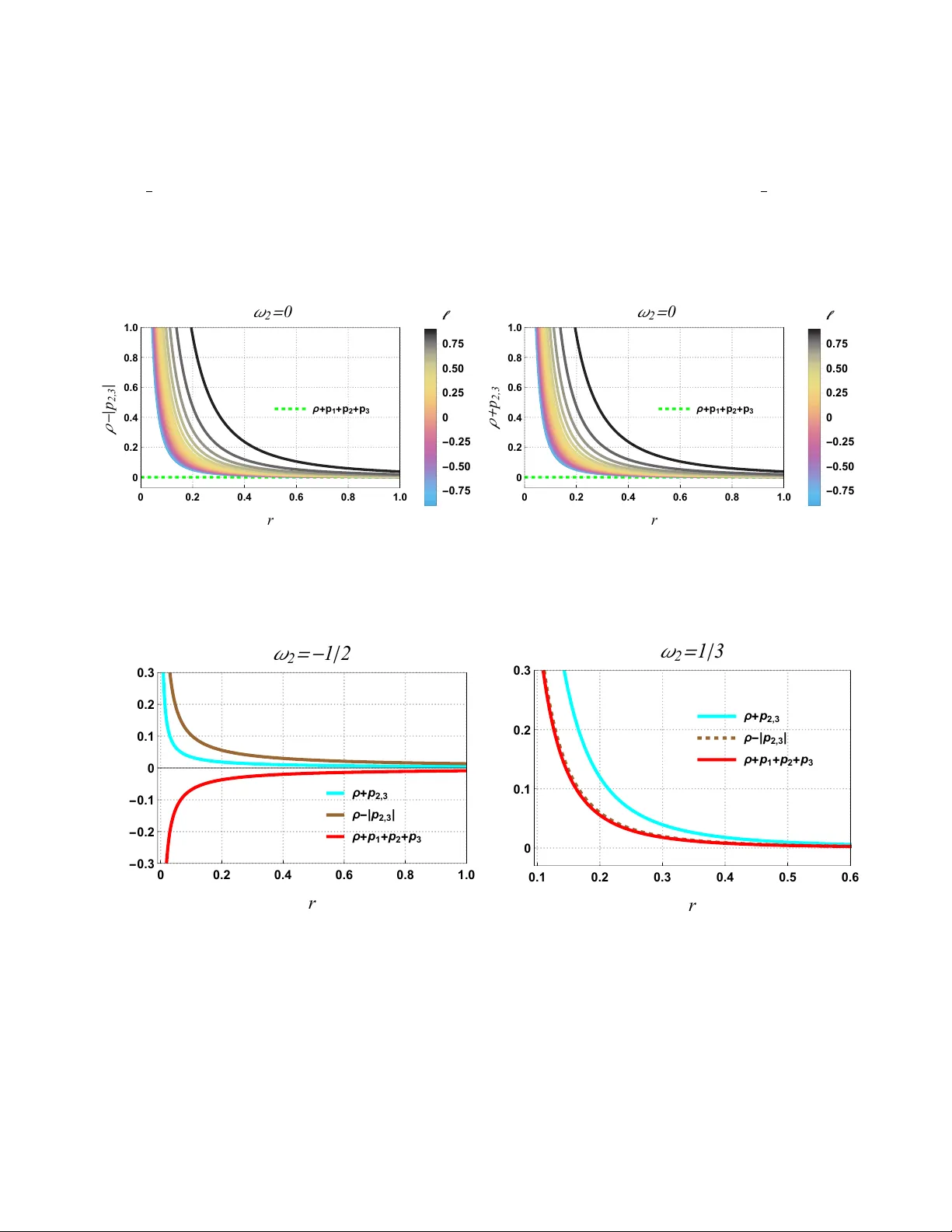
Blac k hole solutions surrounded b y an anisotropic uid in a Kalb–Ramond tw o-form bac kground Y. Sekhmani , 1, 2 , ∗ A. Al-Bada wi , 3 , † Mohsen F athi , 4 , ‡ A. V ac hher , 5 , § and Sushan t G. Ghosh 6, 7 , ¶ 1 Center for The or etic al Physics, Khazar University, 41 Mehseti Str e et, Baku, AZ1096, A zerb aijan. 2 Centr e for R ese ar ch Imp act & Outc ome, Chitkar a University Institute of Engine ering and T e chnolo gy, Chitkar a University, R ajpur a, 140401, Punjab, India 3 Dep artment of Physics, Al-Hussein Bin T alal University 71111, Ma’an, Jor dan 4 Centr o de Investigación en Ciencias del Esp acio y Físic a T e óric a (CICEF), Universidad Centr al de Chile, L a Ser ena 1710164, Chile 5 Centr e for The or etic al Physics, Jamia Mil lia Islamia, New Delhi 110025, India 6 Centr e for Theor etic al Physics, Jamia Mil lia Islamia, New Delhi - 110 025, India 7 A str ophysics and Cosmolo gy R ese ar ch Unit, University of K waZulu-Natal, Durban, South Afric a (Dated: Marc h 10, 2026) W e inv estigate static, spherically symmetric black hole spacetimes induced by the sp on taneous Loren tz symmetry breaking of a Kalb–Ramond (KR) t wo-form eld non-minimally coupled to gra v- it y , co existing with an anisotropic uid. By adopting a general equation of state where the radial pressure relates to the energy density via w 1 = − 1 and the tangential pressure via an arbitrary parameter w 2 , w e deriv e exact analytical solutions represen ting blac k holes surrounded by diverse matter elds, including dust ( w 2 = 0 ), radiation ( w 2 = 1 / 3 ), and dark energy-like distributions ( w 2 = − 1 / 2 ). A rigorous analysis of curv ature inv arian ts conrms a gen uine core singularit y , while the global geometry and adherence to standard energy conditions are shown to be highly sensitiv e to the in terplay b et w een the KR coupling ( ℓ ), the uid densit y parameter ( K ), and w 2 . F urthermore, w e analyse null geo desics in detail to determine the photon sphere and shadow radii. Using the Gibb ons-W erner geometrical approach and the Gauss-Bonnet theorem applied to the optical met- ric, we compute the w eak deection angle of light, demonstrating that b oth the KR eld and the anisotropic uid signicantly enhance light bending, particularly in dark-energy-lik e backgrounds. Finally , we ev aluate strong deection limit (SDL) observ ables for the sup ermassive blac k holes Sgr A ∗ and M87 ∗ , rev ealing quantiable deviations from standard Sch w arzschild geometries. These re- sults oer nov el astroph ysical signatures for constraining string-inspired KR gravit y and anisotropic dark matter halos using current and future observ ations. I. INTR ODUCTION Loren tz inv ariance stands as the foundational cornerstone of mo dern theoretical physics, underpinning b oth the Standard Mo del of particle physics and General Relativity . While this symmetry has withsto o d rigorous exp erimental scrutin y across div erse energy scales, v arious high-energy frameworks including string theory and non-commutativ e eld theories—p ostulate that it may falter at the Planck scale [ 1 – 8 ]. T o systematically inv estigate these violations, the Standard Model Extension (SME) was established as a comprehensive eective eld theory [ 9 ]. A prominent realisation of LSB within this framework is the Bum bleb ee mo del, in which a vector eld (the ”bum bleb ee” eld) is non-minimally coupled to the gravitational sector. This eld acquires a non-v anishing v acuum exp ectation v alue (VEV), triggering the symmetry breaking [ 10 – 13 ]. Notably , Casana et al. [ 14 ] derived a Sch w arzschild-lik e blac k hole solution within this context, sparking extensiv e research into the astroph ysical implications of bumblebee gra vity [ 15 – 33 ]. Alternatively , LSB can b e induced via a Kalb-Ramond (KR) eld, i.e., a rank-t wo antisymmetric tensor eld. Muc h like the bum bleb ee eld, the KR eld can couple non-minimally to gravit y and dev elop a non-zero VEV [ 34 ]. The dynamics of KR-mediated symmetry breaking are detailed in [ 35 – 38 ], with a primary exact solution pro vided b y [ 39 ]. Subsequent inv estigations hav e expanded on these foundations [ 40 – 42 ], including the deriv ation of alternative solutions that further prob e the limits of Lorentz-violating spacetime [ 43 ]. A fundamen tal question in relativistic astrophysics concerns the nature of matter congurations that can maintain ∗ sekhmaniyassine@gmail.com † ahmadbadawi@ah u.edu.jo (Corresponding author) ‡ mohsen.fathi@ucentral.cl § amnishv achher22@gmail.com ¶ sghosh2@jmi.ac.in 2 static equilibrium in the vicinit y of a black hole. Although ordinary bary onic matter typically fails to achiev e stabilit y due to intense gravitational attraction and radiation pressure, certain eld congurations, such as the electromagnetic stress-energy tensor in the Reissner-Nordström solution, demonstrate that equilibrium is p ossible when the pressure prole is inheren tly anisotropic [ 44 , 45 ]. Sp ecically , these systems often feature a negative radial pressure ( p r = − ρ ) , suggesting that anisotropy and non-standard equations of state are essential for understanding the co existence of compact ob jects and surrounding matter [ 46 – 48 ]. T raditionally , stellar and black hole mo dels hav e relied on the P ascalian (isotropic) uid approximation, a simplication supported by broad observ ational data in standard Einstein gra vity [ 49 – 51 ]. Ho wev er, as theoretical ph ysics mo ves tow ard modied frameworks like massiv e gra vit y or KR theory , the role of lo cal anisotropy has b ecome a fo cal p oin t of modern research [ 52 – 55 ]. Suc h anisotrop y is not merely a mathematical curiosity; it arises naturally in self-gravitating systems with exotic thermo dynamic prop erties or high-density regimes, such as quark stars or systems go verned by barotropic equations of state [ 56 – 59 ]. Recen t adv ancemen ts, including the deriv ation of cov ariant T olman-Opp enheimer-V olko (TO V) equations for non-isotropic uids [ 60 ], hav e highlighted how pressure gradients signicantly inuence the structural stabilit y and evolutionary tra jectories of relativistic objects [ 55 , 61 ]. Building upon this momentum, the presen t work explores a nov el black hole solution within the context of KR gra vity , specically examining the gra vitational and thermo dynamic implications of an en vironmental anisotropic uid coupled to the KR eld’s non-zero v acuum exp ectation v alue. The in v estigation of gra vitational lensing within the strong-eld limit has emerged as a robust area of inquiry , primarily b ecause relativistic images provide a unique window in to the high-curv ature en vironment immediately surrounding an even t horizon. These images enco de the subtle topological and geometric nuances of the spacetime, oering a p ow erful diagnostic for probing gravit y where it is most extreme. While mo died gravit y theories often conv erge with General Relativity (GR) in the weak-eld limit, the strong-eld regime serves as a critical testing ground for iden tifying p oten tial departures from Einsteinian physics. Consequen tly , gravitational lensing in this context is an indisp ensable tool for distinguishing betw een comp eting gra vitational framew orks. The theoretical tra jectory of this eld began with Darwin’s foundational study of ligh t deection around a Sc hw arzsc hild black hole [ 62 ]. This w ork laid the groundwork for Virbhadra and Ellis, who derived the denitive gravitational lens equation [ 63 ]. Subsequen tly , Bozza and collab orators [ 64 ] extended these analytical metho ds, enabling the systematic study of a diverse range of spacetimes beyond the standard Sch warzsc hild solution [ 65 – 68 ]. In the present study , w e utilize these analytical formalisms to detect signatures of anisotropic uid and Lorentz Symmetry Breaking (LSB). Building on existing literature regarding anisotropic signatures [ 69 ] and LSB eects in specic spacetimes [ 43 , 70 ], we aim to quantify how these phenomena distort the path of electromagnetic radiation. T o ensure our theoretical mo del remains physically grounded, we con trast our results with high-precision observ ational data. Sp ecically , w e employ the deviation parameters δ established b y observ ations of the Supermassive Blac k Holes (SMBHs) M87* [ 71 , 72 ] and Sgr A* [ 73 , 74 ]. By mapping our mo del’s predictions against these empirical b ounds, we can establish rigorous constraints on the theory’s free parameters and assess its ov erall feasibility . The structure of this pap er is organized as follo ws: In Section I I , w e deriv e the static, spherically symmetric blac k hole solutions within the prop osed framework. Section I I I is dedicated to the analysis of null geodesic tra jectories, utilizing Ev ent Horizon T elescop e (EHT) data to establish rigorous constraints on the black hole parameters. Subsequently , Section IV in vestigates the weak deection angle, while Sections V and VI pro vide a comprehensive study of strong gra vitational lensing, further rening our parameter space in ligh t of the M87* and Sgr A* observ ational b ounds. Finally , Section VII summarizes our primary ndings and outlines prosp ective a v en ues for future researc h regarding this black hole model. I I. BH SURR OUNDED BY PFDM WITH A BA CKGR OUND KR FIELD The Lorentz Symmetry Breaking (LSB) considered in this article is induced b y a non-zero v acuum exp ectation v alue (VEV) of the KR t wo-form B µν , an antisymmetric tensor of rank tw o. The KR sector is non-minimally coupled to gra vity . Our ob jective is to obtain static, spherically symmetric black-hole solutions in which a background KR eld co exists with an anisotr opic matter distribution (henceforth the KR–anisotropic–uid system). The total action w e emplo y reads [ 34 – 40 , 75 – 77 ]: S = Z d 4 x √ − g 1 2 κ R − 2Λ + ε B µλ B ν λ R µν − 1 12 H λµν H λµν − V B αβ B αβ ± b 2 + L aniso , (1) where κ = 8 π G ( G being the Newtonian gravitational constan t), ε is the non-minimal coupling constan t, b 2 > 0 xes the norm of the KR VEV, and Λ is the cosmological constan t. The KR eld strength is dened as H µν ρ ≡ ∂ [ µ B ν ρ ] . In 3 ( 1 ), L aniso denotes the Lagrangian density of the anisotropic uid, which constitutes the primary matter sector. The self-in teraction p otential V ( X ) , where X = B αβ B αβ ± b 2 , triggers spontaneous Lorentz symmetry breaking, yielding a non-zero VEV ⟨ B µν ⟩ = b µν sub ject to the constraint b µν b µν = ∓ b 2 . In the v acuum conguration, this constraint implies that the KR eld strength v anishes in the bac kground. V arying the action ( 1 ) with resp ect to g µν leads to the eld equations: R µν − 1 2 g µν R + Λ g µν = κ T KR µν + T M µν , (2) where T M µν is the energy-momen tum tensor of the anisotropic uid and T KR µν is the eectiv e energy–momen tum tensor of the KR eld: κT KR µν = 1 2 H µαβ H ν αβ − 1 12 g µν H αβ ρ H αβ ρ + 2 V ′ ( X ) B αµ B α ν − g µν V ( X ) + ε 1 2 g µν B αγ B β γ R αβ − B α µ B β ν R αβ − B αβ B ν β R µα − B αβ B µβ R ν α + 1 2 ∇ α ∇ µ B αβ B ν β + 1 2 ∇ α ∇ ν B αβ B µβ − 1 2 ∇ α ∇ α ( B µ γ B ν γ ) − 1 2 g µν ∇ α ∇ β B αγ B β γ . (3) Here, the prime denotes the deriv ativ e with resp ect to the argument X . The Bianc hi iden tities ensure the conserv ation of the combined tensor T KR µν + T M µν . In the subsequent analysis, w e consider a v anishing cosmological constant ( Λ = 0 ). The anisotropic uid contribution manifests through its energy-momentum tensor [ 78 ]: T M µν = ( ρ + p 2 ) u µ u ν + ( p 1 − p 2 ) x µ x ν + p 2 g µν , (4) where ρ is the energy density measured by a comoving observ er, u µ is the timelik e four-v elo city , and x µ is a spacelik e unit vector orthogonal to u µ and the angular directions. The resulting stress–energy tensor, T ν µ = diag − ρ ( r ) , p 1 ( r ) , p 2 ( r ) , p 2 ( r ) , (5) together with a static, spherically symmetric geometry , provides a exible framew ork for describing both the in teriors of ultra-dense objects and nontrivial matter distributions exterior to a blac k hole. Allo wing the radial ( p 1 ) and tangen tial ( p 2 ) pressures to dier is ph ysically w ell-motiv ated; such anisotropy naturally arises from electromagnetic elds, scalar condensates, or tangential stresses in dark-matter halos, crucially mo difying equilibrium and stability prop erties compared to the perfect-uid case. T o close the system, w e in troduce equations of state that relate pressure to energy densit y . Rather than imposing a single, global barotropic index, we adopt the more general ansatz p 1 ( r ) = w 1 ( r ) ρ ( r ) , p 2 ( r ) = w 2 ( r ) ρ ( r ) , (6) where w 1 and w 2 ma y b e radial functions and need not coincide. This parametrisation sim ultaneously captures the standard cosmological limits and gen uine anisotropic behaviours: • Dust: w 1 = w 2 = 0 . • Radiation: w 1 = w 2 = 1 / 3 . • Dark energy (cosmological–constant limit): w 1 = w 2 ≃ − 1 / 2 . • Phantom: w i < − 1 . In particular, cold dark matter or PFDM proles are naturally represen ted by w 1 ≈ 0 while w 2 ma y deviate slightly from zero to enco de small tangential stresses; conv ersely , a dominant negative radial pressure ( w 1 < 0 ) models lo cally repulsiv e dark–energy–t ype b eha viour. T o derive static, spherically symmetric solutions, w e emplo y the metric ansatz: ds 2 = − F ( r ) dt 2 + G ( r ) dr 2 + r 2 dθ 2 + r 2 sin 2 θ dϕ 2 . (7) 4 W e consider a pseudo electric KR gravit y eld conguration in which only the b 01 and b 10 comp onen ts are non-zero. The constant norm condition yields: b 01 = − b 10 = | b | r G ( r ) F ( r ) 2 . (8) Assuming the KR gravit y eld remains frozen at its VEV, the eld equations reduce to: − r G ′ ( r ) + G ( r ) − 1 G ( r ) r 2 G ( r ) 2 = ℓ 2 r 2 F ( r ) 2 G ( r ) 2 E 0 − 8 π ρ ( r ) , (9) r F ′ ( r ) + F ( r ) 1 − G ( r ) r 2 F ( r ) G ( r ) = ℓ 2 r 2 F ( r ) 2 G ( r ) 2 E 1 + 8 π p 1 ( r ) , (10) M 4 r F ( r ) 2 G ( r ) 2 = − ℓ 4 r F ( r ) 2 G ( r ) 2 E 2 + 8 π p 2 ( r ) . (11) with E 0 := r 2 G ( r ) F ′ ( r ) 2 + r F ( r ) r F ′ ( r ) G ′ ( r ) − 2 G ( r ) r F ′′ ( r ) + F ′ ( r ) + 2 F ( r ) 2 G ( r ) , (12) E 1 := r 2 G ( r ) F ′ ( r ) 2 + r 2 F ( r ) F ′ ( r ) G ′ ( r ) − 2 G ( r ) F ′′ ( r ) + 2 F ( r ) 2 r G ′ ( r ) + G ( r ) , (13) E 2 := r G ( r ) F ′ ( r ) 2 + F ( r ) r F ′ ( r ) G ′ ( r ) − 2 G ( r ) r F ′′ ( r ) + F ′ ( r ) + 2 F ( r ) 2 G ′ ( r ) , (14) M := − r G ( r ) F ′ ( r ) 2 + F ( r ) 2 G ( r ) r F ′′ ( r ) + F ′ ( r ) − r F ′ ( r ) G ′ ( r ) − 2 F ( r ) 2 G ′ ( r ) . (15) Assuming w 1 = − 1 , subtracting Eq. ( 9 ) from Eq. ( 10 ) yields d dr ln F ( r ) G ( r ) = 0 , (16) hence F ( r ) G ( r ) = C . Imp osing the usual asymptotic normalization xes C = 1 , hence G ( r ) = F ( r ) − 1 . Consequently , the line elemen t reduces to ds 2 = − F ( r ) dt 2 + F ( r ) − 1 dr 2 + r 2 ( dθ 2 + sin 2 θ dϕ 2 ) . (17) This means that there exists a hypersurface-orthogonal Killing v ector in the spacetime. Th us, the spacetime is static in the region where f > 0 , and ρ = ρ ( r ) and p 2 = p 2 ( r ) hold by consistency . Equation ( 9 ) can b e formally in tegrated to give F ( r ) = 1 1 − ℓ − 2 m ( r ) r , (18) where the mass function m ( r ) is dened b y m ( r ) = 4 π Z r r ′ 2 ρ ( r ′ ) dr ′ . (19) Here, the in tegration constant is absorb ed into the denition of m ( r ) . If one requires the analyticit y of the spacetime at the center, it requires m ( r ) ≃ m 3 r 3 + m 5 r 5 + · · · around r = 0 , where m 3 , m 5 are the constants, whic h restricts the form of ρ ( r ) . Putting Eq. ( 18 ) to Eq. ( 11 ), w e obtain the expression of p 2 in terms of ρ as p 2 = 1 2 ( ℓ − 1) ( r ρ ′ ( r ) + 2 ρ ( r )) , (20) whic h can also b e obtained from the conserv ation la w ∇ µ T µν = 0 . The purpose of this work is to nd analytic solutions of Einstein’s equations. In this w ork, we restrict our interests to the exactly solv able case with w 1 = − 1 . (21) 5 When ρ plays the role of an energy densit y , the energy conditions restrict the matter kinds to ph ysically allow ed ones. Among the conditions, the p ositivity of energy density app ears to b e crucial. In addition to it, all the energy conditions require w 2 ≥ − 1 . Sp ecically , the dominant energy condition requires w 2 ≤ 1 and the strong energy condition requires w 2 ≥ 0 . Therefore, when 0 ≤ w 2 ≤ 1 , all the energy conditions are satised. Once we assume p 2 = w 2 ρ , Eq. ( 20 ) is solv ed to giv e m ( r ) for w 2 = 1 / 2 , the densit y and the radial pressure, m ( r ) = M + K r 1+ 2 w 2 ℓ − 1 2(1 − ℓ ) , ρ ( r ) = − p 1 ( r ) = K (1 − 2 w 2 − ℓ ) r 2(1+ w 2 − ℓ ) ℓ − 1 8 π (1 − ℓ ) 2 , (22) where M and K are constan ts. F or the energy densit y to be non-negativ e, w e require r 2 w 2 0 ≡ (1 − 2 w 2 − ℓ ) K ≥ 0 , (23) where the p ositiv e parameter r 0 of length (mass) scale was introduced for con v enience b ecause the dimension of the parameter K is dep endent on the v alue of w 2 . The energy density and the pressure are singular at the origin or at innit y when w 2 > − 1 and w 2 < − 1 , resp ectiv ely . T o hav e a smooth w 2 → (1 − ℓ ) / 2 limit, we introduce a new mass parameter M ′ ≡ M + r 1 − ℓ 0 2(1 − 2 w 2 − ℓ ) . (24) Then, the solutions for w 2 = (1 − ℓ ) / 2 can b e sp ecied by taking the limit w 2 → (1 − ℓ ) / 2 from Eq. ( 22 ), which giv es m ( r ) = M ′ + r 0 2 log r r + r 0 , ρ ( r ) = r 1 − ℓ 0 8 π (1 − ℓ ) 2 r 3 . All the other physical form ulae for w 2 = 1 / 2 in this w ork can b e obtained in the same manner. Therefore, we will not discuss the w 2 = 1 / 2 case separately . The metric function in Eq. ( 18 ) b ecomes F ( r ) = 1 1 − ℓ − 2 M r − K 1 − ℓ r 2 w 2 ℓ − 1 , (25) where M and K can b e rewritten by using Eqs. ( 23 ) and ( 24 ). Because we are in terested in solutions inv olving matter, w e restrict our atten tion to the case with r 0 = 0 . F or 1 / 2 < w 2 ≤ 1 , the spacetime structure must b e v ery similar to that of the Reissner-Nordström geometry in coupling to a self-interacting KR eld. F or 1 / 2 < w 2 ≤ 1 the anisotropic- uid term is sucien tly short-ranged that it pro duces only a lo calized correction to the metric; as a consequence the causal and horizon structure closely resem bles that of a Reissner–Nordström black hole when the geometry is coupled to a self-in teracting KR tw o-form. In the isotropic limit w 1 = w 2 = − 1 , the combinations M / (1 − ℓ ) and 3 K/ (1 − ℓ ) pla y the roles of an eectiv e mass parameter and an eective cosmological term within the KR framew ork — and, for those v alues of ℓ that make the exp onent 2 w 2 / ( ℓ − 1) pro duce an r 2 scaling, the K/ (1 − ℓ ) contribution reduces to an (an ti-)de Sitter cosmological constant while M / (1 − ℓ ) is the ADM mass. In Fig. 1 we display the b eha viour of the metric function f ( r ) for M = 1 and representativ e v alues of the KR coupling ℓ and the anisotropy parameter K . T wo correlated eects are visible. First, the ov erall amplitude of f ( r ) is raised as ℓ approaches unity b ecause of the global prefactor 1 / (1 − ℓ ) , which shifts the baseline and therefore mo ves the radial lo cations of simple zeros (horizons) systematically outw ard. Second, the anisotropic-uid term − K r 2 w 2 / ( ℓ − 1) c hanges its radial scaling dep ending on the equation-of-state parameter w 2 : for w 2 = 0 (dust) it reduces to a constan t oset that primarily translates the curve without altering asymptotic decay; for w 2 = 1 / 3 (radiation) it decays at large r , pro ducing a Reissner–Nordström–like inner/outer-ro ot prole; and for w 2 < 0 (dark-energy–like) it gro ws with r , generating a cosmological-t yp e rise whic h can introduce an additional cosmological root. Hence, Fig. 1 compactly illustrates ho w the interpla y betw een the ℓ -con trolled amplitude and the sign of the exp onent 2 w 2 / ( ℓ − 1) determines b oth the n umber of horizons and their radial positions across the parameter sweep. No w, let us analyze the curv ature singularities. The scalar curv ature reads R = 2( ℓ + w 2 − 1) r 2 w 2 0 r 2 w 2 ℓ − 1 + 2(1 − ℓ ) 2 ℓ ( ℓ − 1) 3 r 2 , (26) is generically singular at the origin due to the r − 2 term. At innity , it deca ys only when w 2 / ( ℓ − 1) < 1 ; if w 2 / ( ℓ − 1) > 1 , the curv ature div erges as r → ∞ , indicating a non-asymptotically at geometry . The squared Ricci tensor is given by R ab R ab = 2(1 − ℓ ) 4 ℓ 2 + 4( ℓ − 1) 3 ℓr 2 w 2 0 r 2 w 2 ℓ − 1 + 2 (1 − ℓ ) 2 + w 2 2 r 4 w 2 0 r 4 w 2 ℓ − 1 ( ℓ − 1) 6 r 4 , (27) 6 ℓ = 0 ℓ = 0.15 ℓ = 0.3 ℓ = 0.4 0 2 4 6 8 - 2 - 1 0 1 r F ( r ) ω 2 = 0 ℓ = 0 ℓ = 0.15 ℓ = 0.3 ℓ = 0.4 0 2 4 6 8 - 2 - 1 0 1 r F ( r ) ω 2 = 1 / 3 ℓ = 0 ℓ = 0.15 ℓ = 0.3 ℓ = 0.4 0 2.5 5.0 7.5 10.0 12.5 - 0.2 - 0.1 0 0.1 0.2 r F ( r ) ω 2 = - 1 / 2 FIG. 1: F ( r ) metric function with K = 0 . 095 and M = 1 . whic h div erges at the origin as r − 4 (or more severely if w 2 / ( ℓ − 1) < 0 ). Similar to the Ricci scalar, it decays at innit y only for w 2 / ( ℓ − 1) < 1 . The Kretschmann inv ariant for this metric is giv en by R abcd R abcd = 4 r 6 4 ( ℓ − 1) 2 M ( ℓ + 2 w 2 − 1) − w 2 r 2 w 2 0 r 2 w 2 ℓ − 1 +1 2 (1 − ℓ ) 4 ( ℓ + 2 w 2 − 1) 2 + 2 M + r ℓ − 1 r 2 w 2 0 r 2 w 2 ℓ − 1 ℓ + 2 w 2 − 1 + ℓ !! 2 + 2( ℓ − 1) 3 M ( ℓ + 2 w 2 − 1) + w 2 ( − ℓ + 2 w 2 + 1) r 2 w 2 0 r 2 w 2 ℓ − 1 +1 2 (1 − ℓ ) 6 ( ℓ + 2 w 2 − 1) 2 ! . (28) As r → 0 , the scalar generically diverges as r − 6 (assuming M = 0 ), while its asymptotic b ehavior at large r is determined b y the ratio 2 w 2 / ( ℓ − 1) . Sp ecically , the inv ariant decays for 2 w 2 / ( ℓ − 1) < 2 and approaches a non-zero limit or grows for 2 w 2 / ( ℓ − 1) ≥ 2 . On the other hand, the factors of ( ℓ + 2 w 2 − 1) in the denominators app ear to suggest a divergence, at w 2 = (1 − ℓ ) / 2 ; ho w ev er, this is a co ordinate-dep endent artifact that is remov able via the reparameterization ( 24 ), and thus do es not constitute a ph ysical curv ature divergence. F or r 0 = 0 , the inv ariant remains regular ev erywhere only in the sp ecic case M = 0 and w 2 = − 1 , whic h corresp onds to (anti-)de Sitter space. In other parameter regimes, the curv ature singularity , whic h is lo cated at the origin or at innity dep ending on the sign of 2 w 2 / ( ℓ − 1) , ma y b e present, manifesting as either a black hole singularity hidden by horizons or a naked singularit y , con tingen t up on the global horizon structure. Energy conditions furnish indisp ensable criteria for assessing the ph ysical admissibility of spacetime solutions and are routinely inv ok ed in studies of b oth cosmological models [ 79 ] and blac k hole geometries [ 80 , 81 ]. These conditions constrain the stress-energy tensor T µν in a manner that remains ph ysically robust across Einstein gra vity [ 82 ] and its v arious mo dications [ 83 ]. The standard set—comprising the Null (NEC), W eak (WEC), Strong (SEC), and Dominan t (DEC) energy conditions—is dened in terms of the energy densit y ρ and principal pressures P i as follows: NEC : ρ + P i ≥ 0 (29) WEC : ρ ≥ 0 , ρ + P i ≥ 0 (30) SEC : ρ + X i P i ≥ 0 , ρ + P i ≥ 0 (31) DEC : ρ ≥ 0 , ρ ≥ | P i | (32) Relev an t quantities are deduced as ρ + p 1 = 0 , ρ + p 2 , 3 = K ( w 2 + 1)(1 − 2 w 2 − ℓ ) r 2 w 2 ℓ − 1 − 2 8 π (1 − ℓ ) 2 , (33) ρ + p 1 + p 2 + p 3 = w 2 K (1 − 2 w 2 − ℓ ) r 2( w 2 − ℓ +1) ℓ − 1 4 π (1 − ℓ ) 2 , (34) ρ − | p 1 | = 0 , ρ − | p 2 , 3 | = ρ − w 2 K (1 − 2 w 2 − ℓ ) r 2( w 2 − ℓ +1) ℓ − 1 8 π (1 − ℓ ) 2 . (35) 7 • The Null Energy Condition (NEC) is saturated, ρ + p 1 = 0 , while the tangential null com bination is given b y ρ + p 2 , 3 = (1 + w 2 ) K (1 − 2 w 2 − ℓ ) r 2 w 2 ℓ − 1 − 2 8 π (1 − ℓ ) 2 . Therefore, the NEC is algebraically equiv alen t to (1 + w 2 ) K (1 − 2 w 2 − ℓ ) ≥ 0 . In particular: – w 2 = − 1 saturates the tangential NEC. – F or w 2 > − 1 the NEC reduces to K (1 − 2 w 2 − ℓ ) ≥ 0 . – F or w 2 < − 1 the NEC requires K (1 − 2 w 2 − ℓ ) ≤ 0 . • Using the display ed expression ρ + X i p i = w 2 K (1 − 2 w 2 − ℓ ) r 2( w 2 − ℓ +1) ℓ − 1 4 π (1 − ℓ ) 2 , the SEC (both ρ + P i p i ≥ 0 and ρ + p i ≥ 0 ) is equiv alent to the pair of algebraic inequalities w 2 K (1 − 2 w 2 − ℓ ) ≥ 0 and (1 + w 2 ) K (1 − 2 w 2 − ℓ ) ≥ 0 . (36) Consequences by w 2 -region: – If w 2 > 0 then w 2 > 0 and 1 + w 2 > 0 , so the SEC reduces to K (1 − 2 w 2 − ℓ ) ≥ 0 . – If − 1 < w 2 < 0 then w 2 < 0 while 1+ w 2 > 0 ; the tw o inequalities are incompatible unless K (1 − 2 w 2 − ℓ ) = 0 . Hence, the SEC is generically violated for − 1 < w 2 < 0 . – If w 2 < − 1 b oth w 2 and 1 + w 2 are negative and the SEC can hold for K (1 − 2 w 2 − ℓ ) ≤ 0 . • The radial DEC is saturated b ecause p 1 = − ρ gives ρ − | p 1 | = 0 . The tangential DEC condition is ρ − | p 2 , 3 | = ρ − w 2 K (1 − 2 w 2 − ℓ ) r 2( w 2 − ℓ +1) ℓ − 1 8 π (1 − ℓ ) 2 ≥ 0 . (37) F or the solution family where ρ and p 2 , 3 share the same o verall parameter factor S and the same radial scaling, the DEC reduces to the simple algebraic requirements K (1 − 2 w 2 − ℓ ) ≥ 0 and | w 2 | ≤ 1 . (38) Th us the DEC requires K (1 − 2 w 2 − ℓ ) ≥ 0 together with − 1 ≤ w 2 ≤ 1 . (If the radial exp onents diered, the condition would b ecome radius-dependent and could hold only inside a restricted radial domain.) Figure 2 sho ws radial proles of ρ , ρ + p 2 , 3 and ρ + P i p i for K = 0 . 095 , M = 1 and v arying ℓ with w 2 = 0 . Hence, the tangential NEC is algebraically equiv alent to K (1 − ℓ ) ≥ 0 , (39) the SEC is saturated ( ρ + P i p i = 0 ), and the DEC reduces to K (1 − ℓ ) ≥ 0 together with | w 2 | ≤ 1 (here | w 2 | = 0 ). The observed decrease in the amplitude of ρ + p 2 , 3 as ℓ approaches unity follows directly from K (1 − ℓ ) : larger ℓ reduces K (1 − ℓ ) and pushes the tangen tial combination tow ard zero. The radial scaling for w 2 = 0 is r − 2 , so the steep rise of the plotted combinations near the left axis corresp onds to the core div ergence implied by this exp onent. Figure 3 presen ts the parameter-dependent behavior of K = 0 . 095 with tw o representativ e equations of state: w 2 = − 1 / 2 (left panel) and w 2 = 1 / 3 (right panel), using ℓ = 0 . 1 in treatmen t. The controlling factor is ev aluated to K (2 − ℓ ) | w 2 = − 1 2 > 0 , K 1 3 − ℓ | w 2 = 1 3 > 0 (for ℓ = 10 − 1 ) . (40) The energy-condition pattern follows from the algebraic sign rules: 8 • F or w 2 = − 1 / 2 : 1 + w 2 = +1 / 2 > 0 and K (2 − ℓ ) > 0 , so the tangen tial NEC (1 + w 2 ) K (2 − ℓ ) is p ositive; | w 2 | < 1 and K (2 − ℓ ) > 0 imply that DEC holds p oin twise; how ever, w 2 < 0 with K (2 − ℓ ) > 0 yields w 2 K (2 − ℓ ) < 0 and therefore ρ + P i p i < 0 , i.e., SEC violation across the plotted radii. The radial slop es are mild, consisten t with the less singular exponents for this choice of w 2 . • F or w 2 = 1 / 3 : w 2 > 0 and 1 + w 2 > 0 , so NEC, SEC and DEC reduce to the single algebraic requirement K 1 3 − ℓ ≥ 0 (together with | w 2 | ≤ 1 for DEC). With ℓ = 10 − 1 and K = 0 . 095 one obtains K 1 3 − ℓ > 0 , hence all three conditions are satised point wise; the radial decay is stronger and produces a sharper fallo at larger r . The tw o panels illustrate the algebraic pattern: K (1 − 2 w 2 − ℓ ) controls the sign of NEC and DEC combinations, while the product w 2 K (1 − 2 w 2 − ℓ ) con trols the SEC. ρ + p 1 + p 2 + p 3 0 0.2 0.4 0.6 0.8 1.0 0 0.2 0.4 0.6 0.8 1.0 r ρ - | p 2 , 3 | ω 2 = 0 ℓ - 0.75 - 0.50 - 0.25 0 0.25 0.50 0.75 (a) [ K = 0 . 095 ]. ρ + p 1 + p 2 + p 3 0 0.2 0.4 0.6 0.8 1.0 0 0.2 0.4 0.6 0.8 1.0 r ρ + p 2 , 3 ω 2 = 0 ℓ - 0.75 - 0.50 - 0.25 0 0.25 0.50 0.75 (b) [ K = 0 . 095 ]. FIG. 2: The v ariation of ρ + ∑ i p i (strong energy condition), ρ + p 2 , 3 (null energy condition), and ρ − | p 2 , 3 | (dominant energy condition) against r for v arious v alues of ℓ with w 2 = 0 . ρ + p 2,3 ρ -| p 2,3 | ρ + p 1 + p 2 + p 3 0 0.2 0.4 0.6 0.8 1.0 - 0.3 - 0.2 - 0.1 0 0.1 0.2 0.3 r ω 2 = - 1 / 2 (a) [ K = 0 . 095 , ℓ = 0 . 1 ]. ρ + p 2,3 ρ -| p 2,3 | ρ + p 1 + p 2 + p 3 0.1 0.2 0.3 0.4 0.5 0.6 0 0.1 0.2 0.3 r ω 2 = 1 / 3 (b) [ K = 0 . 095 , ℓ = 0 . 1 ]. FIG. 3: The v ariation of ρ + ∑ i p i (strong energy condition), ρ + p 2 , 3 (null energy condition), and ρ − | p 2 , 3 | (dominant energy condition) against r for w 2 = − 1 / 2 (left) and w 2 = 1 / 3 (righ t). I I I. GEODESIC MOTIONS: NULL GEODESIC This section examines the geo desic motion of test particles within the spacetime of an anisotropic uid black hole in KR gra vit y . W e fo cus on how the KR eld parameter and the surrounding uid density inuence particle trajectories 9 and light deection. The study of geodesic motion is essential for understanding BH properties, as it provides insights in to spacetime geometry and observ able phenomena such as gra vitational lensing and BH shado ws [ 84 – 87 ]. Analyzing the paths of particles and light is also crucial for interpreting high-energy astrophysical pro cesses. W e will use the Lagrangian approach to in v estigate this motion [ 88 – 92 ]. The Lagrangian densit y for the given metric is presented as the starting p oint for this analysis. L = 1 2 " − f ( r ) dt dτ 2 + 1 f ( r ) dr dτ 2 + r 2 dϕ dτ 2 # , (41) where τ represents an ane parameter and the geo desic motion in the equatorial plane θ = π / 2 . Since the chosen spacetime is static and spherically symmetric, it admits t w o Killing vector elds: the energy E and the angular momen tum L of test particles, which are given by E = f ( r ) dt dτ , L = r 2 dϕ dτ . (42) After substituting Eq. ( 42 ) in to Eq. ( 41 ), w e obtain the equation of motion asso ciated with the radial coordinate r . dr dτ 2 + V e ( r ) = E 2 (43) whic h is equiv alen t to the one-dimensional equation of motion of a unit mass particle ha ving energy E 2 and the p otential V e ( r ) . The eective p otential gov erning the dynamics of test particles around the BH is given b y V e ( r ) = ε + L 2 r 2 1 1 − ℓ − 2 M r − K 1 − ℓ r 2 w 2 ℓ − 1 . (44) Here ε = 0 for null geo desics and 1 for time-like geodesics. A. Null Geo desic The study of null geo desics is essential for understanding black hole physics and their observ able features, lik e the photon sphere and shadow. The eective p otential is a k ey to ol for this analysis, as it describ es how light b ehav es in the curved spacetime near a black hole. In the n ull geo desic case, ε = 0 , the eective p otential from Eq. ( 44 ) b ecomes: V e ( r ) = L 2 r 2 1 1 − ℓ − 2 M r − K 1 − ℓ r 2 w 2 ℓ − 1 . (45) Here, w e study the dynamics of photons in a gra vitational eld and show how v arious parameters aect their eectiv e radial force near a BH. Using the eectiv e p otential given in Eq. ( 45 ), w e can determine the eectiv e radial force on as, F ph = − 1 2 dV e dr = L 2 r 3 1 1 − ℓ − 3 M r − K (1 + w 2 ) (1 − ℓ ) r 2 w 2 . (46) W e see that the eectiv e radial force experienced b y the photon particles is inuenced by the KR parameter ℓ , the uid density parameter K , the conserved angular momentum L and the BH mass M . In the limit where K = 0 , the ab ov e result ( 46 ) reduces to that of the Sc hw arzsc hild BH solution in KR gravit y , which further simplies to the standard Sch w arzschild BH result when ℓ = 0 . B. Photon sphere and BH shado w This subsection analyzes the combined impact of KR gravit y and an anisotropic uid on k ey features of photon dynamics: the photon sphere and shado w radius. 10 Case Eectiv e Radial F orce w 2 = 0 (Dust) L 2 r 3 ( 1 1 − ℓ − 3 M r − K 1 − ℓ ) w 2 = 1 / 3 (Radiation) L 2 r 3 ( 1 1 − ℓ − 3 M r + K (3 ℓ − 4) 3(1 − ℓ ) 2 r 2 / 3( ℓ − 1) ) w 2 = − 1 / 2 (Dark Energy-like) L 2 r 3 ( 1 1 − ℓ − 3 M r + K (2 ℓ − 1) 2(1 − ℓ ) 2 r 1 / (1 − ℓ ) ) . T ABLE I: Eectiv e radial force under v alues of the equation-of-state parameter. Circular null geo desics require the conditions ˙ r = 0 and ¨ r = 0 . This leads to the following tw o relationships: E 2 = V e ( r ) = L 2 r 2 f ( r ) , dV e ( r ) dr = 0 . (47) The rst relation in Eq. ( 47 ) gives us the critical impact parameter for photons. The second relation dV e ( r ) dr = 0 giv es us the photon sphere radius r = r ph satisfying the follo wing equation: 2 f ( r ) = r f ′ ( r ) ⇒ 6(1 − ℓ ) 2 M − 2 r 1 − ℓ + K ( ℓ − 1 − w 2 ) r 2 w 2 / ( ℓ − 1) = 0 . (48) When the parameters are set to K = 0 and ℓ = 0 , Eq. ( 48 ) simplies to 3 M . The solution of Eq. ( 48 ) depends on the choice of the equation-of-state parameter w 2 . Analytically , w e obtain the photon sphere radius for three distinct v alues of the equation-of-state parameter as follows: Case I: w 2 = 0 (Dust) The photon sphere equation ( 48 ) becomes (1 − K ) r − 3(1 − ℓ ) M = 0 ⇒ r ph = 3 M (1 − ℓ ) 1 − K . (49) Case I I: w 2 = 1 3 (Radiation) Equation ( 48 ) b ecomes 1 − ℓ + K ( ℓ − 4 3 ) r 2 / 3( ℓ − 1) r − 3(1 − ℓ ) 2 M = 0 . (50) F or 0 < K < 1 , the photon sphere equation ( 50 ) reduces to a nonlinear algebraic equation with fractional p ow ers. By in tro ducing the v ariable x = r 1 / 3 , the equation can be recast into a mixed-p ow er p olynomial form as (1 − ℓ ) x 3 + K ( ℓ − 4 3 ) x 2 ℓ +1 − 3(1 − ℓ ) 2 M = 0 . (51) Although no closed-form solution exists for generic ℓ , the equation admits a unique p ositive real ro ot. Exact analytical solutions for the photon sphere radius are c hallenging. Thus, we attempted a n umerical solution to determine the photon sphere radius. Case I I I: w 2 = − 1 2 (Dark Energy-like) Equation ( 48 ) b ecomes 1 − ℓ + K ( ℓ − 1 2 ) r 1 / (1 − ℓ ) r − 3(1 − ℓ ) 2 M = 0 . (52) Appro ximate solution of Eq. ( 52 ) is given by (see app endix) r ( K ) ≈ 3(1 − ℓ ) M − ℓ − 1 2 1 − ℓ 3(1 − ℓ ) M 2 − ℓ 1 − ℓ K + O ( K 2 ) (53) Figure 4 shows three-dimensional visualizations of the photon sphere radius for three distinct v alues of the equation- of-state parameter w 2 as a function of the combined v alues of K and ℓ . Our analysis sho ws that raising both K and ℓ expands the photon sphere r ph . Next, w e contin ue computing the black hole shado w, the dark image formed b y photons trapp ed near unstable circular orbits at the photon sphere. Its measurable radius R s is determined b y the critical impact parameter b c , whic h dep ends on the spacetime geometry . The BH shadow, as observed b y a static observer at radial p osition r O , has an apparen t radius giv en b y [ 93 ] R sh = r ph s f ( r O ) f ( r ph ) = r ph v u u u t 1 1 − ℓ − 2 M r O − K 1 − ℓ r 2 w 2 ℓ − 1 O 1 1 − ℓ − 2 M r ph − K 1 − ℓ r 2 w 2 ℓ − 1 ph . (54) 11 FIG. 4: Plot of the photon sphere r ph vs K and ℓ and for certain v alues of w 2 , dust (T op), Radiation (middle), and dark energy-like (bottom). Here, M = 1 . Analytically , the shado w radius for three distinct v alues of the equation-of-state parameter is : Case I: w 2 = 0 (Dust) R sh = r ph v u u t 1 1 − ℓ − 2 M r O − K 1 − ℓ 1 1 − ℓ − 2 M r ph − K 1 − ℓ (55) F or a distan t observer ( r O → ∞ ), the shado w radius simplies to R sh = r ph v u u t 1 − K 1 − ℓ 1 1 − ℓ − 2 M r ph − K 1 − ℓ . (56) Case I I: w 2 = 1 3 (Radiation) R sh = r ph v u u u t 1 1 − ℓ − 2 M r O − K 1 − ℓ r 2 3( ℓ − 1) O 1 1 − ℓ − 2 M r ph − K 1 − ℓ r 2 3( ℓ − 1) ph . (57) 12 FIG. 5: Plot of the shadow radius R s vs K and ℓ and for certain v alues of w 2 , Dust (left) and Radiation (right). Here, M = 1 . F or a distan t observer ( r O → ∞ ) and − 1 < ℓ < 1 , the shadow radius simplies to R sh = r ph v u u u t 1 1 − ℓ 1 1 − ℓ − 2 M r ph − K 1 − ℓ r 2 3( ℓ − 1) ph . (58) Case I I I: w 2 = − 1 2 (Dark Energy-like) R sh = r ph v u u u t 1 1 − ℓ − 2 M r O − K 1 − ℓ r 1 1 − ℓ O 1 1 − ℓ − 2 M r ph − K 1 − ℓ r 1 1 − ℓ ph . (59) F or a distan t observer ( r O → ∞ ), the shado w radius R sh = Undened. Figure 5 shows three-dimensional visualizations of the shadow radius for tw o distinct v alues of the equation-of-state parameter w 2 as a function of the combined v alues of K and ℓ . The gure shows that the shadow radius increases with b oth parameters K and ℓ . A t this stage, w e constrain the model parameters ℓ and K by using the shadow data from the EHT observ ations of M87* and Sgr A* [ 71 , 94 – 98 ]. W e also tak e into accoun t the observ ational uncertain ties rep orted in Refs. [ 99 , 100 ]. Since the shadow size is directly related to the photon sphere, these observ ations provide a strong test for gravitational mo dels in the strong-eld regime. F or the comparison with the EHT results, we recall that the theoretical shadow diameter is dened as d theo sh = 2 R sh . In our analysis, this quan tit y is dimensionless b ecause the radial co ordinate is scaled b y the black hole mass M . On the observ ational side, the shadow diameter is giv en b y [ 101 ] d sh = D θ ∗ γ M ⊙ , (60) where D is the distance to the source in parsecs, θ ∗ is the measured angular diameter, and γ is the mass of the black hole in units of the solar mass. F or M87* w e use γ = (6 . 5 ± 0 . 90) × 10 9 and D = 16 . 8 Mp c [ 94 ], while for Sgr A* we take γ = (4 . 3 ± 0 . 013) × 10 6 and D = 8 . 127 kp c [ 97 ]. The measured angular diameters are θ ∗ = (42 ± 3) µ as for M87* and θ ∗ = (48 . 7 ± 7) µ as for Sgr A*. Substituting these v alues into Eq. ( 60 ), w e obtain d M87 ∗ sh = (11 ± 1 . 5) and d SgrA ∗ sh = (9 . 5 ± 1 . 4) . These constraints at the 1 σ level are used in Fig. 6 to determine the allo wed regions in the ( ℓ, K ) plane for the represen tative cases w 2 = 0 and w 2 = 1 / 3 . F rom the plots, one can see a clear dependence of the allow ed region on b oth w 2 and the source. F or w 2 = 0 , the contours of constant d theo sh are almost linear, and the allow ed region has a wedge-lik e shap e. This sho ws a near-linear degeneracy b etw een ℓ and K , meaning that an increase in ℓ can 13 d sh 5.0 7.5 10.0 12.5 15.0 17.5 (a) d sh 0 5 10 (b) d sh 5.0 7.5 10.0 12.5 15.0 17.5 (c) d sh 0 5 10 (d) FIG. 6: The dependence of the model parameters ℓ and K in the con text of the theoretical shado w diameter d theo sh , within the observ ational bounds for (a,b) M87* and (c,d) Sgr A*. The solid black curv e represen ts the cen tral v alue dened by d theo sh = d sh , whereas the red and yello w dashed curves corresp ond to the − 1 σ and +1 σ uncertaint y levels, resp ectiv ely . b e comp ensated by a larger K to keep the shado w size unc hanged. This b ehaviour is similar for M87* and Sgr A*, although the width and slop e of the bands are slightly dieren t because of the dierent observ ational inputs. F or w 2 = 1 / 3 , the situation changes, and the contours b ecome clearly curv ed. In this case, the degeneracy b etw een ℓ and K is partially remo v ed, and the shado w diameter b ecomes more sensitiv e to ℓ , especially for larger v alues of this parameter. Comparing the tw o sources, the allow ed region for Sgr A* is sligh tly narrow er, whic h gives stronger b ounds on the parameter combination. How ev er, the degeneracy orien tation is the same in b oth cases, indicating that the KR corrections aect the shado w in a univ ersal w ay . In addition, larger v alues of d theo sh are lo cated to w ard the upp er-right part of the parameter space, whic h means that b oth ℓ and K increase the shado w size, while the low er-left region is excluded b y the EHT data. Hence, the case w 2 = 1 / 3 imp oses stronger constrain ts, as it reduces the linear degeneracy among the parameters. The ov erlap b et ween the allo wed regions from M87* and Sgr A* indicates a common range of ( ℓ, K ) compatible with b oth observ ations, supporting the viability of the mo del and suggesting that a combined analysis can further tighten the bounds. IV. WEAK DEFLECTION ANGLE Gra vitational lensing arises from the b ending of ligh t b y the gravitational eld of massive ob jects suc h as planets, blac k holes, or dark matter, a phenomenon predicted b y Einstein’s general relativity in the weak-eld regime. In 14 particular, w eak gravitational deection plays a cen tral role in observ ational astrophysics, as it is widely used to trace dark matter laments and to prob e the large-scale structure of the Universe. Among the av ailable techniques to compute the weak deection angle, a pow erful geometric approac h w as developed by Gibb ons and W erner, based on the Gauss–Bonnet theorem applied to the optical metric [ 102 , 103 ]. Within this framew ork, the b ending of ligh t can b e in terpreted as a global geometric (partly top ological) eect, and the deection angle is obtained by integrating the Gaussian curv ature of the optical manifold outside the photon tra jectory . Thanks to its geometric formulation, this metho d has b een widely used in man y lensing scenarios [ 104 – 115 ]). In this subsection, we pursue the approac h in Refs. [ 116 , 117 ], which introduces a metho d to calculate the light b ending angle for non-asymptotically at spacetimes. F or null geo desics ( ds 2 = 0 ), the optical metric is dened b y dt 2 = ¯ g ij dx i dx j , (61) whic h yields dσ 2 = dr 2 f ( r ) 2 + r 2 f ( r ) dϕ 2 . (62) This t w o-dimensional Riemannian geometry fully enco des light propagation. In such a case, the Gaussian curv ature asso ciated with the optical metric is obtained as K = − 1 r f ( r ) p f ( r ) d dr " f ( r ) d dr " r p f ( r ) ## , (63) whic h can b e appro ximated as K = − 2 M r 3 − K 2(1 − ℓ ) ν ( ν − 1) r ν − 2 + O ( M 2 , K 2 , M K ) , (64) where we hav e dened ν ≡ 2 w 2 ℓ − 1 . (65) The expression ( 64 ) is essen tially what is needed to apply the Gauss-Bonnet theorem used in Refs. [ 116 , 117 ]. W e consider the quadrilateral domain D b ounded b y the photon trajectory γ , a radial geodesic from the source S at r S , and a radial geodesic from the observer O at r O , a circular arc C R of radius R , which will b e shrunk a wa y . The Gauss-Bonnet theorem then gives Z Z D K d S + Z γ κ g dl + X i θ i = 2 π , (66) where κ g is the geo desic curv ature of the ligh t ra y boundary curv e with respect to the optical metric, and along the photon tra jectory , w e ha v e κ g = 0 . After careful ev aluation, the nite-distance deection angle is [ 117 ] ˆ α = − Z Z D K d S + Ψ O + Ψ S − π , (67) in whic h Ψ O is the angle b etw een the photon tra jectory and the radial direction at the observer, and Ψ S is the corresp onding angle at the source. The surface elemen t of the optical metric is d S = p det[ ¯ g ] dr dϕ = r f ( r ) 3 / 2 dr dϕ. (68) T o leading-order, the photon trajectory is approximated by r ( ϕ ) ≃ b sin ϕ , (69) 15 where the impact parameter b ≡ L / E , is dened at the p oint of closest approac h as b 2 = r 2 0 f ( r 0 ) , (70) whic h remains well-dened without asymptotic atness. The radial integration is therefore b ounded by r ( ϕ ) ≤ r ≤ r O ( observ er side ) , r ( ϕ ) ≤ r ≤ r S ( source side ) . (71) No w, splitting the domain at the point of closest approach, the curv ature contribution b ecomes ˆ α K = − Z ϕ O 0 Z r O b/ sin ϕ K d S − Z π ϕ O Z r S b/ sin ϕ K d S . (72) W e now ev aluate this explicitly . Using the expression in Eq. ( 64 ), one gets the contribution of the Sc hw arzsc hild part to the deection angle as ˆ α M = Z 2 M r 3 r f 3 / 2 0 dr dϕ, (73) where f 0 = 1 / (1 − ℓ ) . This yields ˆ α M = 2 M f 3 / 2 0 " Z ϕ O 0 1 b/ sin ϕ − 1 r O dϕ + Z π Φ O 1 b/ sin ϕ − 1 r S dϕ # . (74) This integral can be calculated directly , yielding ˆ α M = 2 M b f − 3 / 2 0 (sin ϕ O + sin ϕ S ) − 2 M f 3 / 2 0 ϕ O r O + π + ϕ O r S . (75) No w the lo cal angles at the source and observ er satisfy the relations sin Ψ O = b p f ( r O ) r O , sin Ψ S = b p f ( r S ) r S . (76) Geometrically this means ϕ O = π − Ψ O , ϕ S = Ψ S . (77) A ccordingly , the total deection angle is giv en by ˆ α = ˆ α M + ˆ α K + Ψ O + Ψ S − π . (78) No w to calculate the contribution of the dark matter, i.e., the K -term, we use the second term of Eq. ( 64 ), which giv es ˆ α k = f 0 2 K ( ν − 1) ( Z ϕ 0 0 b sin ϕ ν − r ν O dϕ + Z π ϕ 0 b sin ϕ ν − r ν S dϕ ) . (79) F or the case of a universe lled with dust (i.e. w 2 = 0 or ν = 0 ), this integral provides, after manipulations ˆ α dust K = − π 2 K f 0 . (80) F or the radiation case (i.e. w 2 = 1 / 3 or ν = 2 f 0 / 3 ), the in tegral in Eq. ( 79 ), provides ˆ α rad K = f 0 2 K ( ν − 1) b ν √ π Γ 1 − ν 2 Γ 2 − ν 2 − ϕ O r ν O + ( π − ϕ O ) r ν S , (81) 16 0 10 20 30 40 50 0.0 0.2 0.4 0.6 0.8 1.0 b / M α ( b ) w 2 = 0 K 0. 0.2 0.4 0.6 0.8 1.0 (a) 0 10 20 30 40 50 0.0 0.2 0.4 0.6 0.8 1.0 b / M α ( b ) w 2 = 1 / 3 K 0. 0.2 0.4 0.6 0.8 1.0 (b) 0 10 20 30 40 50 0.0 0.2 0.4 0.6 0.8 1.0 b / M α ( b ) w 2 = - 1 / 2 K 0. 0.2 0.4 0.6 0.8 1.0 (c) 0 10 20 30 40 50 0.0 0.2 0.4 0.6 0.8 1.0 1.2 b / M α ( b ) w 2 = 0 ℓ 0. 0.2 0.4 0.6 0.8 1.0 (d) 0 10 20 30 40 50 0.0 0.2 0.4 0.6 0.8 1.0 1.2 b / M α ( b ) w 2 = 1 / 3 ℓ 0. 0.2 0.4 0.6 0.8 1.0 (e) 0 10 20 30 40 50 0.0 0.2 0.4 0.6 0.8 1.0 1.2 b / M α ( b ) w 2 = - 1 / 2 ℓ 0. 0.2 0.4 0.6 0.8 1.0 (f ) FIG. 7: The b -proles of the weak deection angle ˆ α ( b ) for the three v alues of w 2 , ev aluated at r O = r S = 100 M . P anels (a–c) corresp ond to xed ℓ = 0 . 1 and v arying K , while panels (d–f ) show xed K = 0 . 1 and v arying ℓ . to obtain whic h, we hav e used the identit y Z π 0 sin − ν ϕ dϕ = √ π Γ 1 − ν 2 Γ 2 − ν 2 . (82) F or a universe dominated by DE-lik e matter, c haracterized b y w 2 = − 1 / 2 or equiv alently ν = f 0 , the same pro cedure applied to the master in tegral in Eq. ( 79 ) leads to an analytic expression iden tical to that obtained in Eq. ( 81 ). The distinction arises at the numerical level, where the appropriate v alue of ν must b e implemen ted when generating the corresp onding proles. In Fig. 8 , we displa y several b -proles of the weak deection angle for the three considered v alues of w 2 , allowing a direct comparison of the lensing b ehaviour across the dierent cosmological backgrounds. F rom the diagrams, it is clear that, in all congurations, the deection angle decreases monotonically with increasing impact parameter b , while larger v alues K enhance the o v erall bending, consistently reecting a stronger eective gravitational eld. F or dust ( w 2 = 0 ), the curv es sho w only a mo derate spread, indicating a weak sensitivity of the deection angle to both K and the KR parameter ℓ . This sensitivity b ecomes more pronounced for radiation ( w 2 = 1 / 3 ), where the proles are steeper at small b and the separation betw een curv es increases, signaling a stronger in terplay b etw een geometry , matter conten t, and the ℓ sp ectrum. The DE-like case ( w 2 = − 1 / 2 ) exhibits the largest deviations, with b oth K and ℓ pro ducing a signicant enhancemen t of the deection angle ov er a wide range of impact parameters, particularly in the strong-lensing regime. Th us, while the qualitativ e b ehaviour of ˆ α ( b ) is universal, its magnitude and parametric sensitivit y gro w as one mov es from dust to radiation and nally to DE-dominated bac kgrounds. V. GRA VIT A TIONAL LENSING IN SDL In this section, we inv estigate strong gravitational lensing by an anisotropic uid black hole within the Kalb-Ramond gra vity framework. Specically , we analyse the tra jectory of light rays in the equatorial plane and examine ho w the blac k hole parameters inuence the lensing observ ables in SDL, where the closest approac h distance r 0 approac hes the photon sphere radius r ph . In this regime, the deection angle increases monotonically , exceeding 2 π radians and div erging logarithmically as r 0 → r ph [ 65 ]. F or a photon propagating on the equatorial plane of a static and spherically symmetric spacetime, the b ending of ligh t is characterized by the deection angle α D ( r 0 ) , dened as the angle betw een the asymptotic incoming and outgoing directions. As a function of the closest approac h distance r 0 , it is given by [ 65 , 118 – 121 ]: α D ( r 0 ) = I ( r 0 ) − π , (83) 17 0 20 40 60 80 100 - 4 - 2 0 2 4 6 b / M ( b ) w 2 = 0 K 0 0.2 0.4 0.6 (a) 4 5 6 7 8 9 10 - 2 0 2 4 6 8 b / M ( b ) w 2 = 1 / 3 K 0 0.2 0.4 0.6 (b) 0 10 20 30 40 - 4 - 2 0 2 4 b / M ( b ) w 2 = 0 l 0 0.2 0.4 0.6 (c) 2 4 6 8 10 12 14 16 - 6 - 4 - 2 0 2 4 6 8 b / M ( b ) w 2 = 1 / 3 l 0 0.2 0.4 0.6 (d) FIG. 8: The deection angle as a function of b for tw o v alues of w 2 . P anels (a–b) corresp ond to xed ℓ = 0 . 1 and v arying K , while panels (c–d) sho w xed K = 0 . 4 and v arying ℓ . Here, the dots on the blac k solid line corresp ond to the v alues of the critical impact parameter where α ( b ) div erges. where I ( r 0 ) represents the total azim uthal angle trav ersed by the photon from its p oint of closest approach to innit y . Using the geo desic equations ( 42 ) and ( 43 ), we can nd an explicit expression for the integral I ( r 0 ) in terms of metric coecients. Since the in tegral cannot be solv ed explicitly , the integral is expanded near the unstable photon sphere radius [ 63 , 65 ] by dening a new v ariable z = 1 − r 0 /r in SDL [ 122 , 123 ]. The analytical expression of the deection angle for spacetime ( 17 ) as a function of the impact parameter ( b ≈ θ D OL ) is giv en by [ 65 , 124 , 125 ] α D ( b ) = ¯ a log b b c − 1 + ¯ b + O ( b − b c ) , (84) where ¯ a , ¯ b are the strong lensing coecients. Detailed calculations can b e found in [ 65 , 124 , 125 ]. Figure 8 shows the deection angle for an anisotropic uid black hole in KR gravit y , with w 2 = 0 (Dust) and w 2 = 1 / 3 (Radiation), for dieren t v alues of the parameters l and K . F or dust, we observe that the deection angle diverges at larger v alues of the critical impact parameter than in the radiation case. In case of w 2 = − 1 / 2 (Dark energy like), how ev er, the critical impact parameter is not dened, as indicated in Eq. ( 59 ). As a result, strong deection cannot o ccur from the p ersp ective of a distant observer. The theoretical framework for analyzing strong gravitational lensing in the vicinit y of a black hole is completed by the lens equation, whic h relates the angular p osition of the source to the apparent p ositions of the resulting relativistic images. F or a scenario where b oth the observer and the source are situated in an asymptotically at spacetime region far from the lensing blac k hole, and are nearly p erfectly aligned with it, the lens equation can b e approximated as [ 65 , 126 ]: β = θ − D LS D OL + D LS ∆ α n , (85) where β and θ denote the angular p ositions of the source and the image, resp ectively , measured from the optical axis (the line connecting the observer to the lens). The quantit y ∆ α n = α ( θ ) − 2 nπ represents the oset of the 18 deection angle from the 2 nπ multiple required for the photon to lo op around the black hole n times. In SDL, we ha ve 0 < ∆ α n ≪ 1 . Here, D LS is the distance from the lens to the source plane, and D OL is the distance from the observ er to the lens, with the observ er-source distance appro ximated as D OS ≈ D OL + D LS . F ollo wing Bozza [ 65 , 127 ], w e dene three characteristic observ ables in SDL as θ ∞ = b c D OL , (86) s = θ 1 − θ ∞ ≈ θ ∞ exp ¯ b ¯ a − 2 π ¯ a , (87) r mag = µ 1 P ∞ n =2 µ n ≈ 5 π ¯ a log (10) . (88) In the ab o ve expression, θ ∞ is the asymptotic angular distance of the image distance, s is the angular separation b etw een θ 1 and θ ∞ , and r mag is the ratio of the ux of the rst image to that of all other images. Note that the observ able r mag do es not dep end on the distance b etw een the observ er and the lens D OL , making it a direct prob e of the spacetime geometry in the strong-eld regime. By measuring these three quan tities— θ ∞ , s , and r mag one can, in principle, reconstruct the black hole metric parameters and distinguish b etw een dierent gravitational theories. VI. ANAL YSIS OF LENSING OBSER V ABLES FOR SUPERMASSIVE BLA CK HOLES In this section, we apply the formalism from the previous section to n umerically estimate lensing observ ables in SDL by treating Sgr A* and M87* as anisotropic uid blac k holes in KR gravit y , using the parameters inferred from EHT observ ations. Using the latest astronomical observ ation data, the estimated mass and distance from the Earth of the M87* is giv en as (6 . 5 ± 0 . 7) × 10 9 M ⊙ , and d = 16 . 8 MPc [ 128 ], resp ectively . Similarly . the estimated mass and distance of SgrA* is giv en as 4 +1 . 1 − 0 . 6 × 10 6 M ⊙ , and d = 8 . 15 ± 0 . 15 KPc [ 129 ]. W e compare the relativistic image p ositions θ ∞ and lensing observ ables, s and r mag , for an anisotropic uid black hole in KR gravit y with those for the Sc h warzsc hild black hole. The results are summarized in T able II . W e see that as we increase the KR coupling parameter l , the observ able θ ∞ and s decrease while r mag increases. F urthermore, the deviations in these quantities with resp ect to changes in l and K are more pronounced for the dust case ( w 2 = 0 ) than for the radiation case ( w 2 = 1 / 3 ). Ho wev er, it is imp ortant to note that these strong deection observ ables cannot b e dened for the w 2 = − 1 / 2 case (dark energy-like). A. Constrain ts from EHT The EHT campaign revealed a bright, asymmetric emission ring around M87 with an angular diameter θ sh = 42 ± 3 µ as, exhibiting a central brightness depression—the characteristic shadow signature—and constraining the ring’s fractional width to < 0 . 5 [ 94 , 95 , 130 ]. Subsequent analysis of Sgr A* from the same observing campaign, released in 2022, similarly conrmed a ring-like structure with a diameter of 51 . 8 ± 2 . 3 µ as [ 97 ]. By combining m ultiple imaging tec hniques—including EHT Imaging, SMILI, and DIFMAP—the en velope of 1- σ for the angular diameter of Sgr A* shado w is constrained to θ sh = 48 . 7 ± 7 µ as [ 71 ]. Despite M87* b eing appro ximately 1500 times more massive and 2000 times more distant than Sgr A*, their shadow diameters app ear remarkably similar in the sky , making them ideal laboratories for testing gra vit y theories [ 84 , 123 , 131 – 136 ] T aking the angular radius of the image p osition ( θ ∞ ) as the angular size of the black hole shadow, the shadow diameter is dened as θ sh = 2 θ ∞ . By modelling M87* and Sgr A* as an anisotropic uid blac k hole within the Kalb- Ramond gra vity framework, we can then place observ ational constraints on the deviation parameters l and K for dieren t v alues of the equation-of-state parameter w 2 . This is ac hieved by requiring that the theoretically predicted shado w diameter falls within the 1- σ observ ational b ounds rep orted by the EHT for eac h sup ermassive black hole. a. Constr aints fr om Sgr A*: The observed av erage b ounds for the shadow size of Sgr A * θ sh ∈ (46 . 9 , 50) µ as and the full 1- σ in terv al as ∈ (41 . 7 , 55 . 6) µ as [ 71 ] in Fig. 9 . The dashed black and solid red lines corresp ond to θ sh = 55 . 6 µ as and θ sh = 41 . 7 µ as, resp ectively . F or dust ( w 2 = 0 ), the 1- σ b ound is given as - 0 ≥ l ≥ 0 . 065 and 0 ≥ K ≥ 0 . 04 , while for radiation ( w 2 = 1 / 3 ), b ound is - 0 . 65 ≥ K ≥ 0 . 85 and no constraint on the parameter l . Within this parameter range, the anisotropic uid blac k hole in KR gravit y is consisten t with observ ations of the Sgr A* black hole shado w from the EHT. 19 T ABLE I I: Numerical estimation of strong lensing observ ables for supermassive black holes Sgr A* and M87*, as an anisotropic uid blac k hole in KR gra vity . W e compare these observ ables with those for Sc h warzsc hild black holes. Sgr A* M87* w 2 l K θ ∞ ( µ as) s ( µ as) θ ∞ ( µ as) s ( µ as) r mag (GR) 0 0.0 26.39 0.32 19.33 0.233 6.24 0 (Dust) 0.2 0.0 18.840 0.00775 14.155 0.00582 7.627 0.2 0.2 26.330 0.03295 19.782 0.02476 6.822 0.2 0.4 40.537 0.17933 30.456 0.13474 5.908 0.2 0.6 74.472 1.4732 55.952 1.1069 4.824 0.2 0.8 210.64 29.345 158.26 22.047 3.411 0.4 0.0 12.237 0.00099 9.194 0.00074 8.807 0.4 0.2 17.102 0.00498 12.849 0.00374 7.877 0.4 0.4 26.330 0.03295 19.782 0.02476 6.822 0.4 0.6 48.371 0.34129 36.342 0.25641 5.570 0.4 0.8 136.81 3.939 102.79 6.9078 9.1943 0.6 0.0 6.661 3 . 49 × 10 − 5 5.005 2 . 62 × 10 − 5 10.786 0.6 0.2 9.309 0.000235 6.994 0.000176 9.648 0.6 0.4 14.332 0.002157 10.768 0.001621 8.355 0.6 0.6 26.330 0.03295 19.782 0.02476 6.822 0.6 0.8 74.472 1.4732 4.824 55.952 1.1069 1/3 (Radiation) 0.2 0.0 18.8401 0.00775148 14.1549 0.00582381 7.6271 0.2 0.2 21.6894 0.0101109 16.2956 0.0075965 7.20685 0.2 0.4 24.8362 0.0149536 18.6598 0.0112349 6.756 0.2 0.6 28.3439 0.0233588 21.2952 0.0175498 6.2867 0.2 0.8 32.2611 0.0376766 24.2383 0.028307 5.80704 0.4 0 12.237 0.000986 9.19 0.00074 8.807 0.4 0.2 14.314 0.00165 10.754 0.00124 7.9443 0.4 0.4 16.97 0.0049 12.75 0.0037 6.738 0.4 0.6 20.509 0.0221 15.409 0.0166 5.218 0.4 0.8 25.186 0.1341 18.923 0.1007 3.209 0.6 0 6.6609 3 . 48 × 10 − 5 5.0045 2 . 61 × 10 − 5 10.78 0.6 0.2 8.238 9 . 74 × 10 − 5 6.18 7 . 320 × 10 − 5 9.354 0.6 0.4 11.013 0.00602 8.27 0.00452 5.331 θ sh μ as ) 100 200 300 400 θ sh μ as ) 10 20 30 40 50 60 70 FIG. 9: Shadow angular diameter θ sh (= 2 θ ∞ ) as a function of parameters l and K for Dust w 2 = 0 ( Left ) and Radiation w 2 = 1 / 3 ( Right ) , when Sgr A* is mo delled as anisotropic uid blac k hole in KR gra vity . The dashed blac k and solid lines corresp ond to θ sh = 55 . 6 and θ sh = 41 . 7 , resp ectiv ely . The region b etw een these lines satises the Sgr A* shadow 1- σ b ound. 20 b. Constr aints fr om M87*: In Fig. 10 , the angular diameter θ sh is shown as a function of l and K for the M87* blac k hole. Given the oset of ≈ 10% b etw een the emission ring and the angular shadow diameter, we get the angular diameter of shadow to b e within the range ∈ (35 . 1 , 40 . 5) µ as [ 86 , 94 , 137 ] with an error of ± 2 . 7% incorp orating b oth measurement uncertain ty and p otential oset. Figure 10 , the angular diameter θ sh for the for an anisotropic uid blac k hole in KR gra vity as M87* where dashed black and solid lines correspond to θ sh = 40 . 5 and θ sh = 35 . 1 , resp ectively . In Fig. 10 , the angular diameter θ sh is sho wn as a function of κη 2 and γ for the M87* blac k hole. The b ounds for dust ( w 2 = 0 ) are 0 . 15 < l < 0 . 23 and unbound for K , while for radiation ( w 2 = 1 / 3 ), the b ounds are 0 . 29 < K < 0 . 45 and un b ound for l . θ sh μ as ) 50 100 150 200 250 300 θ sh μ as ) 0 10 20 30 40 50 60 FIG. 10: Shadow angular diameter θ sh (= 2 θ ∞ ) as a function of parameters l and K for Dust w 2 = 0 ( Left ) and Radiation w 2 = 1 / 3 ( Right ) , when M87* is modelled as anisotropic uid black hole in KR gravit y . Here, the dashed blac k and solid lines corresp ond to θ sh = 40 . 5 and θ sh = 35 . 1 . The region within this line satises the M87* shadow 1- σ b ound. VI I. CONCLUSION In this pap er, w e hav e successfully constructed and analyzed a nov el class of exact blac k hole solutions within a framew ork where gravit y is non-minimally coupled to a background KR eld and immersed in an anisotropic uid. The presence of a non-zero v acuum exp ectation v alue of the KR eld triggers spontaneous Lorentz symmetry break- ing, which, when com bined with the anisotropic matter distribution, profoundly modies the underlying spacetime geometry . Our comprehensive analysis yields several signicant physical insights. Firstly , we found that the space- time admits a rich horizon structure dictated b y the KR coupling parameter ℓ and the uid density parameter K . W e established that the asymptotic b ehaviour and the satisfaction of the null, weak, strong, and dominant energy conditions dep end strictly on the equation-of-state parameter w 2 , where lo cal repulsiv e b ehaviours (dark energy-like) induce sev ere violations of the strong energy condition while simultaneously extending the spatial inuence of the blac k hole. F urthermore, the critical parameters gov erning n ull geo desics, namely the photon sphere and the shadow radius, were deriv ed analytically and explored numerically . W e demonstrated that dark energy-like congurations ( w 2 = − 1 / 2 ) drastically alter the eectiv e potential barrier, whereas dust ( w 2 = 0 ) and radiation ( w 2 = 1 / 3 ) bac kgrounds pro duce lo calised corrections to the Reissner–Nordström-like prole. W e also analyzed the weak gravitational lensing in this spacetime using the Gauss–Bonnet metho d applied to the optical metric, which remains v alid despite the non- asymptotically at nature induced by the KR eld and the surrounding anisotropic matter. The resulting deection angle receiv es, in addition to the Sch warzsc hild-lik e term, corrections controlled by the uid parameter K , the KR coupling ℓ , and the equation-of-state parameter w 2 . In all considered cases, the deection angle decreases with the impact parameter, while larger v alues of K and ℓ enhance the b ending, with the strongest sensitivity app earing in the DE-like background. Finally , we extended our optical analysis to the strong-eld regime to extract measurable lensing observ ables, including the asymptotic angular p osition, image separation, and magnication ratio. Applying our mo del to the 21 sup ermassive blac k holes Sgr A ∗ and M87 ∗ , we rev ealed quan tiable deviations from general relativit y . Ultimately , this study bridges fundamen tal high-energy physics with observ able astrophysics. The distinct lensing signatures and shado w modications c haracterized here provide a concrete theoretical baseline for testing modied gravit y and detecting anisotropic matter distributions, suc h as dark matter halos or scalar condensates, using high-resolution in terferometric data. The family of solutions derived here provides a robust theoretical foundation for exploring the strong-eld phe- nomenology of KR gra vit y and its in terplay with environmen tal anisotrop y . A primary future direction is to extend these static metrics to stationary and rotating congurations, a necessary step for direct comparison with current and next-generation Even t Horizon T elescop e (ngEHT) data. F or such rotating counterparts, the KR coupling ℓ and uid parameter K are exp ected to induce measurable asymmetries in the shadow morphology and the displacement of the photon ring, p otentially pro viding a unique signature of Lorentz symmetry breaking. F urthermore, the dynam- ical stability and gra vitational-wa v e signatures of these spacetimes can b e prob ed through their Quasinormal Mo de (QNM) sp ectra. The mo dications to the eective p oten tial introduced by the KR eld are likely to yield distinctive shifts in the damping rates and oscillation frequencies of the ℓ = 2 fundamen tal mode, providing a pathw ay for veri- cation b y future space-based detectors such as LISA. Additionally , these solutions pro vide a framework for mo delling quasi-p erio dic oscillations (QPOs) in the X-ray sp ectra of accreting black hole binaries. App endix A: Deriv ation of the Approximate Root Eq. ( 52 ) for Small K W e consider the equation 1 − ℓ + K ( ℓ − 1 2 ) r 1 / (1 − ℓ ) r − 3(1 − ℓ ) 2 M = 0 , (A1) with − 1 < ℓ < 1 and K treated as a small parameter. Let A = 1 − ℓ > 0 , B = ℓ − 1 2 , C = K B A , D = 3 AM . The equation becomes r + C r 1+ 1 A − D = 0 , (A2) where we note 1 + 1 A = 2 − ℓ 1 − ℓ ≡ n. F or − 1 < ℓ < 1 , we hav e n > 0 . W e expand the ro ot r ( K ) as r ( K ) = r 0 + r 1 K + r 2 K 2 + O ( K 3 ) . (A3) Substituting into ( A2 ) giv es r 0 + r 1 K + r 2 K 2 + · · · + B A K r 0 + r 1 K + · · · n − D = 0 . (A4) Setting K = 0 in ( A4 ) yields r 0 − D = 0 = ⇒ r 0 = D = 3(1 − ℓ ) M . (A5) Expand ( r 0 + r 1 K + · · · ) n = r n 0 + nr n − 1 0 r 1 K + O ( K 2 ) . The O ( K ) part of ( A3 ) is r 1 K + B A K r n 0 = 0 , so r 1 = − B A r n 0 . (A6) 22 Since B = ℓ − 1 2 , A = 1 − ℓ , and r 0 = 3(1 − ℓ ) M , r n 0 = 3(1 − ℓ ) M 2 − ℓ 1 − ℓ . Hence r 1 = − ℓ − 1 2 1 − ℓ 3(1 − ℓ ) M 2 − ℓ 1 − ℓ (A7) r ( K ) ≈ 3(1 − ℓ ) M − ℓ − 1 2 1 − ℓ 3(1 − ℓ ) M 2 − ℓ 1 − ℓ K + O ( K 2 ) (A8) F or the Sp ecial case ℓ = 1 / 2 , w e hav e B = 0 , so r 1 = 0 and the term prop ortional to K v anishes identically . Equation ( A2 ) reduces to r − D = 0 , giving the exact solution r = 3(1 − 1 2 ) M = 3 M 2 , indep endent of K , in agreement with ( A8 ). A CKNOWLEDGMENTS The w ork of M.F. has b een supp orted by Universidad Central de Chile through the pro ject No. PDUCEN20240008. [1] V. A. Kostelec ky and S. Samuel, “Sp on taneous Breaking of Loren tz Symmetry in String Theory ,” Phys. R ev. D , vol. 39, p. 683, 1989. [2] T. Jacobson and D. Mattingly , “Gra vity with a dynamical preferred frame,” Phys. R ev. D , v ol. 64, p. 024028, 2001. [3] S. M. Carroll, J. A. Harv ey , V. A. Kostelec ky , C. D. Lane, and T. Okamoto, “Noncommutativ e eld theory and Lorentz violation,” Phys. R ev. L ett. , vol. 87, p. 141601, 2001. [4] J. Alfaro, H. A. Morales-T ecotl, and L. F. Urrutia, “Loop quantum gravit y and light propagation,” Phys. R ev. D , vol. 65, p. 103509, 2002. [5] S. L. Dub ovsky , P . G. Tiny ako v, and I. I. Tkac hev, “Massiv e graviton as a testable cold dark matter candidate,” Phys. R ev. L ett. , v ol. 94, p. 181102, 2005. [6] A. G. Cohen and S. L. Glashow, “V ery special relativity ,” Phys. R ev. L ett. , v ol. 97, p. 021601, 2006. [7] G. R. Bengo chea and R. F erraro, “Dark torsion as the cosmic sp eed-up,” Phys. R ev. D , vol. 79, p. 124019, 2009. [8] P . Horav a, “Quantum Gravit y at a Lifshitz Poin t,” Phys. R ev. D , vol. 79, p. 084008, 2009. [9] V. A. Kostelec ky , “Gra vit y , Lorentz violation, and the standard model,” Phys. R ev. D , v ol. 69, p. 105009, 2004. [10] R. Bluhm, N. L. Gagne, R. P otting, and A. V rublevskis, “Constraints and Stability in V ector Theories with Sp ontaneous Loren tz Violation,” Phys. R ev. D , vol. 77, p. 125007, 2008. [Erratum: Ph ys.Rev.D 79, 029902 (2009)]. [11] Q. G. Bailey and V. A. Kostelec ky , “Signals for Lorentz violation in p ost-Newtonian gravit y ,” Phys. R ev. D , vol. 74, p. 045001, 2006. [12] V. A. Kostelec ky and S. Samuel, “Phenomenological Gravitational Constrain ts on Strings and Higher Dimensional The- ories,” Phys. R ev. L ett. , vol. 63, p. 224, 1989. [13] V. A. Kostelec ky and S. Sam uel, “Gra vitational Phenomenology in Higher Dimensional Theories and Strings,” Phys. R ev. D , v ol. 40, pp. 1886–1903, 1989. [14] R. Casana, A. Cav alcan te, F. P . Poulis, and E. B. Santos, “Exact Sch w arzschild-lik e solution in a bumblebee gra vity mo del,” Phys. R ev. D , vol. 97, no. 10, p. 104001, 2018. [15] A. Övgün, K. Jusu, and İ. Sakallı, “Exact trav ersable wormhole solution in bum bleb ee gravit y ,” Phys. R ev. D , vol. 99, no. 2, p. 024042, 2019. [16] İ. Güllü and A. Övgün, “Sch w arzschild-lik e black hole with a top ological defect in bum bleb ee gravit y ,” A nnals Phys. , v ol. 436, p. 168721, 2022. [17] A. Ovgün, K. Jusu, and I. Sakalli, “Gravitational lensing under the eect of W eyl and bumblebee gravities: Applications of Gauss–Bonnet theorem,” Annals Phys. , v ol. 399, pp. 193–203, 2018. [18] S. Kanzi and İ. Sakallı, “GUP Mo died Hawking Radiation in Bum blebee Gra vity ,” Nucl. Phys. B , v ol. 946, p. 114703, 2019. [19] K. M. Amarilo, M. B. F. Filho, A. A. A. Filho, and J. A. A. S. Reis, “Gravitational wa v es eects in a Loren tz–violating scenario,” Phys. L ett. B , vol. 855, p. 138785, 2024. 23 [20] D. Liang, R. Xu, X. Lu, and L. Shao, “P olarizations of gravitational wa ves in the bumblebee gravit y mo del,” Phys. R ev. D , v ol. 106, no. 12, p. 124019, 2022. [21] C. Ding, X. Chen, and X. F u, “Einstein-Gauss-Bonnet gravit y coupled to bumblebee eld in four dimensional spacetime,” Nucl. Phys. B , vol. 975, p. 115688, 2022. [22] R.-H. Lin, R. Jiang, and X.-H. Zhai, “Quasinormal mo des of the spherical bumblebee black holes with a global monop ole,” Eur. Phys. J. C , vol. 83, no. 8, p. 720, 2023. [23] X. Zhang, M. W ang, and J. Jing, “Quasinormal modes and late time tails of p erturbation elds on a Sch w arzschild-lik e blac k hole with a global monop ole in the Einstein-bum bleb ee theory ,” Sci. China Phys. Me ch. A str on. , v ol. 66, no. 10, p. 100411, 2023. [24] R. Xu, D. Liang, and L. Shao, “Bum bleb ee Blac k Holes in Light of Even t Horizon T elescope Observ ations,” Astr ophys. J. , v ol. 945, no. 2, p. 148, 2023. [25] R. Xu, D. Liang, and L. Shao, “Static spherical v acuum solutions in the bumblebee gravit y mo del,” Phys. R ev. D , v ol. 107, no. 2, p. 024011, 2023. [26] R. V. Maluf and J. C. S. Neves, “Black holes with a cosmological constan t in bumblebee gra vit y ,” Phys. R ev. D , v ol. 103, no. 4, p. 044002, 2021. [27] Y. Sekhmani, A. Baruah, S. K. Maurya, J. Ra yimbaev, M. Altanji, I. Ibragimov, and S. Muminov, “Kalb-Ramond blac k holes sourced by Mo dMax electro dynamics: Some p erturbative prop erties in the phan tom sector,” Phys. Dark Univ. , v ol. 50, p. 102157, 2025. [28] Y. Sekhmani, S. K. Maurya, J. Rayim baev, M. Altanji, I. Ibragimov, and S. Muminov, “Lorentz-violating Mo dMax black holes in phantom-enhanced Kalb–Ramond gravit y: Thermo dynamics and top ological charges,” Phys. Dark Univ. , vol. 50, p. 102079, 2025. [29] B. Sho dikulov, M. Miro v, F. Atam urotov, S. G. Ghosh, and A. Abdujabbarov, “Impact of Kalb–Ramond elds and p erfect uid dark matter on black hole shadows and gravitational lensing,” Phys. Dark Univ. , vol. 50, p. 102096, 2025. [30] M. Afrin, S. G. Ghosh, and A. W ang, “T esting EGB gra vity coupled to bumblebee eld and black hole parameter estimation with EHT observ ations,” Phys. Dark Univ. , v ol. 46, p. 101642, 2024. [31] Z. Cai and R.-J. Y ang, “A ccretion of the Vlasov gas on to a Sch w arzschild-lik e black hole,” Phys. Dark Univ. , v ol. 42, p. 101292, 2023. [32] R.-J. Y ang, H. Gao, Y. Zheng, and Q. W u, “Eects of Lorentz breaking on the accretion onto a Sch w arzschild-lik e blac k hole,” Commun. The or. Phys. , vol. 71, no. 5, pp. 568–572, 2019. [33] S. U. Islam, S. G. Ghosh, and S. D. Mahara j, “Inv estigating rotating black holes in bumblebee gravit y: insights from EHT observ ations,” JCAP , vol. 12, p. 047, 2024. [34] B. Altsch ul, Q. G. Bailey , and V. A. Kostelec ky , “Loren tz violation with an antisymmetric tensor,” Phys. R ev. D , vol. 81, p. 065028, 2010. [35] K. K. Nair and A. M. Thomas, “Kalb-Ramond eld-induced cosmological b ounce in generalized teleparallel gravit y ,” Phys. R ev. D , vol. 105, no. 10, p. 103505, 2022. [36] S. Chakraborty and S. SenGupta, “Strong gravitational lensing — A prob e for extra dimensions and Kalb-Ramond eld,” JCAP , v ol. 07, p. 045, 2017. [37] M. Kalb and P . Ramond, “Classical direct interstring action,” Phys. R ev. D , v ol. 9, pp. 2273–2284, 1974. [38] W. F. Kao, W. B. Dai, S.-Y. W ang, T.-K. Chyi, and S.-Y. Lin, “Induced Einstein-Kalb-Ramond theory and the black hole,” Phys. R ev. D , vol. 53, pp. 2244–2247, 1996. [39] L. A. Lessa, J. E. G. Silv a, R. V. Maluf, and C. A. S. Almeida, “Mo died blac k hole solution with a bac kground Kalb–Ramond eld,” Eur. Phys. J. C , v ol. 80, no. 4, p. 335, 2020. [40] R. Kumar, S. G. Ghosh, and A. W ang, “Gravitational deection of light and shado w cast by rotating Kalb-Ramond black holes,” Phys. R ev. D , vol. 101, no. 10, p. 104001, 2020. [41] R. V. Maluf and J. C. S. Neves, “Bianchi t yp e I cosmology with a Kalb–Ramond background eld,” Eur. Phys. J. C , v ol. 82, no. 2, p. 135, 2022. [42] L. A. Lessa, R. Oliv eira, J. E. G. Silv a, and C. A. S. Almeida, “T ra v ersable w ormhole solution with a bac kground Kalb–Ramond eld,” A nnals Phys. , v ol. 433, p. 168604, 2021. [43] K. Y ang, Y.-Z. Chen, Z.-Q. Duan, and J.-Y. Zhao, “Static and spherically symmetric blac k holes in gra vity with a bac kground Kalb-Ramond eld,” Phys. R ev. D , vol. 108, no. 12, p. 124004, 2023. [44] S. T adaki and S. T akagi, “Phenomenological Theory of the Equilibrium State of the System with a Black Hole and Radiation,” Pr o gr ess of The or etic al Physics , vol. 73, pp. 288–291, Jan. 1985. [45] H.-C. Kim and Y. Lee, “Spherically Symmetric W ormholes with anisotropic matter,” JCAP , v ol. 09, p. 001, 2019. [46] H. Stephani, D. Kramer, M. A. H. MacCallum, C. Ho enselaers, and E. Herlt, Exact solutions of Einstein ’s eld equations . Cam bridge Monographs on Mathematical Ph ysics, Cam bridge: Cambridge Univ. Press, 2003. [47] M. S. R. Delgat y and K. Lake, “Physical acceptabilit y of isolated, static, spherically symmetric, p erfect uid solutions of Einstein’s equations,” Comput. Phys. Commun. , vol. 115, pp. 395–415, 1998. [48] I. Semiz, “All ’static’ spherically symmetric p erfect uid solutions of Einstein’s equations with constan t equation of state parameter and nite-polynomial ’mass function’,” R ev. Math. Phys. , vol. 23, pp. 865–882, 2011. [49] T. Katsuragaw a, S. No jiri, S. D. Odin tsov, and M. Y amazaki, “Relativistic stars in de Rham-Gabadadze-T olley massiv e gra vity ,” Phys. R ev. D , v ol. 93, p. 124013, 2016. [50] S. H. Hendi, G. H. Bordbar, B. Eslam P anah, and S. Panahiy an, “Neutron stars structure in the context of massiv e gra vity ,” JCAP , vol. 07, p. 004, 2017. 24 [51] S. H. Hendi, N. Riazi, and S. Panahiy an, “Holographical asp ects of dy onic black holes: Massive gravit y generalization,” A nnalen Phys. , vol. 530, no. 2, p. 1700211, 2018. [52] A. A. Isay ev, “Relativistic anisotropic stars with the polytropic equation of state in general relativity ,” J. Phys. Conf. Ser. , v ol. 934, no. 1, p. 012039, 2017. [53] N. Pan t, N. Pradhan, and M. Malav er, “Anisotropic uid star mo del in isotropic coordinates,” 10 2014. [54] T. Harko and M. K. Mak, “An Exact Anisotropic Quark Star Model,” Chin. J. A str on. A strophys. , vol. 2, no. 3, p. 248, 2002. [55] M. K. Mak and T. Hark o, “Anisotropic stars in general relativity ,” Pr o c. R oy. Soc. L ond. A , vol. 459, pp. 393–408, 2003. [56] L. Herrera and N. O. San tos, “Local anisotropy in self-gravitating systems,” Phys. R ept. , vol. 286, pp. 53–130, 1997. [57] V. V arela, F. Rahaman, S. Ray , K. Chakraborty , and M. Kalam, “Charged anisotropic matter with linear or nonlinear equation of state,” Phys. R ev. D , v ol. 82, p. 044052, 2010. [58] R. L. Bo wers and E. P . T. Liang, “Anisotropic Spheres in General Relativit y ,” A strophys. J. , vol. 188, pp. 657–665, 1974. [59] B. V. Iv ano v, “Static c harged perfect uid spheres in general relativit y ,” Phys. R ev. D , vol. 65, p. 104001, 2002. [60] S. Carloni and D. V ernieri, “Cov ariant T olman-Opp enheimer-V olko equations. I I. The anisotropic case,” Phys. R ev. D , v ol. 97, no. 12, p. 124057, 2018. [61] J. J. Matese and P . G. Whitman, “New metho d for extracting static equilibrium congurations in general relativit y ,” Physic al R eview D , vol. 22, no. 6, p. 1270, 1980. [62] C. G. Darwin, “The gravit y eld of a particle,” Pr o c e e dings of the R oyal So ciety of L ondon. Series A. Mathematic al and Physic al Scienc es , v ol. 249, pp. 180 – 194, 1959. [63] K. S. Virbhadra and G. F. R. Ellis, “Sch w arzschild black hole lensing,” Phys. R ev. D , v ol. 62, p. 084003, 2000. [64] V. Bozza, S. Cap ozziello, G. Iov ane, and G. Scarp etta, “Strong eld limit of black hole gra vitational lensing,” Gen. Rel. Gr av. , vol. 33, pp. 1535–1548, 2001. [65] V. Bozza, “Gravitational lensing in the strong eld limit,” Phys. R ev. D , v ol. 66, p. 103001, 2002. [66] F. F eleppa, V. Bozza, and O. Y. T supk o, “Strong deection limit analysis of black hole lensing in inhomogeneous plasma,” Phys. R ev. D , vol. 110, no. 6, p. 064031, 2024. [67] A. Bhadra, “Gravitational lensing by a charged black hole of string theory ,” Phys. Rev. D , vol. 67, p. 103009, 2003. [68] R. Shaikh, P . Banerjee, S. P aul, and T. Sarkar, “Analytical approac h to strong gra vitational lensing from ultracompact ob jects,” Phys. R ev. D , vol. 99, no. 10, p. 104040, 2019. [69] R. Perna and C. R. Keeton, “Gra vitational lensing of anisotropic sources,” Monthly Notic es of the R oyal A str onomical So ciety , vol. 397, no. 2, pp. 1084–1092, 2009. [70] E. L. B. Junior, J. T. S. S. Junior, F. S. N. Lob o, M. E. Ro drigues, D. Rubiera-Garcia, L. F. D. da Silv a, and H. A. Vieira, “Gra vitational lensing of a Sc hw arzsc hild-lik e black hole in Kalb-Ramond gravit y ,” Phys. R ev. D , vol. 110, no. 2, p. 024077, 2024. [71] K. Akiy ama et al. , “First Sagittarius A* Ev ent Horizon T elescop e Results. VI. T esting the Blac k Hole Metric,” A str ophys. J. L ett. , vol. 930, no. 2, p. L17, 2022. [72] P . Kocherlak ota et al. , “Constrain ts on blac k-hole c harges with the 2017 EHT observ ations of M87*,” Phys. R ev. D , v ol. 103, no. 10, p. 104047, 2021. [73] T. Do et al. , “Relativistic redshift of the star S0-2 orbiting the Galactic center sup ermassive black hole,” Scienc e , vol. 365, no. 6454, pp. 664–668, 2019. [74] R. Abuter et al. , “Mass distribution in the Galactic Cen ter based on in terferometric astrometry of multiple stellar orbits,” A str on. A str ophys. , vol. 657, p. L12, 2022. [75] S. Kar, S. SenGupta, and S. Sur, “Static spherisymmetric solutions, gra vitational lensing and p erihelion precession in Einstein-Kalb-Ramond theory ,” Phys. R ev. D , vol. 67, p. 044005, 2003. [76] C.-E. F u, Y.-X. Liu, K. Y ang, and S.-W. W ei, “q-F orm elds on p-branes,” JHEP , v ol. 10, p. 060, 2012. [77] S. Chakraborty and S. SenGupta, “Solutions on a brane in a bulk spacetime with Kalb-Ramond eld,” A nnals Phys. , v ol. 367, pp. 258–279, 2016. [78] I. Cho and H.-C. Kim, “Simple black holes with anisotropic uid,” Chin. Phys. C , v ol. 43, no. 2, p. 025101, 2019. [79] S. No jiri and S. D. Odintso v, “Unied cosmic history in mo died gravit y: from F(R) theory to Lorentz non-inv ariant mo dels,” Phys. R ept. , v ol. 505, pp. 59–144, 2011. [80] S. W. Ha wking and G. F. R. Ellis, The L ar ge Sc ale Structur e of Sp ac e-Time . Cam bridge Monographs on Mathematical Ph ysics, Cambridge Universit y Press, 2 2023. [81] R. M. W ald, Gener al R elativity . Chicago, USA: Chicago Univ. Pr., 1984. [82] A. Einstein, “Die F eldgleic hungen der Gra vitation,” Sitzungsb erichte der K öniglich Pr eussischen Akademie der Wis- senschaften , pp. 844–847, Jan. 1915. [83] S. Cap ozziello and M. De Lauren tis, “Extended Theories of Gravit y ,” Phys. R ept. , vol. 509, pp. 167–321, 2011. [84] M. Afrin and S. G. Ghosh, “T esting Horndeski Gra vity from EHT Observ ational Results for Rotating Black Holes,” A str ophys. J. , v ol. 932, no. 1, p. 51, 2022. [85] R. Kumar and S. G. Ghosh, “Rotating black holes in 4 d einstein-gauss-b onnet gra vit y and its shado w,” Journal of Cosmolo gy and Astr op article Physics , vol. 2020, pp. 053–053, jul 2020. [86] H. Ali, S. U. Islam, and S. G. Ghosh, “Shadows and parameter estimation of rotating quantum corrected black holes and constrain ts from EHT observ ation of M87* and Sgr A*,” JHEA p , v ol. 47, p. 100367, 2025. [87] H. Ali and S. G. Ghosh, “Parameter estimation of Kerr-Bertotti-Robinson black holes using their shado ws,” JCAP , v ol. 01, p. 018, 2026. 25 [88] A. Al-Badawi and F. Ahmed, “Spherically symmetric black hole with king dark matter halo,” The Eur op e an Physic al Journal C , vol. 86, pp. 1434–6052, 2026. [89] A. Al-Badawi and F. Ahmed, “A new black hole coupled with nonlinear electro dynamics surrounded by quin tessence: Thermo dynamics, geodesics, and regge–wheeler p otential,” Chinese Journal of Physics , vol. 94, pp. 185–203, 2025. [90] A. Al-Badawi and M. Q. Owaidat, “Particle dynamics and shadow of a regular non-minimal magnetic blac k hole,” Gener al R elativity and Gravitation , vol. 55, 2023. [91] F. Ahmed, A. Al-Badawi, and I. Sakalli, “Probing quantum gravit y eects: Geo desic structure and thermo dynamics of deformed sc hw arzsc hild ads blac k holes surrounded b y cosmic strings,” Phys. Dark Univ. , vol. 48, p. 101925, 2025. [92] F. Ahmed, A. Al-Badawi, and İ. Sakallı, “A ds blac k strings in a cosmic w eb: geo desics, shado ws, and thermo dynamics,” Eur. Phys. J C , vol. 85, no. 5, p. 554, 2025. [93] V. Perlic k and O. Y. T supk o, “Calculating black hole shadows: Review of analytical studies,” Physics R ep orts , vol. 947, pp. 1–39, 2022. [94] K. Akiyama et al. , “First M87 Ev en t Horizon T elescop e Results. I. The Shado w of the Supermassive Blac k Hole,” A str ophys. J. L ett. , v ol. 875, p. L1, 2019. [95] K. Akiyama et al. , “First M87 Ev ent Horizon T elescope Results. VI. The Shadow and Mass of the Cen tral Black Hole,” A str ophys. J. L ett. , v ol. 875, no. 1, p. L6, 2019. [96] K. Akiyama et al. , “First M87 Even t Horizon T elescope Results. I I I. Data Pro cessing and Calibration,” Astr ophys. J. L ett. , vol. 875, no. 1, p. L3, 2019. [97] K. Akiyama et al. , “First Sagittarius A* Even t Horizon T elescop e Results. I. The Shadow of the Sup ermassive Black Hole in the Cen ter of the Milky W ay ,” A str ophys. J. L ett. , v ol. 930, no. 2, p. L12, 2022. [98] K. Akiyama et al. , “First Sagittarius A* Even t Horizon T elescop e Results. I. The Shadow of the Sup ermassive Black Hole in the Cen ter of the Milky W ay ,” A str ophys. J. L ett. , v ol. 930, no. 2, p. L12, 2022. [99] [The Ev en t Horizon T elescop e Collaboration], P . Kocherlak ota, et al. , “Constraints on black-hole charges with the 2017 EHT observ ations of M87*,” Physic al R eview D , vol. 103, p. 104047, May 2021. [100] S. V agnozzi et al. , “Horizon-scale tests of gravit y theories and fundamental physics from the Even t Horizon T elescope image of Sagittarius A*,” Classic al and Quantum Gr avity , v ol. 40, p. 165007, A ug. 2023. [101] C. Bambi, K. F reese, S. V agnozzi, and L. Visinelli, “T esting the rotational nature of the sup ermassive ob ject M87* from the circularit y and size of its rst image,” Phys. Rev. D , v ol. 100, no. 4, p. 044057, 2019. [102] G. W. Gibb ons and M. C. W erner, “Applications of the Gauss–Bonnet theorem to gra vitational lensing,” Classic al and Quantum Gr avity , vol. 25, p. 235009, Dec. 2008. [103] M. C. W erner, “Gravitational lensing in the Kerr-Randers optical geometry ,” Gener al R elativity and Gr avitation , vol. 44, pp. 3047–3057, Dec. 2012. [104] K. Jusu, M. C. W erner, A. Banerjee, and A. Övgün, “Light deection by a rotating global monopole spacetime,” Physic al R eview D , vol. 95, p. 104012, Ma y 2017. [105] G. Crisnejo and E. Gallo, “W eak lensing in a plasma medium and gravitational deection of massive particles using the Gauss-Bonnet theorem. A unied treatment,” Physical R eview D , v ol. 97, p. 124016, June 2018. [106] A. Övgün, K. Jusu, and I. Sakallı, “Gravitational lensing under the eect of W eyl and bumblebee gravities: Applications of Gauss–Bonnet theorem,” Annals of Physics , vol. 399, pp. 193–203, Dec. 2018. [107] K. Jusu and A. Övgün, “Eect of the cosmological constant on the deection angle by a rotating cosmic string,” Physic al R eview D , vol. 97, p. 064030, Mar. 2018. [108] A. Övgün, “W eak eld deection angle by regular black holes with cosmic strings using the Gauss-Bonnet theorem,” Physic al R eview D , vol. 99, p. 104075, Ma y 2019. [109] W. Ja ved, R. Babar, and A. Övgün, “Eect of the dilaton eld and plasma medium on deection angle b y black holes in Einstein-Maxw ell-dilaton-axion theory ,” Physic al R eview D , vol. 100, p. 104032, Nov. 2019. [110] K. De Leon and I. V ega, “W eak gravitational deection by tw o-pow er-la w densities using the Gauss-Bonnet theorem,” Physic al R eview D , vol. 99, p. 124007, June 2019. [111] A. Övgün, I. Sakallı, and J. Saa vedra, “W eak gravitational lensing by Kerr-MOG black hole and Gauss–Bonnet theorem,” A nnals of Physics , vol. 411, p. 167978, Dec. 2019. [112] Z. Li and T. Zhou, “Equiv alence of Gibbons-W erner method to geodesics metho d in the study of gravitational lensing,” Physic al R eview D , vol. 101, p. 044043, F eb. 2020. [113] W. Ja v ed, A. Hamza, and A. Övgün, “Eect of nonlinear electrodynamics on the w eak eld deection angle by a blac k hole,” Physic al R eview D , vol. 101, p. 103521, Ma y 2020. [114] W. Ja v ed, M. B. Khadim, J. Abbas, and A. Övgün, “W eak gra vitational lensing b y stringy blac k holes,” The Eur op ean Physic al Journal Plus , vol. 135, p. 314, Mar. 2020. [115] W. Ja v ed, M. B. Khadim, J. Abbas, and A. Övgün, “W eak gra vitational lensing b y stringy blac k holes,” The Eur op ean Physic al Journal Plus , vol. 135, p. 314, Mar. 2020. [116] A. Ishihara, Y. Suzuki, T. Ono, T. Kitam ura, and H. Asada, “Gra vitational b ending angle of light for nite distance and the gauss-bonnet theorem,” Phys. R ev. D , v ol. 94, p. 084015, Oct 2016. [117] A. Ishihara, Y. Suzuki, T. Ono, and H. Asada, “Finite-distance corrections to the gravitational bending angle of ligh t in the strong deection limit,” Phys. R ev. D , v ol. 95, p. 044017, F eb 2017. [118] K. S. Virbhadra, D. Narasimha, and S. M. Chitre, “Role of the scalar eld in gravitational lensing,” A str on. A str ophys. , v ol. 337, pp. 1–8, 1998. [119] S. U. Islam, J. Kumar, and S. G. Ghosh, “Strong gravitational lensing by rotating Simpson-Visser black holes,” JCAP , v ol. 10, p. 013, 2021. 26 [120] S. U. Islam and S. G. Ghosh, “Strong eld gra vitational lensing by hairy Kerr black holes,” Phys. R ev. D , vol. 103, no. 12, p. 124052, 2021. [121] A. V ac hher, A. Kumar, and S. G. Ghosh, “The inuence of uniform magnetic elds on strong eld gra vitational lensing b y Kerr black holes,” JCAP , v ol. 11, p. 021, 2025. [122] S. U. Islam, S. G. Ghosh, and S. D. Mahara j, “Strong gra vitational lensing b y Bardeen black holes in 4D EGB gravit y: Constrain ts from sup ermassive black holes,” Chin. J. Phys. , v ol. 89, pp. 1710–1724, 2024. [123] A. V ac hher, S. U. Islam, R. Kumar W alia, and S. G. Ghosh, “T esting strong gravitational lensing eects of sup ermassive blac k holes with string-inspired metric: Observ ational signatures and EHT constraints,” A nnals Phys. , vol. 480, p. 170084, 2025. [124] R. Kumar, S. U. Islam, and S. G. Ghosh, “Gravitational lensing b y c harged blac k hole in regularized 4 D Einstein–Gauss– Bonnet gra vity ,” Eur. Phys. J. C , vol. 80, no. 12, p. 1128, 2020. [125] S. U. Islam, R. Kumar, and S. G. Ghosh, “Gravitational lensing by black holes in the 4 D Einstein-Gauss-Bonnet gravit y ,” JCAP , v ol. 09, p. 030, 2020. [126] V. Bozza, “A Comparison of approximate gravitational lens equations and a prop osal for an impro v ed new one,” Phys. R ev. D , vol. 78, p. 103005, 2008. [127] A. Kumar, S. U. Islam, and S. G. Ghosh, “Probing Lorentz Symmetry Violation through Lensing Observ ables of Rotating Blac k Holes,” 8 2025. [128] [The Ev en t Horizon T elescope Collaboration], K. Akiy ama, et al. , “First M87 Ev en t Horizon T elescope Results. IV. Imaging the Cen tral Supermassive Blac k Hole,” A str ophys. J. L ett. , v ol. 875, no. 1, p. L4, 2019. [129] [The Ev ent Horizon T elescope Collaboration], K. Akiyama, et al. , “First Sagittarius A ∗ Ev ent Horizon T elescope results. I. The shadow of the sup ermassive black hole in the center of the Milky W ay .,” A str ophys. J. L ett. , vol. 930, no. 2, p. L12, 2022. [130] K. Akiyama et al. , “First M87 Even t Horizon T elescop e Results. V. Physical Origin of the Asymmetric Ring,” A strophys. J. L ett. , vol. 875, no. 1, p. L5, 2019. [131] A. F. Zakharo v, “Shadows around at Sgr A* and M87* as a tool to test gravit y theories,” in ICRANet-ISF AHAN A str onomy Me eting: F r om the Ancient Persian A str onomy to R e c ent Developments in The or etic al and Exp erimental Physics, A str ophysics and Gener al R elativity , 8 2022. [132] A. V achher and S. G. Ghosh, “Strong gravitational lensing b y rotating quan tum-corrected black holes: Insights and constrain ts from EHT observ ations of M87* and Sgr A*,” JHEA p , v ol. 45, pp. 75–86, 2025. [133] R. Kumar W alia, S. G. Ghosh, and S. D. Mahara j, “T esting Rotating Regular Metrics with EHT Results of Sgr A*,” A str ophys. J. , v ol. 939, no. 2, p. 77, 2022. [134] S. G. Ghosh and M. Afrin, “An Upp er Limit on the Charge of the Black Hole Sgr A* from EHT Observ ations,” A str ophys. J. , v ol. 944, no. 2, p. 174, 2023. [135] J. Kumar, S. U. Islam, and S. G. Ghosh, “Strong gravitational lensing b y lo op quantum gravit y motiv ated rotating blac k holes and EHT observ ations,” Eur. Phys. J. C , vol. 83, no. 11, p. 1014, 2023. [136] S. U. Islam, J. Kumar, R. Kumar W alia, and S. G. Ghosh, “Inv estigating Loop Quantum Gravit y with Ev ent Horizon T elescop e Observ ations of the Eects of Rotating Blac k Holes,” A str ophys. J. , v ol. 943, no. 1, p. 22, 2023. [137] I. Banerjee, S. Sau, and S. SenGupta, “Do shadows of Sgr A* and M87* indicate black holes with a magnetic monop ole c harge?,” 7 2022.
Original Paper
Loading high-quality paper...
Comments & Academic Discussion
Loading comments...
Leave a Comment