Three Fixed-Dimension Satisfiability Semantics for Quantum Logic: Implications and an Explicit Separator
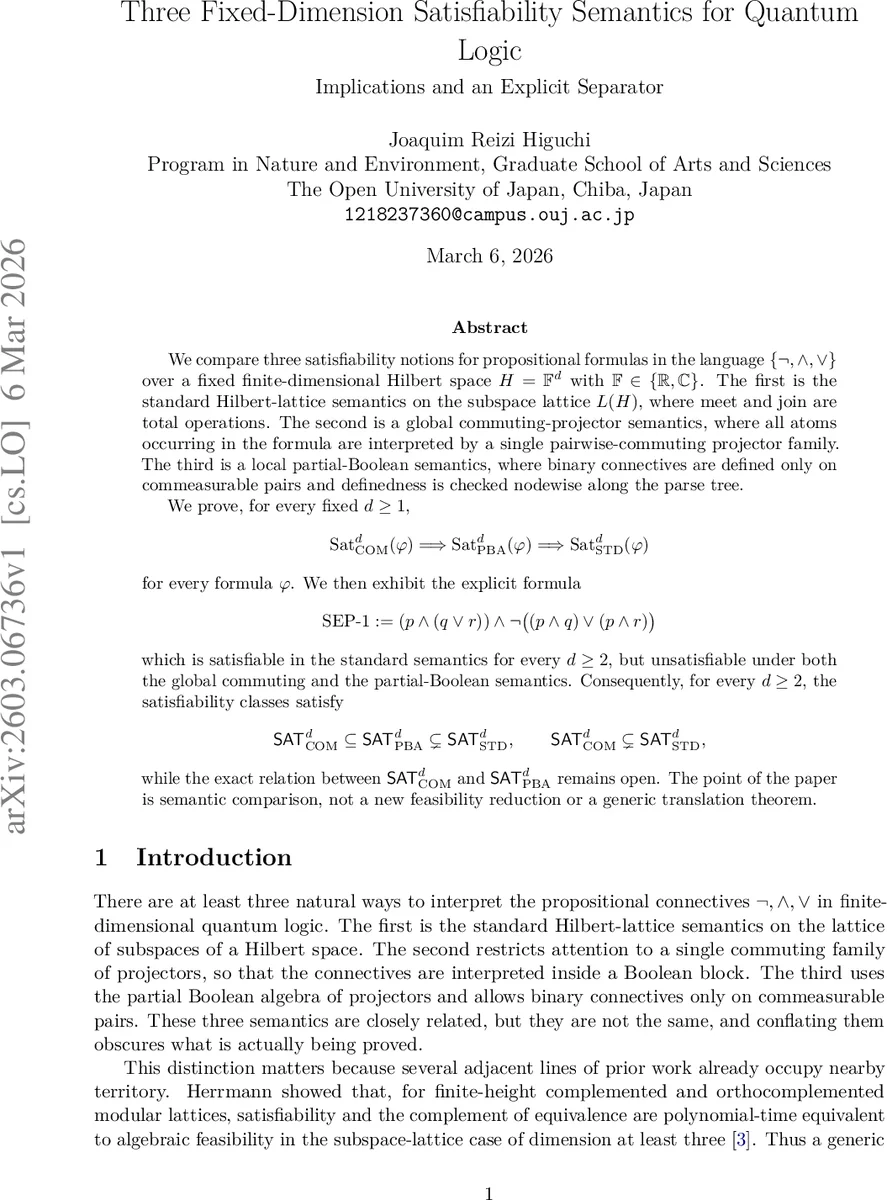
We compare three satisfiability notions for propositional formulas in the language {not, and, or} over a fixed finite-dimensional Hilbert space H=F^d with F in {R, C}. The first is the standard Hilbert-lattice semantics on the subspace lattice L(H), where meet and join are total operations. The second is a global commuting-projector semantics, where all atoms occurring in the formula are interpreted by a single pairwise-commuting projector family. The third is a local partial-Boolean semantics, where binary connectives are defined only on commeasurable pairs and definedness is checked nodewise along the parse tree. We prove, for every fixed d >= 1, Sat_COM^d(phi) implies Sat_PBA^d(phi) implies Sat_STD^d(phi) for every formula phi. We then exhibit the explicit formula SEP-1 := (p and (q or r)) and not((p and q) or (p and r)) which is satisfiable in the standard semantics for every d >= 2, but unsatisfiable under both the global commuting and the partial-Boolean semantics. Consequently, for every d >= 2, the satisfiability classes satisfy SAT_COM^d subseteq SAT_PBA^d subset SAT_STD^d and SAT_COM^d subset SAT_STD^d, while the exact relation between SAT_COM^d and SAT_PBA^d remains open. The point of the paper is semantic comparison, not a new feasibility reduction or a generic translation theorem.
💡 Research Summary
The paper investigates three natural semantics for propositional formulas built from the connectives ¬, ∧, and ∨ when interpreted over a fixed finite‑dimensional Hilbert space H = F^d (F = ℝ or ℂ).
-
Standard Hilbert‑lattice semantics (STD). An atom p_i is assigned an arbitrary subspace of H. Negation is interpreted as orthogonal complement, conjunction as intersection, and disjunction as the (closed) sum of subspaces. A formula is satisfiable if its interpretation is a non‑zero subspace.
-
Global commuting‑projector semantics (COM). Each atom is assigned a projection operator on H, with the extra requirement that all atom projections commute pairwise. Under this restriction, ¬ is I − P, ∧ is the product of projections, and ∨ is P + Q − PQ. The result of any subformula is again a projection.
-
Local partial‑Boolean semantics (PBA). Here the commutativity condition is enforced only when a binary connective is actually evaluated. An atom is still a projection, ¬ is always defined, but ∧ and ∨ are defined only if the two operand projections are defined and commute (denoted #). If a subformula is undefined, the whole formula is undefined.
The authors first prove elementary range identities for commuting projections (Lemma 3.1) and then show (Lemma 3.2) that any COM‑valuation automatically yields a well‑defined PBA‑valuation with identical values. Consequently, they establish the implication chain
SAT_COM(φ) ⇒ SAT_PBA(φ) ⇒ SAT_STD(φ) for every formula φ and every dimension d ≥ 1 (Theorem 3.3, 3.4, Corollary 3.5).
To demonstrate that these inclusions are strict, they introduce an explicit separating formula:
SEP‑1 := (p ∧ (q ∨ r)) ∧ ¬((p ∧ q) ∨ (p ∧ r)).
In a commuting Boolean block the distributive law holds, so the two inner terms coincide; the outer conjunction then collapses to the zero projection, making SEP‑1 unsatisfiable under both COM and PBA. The authors prove this formally (Theorem 4.2, Lemma 4.3, Theorem 4.4).
However, in the full subspace lattice distributivity fails. By choosing a concrete 2‑dimensional subspace configuration (p = span(e₁+e₂), q = span(e₁), r = span(e₂)) they show that under the standard semantics the left part evaluates to a non‑zero subspace while the right part evaluates to the whole space, yielding a non‑zero overall interpretation. Hence SEP‑1 is satisfiable in STD for every d ≥ 2 (Theorem 4.5).
From these results they derive explicit separation theorems (Theorem 5.1, 5.2) and the class inclusion picture (Corollary 5.3):
SAT_COM ⊆ SAT_PBA ⊂ SAT_STD, SAT_COM ⊂ SAT_STD,
while the exact relationship between SAT_COM and SAT_PBA remains open.
The paper concludes with an open problem (Problem 6.1): for a fixed dimension d ≥ 2, determine whether SAT_COM = SAT_PBA or SAT_COM ⊂ SAT_PBA, i.e., whether there exists a formula that is PBA‑satisfiable but COM‑unsatisfiable.
Overall, the contribution is a clean semantic comparison that clarifies the hierarchy of satisfiability notions in finite‑dimensional quantum logic, provides a concrete separating example, and isolates a natural open question about the gap between global commuting and local commeasurability. The work situates itself relative to prior complexity results (Herrmann’s modular‑lattice reductions and Dawar‑Shah’s Kochen‑Specker partial‑Boolean complexity) and emphasizes that its aim is semantic clarification rather than new reduction theorems.
Comments & Academic Discussion
Loading comments...
Leave a Comment