Uncertainty-Aware Adaptive Dynamics For Underwater Vehicle-Manipulator Robots
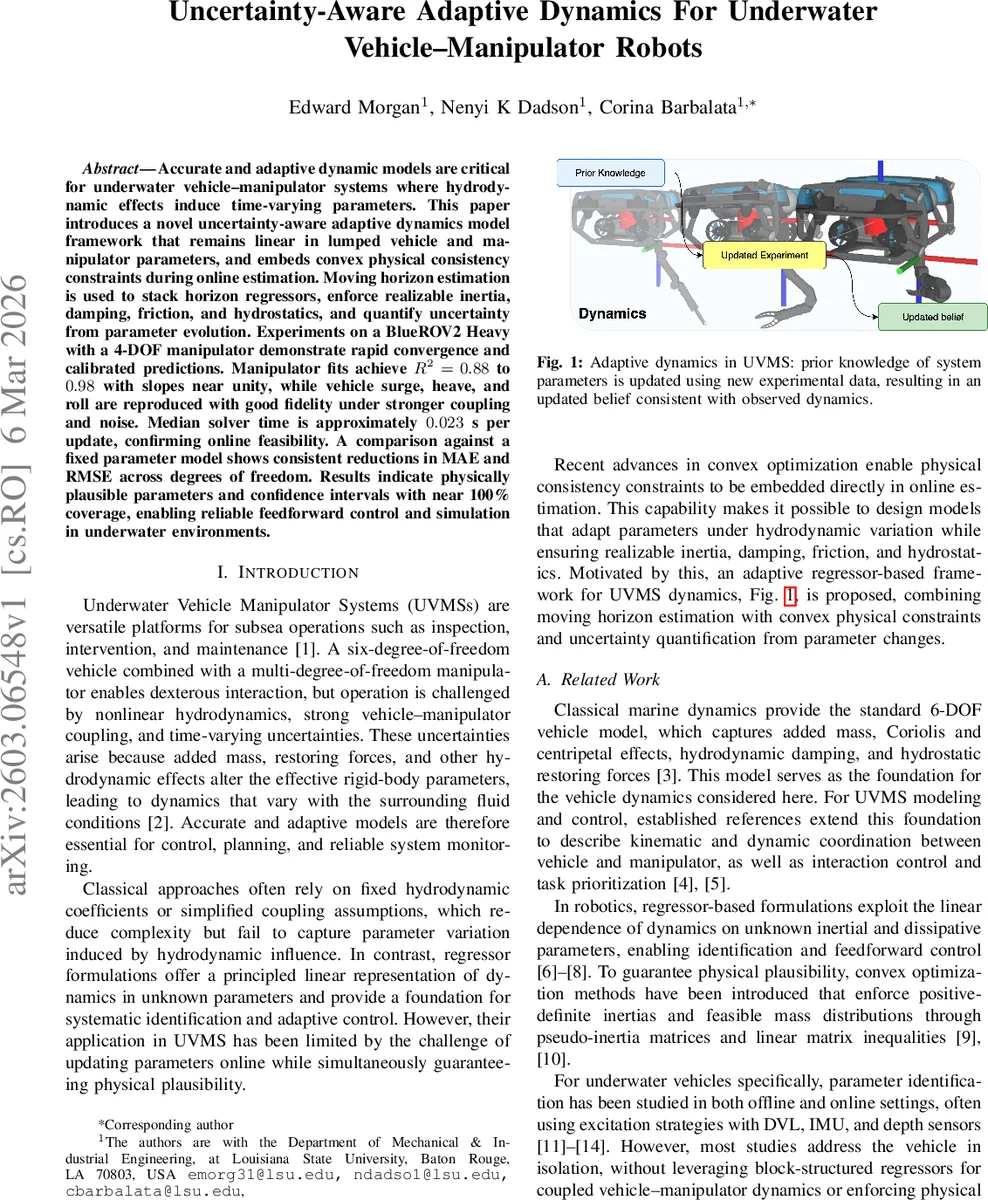
Accurate and adaptive dynamic models are critical for underwater vehicle-manipulator systems where hydrodynamic effects induce time-varying parameters. This paper introduces a novel uncertainty-aware adaptive dynamics model framework that remains linear in lumped vehicle and manipulator parameters, and embeds convex physical consistency constraints during online estimation. Moving horizon estimation is used to stack horizon regressors, enforce realizable inertia, damping, friction, and hydrostatics, and quantify uncertainty from parameter evolution. Experiments on a BlueROV2 Heavy with a 4-DOF manipulator demonstrate rapid convergence and calibrated predictions. Manipulator fits achieve R2 = 0.88 to 0.98 with slopes near unity, while vehicle surge, heave, and roll are reproduced with good fidelity under stronger coupling and noise. Median solver time is approximately 0.023 s per update, confirming online feasibility. A comparison against a fixed parameter model shows consistent reductions in MAE and RMSE across degrees of freedom. Results indicate physically plausible parameters and confidence intervals with near 100% coverage, enabling reliable feedforward control and simulation in underwater environments.
💡 Research Summary
This paper addresses the critical challenge of modeling and adapting the dynamics of underwater vehicle‑manipulator systems (UVMS) whose parameters vary with the surrounding fluid environment. The authors propose a unified, linear‑in‑parameters regressor formulation that captures both the 6‑DOF vehicle and an n‑DOF manipulator, including their coupling forces. The vehicle parameters are lumped into effective inertia (including added mass), linear and quadratic drag, and hydrostatic restoring terms (weight, buoyancy, center‑of‑gravity/buoyancy offsets). The manipulator parameters consist of 12 effective parameters per link (mass, first moments, inertia components, viscous and Coulomb friction, and hydrodynamic drag mapped to joint space). By arranging the vehicle and manipulator regressors in a block‑upper‑triangular matrix, the complete UVMS dynamics can be written as τ = Y(ζ, ζ̇, ζ̈) π, preserving linearity while allowing nonlinear state dependence.
To estimate the time‑varying parameter vector π online, the authors employ a moving‑horizon estimation (MHE) scheme. Over a finite horizon of N samples, the measured generalized forces/torques τ_t are stacked with the corresponding regressors Y_t, yielding τ_t = Y_t π_t + v_t, where v_t denotes residuals. The MHE solves a convex quadratic program that minimizes a weighted 2‑norm of the parameter increment w_t (π_t – π_{t‑1}) together with a Huber loss on the residuals, thereby limiting the influence of outliers. Crucially, the optimization incorporates a set of convex physical‑consistency constraints: positive‑definiteness of the vehicle inertia matrix, positive‑definiteness of each link’s pseudo‑inertia matrix, non‑negative friction coefficients, non‑positive drag coefficients, and bounds on vehicle weight. Because all constraints are affine in π, the problem remains a standard QP solvable in real time.
Uncertainty quantification is achieved by tracking the sequence of parameter increments w_t. An exponentially weighted moving average and covariance of the normalized increments are maintained, with a forgetting factor α controlling the trade‑off between responsiveness and noise attenuation. After rescaling, the covariance Σ_{π,t} ≈ L Σ_w,t (with L ≈ 2/α – 1) provides calibrated confidence intervals for each estimated parameter. These covariances are propagated to torque predictions (Σ_{τ,t} ≈ Y_t Σ_{π,t} Y_t^T) and, via linearization, to acceleration predictions in forward dynamics, yielding predictive uncertainty bands that can be used for robust control or digital‑twin simulation.
Experimental validation is performed in a 50 m² test pool using a BlueROV2 Heavy (6‑DOF) equipped with a depth/pressure sensor, Doppler velocity log (DVL), and IMU, coupled to a Reach Alpha 5 4‑DOF manipulator. The sensor suite provides depth, orientation, body‑fixed velocities, joint angles, and joint velocities; accelerations are estimated online and filtered before feeding the MHE. The on‑board computer (Intel Core Ultra 9 275HX, 64 GB DDR5) runs the estimator at a median solver time of 0.023 s per update, comfortably supporting control loops above 40 Hz.
Results show rapid convergence of the parameter estimates within 5–10 seconds of excitation. Manipulator torque predictions achieve coefficients of determination R² between 0.88 and 0.98 with slopes near unity, indicating high fidelity. Vehicle surge force, heave force, and roll moment are also reproduced accurately despite stronger coupling and measurement noise. Compared to a fixed‑parameter baseline, the adaptive model consistently reduces mean absolute error (MAE) and root‑mean‑square error (RMSE) across all degrees of freedom. The calibrated confidence intervals exhibit near‑100 % coverage, confirming that the uncertainty estimates are well‑calibrated.
The contributions of the work are fourfold: (1) a unified linear regressor framework for coupled UVMS dynamics; (2) an online MHE algorithm that enforces convex physical constraints, guaranteeing realizable parameter values; (3) a principled uncertainty quantification method based on parameter increments; and (4) extensive real‑world experiments demonstrating improved model fidelity, rapid online adaptation, and feasible computational load. The authors suggest future extensions such as longer horizons, nonlinear constraint handling (e.g., flow‑dependent drag), multi‑robot cooperation, and integration of the adaptive model into feed‑forward control or high‑fidelity digital twins.
Comments & Academic Discussion
Loading comments...
Leave a Comment