Ergodicity for a Constantin-Lax-Majda-DeGregorio model of turbulent flow
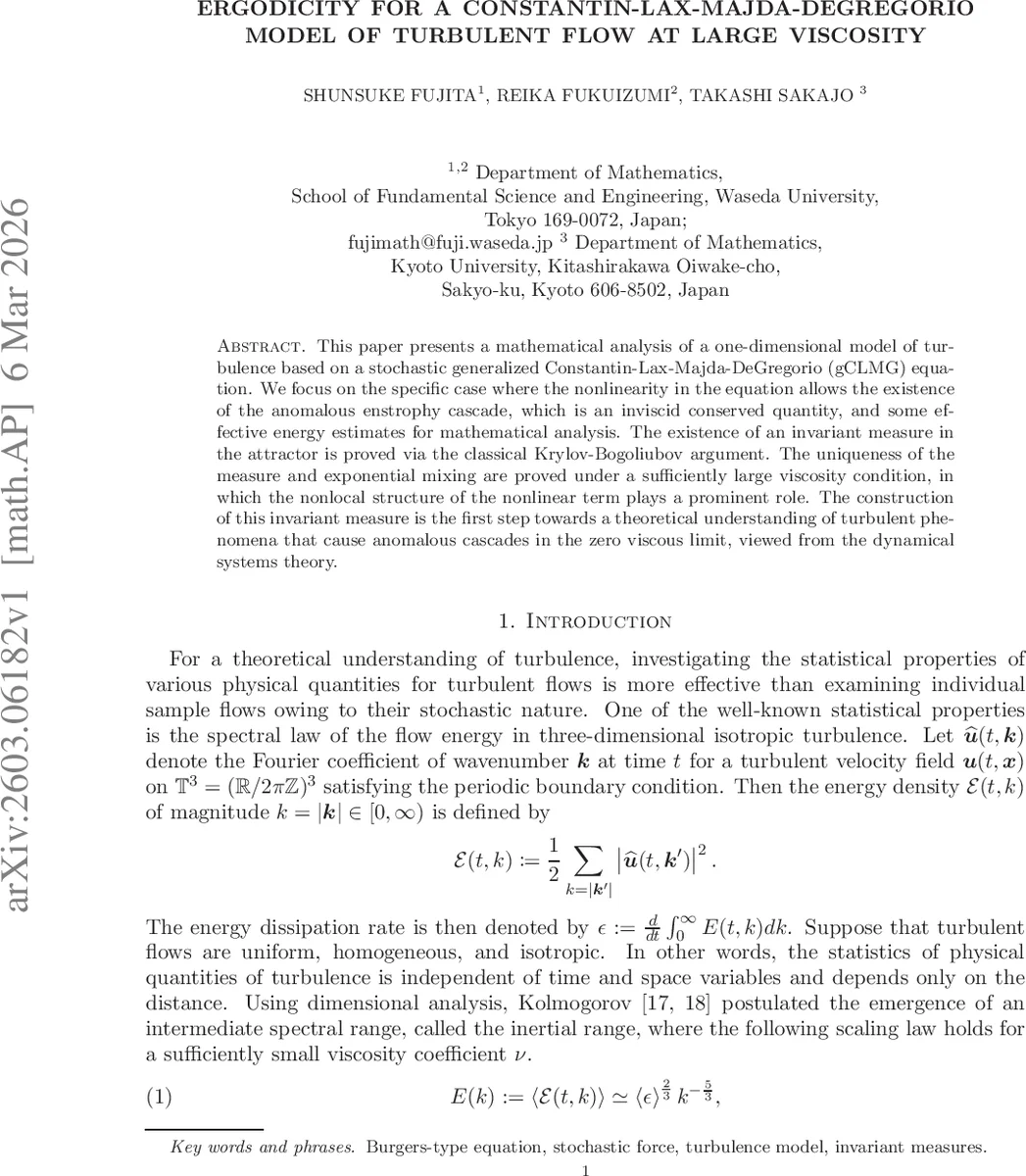
This paper presents a mathematical analysis of a one-dimensional model of turbulence based on a stochastic generalized Constantin-Lax-Majda-DeGregorio (gCLMG) equation. We focus on the specific case where the nonlinearity in the equation allows the existence of the anomalous enstrophy cascade, which is an inviscid conserved quantity, and some effective energy estimates for mathematical analysis. The existence of an invariant measure in the attractor is proved via the classical Krylov-Bogoliubov argument. The uniqueness of the measure and exponential mixing are proved under a sufficiently large viscosity condition, in which the nonlocal structure of the nonlinear term plays a prominent role. The construction of this invariant measure is the first step towards a theoretical understanding of turbulent phenomena that cause anomalous cascades in the zero viscous limit, viewed from the dynamical systems theory.
💡 Research Summary
This paper conducts a rigorous mathematical investigation of a one‑dimensional turbulent model derived from the generalized Constantin‑Lax‑Majda‑DeGregorio (gCLMG) equation, augmented with stochastic forcing and viscous diffusion. The authors focus on the parameter choice (a=-2), for which the squared (L^{2}) norm of the vorticity—i.e., the enstrophy—becomes an inviscid conserved quantity, mirroring the role of enstrophy in two‑dimensional turbulence.
The model under study is
\
Comments & Academic Discussion
Loading comments...
Leave a Comment