Block-Separated Overpartitions: Fibonacci Structure and Euler Factorization
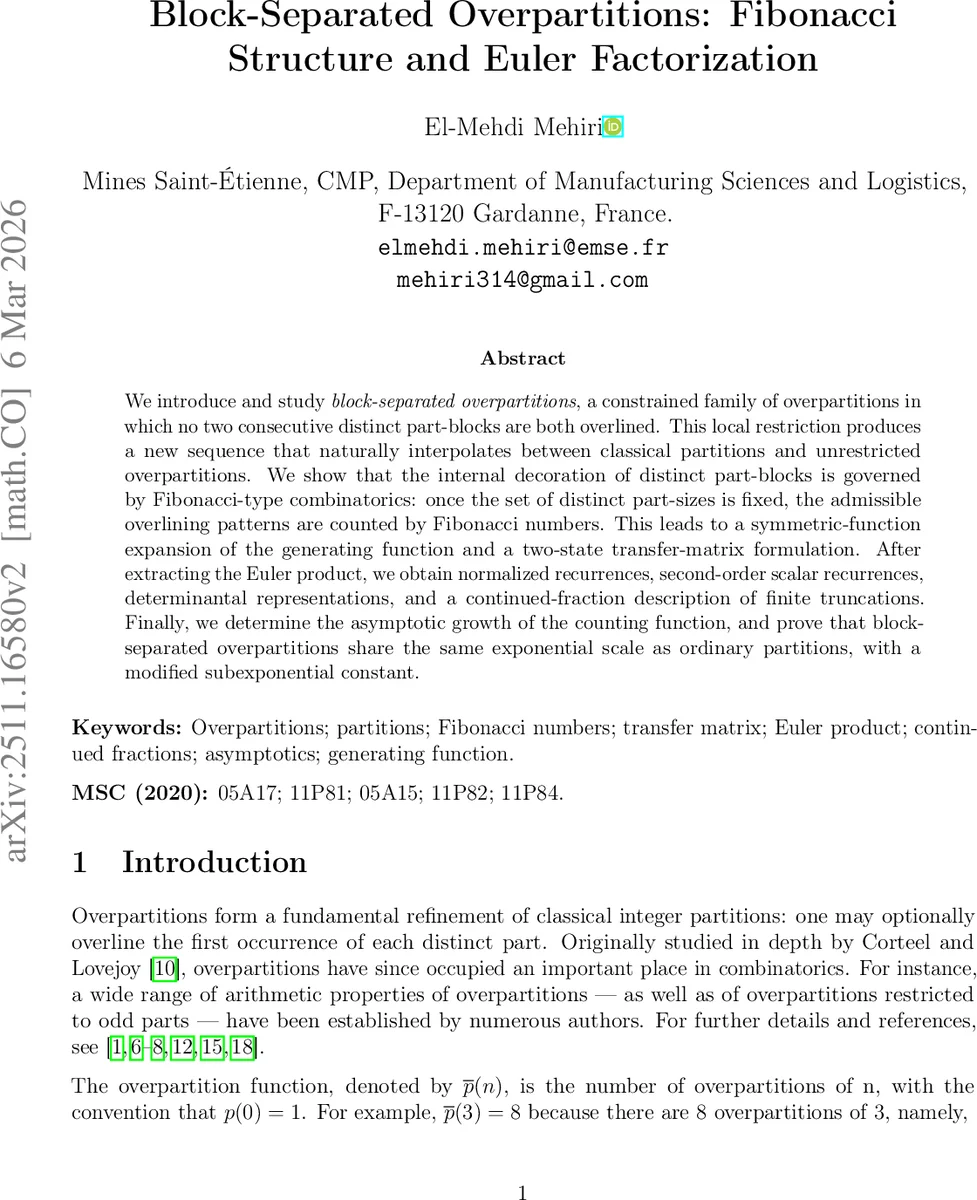
We introduce and study block-separated overpartitions, a constrained family of overpartitions in which no two consecutive distinct part-blocks are both overlined. This local restriction produces a new sequence that naturally interpolates between classical partitions and unrestricted overpartitions. We show that the internal decoration of distinct part-blocks is governed by Fibonacci-type combinatorics: once the set of distinct part-sizes is fixed, the admissible overlining patterns are counted by Fibonacci numbers. This leads to a symmetric-function expansion of the generating function and a two-state transfer-matrix formulation. After extracting the Euler product, we obtain normalized recurrences, second-order scalar recurrences, determinantal representations, and a continued-fraction description of finite truncations. Finally, we determine the asymptotic growth of the counting function, and prove that block-separated overpartitions share the same exponential scale as ordinary partitions, with a modified subexponential constant.
💡 Research Summary
The paper introduces a new family of overpartitions called “block‑separated overpartitions.” An overpartition is a usual integer partition where the first occurrence of each distinct part may be overlined. The block‑separated condition forbids two consecutive distinct part‑blocks from both being overlined. Formally, if a partition λ is written as λ = (d₁^{m₁}, d₂^{m₂}, …, d_r^{m_r}) with d₁ > d₂ > … > d_r, we attach a binary indicator x_i ∈ {0,1} to each block, where x_i = 1 means the first part of block i is overlined. The restriction is x_i·x_{i+1}=0 for all i. Let B(n) be the set of such objects of size n and b(n)=|B(n)|.
The authors first compute initial values and observe that p(n) ≤ b(n) ≤ p̄(n), where p(n) is the ordinary partition function and p̄(n) counts unrestricted overpartitions.
A key combinatorial insight is that once the set of distinct part sizes {j₁ < … < j_r} is fixed, the admissible overlining patterns correspond exactly to binary words of length r with no consecutive 1’s. The number of such words is the Fibonacci number F_{r+2}. This can also be viewed as the number of independent sets in a path graph of length r, or as tilings of a board of length r by tiles “0” and “10”. Consequently, the internal decoration of a block‑separated overpartition is governed solely by a Fibonacci factor that depends only on the number r of distinct part sizes, not on the actual sizes or multiplicities.
Using this observation, the generating function
F(q)=∑{n≥0} b(n) q^n
is expressed as a symmetric‑function expansion:
F(q)=∑{r≥0} F_{r+2} e_r(S₁(q), S₂(q), …),
where S_j(q)=∑_{m≥1} q^{mj}=q^j/(1−q^j) is the ordinary block generating function for parts of size j, and e_r denotes the r‑th elementary symmetric function. This formula cleanly separates the Euler‑type product coming from the S_j’s and the Fibonacci‑type internal combinatorics.
To capture the local restriction algorithmically, the authors build a two‑state automaton. State 0 means the last present block is plain; state 1 means the last present block is overlined. For each part size j there are three possibilities: (A) the block is absent, (B) present and plain, (C) present and overlined (allowed only from state 0). Translating these choices into a weighted transition matrix yields
M_j(q)=(\begin{pmatrix}1+S_j(q) & S_j(q)\ S_j(q) & 1\end{pmatrix}).
Starting from the vector (1,0) and terminating with (1,1)^T, the full generating function is
F(q) = (1,0) · ∏_{j≥1} M_j(q) · (1,1)^T.
The matrix product can be reorganized into an Euler product. The determinant of M_j(q) is 1−S_j(q)^2 = (1−q^{2j})/(1−q^j)^2, and the trace gives the linear term. From these data the authors derive normalized recurrences for the coefficients b(n); in particular a second‑order linear recurrence with constant coefficients emerges after suitable normalization. Moreover, b(n) can be written as the determinant of a 2×2 matrix built from consecutive terms of the recurrence, providing a compact determinantal representation.
Finite truncations of the infinite product lead to a continued‑fraction expansion for the partial generating functions G_N(q)=∑_{n≤N} b(n) q^n. The continued fraction mirrors the structure of the two‑state automaton and offers an alternative analytic tool for extracting coefficients.
For asymptotics, the authors apply the Hardy–Ramanujan–Meinardus framework. The dominant exponential growth is unchanged from ordinary partitions: the term exp(π√(2n/3)) appears, reflecting the same singularity of the Euler product ∏_{j≥1}(1−q^j)^{-1}. The Fibonacci factor contributes a sub‑exponential correction. After a careful saddle‑point analysis they obtain
b(n) ~ C · n^{-3/4} · exp(π√(2n/3)),
where the constant C is expressed explicitly in terms of infinite products involving (1+q^j) and (1−q^{2j})^{−1/2}. This shows that block‑separated overpartitions share the same exponential scale as ordinary partitions but have a slightly larger polynomial prefactor due to the extra combinatorial freedom.
The paper concludes by emphasizing the elegant interplay between classical partition theory, Fibonacci combinatorics, and modern analytic tools such as transfer matrices, Euler factorizations, and continued fractions. It suggests several directions for future work, including connections to modular forms, extensions to other local restrictions (e.g., difference conditions), and multivariate generalizations. Overall, the work provides a thorough and unified treatment of a natural new partition family, enriching both combinatorial and analytic aspects of partition theory.
Comments & Academic Discussion
Loading comments...
Leave a Comment