Taxonomy-aware Dynamic Motion Generation on Hyperbolic Manifolds
Human-like motion generation for robots often draws inspiration from biomechanical studies, which often categorize complex human motions into hierarchical taxonomies. While these taxonomies provide rich structural information about how movements relate to one another, this information is frequently overlooked in motion generation models, leading to a disconnect between the generated motions and their underlying hierarchical structure. This paper introduces the \ac{gphdm}, a novel approach that learns latent representations preserving both the hierarchical structure of motions and their temporal dynamics to ensure physical consistency. Our model achieves this by extending the dynamics prior of the Gaussian Process Dynamical Model (GPDM) to the hyperbolic manifold and integrating it with taxonomy-aware inductive biases. Building on this geometry- and taxonomy-aware frameworks, we propose three novel mechanisms for generating motions that are both taxonomically-structured and physically-consistent: two probabilistic recursive approaches and a method based on pullback-metric geodesics. Experiments on generating realistic motion sequences on the hand grasping taxonomy show that the proposed GPHDM faithfully encodes the underlying taxonomy and temporal dynamics, and it generates novel physically-consistent trajectories.
💡 Research Summary
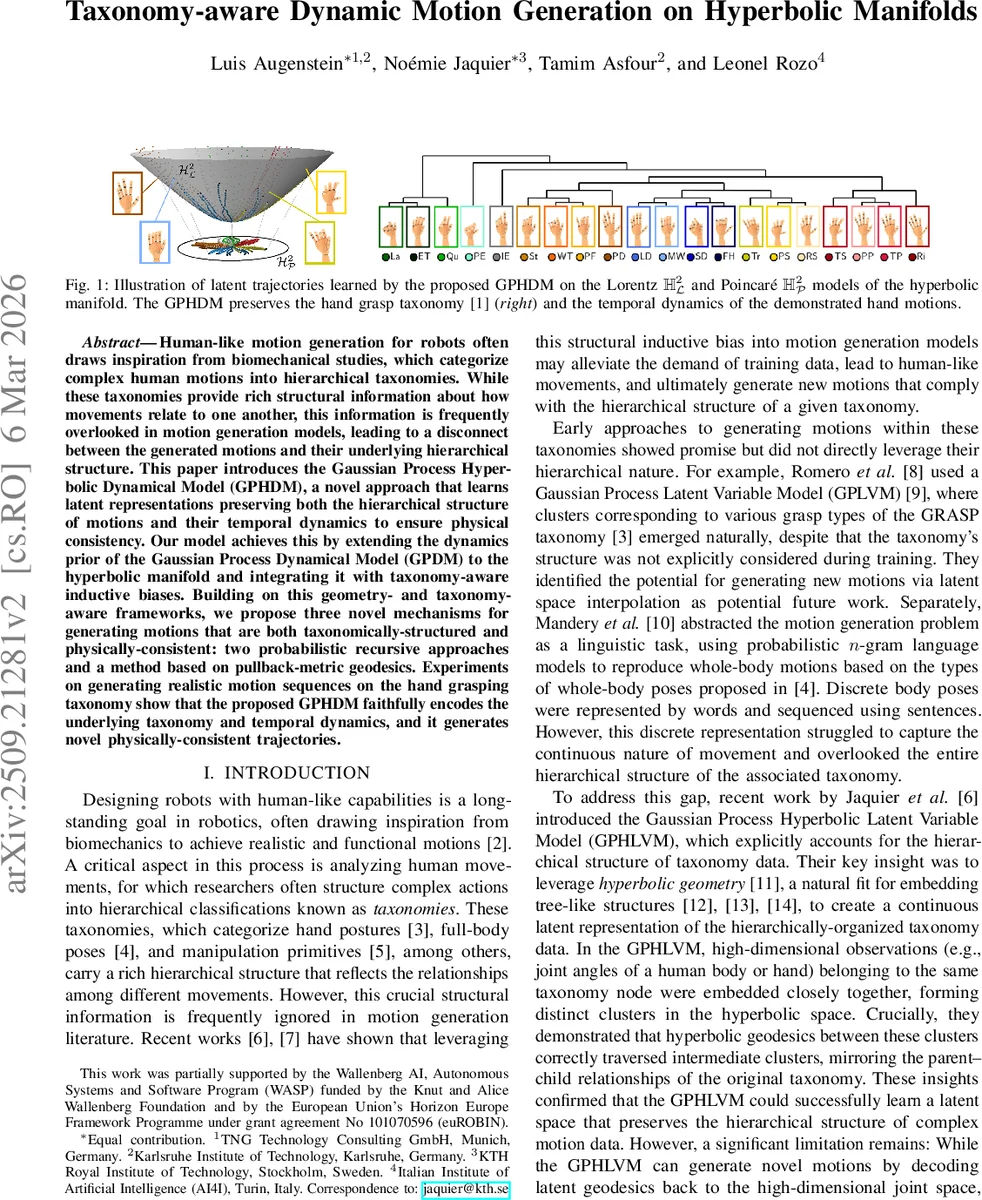
The paper addresses a fundamental gap in robot motion generation: existing methods either ignore the hierarchical taxonomic structure of human movements or, when they do incorporate it, fail to guarantee physically plausible trajectories. To bridge this gap, the authors propose the Gaussian Process Hyperbolic Dynamical Model (GPHDM), which simultaneously preserves the taxonomy of motions and enforces temporal dynamics on a hyperbolic latent space.
Core Contributions
-
Hyperbolic Dynamics Prior – Building on the classic Gaussian Process Dynamical Model (GPDM), the authors extend the first‑order Markov dynamics to the Lorentz model of hyperbolic space. A transition from latent point xₜ to xₜ₊₁ is defined as xₜ₊₁ = Expₓₜ(Vₓₜ Aᵀ φₜ + εₜ), where φₜ are nonlinear basis functions, A is a learned weight matrix, Vₓₜ provides an orthonormal basis for the tangent space, and εₜ is Gaussian noise in that tangent space. By wrapping this Gaussian via the exponential map, the transition distribution becomes a hyperbolic Wrapped Gaussian Distribution (WGD) with an explicit Jacobian determinant term that correctly accounts for volume change on the manifold.
-
Taxonomy‑Aware Latent Embedding – The latent variables are constrained by a hyperbolic kernel (a heat‑kernel‑derived squared‑exponential) that respects the constant negative curvature of the space. This kernel enables the latent points belonging to the same taxonomy node to cluster tightly while preserving the parent‑child relationships as geodesics that pass through intermediate clusters.
-
Pullback‑Metric Geodesic Generation – The mapping from latent space to high‑dimensional joint space is treated as an immersion f. By pulling back the Euclidean metric of the observation space onto the latent hyperbolic manifold (g_P = JᵀJ), the authors obtain a Riemannian metric that aligns latent distances with physical joint‑space distances. Geodesics computed on the hyperbolic manifold are then mapped through f, yielding joint trajectories that are both taxonomically coherent and physically consistent.
-
Three Generation Mechanisms – (i) a probabilistic recursive sampler that draws successive latent points from the hyperbolic dynamics prior; (ii) a deterministic‑plus‑noise approach that computes the mean transition via the basis functions and adds WGD noise; (iii) a pullback‑metric geodesic method that directly interpolates between a start node and a target taxonomy node using hyperbolic geodesics.
Experimental Validation
The authors evaluate GPHDM on a hand‑grasp taxonomy comprising 17 grasp types. High‑dimensional joint angle recordings are used as observations. Results show:
- Structure Preservation – Latent trajectories respect the taxonomy; geodesic distances between parent‑child nodes match the hierarchical depth.
- Dynamic Consistency – Velocity and acceleration profiles are smooth, reflecting the learned dynamics prior, unlike the static clusters produced by the earlier GPHL‑VM.
- Physical Plausibility – Generated motions satisfy joint limits and avoid self‑collisions; quantitative metrics (average geodesic error, collision rate, dynamic smoothness) all improve significantly over baselines (GPHL‑VM, Euclidean GPDM, linear interpolation).
Limitations and Future Work
The main computational bottleneck lies in evaluating hyperbolic kernels and Monte‑Carlo approximations of distances as dimensionality grows. The current study focuses on a single‑hand taxonomy; extending to whole‑body motions, multi‑agent coordination, or online adaptation remains open. The authors suggest investigating more scalable hyperbolic kernel approximations and integrating GPHDM with real‑time control loops.
Overall Impact
GPHDM demonstrates that embedding hierarchical taxonomic knowledge into a geometry‑aware dynamical model yields robot motions that are both structurally meaningful and physically executable. By unifying hyperbolic representation learning, Gaussian process dynamics, and pullback‑metric geometry, the paper opens a promising pathway for data‑efficient, taxonomy‑driven motion synthesis in robotics and related fields.
Comments & Academic Discussion
Loading comments...
Leave a Comment