A symmetric multivariate Elekes-Rónyai theorem
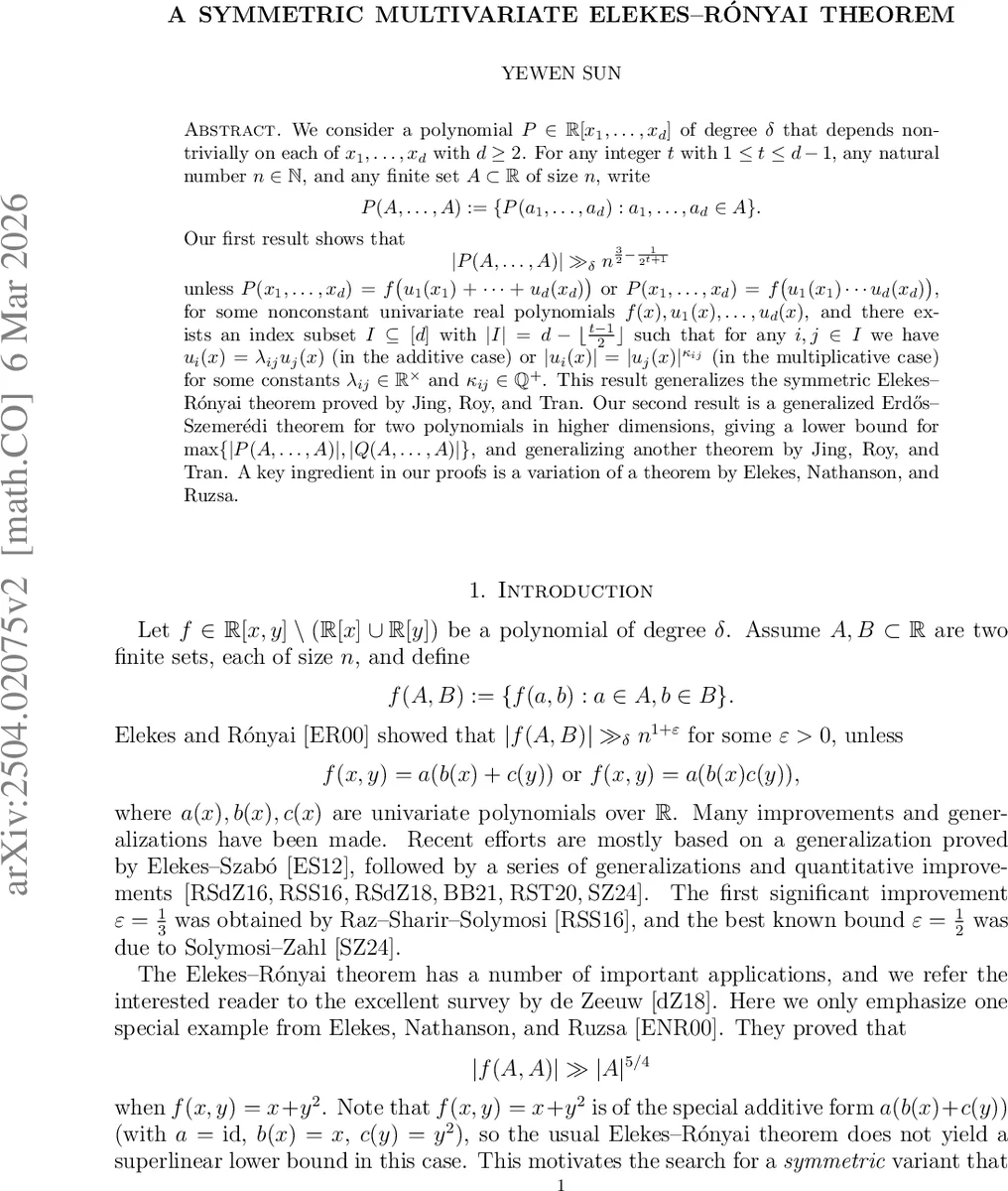
We consider a polynomial $P\in \mathbb{R}[x_{1},\cdots, x_{d}]$ of degree $ δ$ that depends non-trivially on each of $x_1,…,x_d$ with $d\geq 2$. For any integer $t$ with $2\leq t\leq d$, any natural number $n \in \mathbb{N}$, and any finite set $A \subset \mathbb{R}$ of size $n$, our first result shows that [ |P(A, A, \dots, A)| \gg_δ n^{\frac{3}{2} - \frac{1}{2^{d-t+2}}}, ] unless \begin{align*} &P(x_1, x_2, \dots, x_d) = f\big( u_1(x_1) + u_2(x_2) + \cdots + u_d(x_d) \big) \quad \text{or } &P(x_1, x_2, \dots, x_d) = f\big( v_1(x_1) v_2(x_2) \cdots v_d(x_d) \big), \end{align*} where $f$, $u_i$, and $v_i$ are nonconstant univariate polynomials over $\mathbb{R}$, and there exists an index subset $I \subseteq [d]$ with $|I| = t$ such that for any $i, j \in I$, we have $u_i = λ_{ij} u_j$ (in the additive case) or $|v_i|= |v_j|^{κ_{ij}}$ (in the multiplicative case) for some constants $λ_{ij}\in \mathbb{R}^{\neq 0},κ_{ij}\in\mathbb{Q}^{+}$. This result generalizes the symmetric Elekes-Rónyai theorem proved by Jing, Roy, and Tran. Our second result is a generalized Erdős-Szemerédi theorem for two polynomials in higher dimensions, generalizing another theorem by Jing, Roy, and Tran. A key ingredient in our proofs is a variation of a theorem by Elekes, Nathanson, and Ruzsa.
💡 Research Summary
The paper studies expansion properties of multivariate real polynomials when evaluated on a single finite set. Let P ∈ ℝ
Comments & Academic Discussion
Loading comments...
Leave a Comment