LUCI in the Surface Code with Dropouts
Recently, usage of detecting regions facilitated the discovery of new circuits for fault-tolerantly implementing the surface code. Building on these ideas, we present LUCI, a framework for constructing fault-tolerant circuits flexible enough to construct aperiodic and anisotropic circuits, making it a clear step towards quantum error correction beyond static codes. We show that LUCI can be used to adapt surface code circuits to lattices with imperfect qubit and coupler yield, a key challenge for fault-tolerant quantum computers using solid-state architectures. These circuits preserve spacelike distance for isolated broken couplers or isolated broken measure qubits in exchange for halving timelike distance, substantially reducing the penalty for dropout compared to the state of the art and creating opportunities in device architecture design. For qubit and coupler dropout rates of 1% and a patch diameter of 15, LUCI achieves an average spacelike distance of 13.1, compared to 9.1 for the best method in the literature. For a SI1000(0.001) circuit noise model, this translates to a 36x improvement in median logical error rate per round, a factor which increases with device performance. At these dropout and error rates, LUCI requires roughly 25% fewer physical qubits to reach algorithmically relevant one-in-a-trillion logical codeblock error rates.
💡 Research Summary
The paper introduces LUCI, a novel framework for constructing fault‑tolerant surface‑code circuits that remain robust in the presence of qubit and coupler dropouts. Building on the concept of detecting regions, the authors treat the mid‑cycle state of the surface code—an unrotated stabilizer configuration—as a “home base” from which each circuit round begins and ends. LUCI represents each round with a diagram composed of four primitive shapes (L, U, C, and I), each encoding a specific pattern of CNOT gates, measurements, and resets that together measure a set of mid‑cycle stabilizers. Compatibility rules between adjacent shapes (identical layer‑1 CNOTs and non‑overlapping layer‑2 CNOTs) guarantee that no gate collisions occur, allowing many shapes to be executed in parallel.
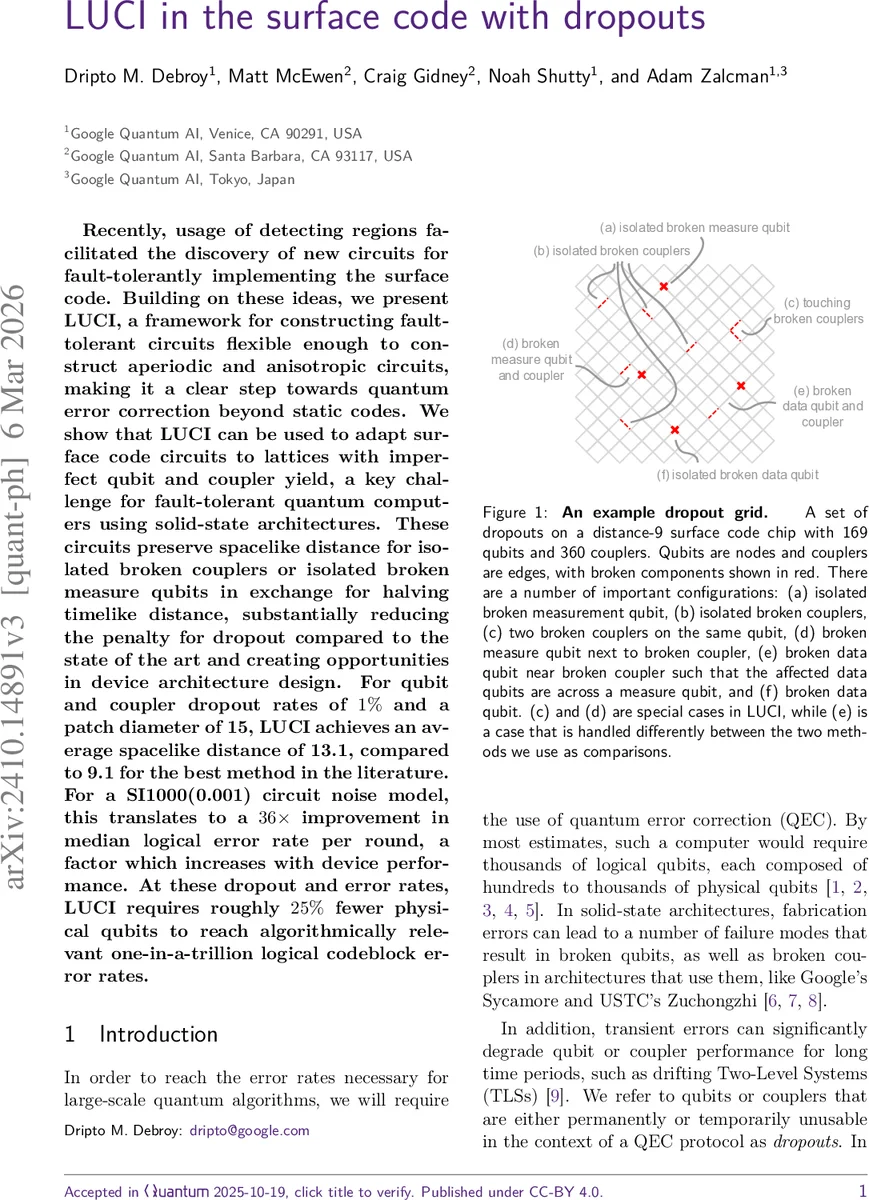
The authors model dropouts as independent failures of qubits (probability p_q) and couplers (probability p_c). In a typical 1 % dropout scenario on a distance‑9 patch (169 qubits, 360 couplers), they demonstrate how LUCI can preserve the spacelike distance for isolated broken components while halving the timelike distance, a trade‑off that dramatically reduces the penalty compared with prior methods that often shrink both distances.
The LUCI construction algorithm proceeds in two phases. First, it identifies a set of viable mid‑cycle stabilizers compatible with the given dropout grid, removing any stabilizer that would involve a missing qubit or coupler. Second, it colors the underlying square lattice with four colors; squares of the same color share no qubits, so they can be filled simultaneously without violating compatibility constraints. By iterating over colors and inserting the appropriate shapes, the algorithm produces a complete LUCI diagram for any dropout configuration, guaranteeing that every stabilizer is measured at least once.
Performance evaluation uses the SI1000(0.001) circuit noise model. For a patch diameter of 15 and dropout rates of 1 % for both qubits and couplers, LUCI achieves an average spacelike distance of 13.1 versus 9.1 for the best existing method. This improvement translates to a 36‑fold reduction in median logical error rate per round, and the advantage grows as device error rates improve. Moreover, to reach an algorithmically relevant logical error rate of one‑in‑a‑trillion (10⁻¹²), LUCI requires roughly 25 % fewer physical qubits than competing approaches.
In summary, LUCI offers a flexible, diagram‑driven method for adapting surface‑code circuits to imperfect hardware. By leveraging the mid‑cycle state and a small set of well‑defined shapes, it can navigate around isolated defects, preserve spatial code distance, and halve temporal distance, yielding substantial reductions in logical error rates and physical resource overhead. The framework opens pathways for future work on more complex defect patterns, dynamic dropout handling, and integration with lattice‑surgery operations, moving quantum error correction closer to the realities of solid‑state quantum processors.
Comments & Academic Discussion
Loading comments...
Leave a Comment