Liouville polarizations and the rigidity of their Lagrangian skeleta in dimension $4$
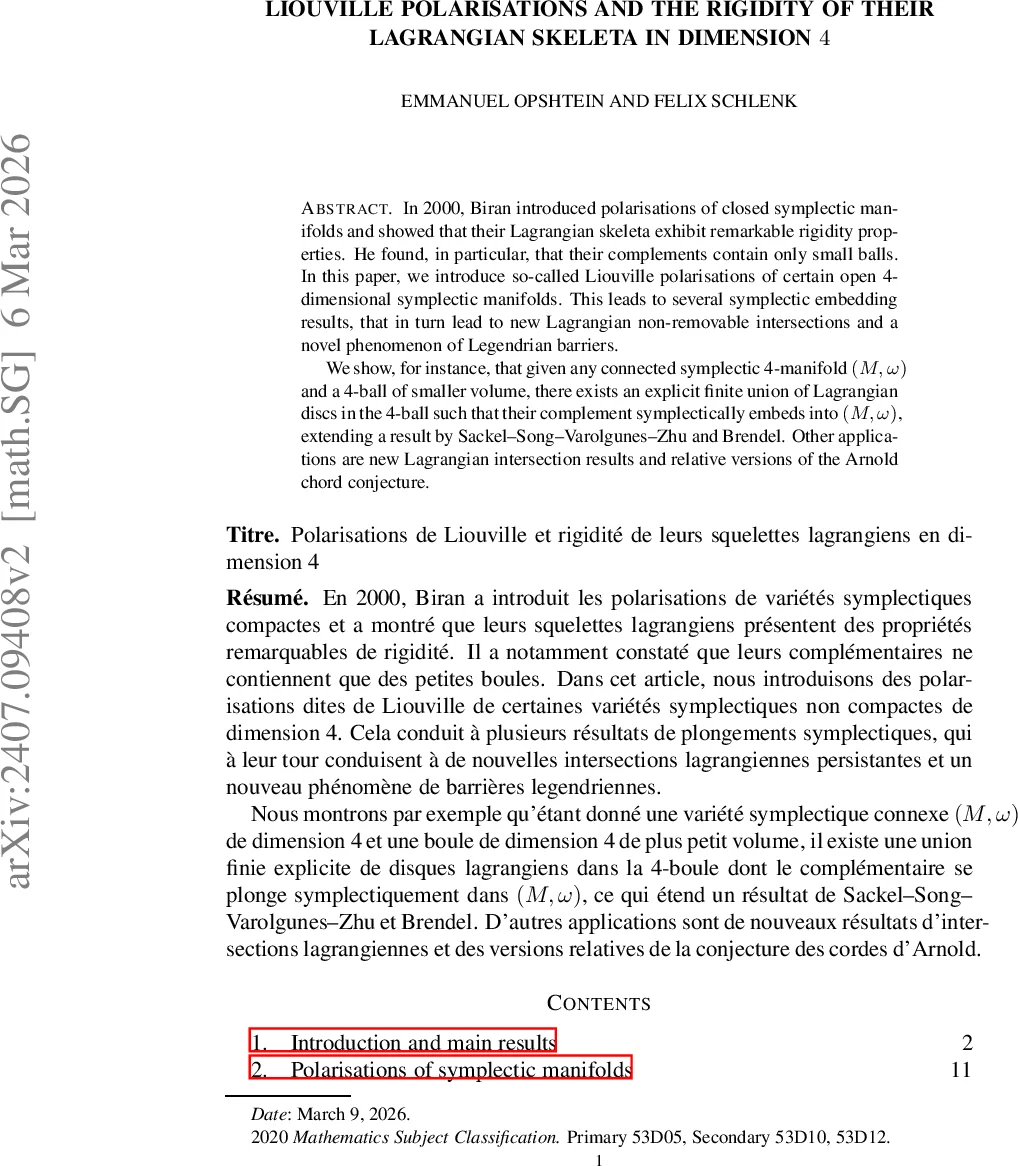
The main theme of this paper is the introduction of a new type of polarizations, suited for some open symplectic manifolds, and their applications. These applications include symplectic embedding results that answer a question by Sackel-Song-Varolgunes-Zhu and Brendel, new Lagrangian non-removable intersections at small scales, and a novel phenomenon of Legendrian barriers in contact geometry.
💡 Research Summary
The paper introduces a new notion called “Liouville polarizations” for certain open symplectic 4‑manifolds and uses this framework to obtain a suite of symplectic embedding theorems, Lagrangian non‑removable intersection results, and a novel Legendrian barrier phenomenon.
The authors begin by recalling Biran’s polarizations of closed symplectic manifolds, where a divisor Σ dual to a large multiple of the symplectic class cuts the manifold into a Weinstein complement whose Lagrangian skeleton Δ exhibits strong rigidity: any symplectic ball of capacity ≥ 1/k must intersect Δ. They then define a Liouville polarization (M, dα) as an exact symplectic domain equipped with a Liouville form α whose differential coincides with the ambient symplectic form; the complement of a suitable Lagrangian CW‑complex (the skeleton) is called an affine part.
The first major result (Theorem 1) constructs, for each integer k≥1, a Lagrangian “grid” Δₖ ⊂ C⁴(1) obtained as the product of k half‑lines in each complex coordinate. They prove that the complement C⁴(1) \ Δₖ admits an (α_st,α_st)‑exact symplectic embedding into the standard symplectic cylinder Z⁴(2k). This is sharp up to a factor of two by Gromov’s non‑squeezing theorem and shows that the cylindrical capacity of the complement is bounded by 2k.
Theorem 2 extends the construction to the non‑compact setting: the complement of the product of two planar integer grids, R⁴ \ (Γ × Γ), embeds exactly into Z⁴(1). This answers a question of Viterbo (1998) concerning whether the Gromov width of R⁴ \ (Γ × Γ) is infinite.
Theorem 3 addresses arbitrary connected symplectic 4‑manifolds (M, ω) of finite volume. Given a 4‑ball B⁴(a) of the same volume, for any ε>0 there exists an even integer k such that B⁴(a−ε) \ Δₖ symplectically embeds into (M, ω). In other words, after removing a sufficiently large finite Lagrangian CW‑complex (a union of k Lagrangian disks), the remaining piece can be placed inside any larger symplectic 4‑manifold. This generalises recent embedding results of Sackel‑Song‑Varlgunes‑Zhu and Brendel.
The paper then turns to rigidity. Theorem 4 shows that if Δₐ × Δ_b is a product of two Lagrangian grids coming from regular planar grids of areas a and b, then any closed Lagrangian submanifold L⊂D(A)×D(B) with minimal symplectic area A_min(L)≥a+b cannot be Hamiltonian‑displaced away from Δₐ × Δ_b. This is a direct analogue of the Biran–Cieliebak–Mohnke inequality for polarizations, now applied to singular (grid) skeleta.
Theorem 5 introduces Legendrian barriers. For two radial grids Γ_{δ₁}, Γ_{δ₂} dividing the unit disc into sectors of areas ≤δ₁ and ≤δ₂, consider the Legendrian complex Λ_δ = (Γ_{δ₁}×Γ_{δ₂})∩S on the boundary S of a star‑shaped domain U⊂C⁴(1). The theorem asserts that any Legendrian knot Λ⊂S admits a Reeb chord from Λ to Λ∪Λ_δ of length at most δ₁+δ₂. This yields a relative version of the Arnold chord conjecture and shows that the presence of Λ_δ forces short Reeb chords, i.e., a Legendrian barrier.
Theorem 6 provides a general embedding statement for regular grids: if Γₐ⊂D(A) and Γ_b⊂D(B) are regular planar grids whose complements consist of topological discs of total area ≤a and ≤b, then the complement D(A)×D(B) \ (Γₐ×Γ_b) embeds exactly into Z⁴(a+b). This theorem underlies the previous rigidity results, as the exactness of the embedding is crucial for the Hamiltonian and contact arguments.
In the final sections the authors compare their results with Biran’s classical theory. While Biran’s polarizations give upper bounds 1/k for various symplectic capacities of the complement of the skeleton, the present work shows that after removing the explicit grid Δₖ, all capacities of the remaining domain become small (e.g., Hofer–Zehnder capacity, Gromov width). Moreover, the paper demonstrates that singular polarizations (with non‑smooth divisors) can be handled via Liouville polarizations, extending the scope of embedding techniques beyond the Kähler setting.
Overall, the article provides a comprehensive framework for constructing explicit Lagrangian skeleta in open 4‑dimensional symplectic manifolds, proves sharp embedding theorems for their complements, and derives strong rigidity phenomena both in the Lagrangian and Legendrian categories. These contributions open new avenues for studying symplectic capacities, contact dynamics, and the interplay between singular polarizations and symplectic topology.
Comments & Academic Discussion
Loading comments...
Leave a Comment