Auto-Generating Personas from User Reviews in VR App Stores
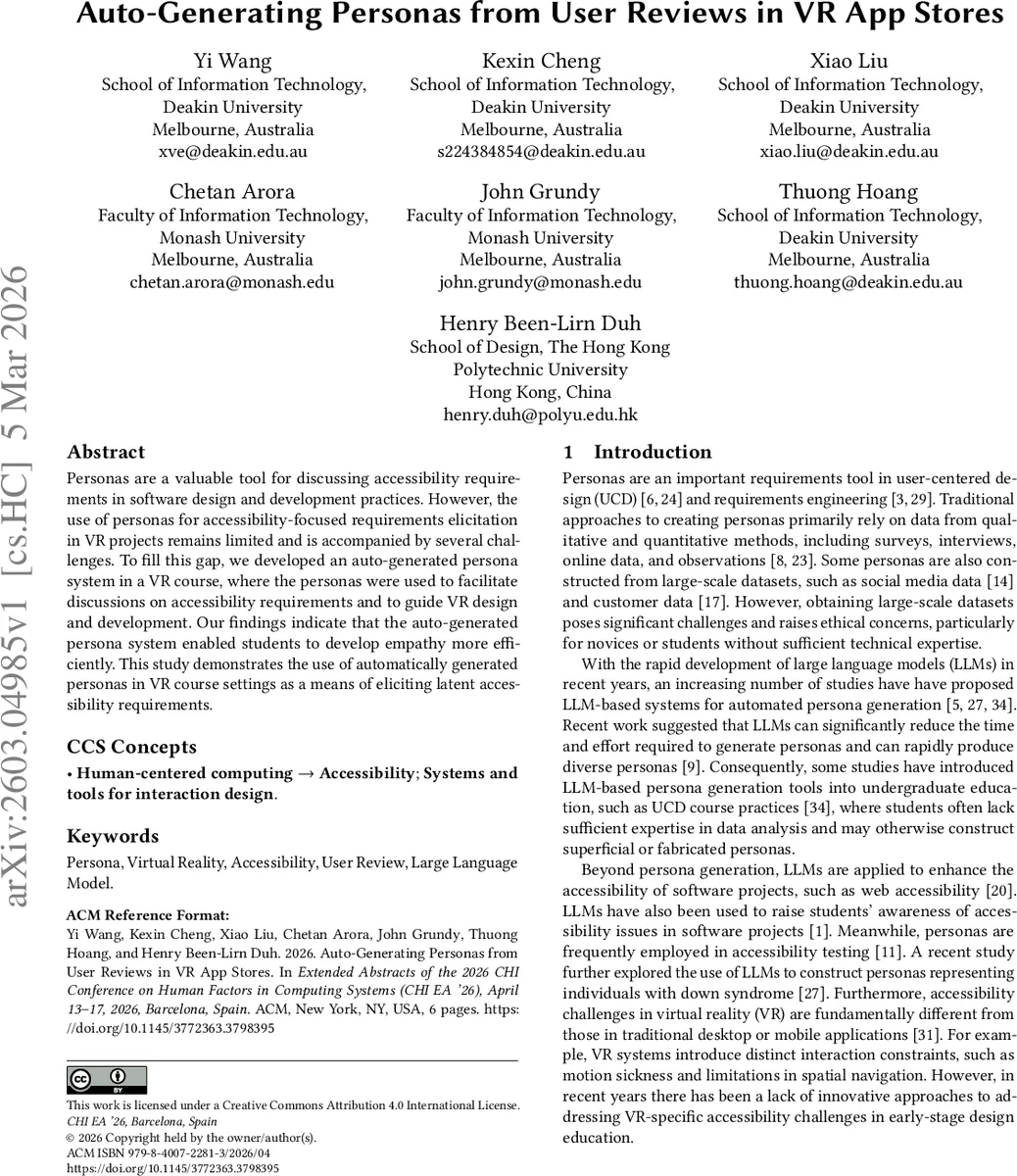
Personas are a valuable tool for discussing accessibility requirements in software design and development practices. However, the use of personas for accessibility-focused requirements elicitation in VR projects remains limited and is accompanied by several challenges. To fill this gap, we developed an auto-generated persona system in a VR course, where the personas were used to facilitate discussions on accessibility requirements and to guide VR design and development. Our findings indicate that the auto-generated persona system enabled students to develop empathy more efficiently. This study demonstrates the use of automatically generated personas in VR course settings as a means of eliciting latent accessibility requirements.
💡 Research Summary
**
The paper addresses a critical gap in virtual‑reality (VR) design education: the lack of efficient, evidence‑based tools for eliciting accessibility requirements early in the development process. To this end, the authors built a web‑based system that automatically generates accessibility‑focused personas from user reviews posted in the Meta Quest Store and Steam VR Store. The system combines large language models (LLMs) with a Retrieval‑Augmented Generation (RAG) framework to ensure that the generated personas are grounded in real user feedback rather than purely on keyword heuristics.
Data Collection and Pre‑processing
The authors limited their data set to the 50 most popular VR applications, a decision justified by prior work showing that less popular titles contain sparse or low‑quality reviews. Because the Meta Quest Store lacks a public API, the team employed web‑scraping techniques, while Steam data were retrieved via its official API. They applied a curated list of disability‑related keywords derived from WHO classifications and used fuzzy matching to improve recall. Reviews shorter than 20 words, non‑English entries, advertisements, and content containing insults or discriminatory language were filtered out. After manual verification by two researchers, 396 high‑quality, accessibility‑related reviews remained. These reviews were segmented into semantically coherent chunks, embedded with a sentence‑transformer model, and stored in a Chroma vector database for fast similarity search.
RAG‑Based Persona Generation
When a student inputs a project type (e.g., action, social) and a disability category (e.g., motion sickness, hearing loss), the system queries the vector store to retrieve the most relevant review excerpts. The retrieved evidence is injected into a prompt for GPT‑4o. The LLM first produces a concise user summary, then extracts structured dimension‑value pairs where dimensions correspond to mutually exclusive disability categories and values capture pain points, demographic details, and concrete accessibility requirements. This intermediate representation constrains the final generation step, reducing hallucination risk. The dimension‑value pairs are then assembled into a standardized persona template that includes a brief biography, representative quotes directly quoted from reviews, a list of accessibility requirements, and a profile picture generated by DALL·E 3 based on the demographic information.
Educational Study Design
The system was evaluated in a VR design course with 24 undergraduate students (10 M, 14 F, ages 22‑24). All participants had prior exposure to user‑centered design and persona techniques. The study spanned two weeks and comprised three in‑person sessions (total ≤ 8 hours). In the first week, students received foundational lectures on accessibility and VR‑specific challenges. In the second week, the researchers introduced the auto‑persona system and randomly assigned participants to either the “system condition” (using the tool) or a “survey‑based condition” (creating personas from self‑collected resources). After a hands‑on phase, groups switched conditions to control for order effects.
Measures
Empathy was measured using three subscales of the Interpersonal Reactivity Index (IRI): Perspective Taking, Empathic Concern, and Fantasy, each on a 7‑point Likert scale. Normality was confirmed via Shapiro‑Wilk, and paired‑samples t‑tests compared scores between conditions. Qualitative data were gathered through semi‑structured group interviews, transcribed, and thematically coded using MAXQDA by three independent researchers until saturation.
Results
Quantitatively, the system condition yielded significantly higher empathy scores (M = 4.45, SD = 0.78) than the survey‑based condition (M = 3.06, SD = 1.39), t = 2.989, p = .015. The Perspective Taking subscale showed the strongest effect (t = 3.715, p = .004). Qualitative analysis revealed that participants perceived the automatically generated personas as “real‑world voices” that exposed previously unnoticed accessibility pain points, such as motion sickness in fast‑paced action games or audio cues for users with hearing loss. Several students reported a shift from viewing VR merely as a novel technology to recognizing it as a medium with concrete inclusion challenges.
Discussion and Limitations
The authors acknowledge that restricting the corpus to the top‑50 apps may bias the persona pool toward mainstream genres, potentially overlooking niche accessibility concerns. Although the RAG architecture mitigates hallucinations, occasional factual drift remains possible, suggesting a need for post‑generation verification. The study’s sample size and single‑institution context limit external validity.
Future Work
Planned extensions include expanding the review corpus to multilingual sources, integrating a real‑time feedback loop where end‑users can validate generated personas, and linking persona‑driven requirement specifications to actual VR prototype testing. Additionally, the authors propose developing objective metrics for persona quality and exploring automated bias detection within the generated content.
Conclusion
The paper demonstrates that an LLM‑augmented, retrieval‑based system can automatically produce accessibility‑focused personas grounded in authentic user reviews, and that such personas significantly enhance empathy among VR design students. By providing concrete, evidence‑based user perspectives, the tool bridges the gap between abstract accessibility principles and the lived experiences of users with disabilities, offering a scalable approach for inclusive VR education and early‑stage requirement elicitation.
Comments & Academic Discussion
Loading comments...
Leave a Comment