Differential symmetry breaking operators from a line bundle to a vector bundle over real projective spaces
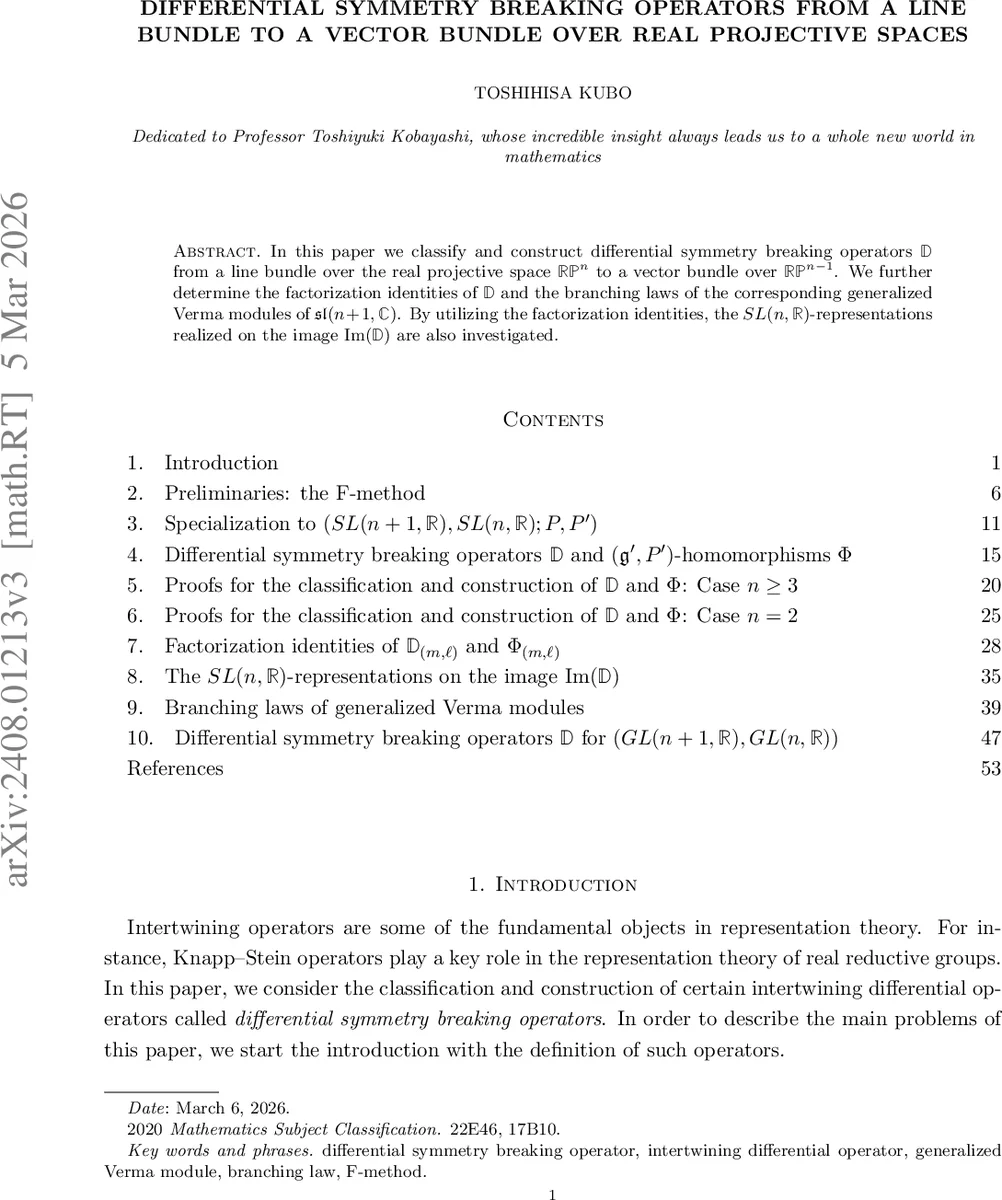
In this paper we classify and construct differential symmetry breaking operators $\mathbb{D}$ from a line bundle over the real projective space $\mathbb{R}\mathbb{P}^n$ to a vector bundle over $\mathbb{R}\mathbb{P}^{n-1}$. We further determine the factorization identities of $\mathbb{D}$ and the branching laws of the corresponding generalized Verma modules of $\mathfrak{sl}(n+1,\mathbb{C})$. By utilizing the factorization identities, the $SL(n,\mathbb{R})$-representations realized on the image $\text{Im}(\mathbb{D})$ are also investigated.
💡 Research Summary
This paper provides a comprehensive classification and construction of differential symmetry breaking operators (SBOs) that map sections of a line bundle over the real projective space ℝPⁿ to sections of a vector bundle over ℝPⁿ⁻¹. The authors work primarily with the pair (G,G′) = (SL(n+1,ℝ), SL(n,ℝ)) and also treat the analogous (GL(n+1,ℝ), GL(n,ℝ)) case.
The setting is as follows: let P⊂G and P′⊂G′ be maximal parabolic subgroups such that G/P≅ℝPⁿ and G′/P′≅ℝPⁿ⁻¹. A line bundle L_λ(ξ) over ℝPⁿ is induced from a one‑dimensional representation ξ of the Levi factor M of P, while a vector bundle V_ν(η) over ℝPⁿ⁻¹ is induced from an arbitrary finite‑dimensional representation η of the Levi factor M′ of P′. A differential SBO D is a G′‑intertwining differential operator respecting the natural inclusion ℝPⁿ⁻¹↪ℝPⁿ.
The core technical tool is the “F‑method”, which translates the problem of finding D into solving a system of partial differential equations derived from the algebraic Fourier transform of generalized Verma modules M_g(λ)=U(g)⊗_{U(p)}(σ⊗ℂ_λ). The method yields a bijection between differential SBOs and (g′,P′)‑homomorphisms Φ between appropriate generalized Verma modules (Theorem 2.3).
Using this framework, the authors obtain the following main results (Problem A):
- For n ≥ 3 the space Diff_{G′}(I(ξ,λ),J(η,ν)) is either zero or one‑dimensional. When it is one‑dimensional, the unique operator is explicitly given as D(m,ℓ) for a pair of non‑negative integers (m,ℓ).
- For n = 2 in the SL‑case, a “multiplicity‑two” phenomenon occurs: for certain parameter ranges the space of differential SBOs has dimension two. This does not happen in the GL‑case, where the space is always multiplicity‑free for all n ≥ 2 (Theorem 10.3).
- The explicit formulas for D(m,ℓ) involve homogeneous polynomial differential operators combined with multiplication by powers of the defining coordinate of the hyperplane ℝPⁿ⁻¹⊂ℝPⁿ.
Problem B concerns factorization identities. Every differential SBO D constructed above satisfies a double factorization
D = D_J ∘ D₁ = D₂ ∘ D_I,
where D_I and D_J are G‑invariant and G′‑invariant differential operators, respectively, and D₁, D₂ are lower‑order operators that change the degree of the bundle. Theorem 7.18 gives the precise factorization for each D(m,ℓ). Notably, D_J coincides with the residue of a Knapp–Stein intertwining operator, linking the factorization to classical representation‑theoretic objects.
Problem C asks for the structure of the image Im(D). By exploiting the double factorization, the authors relate Ker(D_I) and Ker(D_J) and prove that Im(D) is isomorphic either to Ker(D_J) or to the image of D₁ restricted to Ker(D_I). Consequently, Im(D) carries a natural SL(n,ℝ)‑module structure that can be identified with a specific submodule of a generalized Verma module. Section 8 provides a detailed description of these images, using earlier results on intertwining differential operators.
The paper also studies the branching laws of the generalized Verma modules M_g(λ) when restricted to the subalgebra g′ = sl(n,ℂ). By employing character identities in the Grothendieck group of the BGG category O′, the authors first obtain formal branching formulas for generic λ. For singular λ, the F‑method supplies the necessary information about n′⁺‑invariant subspaces, leading to explicit decomposition formulas (Theorems 9.22 and 9.27). These branching laws match precisely the SL(n,ℝ)‑representations realized on Im(D), confirming the compatibility of the three main problems.
In the GL‑case (Section 10) the same classification holds, but the extra parameter from the determinant character eliminates the multiplicity‑two situation. Theorems 10.3 and 10.7 give the complete list of differential SBOs and their factorization identities for (GL(n+1,ℝ), GL(n,ℝ)).
Overall, the paper achieves a unified treatment of differential symmetry breaking operators from line bundles to vector bundles over real projective spaces. It combines the algebraic F‑method, explicit factorization identities, and branching law analysis to not only classify these operators but also to elucidate the representation‑theoretic content of their images. The results lay a solid foundation for further investigations into symmetry breaking phenomena for other homogeneous spaces, non‑maximal parabolic subgroups, and potential applications in geometric analysis and mathematical physics.
Comments & Academic Discussion
Loading comments...
Leave a Comment