Aromatic Species in the Molecular Universe
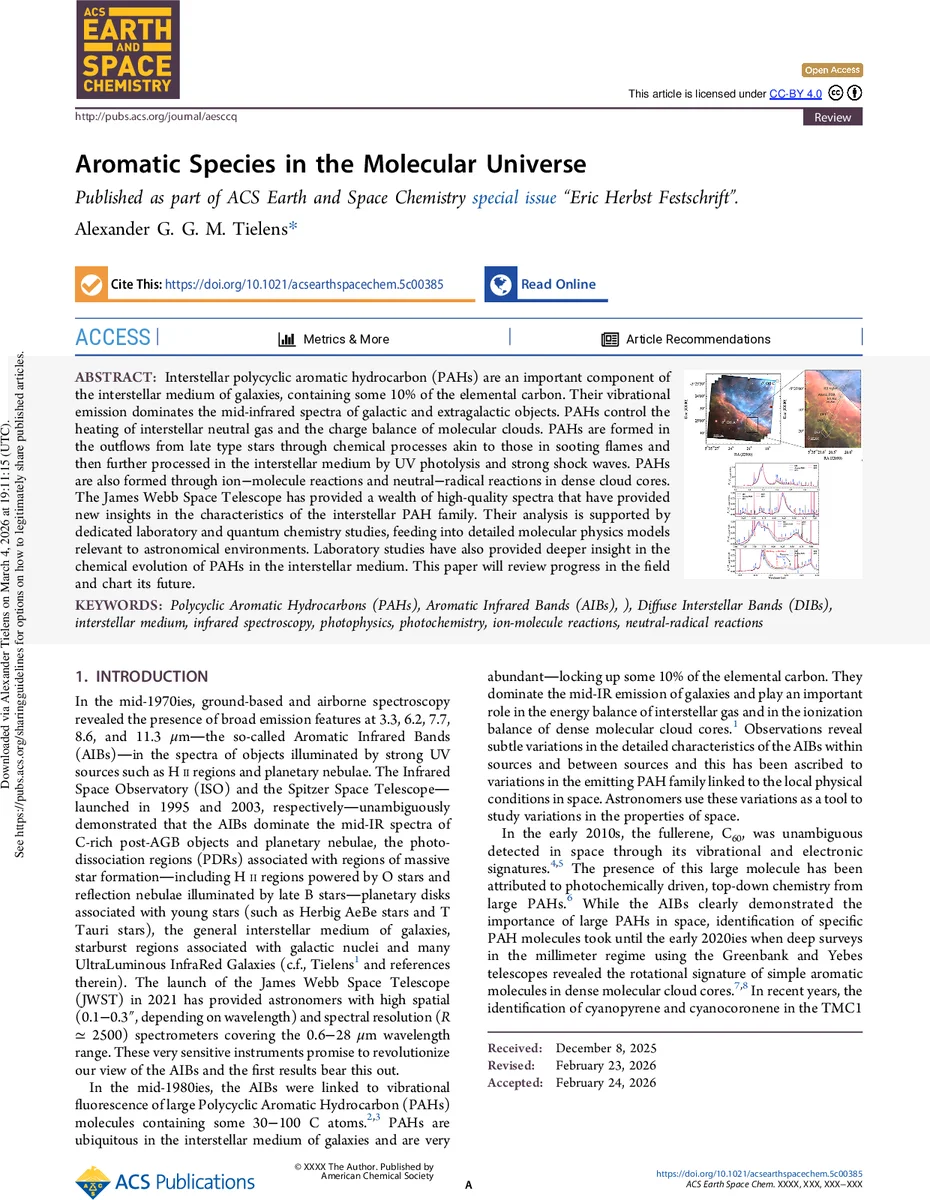
Interstellar polycyclic aromatic hydrocarbon (PAHs) are an important component of the interstellar medium of galaxies, containing some 10 percent of the elemental carbon. Their vibrational emission dominates the mid-infrared spectra of galactic and extragalactic objects. PAHs control the heating of interstellar neutral gas and the charge balance of molecular clouds. PAHs are formed in the outflows from late type stars through chemical processes akin to those in sooting flames and then further processed in the interstellar medium by UV photolysis and strong shock waves. PAHs are also formed through ion molecule reactions and neutral radical reactions in dense cloud cores. The James Webb Space Telescope has provided a wealth of high-quality spectra that have provided new insights in the characteristics of the interstellar PAH family. Their analysis is supported by dedicated laboratory and quantum chemistry studies, feeding into detailed molecular physics models relevant to astronomical environments. Laboratory studies have also provided deeper insight in the chemical evolution of PAHs in the interstellar medium. This paper will review progress in the field and chart its future.
💡 Research Summary
The review “Aromatic Species in the Molecular Universe” provides a comprehensive synthesis of three decades of research on interstellar polycyclic aromatic hydrocarbons (PAHs), focusing on the transformative impact of the James Webb Space Telescope (JWST) and on the parallel advances in laboratory spectroscopy and quantum‑chemical modeling. The authors begin by recalling the discovery of the Aromatic Infrared Bands (AIBs) in the mid‑1970s and their identification as vibrational fluorescence from large PAH molecules containing 30–100 carbon atoms. They emphasize that PAHs lock up roughly ten percent of the cosmic carbon budget, dominate the mid‑infrared emission of galaxies, and play a central role in the heating of neutral gas and the charge balance of dense molecular clouds.
The core of the paper is an in‑depth analysis of JWST observations, especially the PDRs4All early‑release science program that mapped the Orion Bar with NIRSpec and MIRI integral‑field units. The unprecedented spatial (0.1–0.3″) and spectral (R≈2500) resolution revealed not only the classic AIBs at 3.3, 6.2, 7.7, 8.6, and 11.3 µm but also a forest of weaker features at 3.4, 3.5, 5.25, 5.65, 6.0, 6.9, 10.5, 11.0, 12.7, 13.5, 14.2, and 16.4 µm. Detailed spatial‑spectral decomposition showed systematic variations of band intensities, widths, and sub‑structures across the ionization front, atomic zone, and H₂ dissociation fronts. In the 11–14 µm region, the CH out‑of‑plane bending modes were linked to specific edge structures—solo, duo, trio, and quartet CH groups—through a combination of JWST data, density‑functional theory (DFT) calculations, and laboratory spectra. The analysis demonstrated that the interstellar PAH population is dominated by compact molecules with long straight edges and relatively few “bay” or “fjord” corners; compact PAHs are about seven times more abundant than irregular counterparts.
The review also discusses the subtle behavior of the 3.3 µm aromatic CH stretch versus the 3.4 µm aliphatic/substituted CH features. Machine‑learning classification of the Orion Bar spectra uncovered correlated variations of the 3.4/3.3 intensity ratio and the presence of multiple sub‑components (3.395, 3.403, 3.424, 3.48, 3.52 µm). These trends are interpreted as signatures of super‑hydrogenation, methyl/ethyl side‑groups, and PAH clustering, especially deep in the H₂ dissociation front.
From a physical‑chemistry perspective, the authors review the IR cascade model that describes how an absorbed UV photon’s energy is redistributed among anharmonic vibrational modes and emitted as a sequence of infrared photons. They highlight recent laboratory work showing that electronic fluorescence can dominate the relaxation of small PAH cations, and they stress the importance of including anharmonicity in spectral simulations to reproduce JWST line shapes.
A major conceptual discussion concerns the “grandPAH” hypothesis, which posits that a limited set of large, highly stable PAHs (e.g., coronene, circumcoronene) may dominate the observed AIB spectrum. The authors weigh evidence for and against this idea, noting that while the dominance of compact, highly symmetric PAHs supports the hypothesis, the detection of specific small PAHs (cyanopyrene, cyanocoronene) in the cold dark cloud TMC‑1 demonstrates that bottom‑up formation pathways—ion‑molecule and neutral‑radical reactions—also operate in dense cores.
Rotational spectroscopy is addressed in a dedicated section. The authors summarize how PAHs contribute to the anomalous microwave emission (AME) and describe the first detections of rotational lines from PAH derivatives in TMC‑1, providing a direct link between infrared AIB carriers and microwave emitters.
The review further explores the connection between PAHs and the diffuse interstellar bands (DIBs). Laboratory measurements of electronic transitions and photochemical pathways suggest that certain PAH ions and radicals could be responsible for a subset of DIBs, although definitive assignments remain elusive.
In concluding sections, the authors outline future directions: expanded JWST mapping of diverse environments (e.g., extragalactic starbursts, protoplanetary disks), systematic laboratory databases of high‑resolution IR and microwave spectra for a wide range of PAH sizes, charges, and substitution patterns, and large‑scale quantum‑chemical calculations to refine the grandPAH inventory. They argue that the synergy of space‑based observations, laboratory astrophysics, and theoretical chemistry is now poised to answer long‑standing questions about PAH formation, evolution, and their broader role in astrochemistry and the origin of organic matter in the universe.
Comments & Academic Discussion
Loading comments...
Leave a Comment