The trans-Neptunian object (119951) 2002 KX14 revealed via multiple stellar occultations
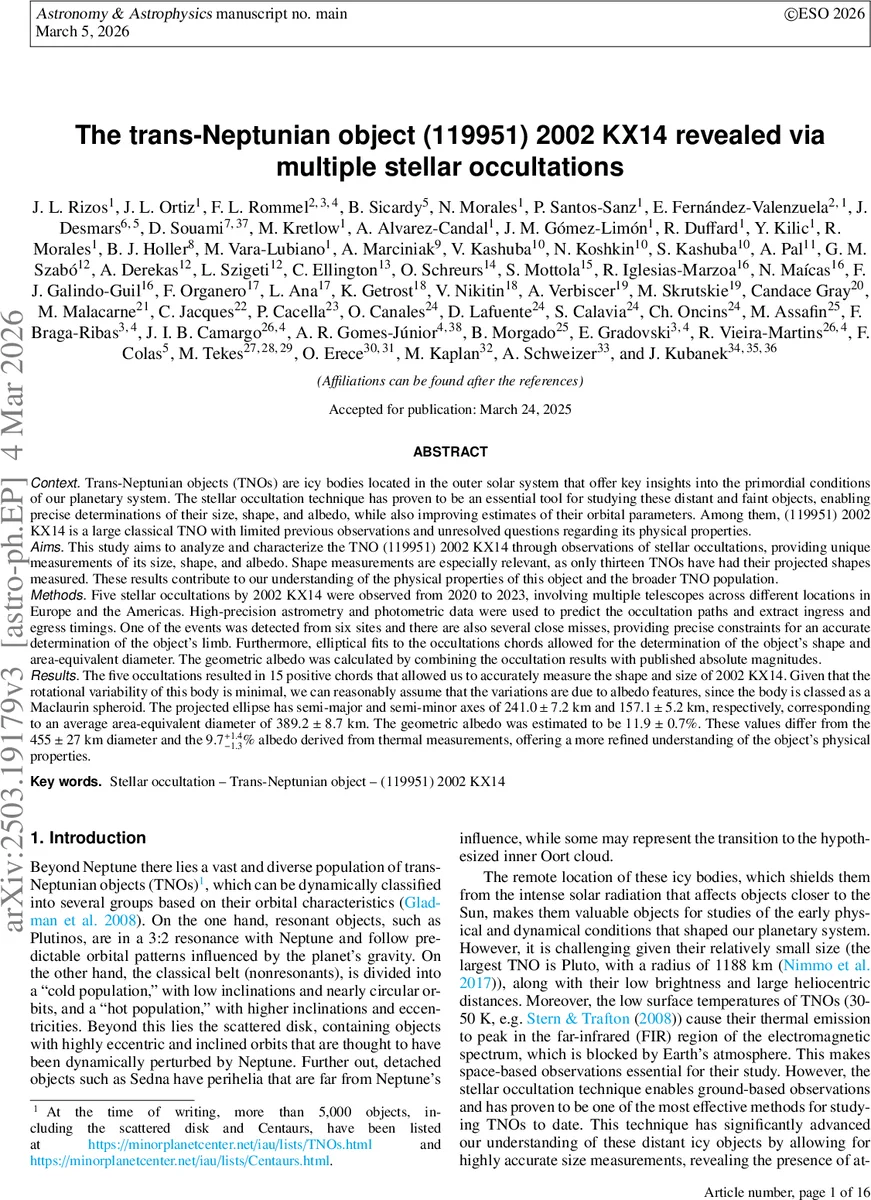
(119951) 2002 KX14 is a large classical TNO with limited previous observations and unresolved questions regarding its physical properties. Five stellar occultations by 2002 KX14 were observed from 2020 to 2023, involving multiple telescopes across different locations in Europe and the Americas. The five occultations resulted in 15 positive chords, accurately measuring the 2002 KX14’s shape and size. The projected ellipse has semi-major and semi-minor axes of $241.0 \pm 7.2$ km and $157.1 \pm 5.2$ km, respectively, corresponding to an average area-equivalent diameter of $389.2 \pm 8.7$ km. The geometric albedo was estimated at $11.9 \pm 0.7%$.
💡 Research Summary
The paper presents a comprehensive study of the trans‑Neptunian object (119951) 2002 KX14 using five stellar occultations observed between 2020 and 2023. A total of fifteen positive chords were obtained from multiple sites across Europe and the Americas, allowing a precise reconstruction of the object’s projected silhouette. By fitting an ellipse to the chord ensemble, the authors derive a semi‑major axis of 241 ± 7 km and a semi‑minor axis of 157 ± 5 km, corresponding to an area‑equivalent diameter of 389 ± 9 km. This size is significantly smaller—by about 15 %—than the 455 ± 27 km diameter previously inferred from Herschel thermal measurements. Combining the new diameter with published absolute magnitudes yields a geometric albedo of 11.9 ± 0.7 %, higher than the earlier estimate of ~9.7 %.
The observational campaign relied on accurate pre‑event predictions using the NIMA orbital solution, followed by intensive astrometric refinement with the 1.23 m Calar Alto and 2.0 m Liverpool telescopes. During each occultation, time series imaging was synchronized via GPS or NTP, and no filters were employed to maximize signal‑to‑noise. The authors carefully accounted for the angular diameters of the occulted stars, Fresnel diffraction scales (~1.3 km at the object’s distance), and instrument cycle times, ensuring that ingress and egress timings were determined with sub‑second precision.
The shape analysis indicates that 2002 KX14 is best described as a Maclaurin spheroid—a rotationally flattened ellipsoid—consistent with its very low light‑curve amplitude (<0.05 mag). The axis ratio (≈1.53) suggests a modest flattening, implying a bulk density compatible with a mixed ice‑rock composition. Given its diameter near 400 km, the object lies close to the threshold where hydrostatic equilibrium may no longer be maintained, making it a valuable test case for theories of internal structure and differentiation in the outer Solar System.
Dynamically, 2002 KX14 has a semi‑major axis of 38.63 AU, eccentricity of 0.04, and inclination of 0.41°, placing it near the boundary between the cold classical belt and the low‑inclination tail of the hot population. Some authors have classified it as an “inner classical” object, a subgroup that may retain primordial orbital characteristics. The refined size and albedo directly affect mass estimates, which are essential for dynamical modeling and for assessing the object’s role in the broader trans‑Neptunian population.
The study demonstrates the power of coordinated, multi‑site occultation observations for small‑body characterization. By securing a dense network of chords—including several near‑misses—the authors reduced geometric uncertainties and achieved a robust shape solution. The work also highlights the importance of integrating occultation data with thermal, photometric, and spectroscopic observations to build a coherent physical picture.
Future work should aim to determine the spin axis orientation and rotation period through long‑term light‑curve monitoring and possibly high‑precision stellar occultations that sample different aspect angles. Radio or sub‑millimeter observations could further constrain the object’s thermal inertia and surface composition. Overall, this paper provides a significant advancement in our knowledge of 2002 KX14, offering a benchmark for the physical properties of mid‑size TNOs and underscoring the continued relevance of stellar occultations in planetary science.
Comments & Academic Discussion
Loading comments...
Leave a Comment