Averaging formulas for the Reidemeister trace, Lefschetz and Nielsen numbers of $n$-valued maps
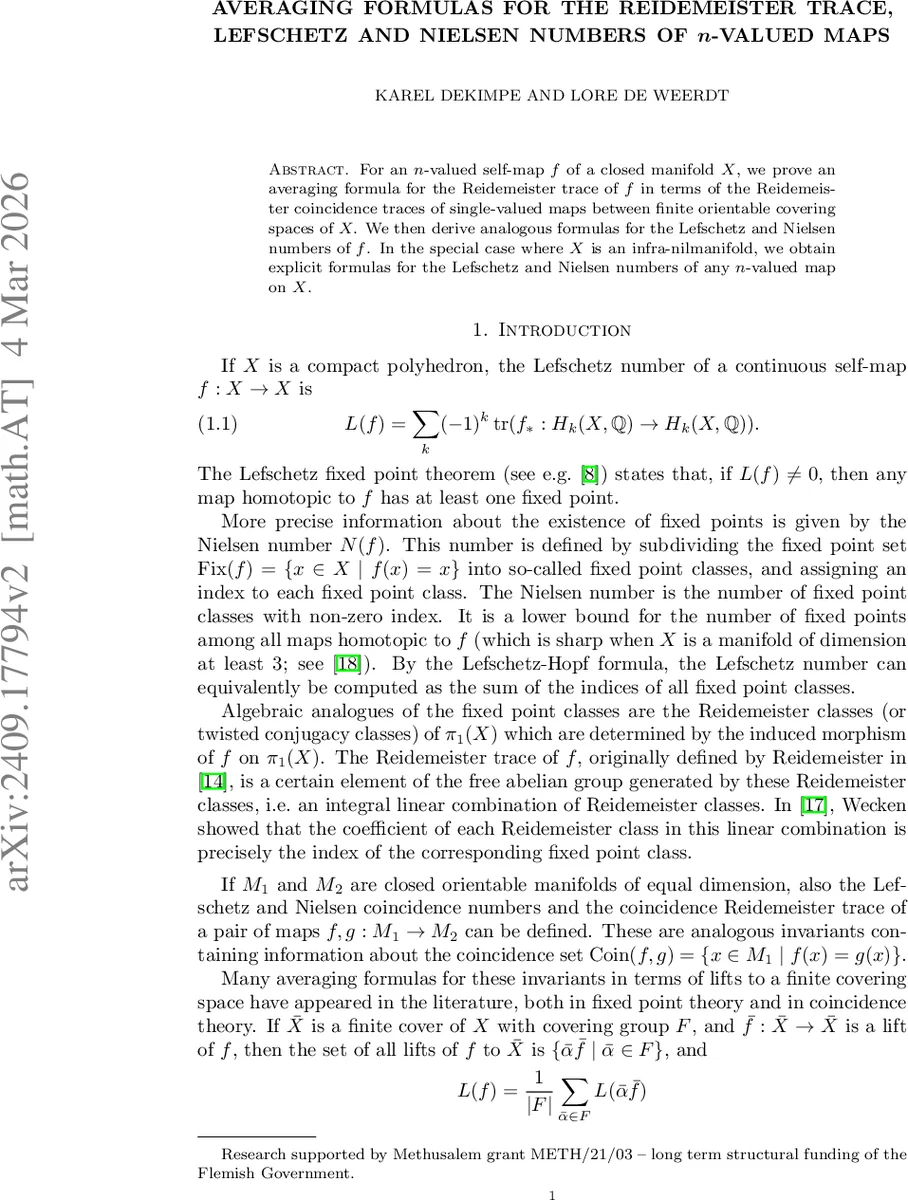
For an $n$-valued self-map $f$ of a closed manifold $X$, we prove an averaging formula for the Reidemeister trace of $f$ in terms of the Reidemeister coincidence traces of single-valued maps between finite orientable covering spaces of $X$. We then derive analogous formulas for the Lefschetz and Nielsen numbers of $f$. In the special case where $X$ is an infra-nilmanifold, we obtain explicit formulas for the Lefschetz and Nielsen numbers of any $n$-valued map on $X$.
💡 Research Summary
The paper develops averaging formulas for three fundamental fixed‑point invariants—Reidemeister trace, Lefschetz number, and Nielsen number—when the map under consideration is an n‑valued self‑map of a closed manifold. The authors begin by recalling the classical single‑valued theory: for a map f : X→X on a compact polyhedron X, the Lefschetz number L(f) is given by the alternating trace on rational homology, the Nielsen number N(f) counts fixed‑point classes with non‑zero index, and the Reidemeister trace RT(f, \tilde f) records the index of each Reidemeister (twisted‑conjugacy) class in a formal sum. They review the well‑known averaging formula for single‑valued maps: if \bar X→X is a finite covering with group F and \bar f is a lift of f, then
RT(f, \tilde f) = (1/|F|) ∑_{α∈F} \hat r_α (RT(α·\bar f, α·\tilde f)),
and analogous formulas hold for L(f) and N(f).
The paper then turns to n‑valued maps f : X⊸X, which can be viewed as single‑valued maps X→D_n(X) into the unordered configuration space. Lifting to the universal cover \tilde X yields a map \tilde f : \tilde X→F_n(\tilde X,π) that splits as \tilde f=(\tilde f_1,…,\tilde f_n). This induces a homomorphism \tilde f_# = (φ_1,…,φ_n; σ) : π→π^n⋊Σ_n, where σ : π→Σ_n records the permutation of the n sheets and each φ_i : π→π is a (generally non‑homomorphic) map that becomes a homomorphism when restricted to the stabilizer S_i = {α | σ(α)(i)=i}. Reidemeister classes for an n‑valued map are defined on the set π×{1,…,n} by a doubly‑twisted conjugacy relation; they decompose into orbits of the Σ_n‑action, each orbit giving rise to a collection of ordinary coincidence Reidemeister classes R
Comments & Academic Discussion
Loading comments...
Leave a Comment