Barycentric bounds on the error exponents of quantum hypothesis exclusion
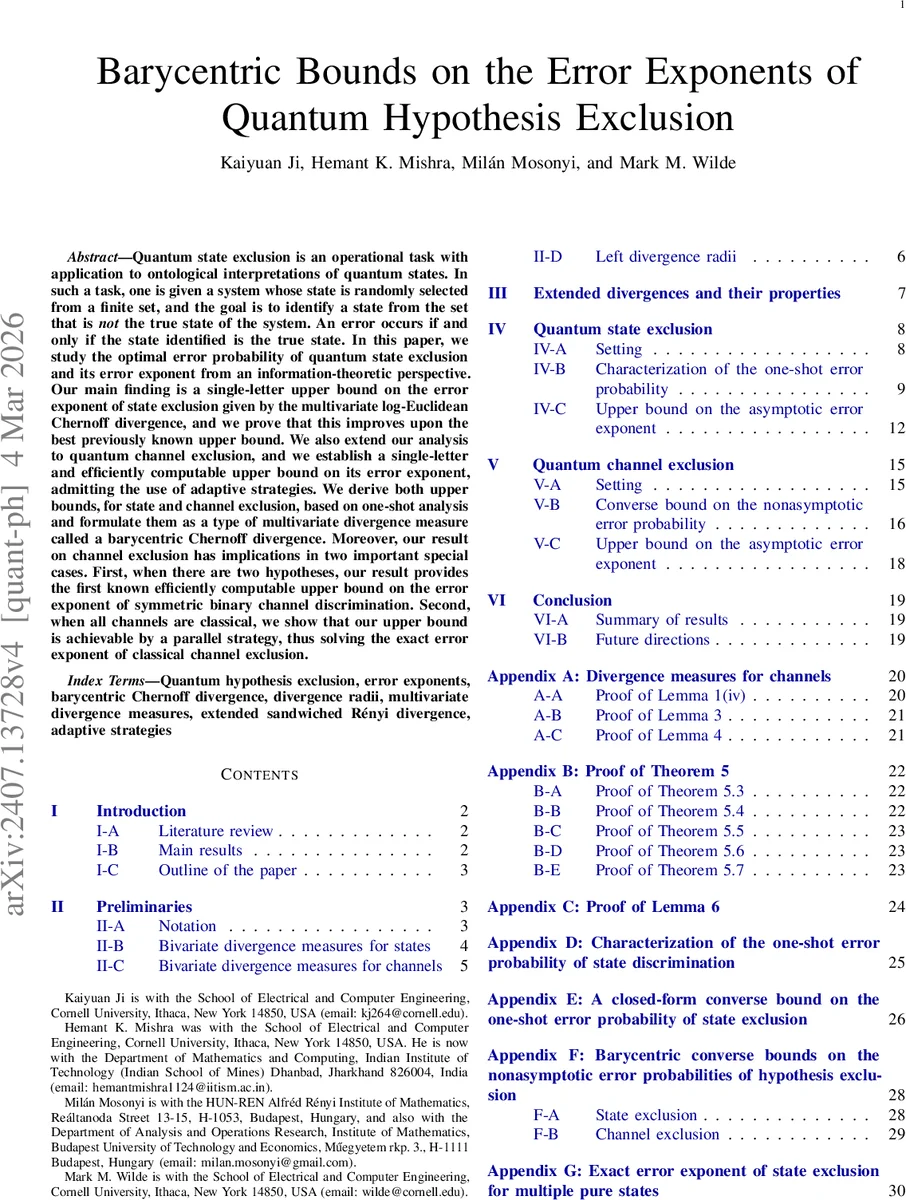
Quantum state exclusion is an operational task with application to ontological interpretations of quantum states. In such a task, one is given a system whose state is randomly selected from a finite set, and the goal is to identify a state from the set that is not the true state of the system. An error occurs if and only if the state identified is the true state. In this paper, we study the optimal error probability of quantum state exclusion and its error exponent from an information-theoretic perspective. Our main finding is a single-letter upper bound on the error exponent of state exclusion given by the multivariate log-Euclidean Chernoff divergence, and we prove that this improves upon the best previously known upper bound. We also extend our analysis to quantum channel exclusion, and we establish a single-letter and efficiently computable upper bound on its error exponent, admitting the use of adaptive strategies. We derive both upper bounds, for state and channel exclusion, based on one-shot analysis and formulate them as a type of multivariate divergence measure called a barycentric Chernoff divergence. Moreover, our result on channel exclusion has implications in two important special cases. First, when there are two hypotheses, our result provides the first known efficiently computable upper bound on the error exponent of symmetric binary channel discrimination. Second, when all channels are classical, we show that our upper bound is achievable by a parallel strategy, thus solving the exact error exponent of classical channel exclusion.
💡 Research Summary
This paper investigates the asymptotic performance of quantum hypothesis exclusion, focusing on both state exclusion and channel exclusion, from an information‑theoretic perspective. The authors introduce a novel single‑letter upper bound on the error exponent for state exclusion, expressed in terms of a multivariate log‑Euclidean Chernoff divergence, which they term the “barycentric Chernoff divergence.” Formally, for an r‑tuple of quantum states ρ
Comments & Academic Discussion
Loading comments...
Leave a Comment