Weak-Strong Uniqueness for a Rigid Body Immersed in an Inviscid Compressible Fluid
We consider the coupled motion of a free rigid body immersed in an inviscid compressible isentropic fluid. By means of a vanishing viscosity limit, we obtain the local-in-time existence of a dissipative measure-valued solution to the model. Moreover, we establish the weak-strong uniqueness property of the obtained measure-valued solution. To our knowledge, this is the first mathematical result on compressible inviscid fluid-structure interaction. The key novel technique is the construction of a suitable approximation of the test function in the weak formulation of the inviscid system, as the space of test functions depends on the viscosity parameter.
💡 Research Summary
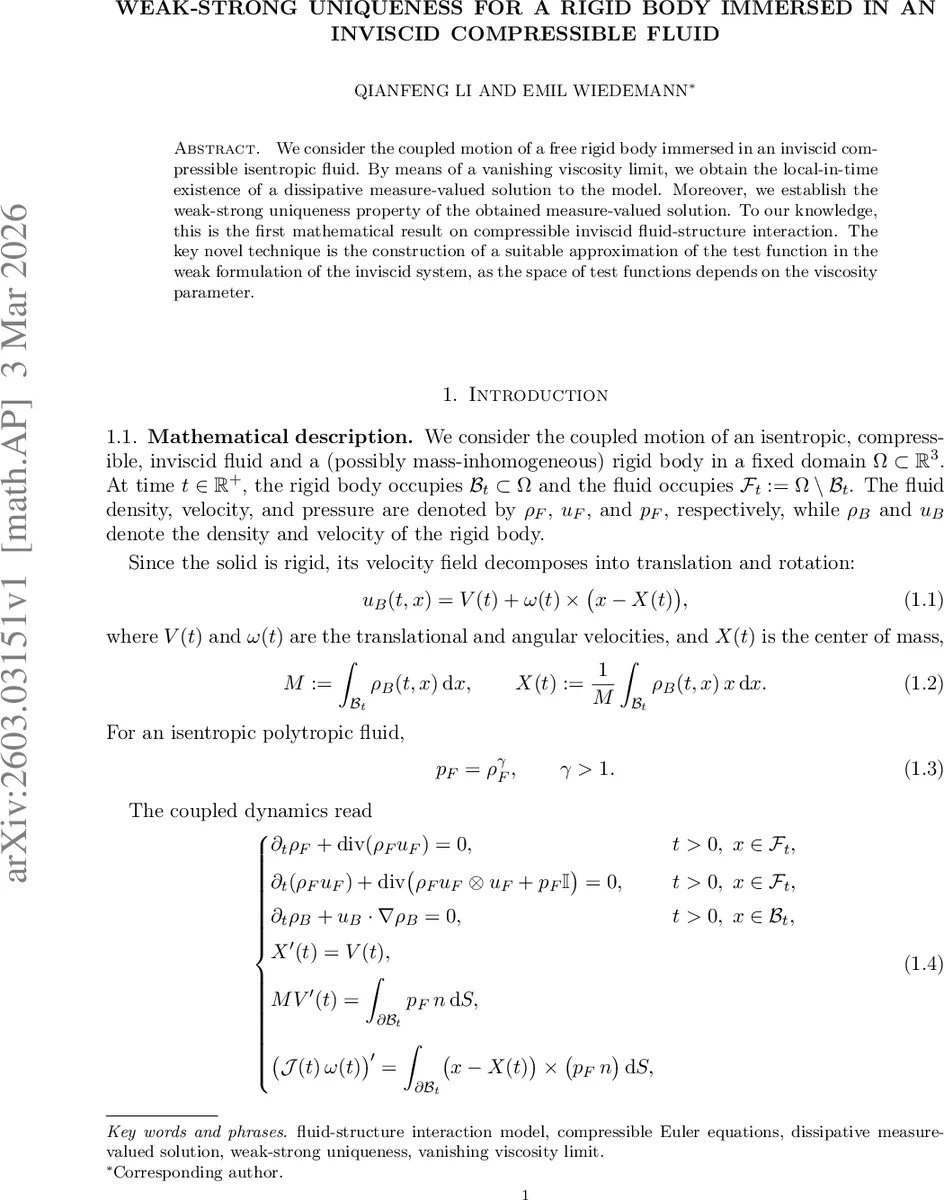
The paper addresses the coupled dynamics of a free rigid body immersed in an inviscid, compressible, isentropic fluid within a fixed three‑dimensional domain Ω. The fluid occupies the time‑dependent region Fₜ = Ω \ Bₜ, while the solid occupies Bₜ. The fluid satisfies the continuity equation and the compressible Euler equations with pressure law p_F = ρ_F^γ (γ > 1). The solid, being rigid, has a velocity field that decomposes into translation V(t) and rotation ω(t) about its centre of mass X(t). Momentum exchange occurs through the pressure acting on the fluid–solid interface, and slip boundary conditions are imposed both on the outer boundary (u_F·n = 0) and on the fluid–solid interface (the normal component of the velocity is continuous, while the tangential component may slip).
The main contributions are twofold:
-
Existence of a dissipative Young‑measure‑valued solution for the inviscid fluid‑structure system, obtained via a vanishing‑viscosity limit from the compressible Navier‑Stokes‑rigid‑body system with Navier slip boundary conditions. The authors start from the viscous system with viscosity ε > 0, for which local‑in‑time weak solutions are known when the adiabatic exponent satisfies γ > 3/2. Uniform a‑priori estimates are derived: an energy inequality that includes a non‑negative dissipation term D_ε(t), the BD entropy structure, and renormalized continuity. These estimates are independent of ε.
Because the nonlinear terms ρ_ε u_ε ⊗ u_ε and (ρ_ε)^γ are only bounded in L¹, compactness cannot be obtained directly. The authors therefore introduce a generalized Young measure ν(t,x) ∈ P(ℝ⁺×ℝ³) to capture oscillations and concentrations, together with a family of defect measures m_f that quantify the loss of compactness. Lemma 2.1 (standard Young‑measure compactness) and Lemma 2.2 (comparison principle for defect measures) are employed to pass to the limit. A crucial technical difficulty is that the admissible test‑function space depends on the moving solid Bₜ^ε, and hence on ε. To overcome this, the paper constructs ε‑dependent test functions ϕ^ε that coincide with a smooth fluid test ϕ_F in the fluid region, with a rigid‑body test ϕ_B in the solid region, and are smoothly interpolated across a thin layer near the interface. This construction guarantees the C¹ regularity required in the inviscid weak formulation while remaining admissible for the viscous problem. The resulting limit (ν, D, Bₜ) satisfies the definition of a dissipative Young‑measure‑valued solution (Definition 2.1): it respects mass and momentum balance, incorporates a defect measure ν_M controlled by the dissipation D(t), and fulfills a total‑energy inequality.
-
Weak‑strong uniqueness: The second main theorem shows that if, in addition to the dissipative Young‑measure solution, there exists a strong solution (ρ_F², u_F², ρ_B², u_B², Bₜ²) with sufficient regularity (C¹ in space‑time, positive density, and a uniform distance from the outer boundary), then the Young‑measure solution must coincide with the strong one. The proof uses a relative‑energy method. The authors define a relative energy functional measuring the distance between the Young‑measure state and the strong state, and they use the strong solution itself as a test function (justified by the higher regularity). A coordinate transformation is introduced to map the moving solid domain of the Young‑measure solution onto that of the strong solution, eliminating geometric discrepancies. The defect measure ν_M appears in the momentum balance with a bound proportional to D(t); the relative‑energy inequality then forces D(t) ≡ 0 and ν to collapse to a Dirac mass concentrated on the strong state. Consequently, Bₜ¹ = Bₜ² for all t, the defect measure vanishes, and the dissipative solution reduces to the classical strong solution.
The paper highlights that the existence result requires γ > 3/2 only because the underlying viscous Navier‑Stokes‑rigid‑body theory is presently known under this restriction. However, the weak‑strong uniqueness holds for any γ > 1, matching the range where the compressible Euler equations are physically relevant (e.g., γ = 5/3 for a monatomic gas). The novel approximation of test functions that respects the moving interface is the key technical advance, addressing a gap in earlier works on vanishing‑viscosity limits for fluid‑structure interaction.
In summary, the authors provide the first rigorous mathematical framework for compressible, inviscid fluid‑rigid‑body interaction, establishing both existence of a generalized (measure‑valued) solution via vanishing viscosity and its uniqueness as long as a classical solution exists. The methodology opens the way for further investigations into global existence, collision phenomena, and extensions to more complex thermodynamic models.
Comments & Academic Discussion
Loading comments...
Leave a Comment