Exact stabilizer scars in two-dimensional $U(1)$ lattice gauge theory
The complexity of highly excited eigenstates is a central theme in nonequilibrium many-body physics, underpining questions of thermalization, classical simulability, and quantum information structure. In this work, considering the paradigmatic Rokhsa…
Authors: Sabhyata Gupta, Piotr Sierant, Luis Santos
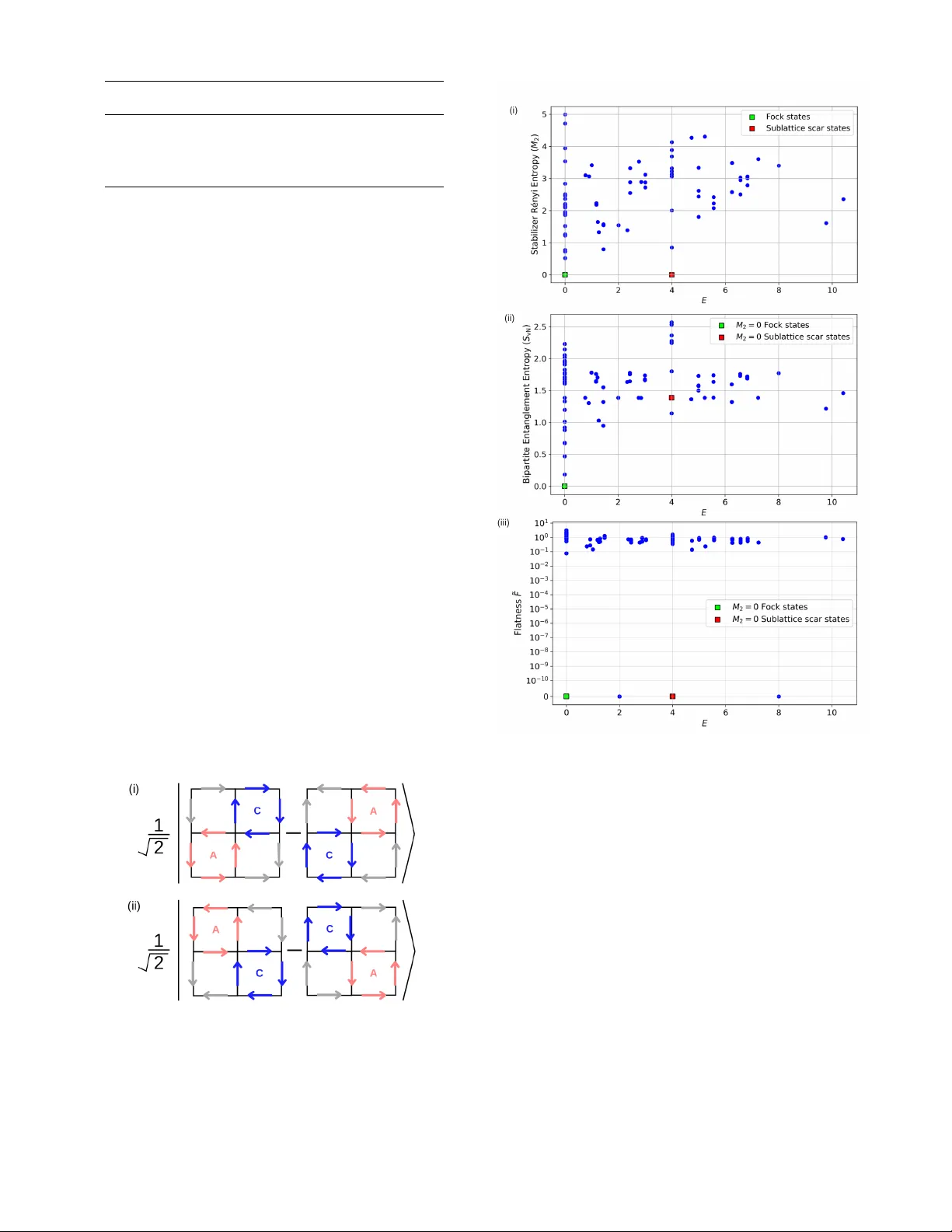
Exact stabilizer scars in t w o-dimensional U ( 1 ) lattice gauge theory Sabh yata Gupta , 1 , ∗ Piotr Sierant , 2 , † Luis Santos , 1 , ‡ and Paolo Stornati 2 , § 1 Institut f¨ ur The or etische Physik, L eibniz Universit¨ at Hannover, App elstr asse 2, 30167, Germany 2 Bar c elona Sup er c omputing Center Pla¸ ca Eusebi G¨ uel l, 1-3 08034, Bar c elona, Sp ain The complexity of highly excited eigenstates is a cen tral theme in nonequilibrium many-bo dy ph ysics, underpining questions of thermalization, classical simulabilit y , and quantum information structure. In this work, considering the paradigmatic Rokhsar–Kivelson mo del, w e connect quantum man y-b ody scarring in Ab elian lattice gauge theories to an emergent stabilizer structure. W e iden- tify a distinct class of scarred eigenstates, termed sublattice scars, originating from gauge-inv arian t zero mo des that form exact stabilizer states. Remark ably , although the underlying Hamiltonian is not a stabilizer Hamiltonian, its eigenspectrum in trinsically hosts exact stabilizer eigenstates. These sublattice scars exhibit v anishing stabilizer R´ enyi en tropy together with finite, highly structured en- tanglemen t, enabling efficien t classical sim ulation. Exploiting their stabilizer structure, w e construct explicit Clifford circuits that prepare these states in a tw o-dimensional lattice gauge mo del. Our results demonstrate that the scarred subspace of the Rokhsar–Kivelson spectrum forms an intrinsic stabilizer manifold, revealing a direct connection b et ween stabilizer quantum information, lattice gauge constraints, and quantum man y-b ody scarring. I. In tro duction Isolated quantum many-bo dy systems are exp ected to self-thermalize under unitary dynamics, a b eha vior en- capsulated by the eigenstate thermalization hypothesis (ETH), whic h asserts that individual high-energy eigen- states reproduce thermal exp ectation v alues of local ob- serv ables [ 1 – 3 ]. An important exception comes from quan tum man y-b ody scars [ 4 , 5 ], a class of highly ex- cited eigenstates that weakly violate ETH and give rise to nonthermal dynamics despite b eing em b edded in an otherwise thermal sp ectrum. Scarred eigenstates exhibit anomalously low entanglemen t and lead to long-lived co- heren t reviv als when the system is initialized in a sp ecial class of product states [ 6 , 7 ]. Constrained quantum systems provide a natural set- ting for this p ersisten t coherent dynamics [ 8 ]. In partic- ular, mo dels gov erned by lo cal conserv ation rules such as Gauss’s law in lattice gauge theories (LGTs) restrict the Hilbert space to a ph ysical subspace, whic h can harb or nonergodic dynamics and long-lived states [ 9 – 21 ]. Recen t studies ha v e sho wn that constrained Hilb ert spaces can protect sp ecial nonthermal eigen- states through symmetry-based mec hanisms, Hilb ert- space fragmentation [ 22 , 23 ], or entanglemen t b ottle- nec ks [ 24 ]. The Rokhsar-Kivelson (RK) mo del [ 25 ] provides a paradigmatic example of a constrained, gauge-inv arian t quan tum system. Originally introduced in the con text of quantum dimer models, the RK Hamiltonian features plaquette flip terms (see Fig. 1 ) acting on a bac kground of hardcore dimers obeying lo cal dimer constraints, a v ari- ∗ sabhy ata.gupta@itp.uni-hannov er.de † piotr.sierant@bsc.es ‡ santos@itp.uni-hanno ver.de § paolo.stornati@bsc.es Figure 1: Sc hematic representation of the RK Hamil- tonian: action of ( i ) O kin ( ii ) O pot op erators on ac- tiv e/flippable plaquettes. an t of Gauss’s la w. The model supports a solv able spin- liquid ground state and has b een studied in connection to resonating v alence b ond phases, top ological order, and lattice gauge theories [ 26 , 27 ]. Recen t works hav e shown classes of stabilizer quan- tum man y b ody scarred states in Z 2 LGT, and other b-lo cal Hamiltonians [ 28 , 29 ]. Stabilizer Hamiltonians, e.g. [ 30 ], by definition, p ossess stabilizer eigenstates that are fixed by a commuting set of P auli op erators. How- ev er, such Hamiltonians are t ypically artificial construc- tions comp osed of mutually commuting pro jector terms and do not represent the t yp e of local, ph ysical mo dels. Bey ond exact stabilizer Hamiltonians, recent theoreti- cal developmen ts hav e established that “dop ed” stabi- lizer states, generalizations of exact stabilizer states with limited non-Clifford conten t, appear naturally as eigen- states of perturb ed man y-b ody Hamiltonians, enabling stabilizer techniques to b e applied in highly entangled regimes [ 31 ]. In con trast, the RK mo del is not a stabilizer Hamiltonian, as its kinetic and p oten tial terms do not comm ute. Y et, as shown b elo w, its sp ectrum nonetheless con tains exact stabilizer eigenstates. In this work, we uncov er and c haracterize a class of eigenstates in the tw o-dimensional RK mo del that are b oth scarred and exact stabilizer states. These stabilizer 2 scars p ossess zero stabilizer R ´ en yi entrop y (SRE) [ 32 , 33 ] and limited bipartite entanglemen t. W e analytically v er- ify their canonical stabilizer form and show that they are in v ariant under a commuting set of physical Pauli opera- tors. These eigenstates violate ETH, are exact stabilizer states, and hence lie within the class of classically sim- ulable quan tum man y-b ody states [ 34 ]. W e further pro- vide explicit Clifford circuits that prepare these stabilizer scar states efficien tly , sho wing that they are accessible on near-term quantum devices. Our results demonstrate that the scarred subspace formed b y the sublattice singlet states of the RK mo del constitutes an exact stabilizer manifold within the gauge- in v ariant Hilb ert space. This establishes a direct cor- resp ondence b et ween sublattice scars and stabilizer- protected subspaces, bridging quantum many-bo dy scar- ring, lattice-gauge constraints, and the theory of stabi- lizer states. I I. Mo del The RK mo del arises in the theory of quantum dimer [ 25 ] and spin-ice [ 35 , 36 ] systems. It captures the essen tial ingredients of lattice gauge theories, namely lo- cal ring-exchange terms and Gauss-la w constraints, giv- ing rise to non trivial phenomenon, lik e cofinement [ 37 ] and non trivial phases of matter [ 38 ]. W e fo cus here on the spin- 1 2 form ulation of the RK mo del, in which each link of the lattice hosts a spin degree of freedom. The Hamiltonian is expressed in terms of plaquette operators: H RK = O kin + λ O pot = − ◻ O kin , ◻ + λ ◻ O pot , ◻ = − ◻ U ◻ + U † ◻ + λ ◻ U ◻ + U † ◻ 2 , (1) where the sums run o ver all plaquettes. The plaquette op erator U ◻ = S + a S + b S − c S − d acts on the four spins ( a, b, c, d ) around the plaquette ◻ , flipping a clo c kwise configuration C in to the corresp onding anticlockwise configuration A , i.e. U ◻ A = C and U † ◻ C = A , see Fig. 1 . Any other spin configuration is inactiv e, i.e. non-flippable, and is annihilated by U ◻ and U † ◻ . Hence, the kinetic term O kin acts only on the activ e, i.e. flippable, plaque- ttes, while the p oten tial term O pot = ∑ ◻ ( U ◻ + U † ◻ ) 2 coun ts the num b er of active plaquettes in a given configuration. The lo cal Hilb ert space is constrained by a Gauss la w. The lo cal Gauss la w op erator at eac h v ertex r is G r = µ ∈ { ˆ x, ˆ y } S z r, ˆ µ − S z r − ˆ µ, ˆ µ , (2) where S z r, ˆ µ denotes the z -component of the spin on the link emanating from site r in the ˆ µ direction. The RK Hamiltonian satisfies [ H RK , G r ] = 0, ensuring that the dynamics remains confined to the gauge-inv ariant sub- space. In this w ork, we restrict to the charge neutral sector, in whic h the physical Hilb ert space is defined b y the set of gauge-inv arian t states that satisfy the lo cal constrain t G r ψ = 0 , ∀ r . I II. Sublattice scars In this mo del, a class of anomalous eigenstate s called sublattice scars, has b een identified in Ref. [ 19 , 39 ]. These states are characterized by integer-v alued eigen- v alues of b oth the kinetic and p oten tial op erators, O kin and O pot , within the constrained Hilb ert space. Sp ecifi- cally , dividing the tw o-dimensional lattice into tw o sub- lattices in a c heck er-b oard configuration, a sublattice scar ψ s satisfies O pot , ◻ ψ s = ψ s for all plaquettes on one sublattice and O pot , ◻ ψ s = 0 on the complementary sub- lattice, while b eing an eigenstate of O kin with integer eigen v alue O kin ψ s = n ψ s , n ∈ { 0 , ± 2 } . By definition, suc h states remain exact eigenstates of the full Hamilto- nian H = O kin + λ O pot for any v alue of the coupling λ , implying that they are isolated from the ergo dic contin- uum and do not hybridize with nearby eigenstates as λ is v aried. Ph ysically , the in teger sp ectrum of O kin sig- nals a coheren t plaquette-flip pattern lo calized on one sublattice, resulting in a robust athermal subspace em- b edded within the otherwise ergo dic sp ectrum. While there are sev eral other classes of scars iden tified within the RK model, in this work we fo cus on the sublattice scars [ 12 , 27 ]. IV. Complexity mark ers A. Stabilizer structure T o quan tify the magic resources, i.e. non- stabilizerness, of a given state ψ , w e compute the sta- bilizer R´ en yi entrop y (SRE) [ 32 ]. The SRE of order n is defined as M n ( ψ ) = 1 1 − n log P ∈ P N ψ P ψ 2 n 2 N , (3) where the sum runs o ver the full N -qubit Pauli group P N , and the logarithm is taken in the natural base. F or n = 2 [ 40 ]. The SRE is a monotone in magic resource theory of pure states [ 33 ], and quantifies deviation of ψ from b eing a stabilizer state. Stabilizer states yield M 2 = 0, while an y state requiring non-Clifford resources for preparation yields a strictly positive v alue of M 2 . Although M 2 ma y be computed exactly for small sys- tem sizes, its ev aluation b ecomes computationally c hal- lenging for larger systems, as it requires calculating the exp ectation v alues of all 4 N P auli op erators [ 41 ]. T o av oid this difficulty , we emplo y multifractal flat- ness ˜ F ( ψ ) [ 42 ], whose ev aluation is significantly less demanding for states written in the computational basis, whic h in our case is the F o c k-lik e basis of gauge-in v ariant 3 spin configurations { σ } . Multifractal flatness is defined via the participation probabilities p σ = σ ψ 2 : ˜ F ( ψ ) = σ p 3 σ − σ p 2 σ 2 . (4) The m ultifractal flatness measures the deviation of the participation distribution { p σ } from a completely uni- form spread, v anishing in the limit where all p σ are equal. If ψ is a stabilizer state, the multifractal flatness is v an- ishing [ 43 ], ˜ F ( ψ ) = 0. The conv erse, ho wev er, is not generally true; a flat eigenstate corresp onds to a stabilizer state only if its w av efunction tak es the canonical form [ 44 , 45 ] ψ = 1 A x ∈ A i ℓ ( x ) ( − 1 ) q ( x ) x , (5) where A is an affine subspace of F n 2 , and ℓ, q ∶ { 0 , 1 } n → { 0 , 1 } are linear and quadratic p olynomials, resp ectiv ely , o ver the finite field F 2 . This implies that a flat state is uniformly supp orted on an affine subspace A of the computational basis, with relativ e phases determined b y linear and quadratic functions. Although the affine-phase structure is strictly required for a state to b e a stabilizer state, the condition ˜ F ( ψ ) = 0 serv es as a practical filter to iden tify candidate stabilizer states without the need to compute the SRE. In the follo wing, we employ these criteria, either M 2 = 0 or the v erification of the canonical stabilizer represen- tation when monitoring the existence of stabilizer states. B. Signatures of scar-b eha vior The entanglemen t entrop y (EE) [ 46 , 47 ] is a key di- agnostic to distinguish thermal and scarred eigenstates: thermal states ob ey the v olume-law scaling predicted b y ETH, while scarred or stabilizer states exhibit low er en tanglement. Splitting the system at half the sys- tem length, and obtaining the reduced density matrix ρ A in one of the halves, we ev aluate the EE, S vN = − T r ( ρ A log ρ A ) , where the logarithm is taken in natu- ral base. F or stabilizer states, EE is strictly quantized to in teger multiples of log ( 2 ) [ 48 ], corresp onding to a p er- fectly flat en tanglemen t spectrum [ 49 ]. F urthermore, as discussed ab o ve, the sublattice scarred eigenstates satisfy O kin ψ s = n ψ s with n = 0 , ± 2, and O pot , ◻ ψ s = ψ s on all plaquettes of one sublattice and 0 on the complementary one. These extremal eigenv al- ues corresp ond to maximally ordered plaquette config- urations that contrast sharply with homogeneous ther- mal av erages ( O pot th ≈ 1 2) predicted by ETH. W e thus compute the exp ectation v alues of the kinetic and p oten- tial op erators, O kin and O pot , resp ectiv ely , to c haracter- ize scarring behaviour. C. Degeneracy and basis dep endence The RK Hamiltonian H RK = O kin + λ O pot p ossesses an extensively degenerate eigenspectrum due to the lo cal gauge constrain ts and the fact that O kin and O pot do not comm ute with each other, and therefore also not with H RK for any λ . As a result, exact numerical diagonaliza- tion yields a sp ecific orthonormal eigen basis within eac h degenerate energy manifold, but the individual eigen- v ectors in that manifold are not uniquely defined. Be- cause M 2 is explicitly basis-dep enden t, p erforming or- thogonal rotations with in these degenerate subspaces can rev eal differen t stabilizer structures. W e exploit this free- dom to systematically engineer an orthonormal basis in whic h certain linear combinations of degenerate eigen- states ac hiev e M 2 = 0. Suc h basis engineering enables the iden tification of hidden stabilizer submanifolds embed- ded in the highly degenerate sp ectrum of the RK mo del. T o systematically uncov er suc h states, w e perform a ba- sis rotation within each degenerate energy sector guided b y the canonical form of stabilizer states. F or a fixed eigen v alue E , we first identify the degenerate subspace H E = span { ψ α } . Within this subspace, we search for linear combinations ϕ = ∑ α c α ψ α , that admit a canon- ical stabilizer represen tation ( 5 ). Such canonical patterns c haracterize stabilizer states up to Clifford transforma- tions, and hence provide a natural v ariational manifold for identifying states with M 2 = 0. The op erators O kin and O pot pla y a crucial role in this construction. Although they do not commute, their ex- p ectation v alues on classical plaquette configurations are in teger v alued revealing scar nature. W e therefore ev al- uate O kin and O pot on candidate sup erp ositions and retain only those states for which b oth quantities tak e sharply defined integer v alues. Empirically , this crite- rion strongly correlates with the stabilizer structure and selects states that are sim ultaneously structured with re- sp ect to plaquette flips and p otential energy contribu- tions. Ha ving identified in that wa y a set of candidate states within H E , we orthonormalize them using a Gram- Sc hmidt procedure restricted to the degenerate subspace. The remaining orthogonal complement is arbitrarily com- pleted to pro duce a complete orthonormal basis of H E , with stabilizer scar states app earing explicitly as basis v ectors. V. Stabilizer sublattice scars W e ha ve ev aluated the existence of stabilizer sublattice scars in RK mo dels of different system sizes, considering p eriodic boundary conditions (PBC). Stabilizer sublat- tice scars app ear systematically across all system sizes considered, as summarized in T able I . W e compute the SRE exactly for systems with 2 × 2 and 4 × 2 plaquettes. F or larger systems we employ the alter- nativ e diagnostics as described in Sec. IV A . F or the 2 × 2, 4 System No. of spins No. of ph ysical states No. of stabilizer scars 2 × 2 8 18 2 4 × 2 16 114 2 6 × 2 24 858 2 4 × 4 32 2,970 8 T able I: Summary of system sizes considered L x × L y , with L x,y the n umber of plaquettes along x and y . The table details the n umber of spins in volv ed, the num b er ph ysical states with zero c harge, and the num ber of iden- tified stabilizer sublattice scars. w e identify 6 stabilizer states with M 2 = 0. Out of these, 4 corresp ond to gauge-inv ariant pro duct configurations, or F o c k-like states, in energy sector E = 0 and exhibit zero entanglemen t entrop y . They are therefore identified as trivial stabilizer states. W e find 2 eigenstates in the energy sector E = 2, with M 2 = 0 and bipartite entangle- men t entrop y S vN = ln 2. These states p ossess O kin = 0 and exhibit O pot , ◻ = 1 on all plaquettes b elonging to one sublattice and 0 on the complemen tary one, corresp ond- ing to the c haracteristic sublattice-scar configuration, see Fig. 2 . These states are hence examples of stabilizer sub- lattice scars. As shown in Figs. 3 , for the 4 × 2 system, we find 2 sublattice stabilizer scars in the energy sector E = 4, c haracterized by v anishing M 2 and bipartite entangle- men t entrop y S vN = 2 × ln 2. While the stabilizer R´ en yi en tropy is computed exactly , see Fig. 3 ( i ) , we addition- ally ev aluate the multifractal flatness to b enc hmark the canonical-form analysis. A state may exhibit uniform amplitude magnitudes in the computational basis yet fail to satisfy the affine-supp ort and quadratic-phase condi- tions required for the canonical form in Eq. ( 5 ). Conse- quen tly , flat states observed at E = 2 and E = 8 in Fig. 3 Figure 2: ( i ) − ( ii ) Stabilizer sublattice scars in a 2 × 2 RK mo del with PBC in the energy sector E = 2. These states p ossess M 2 = 0, S vN = ln 2 and O kin = 0, and exhibit O pot , ◻ = 1 on plaquettes b elonging to one sublattice and 0 on the complementary one. Figure 3: ( i ) Stabilizer R´ en yi en trop y M 2 , ( ii ) bipartite en tanglement entrop y S v N , and ( iii ) multifractal flat- ness ˜ F across the eigensp ectrum for the 4 × 2 plaquette system with PBC. In ( i ) , t wo sublattice stabilizer scars at E = 4 exhibit v anishing M 2 , with trivial F o c k sta- bilizer states marked in green and nontrivial sublattice stabilizer scars marked in red. In ( ii ) , the F o c k states sho w S vN = 0 owing to their pro duct-state nature, while the sublattice stabilizer scars display finite entanglemen t S vN = 2 × ln 2. Panel ( iii ) shows the multifractal flatness, where states at E = 2 and E = 8 app ear flat but do not corresp ond to v alid stabilizer states, consistent with the absence in ( i ) of M 2 = 0 states at E = 2 and 8. ( iii ) do not corresp ond to v alid stabilizer manifolds, con- sisten t with the absence of M 2 = 0 signatures in Fig. 3 ( i ) . A similar analysis w as c arried out for larger system sizes. In lattice systems L x × 2, sublattice scars o ccur only as zero mo des of O kin . 5 Figure 4: ( i ) Multifractal flatness, ( ii ) bipartite entan- glemen t entrop y , across the eigensp ectrum for the 4 × 4 plaquette system with p eriodic boundary conditions. The situation is different for larger system sizes. F or the largest system w e hav e considered, 4 × 4, we observ e 4 sublattice stabilizer scars at energy E = 8 which are zero mo des of O kin , but w e also see 4 stabilizer sublattice scars with O kin ψ s = ± 2 ψ s , 2 at energies E = 6 and other 2 at E = 10 as shown in Fig. 4 . Although the n umber of sublattice scars has b een rep orted to b e higher in [ 19 ], the canonicalization within the de generate sector is not unique and yields a stabilizer structure under the given c hoice of canonicalization. The nature of stabilizer scar states with O kin = 0 for an y system size may be well understo od by realizing that the flippable subspace H L, ◻ = span { C , A } act as an effectiv e tw o-dimensional logical subspace on plaquette ◻ . W e may then in tro duce P auli op erators in that subspace: X L, ◻ ≡ C A + A C and Z L, ◻ ≡ C C − A A ≡ P C − P A . Plaquettes on the active sublattice are paired in to dimers D = {( p, q )} , see Fig. 5 , while the complementary sublattice remains inactive. The local dimer state is the logical Bell singlet Ψ − pq = C p A q − A p C q √ 2 (6) whic h satisfies the logical stabilizers ( Z L,p Z L,q ) Ψ − pq = − Ψ − pq , ( X L,p X L,q ) Ψ − pq = − Ψ − pq . (7) Figure 5: Sk etch of the general structure of stabilizer sublattice scars. Green (white) plaquettes are active (in- activ e). The plaquettes linked by a purple rod formed a dimer in a singlet state. The global sublattice singlet state is then: ψ SS = ( p,q ) ∈ D Ψ − pq ⊗ inactive . (8) These states fulfill that O kin ψ SS = 0, and O pot ψ SS = M ψ SS , and hence [ O kin , O pot ] ψ SS = 0, i.e. the scar lies in a common inv ariant subspace even though [ O kin , O pot ] ≠ 0 on the full Hilb ert space. Th us, the sublattice short-singlet co despace is fixed by a stabi- lizer algebra S , while the logical operators generated b y X L, ◻ , Z L, ◻ act within it. Noting that O kin = ∑ ◻ X L, ◻ , it is straightforw ard to see that O kin ψ S S = 0. Moreov er, O pot ψ S S = M ψ S S , with M equal to one half of the num b er of plaquettes. F urthermore, the states present Bell-pair entanglemen t ( S vN = ln 2 p er crossed dimer) with v anishing stabilizer R ´ enyi entrop y ( M 2 = 0), and hence the states ψ S S con- stitute a stabilizer sublattice scar embedded in the RK sp ectrum. VI. Quantum Circuits to prepare stabilizer scars W e next outline the explicit Clifford circuit preparation for the minimal sublattice stabilizer scar configuration of Fig. 2 . This construction provides an experimentally ac- cessible routine to initialize the non-thermal stabilizer eigenstates, offering insight in to their p oten tial for con- trollable state preparation in constrained quan tum sys- tems. F or a qubit lay out as shown in Fig. 6 , the stabilizer scar state of Fig. 2 ( i ) with PBC, can b e written in F o c k basis as, ψ − = 1 √ 2 ( b 0 − b 1 ) = 1 √ 2 ( 00110110 − 11001001 ) , where we follow the conv en tion q 7 , . . . , q 0 . This 8 qubit state is prepared using a gate sequence sho wn in Fig. 7 . The circuit b egins by initializing the system in the computational basis state b 0 using a la yer of X gates on the appropriate qubits. W e then identify the subset 6 Figure 6: Qubit la y out for 2 × 2 plaquettes with PBC. of qubits S where the configurations b 0 and b 1 differ. These are precisely the links affected by the action of a lo cal plaquette-flip op erator. T o coheren tly generate the sup erposition, we apply a Hadamard gate to a single piv ot qubit q p ∈ S follow ed b y a sequence of CNOT gates from q p to all other qubits in D . This operation en tangles the computational branches to create the symmetric state ( b 0 + b 1 ) √ 2. A single Z gate on the piv ot introduces a relativ e minus sign betw een the branches, yielding the an tisymmetric eigenstate ψ − . This construction applies to any pair of configurations related by a lo cal plaquette flip and satisfying Gauss’s la w. The pro cedure uses only Clifford gates, and the n umber of gates dep ends solely on the size of the plaque- tte supp ort, not on the o verall system size. As a result, the circuit has constant depth p er plaquette-pair singlet. When extended across a larger lattice, multiple copies of the local circuit can b e applied in parallel on disjoint plaquette pairs to construct the stablizer sublattice scar state. The circuit depth scales linearly with the num b er of plaquette pairs, and all operations are comp osed solely of single-qubit rotations and tw o-qubit CNOT gates, ren- dering the proto col exp erimen tally feasible on current NISQ hardware. Figure 7: Quan tum circuit for preparing a stabilizer scar for a 2 × 2 plaquette system with PBC. VI I. Conclusions and Outlook The RK mo del, a paradigmatic and physically lo- cal Hamiltonian of lattice gauge theory , hosts exact stabilizer-scarred eigenstates embedded within its oth- erwise nonintegrable sp ectrum. By com bining exact di- agonalization with stabilizer-based and multifractal diag- nostics, w e hav e identified a distinct family of non ther- mal eigenstates, sublattice stabilizer scars, that simulta- neously violate ETH and p ossess a stabilizer structure. These scars are characterized by v anishing SRE, finite subthermal bipartite entanglemen t, and integer eigen v al- ues of b oth the kinetic and p oten tial op erators, reflect- ing an emergent ordered pattern across the chec k erb oard sublattice. This sublattice order p ersists across all sys- tem sizes studied. Despite arising in a non-commuting, non-integrable Hamiltonian rather than a commuting stabilizer con- struction, these states admit an exact canonical stabi- lizer representation and can b e efficiently prepared using Clifford circuits. While the RK mo del is known to host a rich v ariet y of scarred eigenstates [ 14 ], our results indi- cate that sublattice scars form a distinguished sub class that admits a stabilizer description. Although our anal- ysis do es not exclude the possibility of stabilizer scars of other types in dimensions L x , L y ≥ 4, it strongly suggests that the emergence of a stabilizer structure is intimately tied to the sublattice nature of the scars. Our results establish a direct connection b et w een sta- bilizer quantum information theory and quantum many- b ody scarring in a physically realizable mo del. W e demonstrate that stabilizer-protected subspaces need not b e engineered through artificial commuting-pro jector Hamiltonians, but can instead emerge intrinsically in realistic gauge-theoretic systems. This finding op ens a new persp ectiv e on the in terplay b et w een lo calit y , con- strained dynamics, and classical sim ulability in strongly correlated quan tum matter, and suggests promising di- rections for exp erimen tally probing stabilizer scars using programmable quan tum simulators and near-term quan- tum pro cessors. This connection suggests that certain sectors of gauge theories can host stabilizer-protected subspaces that remain isolated from thermalization, pro- viding a natural platform for robust quantum state engi- neering. F uture w ork can explore the stability of stabilizer scars under generic gauge-in v ariant p erturbations and deter- mine whether their stabilizer structure persists approxi- mately b ey ond the Rokhsar–Kiv elson p oin t, p oten tially giving rise to long-lived or prethermal nonthermal man- ifolds. Inv estigating their dynamical signatures, includ- ing coheren t reviv als and constrained evolution within the stabilizer co despace, will b e essential for identify- ing exp erimen tally observ able consequences. Quan tum mac hine learning metho ds [ 21 , 50 , 51 ] can b e useful to ols in suc h explorations. Extending this framew ork to non-Ab elian lattice gauge theories may reveal richer sta- bilizer structures and connections to top ological order 7 and logical enco ding in gauge-inv ariant systems. More broadly , the stabilizer p ersp ectiv e suggests a natural in terpretation of scarred subspaces as emergen t quan- tum error-correcting co des embedded in ph ysical many- b ody systems. Clarifying the relationship b et ween gauge constrain ts, Hilb ert-space fragmen tation, and stabilizer structure may provide a unified framework linking quan- tum information structure, classical simulabilit y , and the emergence of nonthermal behavior in constrained quan- tum matter. Data Av ailabilit y Statement The data that supp ort the findings of this study are a v ailable from the corresponding author up on request. Ac knowledgmen ts P .Stornati w ould lik e to thank Debasish Banerjee, Egle P agliaro, and Emanuele Tirrito for helpful discussions on related topics. S.G. and L.S. ackno wledge the sup- p ort of the Deutsc he F orsc hungsgemeinsc haft (DF G, Ger- man Researc h F oundation) under German y’s Excellence Strategy – EXC-2123 Quantum-F ron tiers – 390837967. P .S. and P .S. ackno wledges funding from the Spanish Ministry for Digital T ransformation and the Civil Ser- vice of the Spanish Go vernmen t through the QUANTUM ENIA pro ject call - Quan tum Spain, EU, through the Re- co very , T ransformation and Resilience Plan – NextGen- erationEU, within the framework of Digital Spain 2026. [1] J. M. Deutsc h, Phys. Rev. A 43 , 2046 (1991) . [2] M. Srednicki, Ph ys. Rev. E 50 , 888 (1994) . [3] L. D’Alessio, Y. Kafri, A. Polk o vniko v, and M. Rigol, Adv ances in Ph ysics 65 , 239 (2016) . [4] C. J. T urner, A. A. Michailidis, D. A. Abanin, M. Serb yn, and Z. Papi ´ c, Nature Physics 14 , 745 (2018) . [5] M. Serbyn, D. A. Abanin, and Z. Papi ´ c, Nature Ph ysics 17 , 675 (2021) . [6] H. Bernien, S. Sc hw artz, A. Keesling, H. Levine, A. Om- ran, H. Pichler, S. Choi, A. S. Zibrov, M. Endres, M. Greiner, V. V uleti´ c, and M. D. Lukin, Nature 551 , 579 (2017) . [7] W. W. Ho, S. Choi, H. Pichler, and M. D. Lukin, Phys. Rev. Lett. 122 , 040603 (2019) . [8] A. Chandran, T. Iadecola, V. Khemani, and R. Mo ess- ner, Ann ual Review of Condensed Matter Ph ysics 14 , 443 (2023) . [9] F. M. Surace, P . P . Mazza, G. Giudici, A. Lerose, A. Gambassi, and M. Dalmon te, Phys. Rev. X 10 , 021041 (2020) . [10] A. Kersc hbaumer, M. Ljubotina, M. Serbyn, and J.-Y. Desaules, Phys. Rev. Lett. 134 , 160401 (2025) . [11] J. C. Halimeh, L. Barbiero, P . Hauk e, F. Grusdt, and A. Bohrdt, Quantum 7 , 1004 (2023) . [12] D. Banerjee and A. Sen, Physical Review Letters 126 , 220601 (2021) . [13] Z.-Y. Ge, Y.-R. Zhang, and F. Nori, Phys. Rev. Lett. 132 , 230403 (2024) . [14] S. Biswas, D. Banerjee, and A. Sen, SciP ost Physics 12 , 148 (2022) . [15] D. Y uan, S.-Y. Zhang, and D.-L. Deng, Phys. Rev. B 108 , 195133 (2023) . [16] T. Lan and S. Po well, Physical Review B 96 , 115140 (2017) . [17] T. Budde, M. Krstic Marinko vic, and J. C. Pinto Barros, Ph ys. Rev. D 110 , 094506 (2024) . [18] J.-Y. Desaules, A. Hudomal, D. Banerjee, A. Sen, Z. Papi ´ c, and J. C. Halimeh, Phys. Rev. B 107 , 205112 (2023) . [19] I. Sau, P . Stornati, D. Banerjee, and A. Sen, Phys. Rev. D 109 , 034519 (2024) . [20] M. Brenes, M. Dalmonte, M. Heyl, and A. Scardicchio, Ph ys. Rev. Lett. 120 , 030601 (2018) . [21] T. Szo ldra, P . Sieran t, M. Lew enstein, and J. Zakrzewski, Ph ys. Rev. B 105 , 224205 (2022) . [22] P . Sala, T. Rako vszky , R. V erresen, M. Knap, and F. P oll- mann, Phys. Rev. X 10 , 011047 (2020) . [23] V. Khemani, M. Hermele, and R. Nandkishore, Phys. Rev. B 101 , 174204 (2020) . [24] S. Moudgalya, B. A. Bernevig, and N. Regnault, Rep orts on Progress in Physics 85 , 086501 (2022) . [25] D. S. Rokhsar and S. A. Kivelson, Physical Review Let- ters 61 , 2376 (1988) . [26] R. Moessner and S. L. Sondhi, Phys. Rev. Lett. 86 , 1881 (2001) . [27] D. Banerjee, M. Dalmonte, M. M ¨ uller, E. Rico, P . Ste- bler, U.-J. Wiese, and P . Zoller, Ph ys. Rev. Lett. 109 , 175302 (2012) . [28] J. Hartse, L. Fidk owski, and N. Mueller, Phys. Rev. Lett. 135 , 060402 (2025) . [29] S. Do oley , P arent hamiltonians for stabilizer quantum man y-b ody scars (2026), arXiv:2601.10805 [quant-ph] . [30] A. Kitaev, Annals of Physics 303 , 2 (2003) . [31] A. Gu, S. F. E. Oliviero, and L. Leone, Ph ys. Rev. A 110 , 062427 (2024) . [32] L. Leone, S. F. E. Oliviero, and A. Hamma, Physical Review Letters 128 , 050402 (2022) . [33] L. Leone and L. Bittel, Phys. Rev. A 110 , L040403 (2024) . [34] S. Aaronson and D. Gottesman, Ph ys. Rev. A 70 , 052328 (2004) . [35] M. Hermele, M. P . A. Fisher, and L. Balen ts, Phys. Rev. B 69 , 064404 (2004) . 8 [36] N. Shannon, O. Sikora, F. Pollmann, K. Penc, and P . F ulde, Phys. Rev. Lett. 108 , 067204 (2012) . [37] D. Banerjee, F.-J. Jiang, P . Widmer, and U.-J. Wiese, Journal of Statistical Mechanics: Theory and Exp eri- men t 2013 , P12010 (2013) . [38] P . Stornati, P . Krah, K. Jansen, and D. Banerjee, Physi- cal Review D 107 , 10.1103/ph ysrevd.107.l031504 (2023). [39] D. Banerjee and A. Sen, Phys. Rev. Lett. 126 , 220601 (2021) . [40] F ully analogous prop erties hold for any integer n > 2. [41] P . Sierant, J. V all ` es-Muns, and A. Garcia-Saez, Computing quan tum magic of state vectors (2026), arXiv:2601.07824 [quant-ph] . [42] X. T urk eshi, M. Schir` o, and P . Sieran t, Ph ys. Rev. A 108 , 042408 (2023) . [43] P . Sieran t and X. T urkeshi, Ph ys. Rev. Lett. 128 , 130605 (2022) . [44] J. Dehaene and B. De Mo or, Phys. Rev. A 68 , 042318 (2003) . [45] A. Mon tanaro, Learning stabilizer states by bell sampling (2017), arXiv:1707.04012 [quant-ph] . [46] R. Horodecki, P . Horodecki, M. Horo dec ki, and K. Horo dec ki, Rev. Mo d. Phys. 81 , 865 (2009) . [47] L. Amico, R. F azio, A. Osterloh, and V. V edral, Rev. Mo d. Ph ys. 80 , 517 (2008) . [48] A. Hamma, R. Ionicioiu, and P . Zanardi, Phys. Rev. A 71 , 022315 (2005) . [49] E. Tirrito, P . S. T arabunga, G. Lami, T. Chanda, L. Leone, S. F. E. Oliviero, M. Dalmon te, M. Collura, and A. Hamma, Phys. Rev. A 109 , L040401 (2024) . [50] H. Cao, D. G. Angelakis, and D. Leyk am, Machine Learn- ing: Science and T echnology 5 , 025049 (2024) . [51] J.-J. F eng, B. Zhang, Z.-C. Y ang, and Q. Zhuang, np j Quan tum Information 11 , 42 (2025) .
Original Paper
Loading high-quality paper...
Comments & Academic Discussion
Loading comments...
Leave a Comment