The dynamics of a function family over quadratic extensions of finite fields
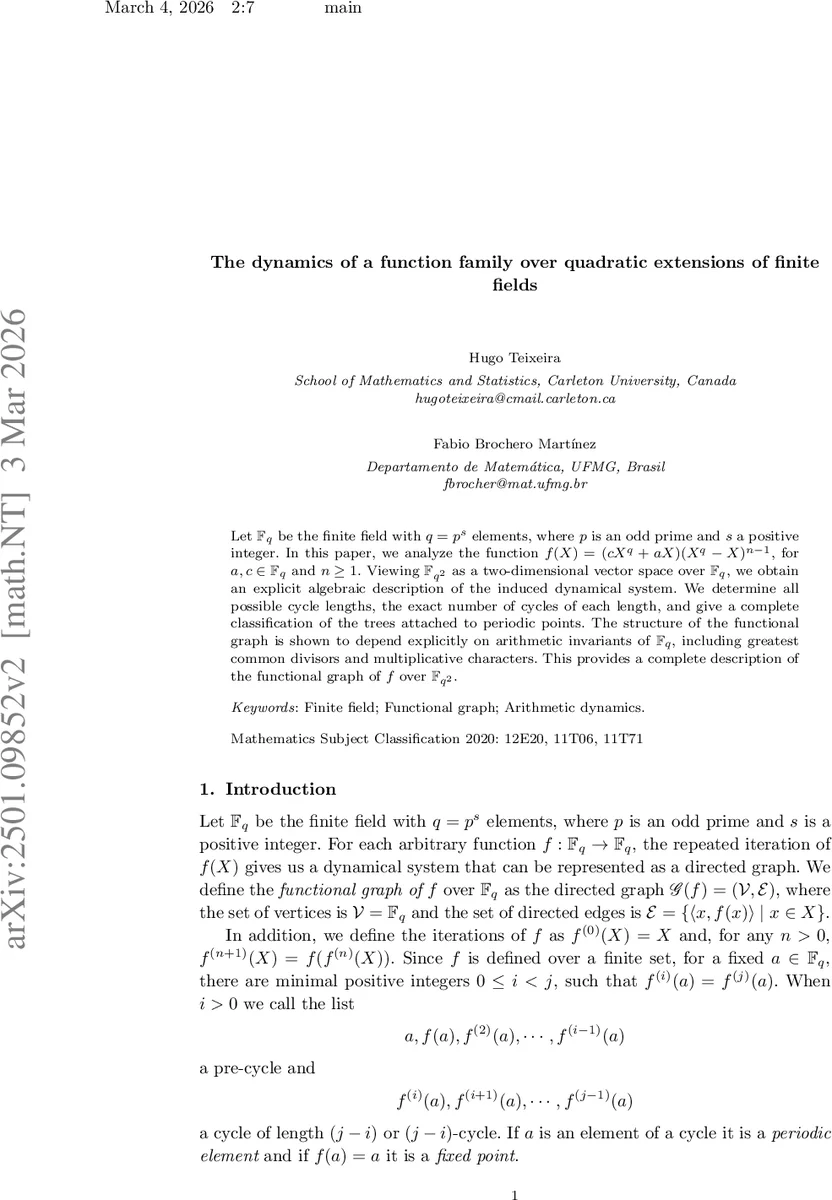
Let $\mathbb{F}_q$ be the finite field with $q=p^s$ elements, where $p$ is an odd prime and $s$ a positive integer. In this paper, we define the function $f(X)=(cX^q+aX)(X^{q}-X)^{n-1}$, for $a,c\in\mathbb{F}q$ and $n\geq 1$. We study the dynamics of the function $f(X)$ over the finite field $\mathbb{F}{q^2}$, determining cycle lengths and number of cycles. We also show that all trees attached to cyclic elements are isomorphic, with the exception of the tree hanging from zero. We also present the general shape of such hanging trees, which concludes the complete description of the functional graph of $f(X)$. Let $\mathbb{F}_q$ be the finite field with $q=p^s$ elements, where $p$ is an odd prime and $s$ a positive integer. In this paper, we analyze the function $f(X)=(cX^q+aX)(X^{q}-X)^{n-1}$, for $a,c\in\mathbb{F}q$ and $n\geq 1$. Viewing $\mathbb{F}{q^2}$ as a two-dimensional vector space over $\mathbb{F}_q$, we obtain an explicit algebraic description of the induced dynamical system. We determine all possible cycle lengths, the exact number of cycles of each length, and give a complete classification of the trees attached to periodic points. The structure of the functional graph is shown to depend explicitly on arithmetic invariants of $\mathbb{F}q$, including greatest common divisors and multiplicative characters. This provides a complete description of the functional graph of $f$ over $\mathbb{F}{q^2}$.
💡 Research Summary
The paper investigates the dynamics of the family of functions
\
Comments & Academic Discussion
Loading comments...
Leave a Comment