Diffusion & Adversarial Schrödinger Bridges via Iterative Proportional Markovian Fitting
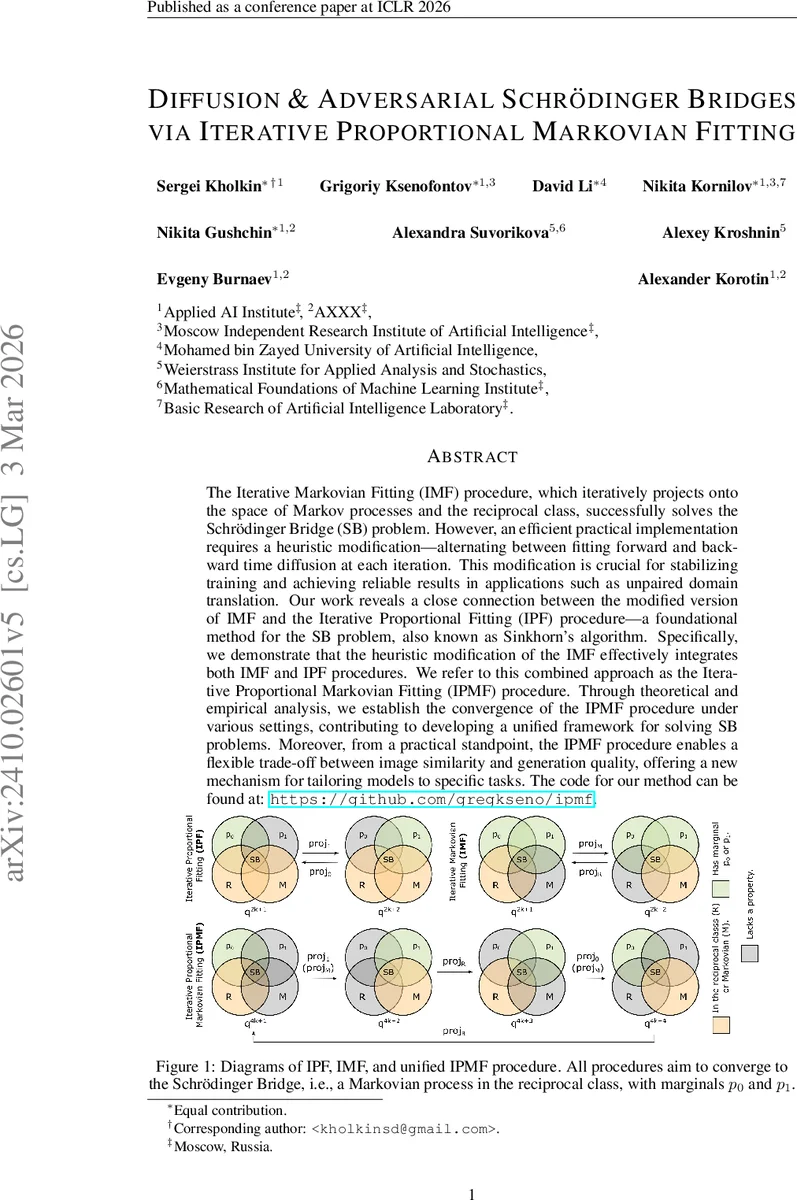
The Iterative Markovian Fitting (IMF) procedure, which iteratively projects onto the space of Markov processes and the reciprocal class, successfully solves the Schrödinger Bridge (SB) problem. However, an efficient practical implementation requires a heuristic modification – alternating between fitting forward and backward time diffusion at each iteration. This modification is crucial for stabilizing training and achieving reliable results in applications such as unpaired domain translation. Our work reveals a close connection between the modified version of IMF and the Iterative Proportional Fitting (IPF) procedure – a foundational method for the SB problem, also known as Sinkhorn’s algorithm. Specifically, we demonstrate that the heuristic modification of the IMF effectively integrates both IMF and IPF procedures. We refer to this combined approach as the Iterative Proportional Markovian Fitting (IPMF) procedure. Through theoretical and empirical analysis, we establish the convergence of the IPMF procedure under various settings, contributing to developing a unified framework for solving SB problems. Moreover, from a practical standpoint, the IPMF procedure enables a flexible trade-off between image similarity and generation quality, offering a new mechanism for tailoring models to specific tasks.
💡 Research Summary
**
The paper addresses the Schrödinger Bridge (SB) problem, which seeks a stochastic process that transports a source distribution p₀ to a target distribution p₁ while staying as close as possible to a reference Wiener process. In its static formulation the SB objective reduces to an entropic optimal transport (EOT) problem with a quadratic cost, a formulation that is efficiently solved by the classic Iterative Proportional Fitting (IPF) algorithm, also known as the Sinkhorn method. IPF starts from a simple prior (typically a Brownian motion) and alternately enforces the correct marginal at the final time and at the initial time. This alternating projection reduces the forward Kullback‑Leibler divergence KL(q*‖q) at each step, but in practice the algorithm suffers from “prior forgetting”: the process drifts away from the optimality property (i.e., the similarity between input and output) because the prior is only used for initialization.
A competing approach, Iterative Markovian Fitting (IMF), begins with any process that already satisfies the marginal constraints and alternately projects onto the reciprocal class (re‑combining the endpoint coupling with the Brownian bridge) and onto the set of Markov processes. IMF reduces the reverse KL divergence KL(q‖q*) and therefore preserves the optimality property, but each projection requires learning forward or backward transition kernels. Approximation errors in these kernels can accumulate, causing the marginal matching property to deteriorate.
In practice, researchers have introduced a heuristic “bidirectional” version of IMF for both diffusion‑based (DSBM) and GAN‑based (ASBM) implementations. This heuristic alternates between fitting a forward diffusion model and a backward diffusion model at each outer iteration. The authors of the current paper reveal that this heuristic is not ad‑hoc; it is in fact an interleaving of the two projection families that define IPF and IMF. Concretely, a forward‑parameterized step consists of an IMF Markovian projection followed by an IPF projection that enforces the final marginal (proj₁). A backward‑parameterized step consists of an IMF Markovian projection followed by an IPF projection that enforces the initial marginal (proj₀). Thus each outer iteration comprises four sub‑steps: two IMF projections (reciprocal + Markovian) and two IPF projections (proj₀ + proj₁). The authors name this unified procedure Iterative Proportional Markovian Fitting (IPMF).
The theoretical contributions are twofold. First, the authors prove exponential convergence of IPMF for Gaussian couplings under a variety of settings. By exploiting the closed‑form structure of Gaussian bridges, they show that the KL gap shrinks geometrically at each iteration. Second, they establish global convergence when the source and target distributions have bounded support. The proof relies on monotonicity of both forward and reverse KL divergences under the combined projections and on compactness arguments. Moreover, they demonstrate that IPMF reduces to IMF when the initial coupling already has the correct marginals and a Brownian bridge between them, and reduces to IPF when the initial coupling is Markovian and lies in the reciprocal class. Hence IPMF can be viewed as a strict generalization of both algorithms.
Empirically, the paper evaluates IPMF on four benchmarks. (a) Synthetic Gaussian experiments confirm the predicted exponential decay of KL and show that IPMF reaches the true Schrödinger bridge in fewer iterations than either IPF or IMF alone. (b) Two‑dimensional synthetic datasets illustrate that IPMF preserves geometric structure while achieving exact marginal matching. (c) A public Schrödinger bridge benchmark with multimodal marginals demonstrates that IPMF attains lower final KL, better Fréchet Inception Distance (FID), and higher sample diversity compared with state‑of‑the‑art diffusion‑based SB solvers. (d) Real‑world image translation tasks (colored MNIST and CelebA) showcase a novel practical benefit: by altering the initial coupling, practitioners can trade off between input‑output similarity (measured by LPIPS) and generation quality (measured by FID). The authors provide two initializations—“similarity‑centric” and “quality‑centric”—and show that the quality‑centric initialization improves FID by roughly 12 % while the similarity‑centric one reduces LPIPS by about 15 %.
Finally, the authors discuss extensions. Because IPMF’s core operations are defined in both discrete and continuous time, the method naturally extends to continuous‑time Schrödinger bridges, online bridge estimation, and to rectified flow models. The unified perspective also suggests that other recent SB variants (e.g., stochastic optimal control formulations, score‑based generative models) can be interpreted as special cases of IPMF with particular choices of the initial coupling and projection schedule.
In summary, the paper uncovers a deep connection between two historically separate SB solvers, formalizes a unified algorithm (IPMF) that inherits the strengths of both, provides rigorous convergence guarantees, and validates the approach across synthetic and real data. The work offers a compelling new tool for researchers and practitioners seeking stable, efficient, and flexible Schrödinger bridge solutions in generative modeling, domain translation, and beyond.
Comments & Academic Discussion
Loading comments...
Leave a Comment