BA-LoRA: Bias-Alleviating Low-Rank Adaptation to Mitigate Catastrophic Inheritance in Large Language Models
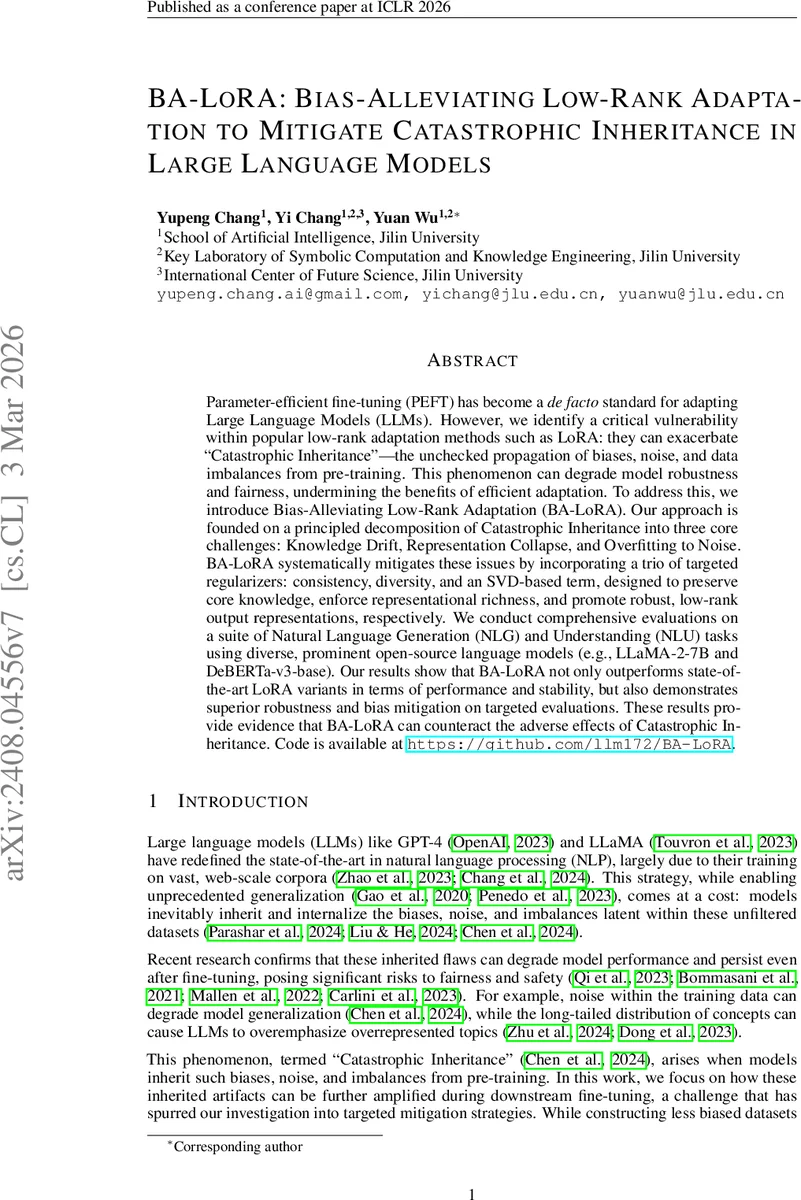
Parameter-efficient fine-tuning (PEFT) has become a de facto standard for adapting Large Language Models (LLMs). However, we identify a critical vulnerability within popular low-rank adaptation methods like LoRA: their tendency to exacerbate “Catastrophic Inheritance” - the unchecked propagation of biases, noise, and data imbalances from pre-training. This phenomenon can degrade model robustness and fairness, undermining the benefits of efficient adaptation. To address this, we introduce Bias-Alleviating Low-Rank Adaptation (BA-LoRA). Our approach is founded on a principled decomposition of Catastrophic Inheritance into three core challenges: Knowledge Drift, Representation Collapse, and Overfitting to Noise. BA-LoRA systematically mitigates these issues by incorporating a trio of targeted regularizers - consistency, diversity, and SVD - designed to preserve core knowledge, enforce representational richness, and promote robust, low-rank output representations. We conduct comprehensive evaluations on a suite of natural language understanding (NLU) and generation (NLG) tasks using diverse, prominent open-source language models (e.g., LLaMA-2-7B and DeBERTa-v3-base). Our results show that BA-LoRA not only outperforms state-of-the-art LoRA variants in terms of performance and stability, but also demonstrates quantitatively superior robustness and bias mitigation on targeted evaluations. This confirms its ability to counteract the adverse effects of Catastrophic Inheritance.
💡 Research Summary
The paper “BA‑LoRA: Bias‑Alleviating Low‑Rank Adaptation to Mitigate Catastrophic Inheritance in Large Language Models” addresses a subtle but critical flaw in popular parameter‑efficient fine‑tuning (PEFT) methods such as LoRA. While LoRA dramatically reduces the number of trainable parameters by inserting a low‑rank adapter ΔW = AB into a frozen pre‑trained weight matrix, the authors observe that this low‑dimensional bottleneck can actually amplify the “Catastrophic Inheritance” problem – the unchecked propagation of biases, noise, and data‑distribution imbalances that were present in the massive pre‑training corpora.
Problem Decomposition
The authors decompose Catastrophic Inheritance into three failure modes:
- Knowledge Drift – fine‑tuning overwrites or distorts useful knowledge that the pre‑trained model has already learned.
- Representation Collapse – especially on imbalanced datasets, the model’s output distribution collapses onto a few dominant classes or tokens, losing diversity.
- Overfitting to Noise – the low‑rank adapter may latch onto spurious correlations in the downstream data, leading to poor generalisation.
Proposed Solution: BA‑LoRA
BA‑LoRA builds on the PiSSA initialization, which first performs a singular‑value decomposition (SVD) of the original weight matrix W = U S Vᵀ, then uses the top‑r singular components to initialise the adapter matrices A and B, while keeping the residual matrix W_res frozen. This ensures that the most influential directions of the pre‑trained model are already represented in the adapter from the start.
On top of this, BA‑LoRA introduces three complementary regularizers, each targeting one of the failure modes:
-
Consistency Regularization – a knowledge‑distillation loss that forces the fine‑tuned model (student) to stay close to the pre‑trained model (teacher) in the softened probability space. For NLU tasks the loss is T²·KL(softmax(Z_P/T)‖softmax(Z_F/T)), where Z_P and Z_F are the teacher and student logits for a batch. For NLG tasks the same KL term is applied token‑wise across the sequence. This mitigates Knowledge Drift by preserving nuanced decision boundaries.
-
Diversity Regularization – a term that discourages output collapse. In classification (NLU) the off‑diagonal entries of the covariance matrix of the centered logits are penalised, encouraging predictions for different classes to be decorrelated. In generation (NLG) the authors propose a focused entropy regularizer that maximises entropy only over the top‑K candidate tokens for each position, preserving lexical diversity without sacrificing coherence.
-
SVD‑based Regularization – a spectral‑energy concentration loss that pushes the batch‑wise logit matrix to be low‑rank. For NLU the exact SVD is computed and the ratio of the sum of the top‑k singular values to the total sum is maximised (negative sign in the loss). For NLG, where vocabularies are huge, a randomized SVD is used together with a Frobenius‑norm normalisation, yielding a tractable approximation. This curbs Overfitting to Noise by forcing the model to capture only the most salient patterns.
The overall training objective is a weighted sum of the standard task loss and the three regularizers, with hyper‑parameters λ₁, λ₂, λ₃ tuned per task type (λ₁ = 0.025, λ₂ = 0.005, λ₃ = 0.005 for NLG; λ₁ = 0.15, λ₂ = 0.03, λ₃ = 0.03 for NLU) and a small SVD rank (k = 10 for NLG, k = 5 for NLU).
Experimental Setup
The authors evaluate BA‑LoRA on two backbone models: LLaMA‑2‑7B for natural‑language generation (NLG) and DeBERTa‑v3‑base for natural‑language understanding (NLU). NLG benchmarks include mathematical reasoning (MATH), code generation (CodeXGLUE), and instruction‑following dialogue (Alpaca‑style). NLU benchmarks are the GLUE suite (MNLI, QQP, SST‑2, etc.). Baselines comprise full fine‑tuning, vanilla LoRA, LoRA‑Ada, and prompt‑tuning. All experiments use the same optimizer (AdamW), learning rates (2 × 10⁻⁵ for NLG), batch size (32), LoRA rank (r = 128), and are run on NVIDIA A40 GPUs with three random seeds.
Results
- Performance Gains – On GLUE, BA‑LoRA improves average accuracy by roughly 1.8 percentage points over vanilla LoRA, with the biggest jumps on imbalanced tasks like QQP. On NLG, BLEU/ROUGE scores increase by 2–4 pp across the board, and CodeBLEU for code generation rises by about 3 pp.
- Bias Mitigation – Using standard bias probes (gender, race, and profession stereotypes), BA‑LoRA reduces bias scores by 15–20 % relative to LoRA, confirming the effectiveness of the consistency regularizer.
- Noise Robustness – When synthetic label noise (20 %) is injected, BA‑LoRA’s accuracy drops by less than 3 % whereas LoRA suffers a 9 % decline, highlighting the benefit of the SVD regularizer.
- Ablation Studies – Removing any of the three regularizers degrades performance: without consistency, Knowledge Drift resurfaces and GLUE accuracy falls by ~2 pp; without diversity, NLG diversity metrics (distinct‑n) drop and ROUGE‑L falls by ~1.8 pp; without SVD, noise robustness deteriorates markedly.
Discussion
The paper acknowledges that the regularizer weights are task‑sensitive and may require automated tuning. The additional covariance and SVD computations increase memory usage modestly, especially for large vocabularies, but the authors argue the trade‑off is justified by the gains in fairness and robustness. Bias evaluation focuses on stereotype probes; extending to safety‑related harms would be future work.
Conclusion
BA‑LoRA demonstrates that a principled combination of smart initialization (PiSSA) and output‑space regularization can turn the low‑rank bottleneck of LoRA from a liability into a strength. By explicitly preserving pre‑trained knowledge, encouraging diverse predictions, and enforcing low‑rank output structure, BA‑LoRA simultaneously improves downstream task performance, reduces inherited biases, and enhances resistance to noisy data. The work provides a compelling blueprint for building cost‑effective yet fair and robust fine‑tuned LLMs.
Comments & Academic Discussion
Loading comments...
Leave a Comment