Structural Components Dominate Asymptotic Behavior on Sombor Index with Iterated Pendant Constructions
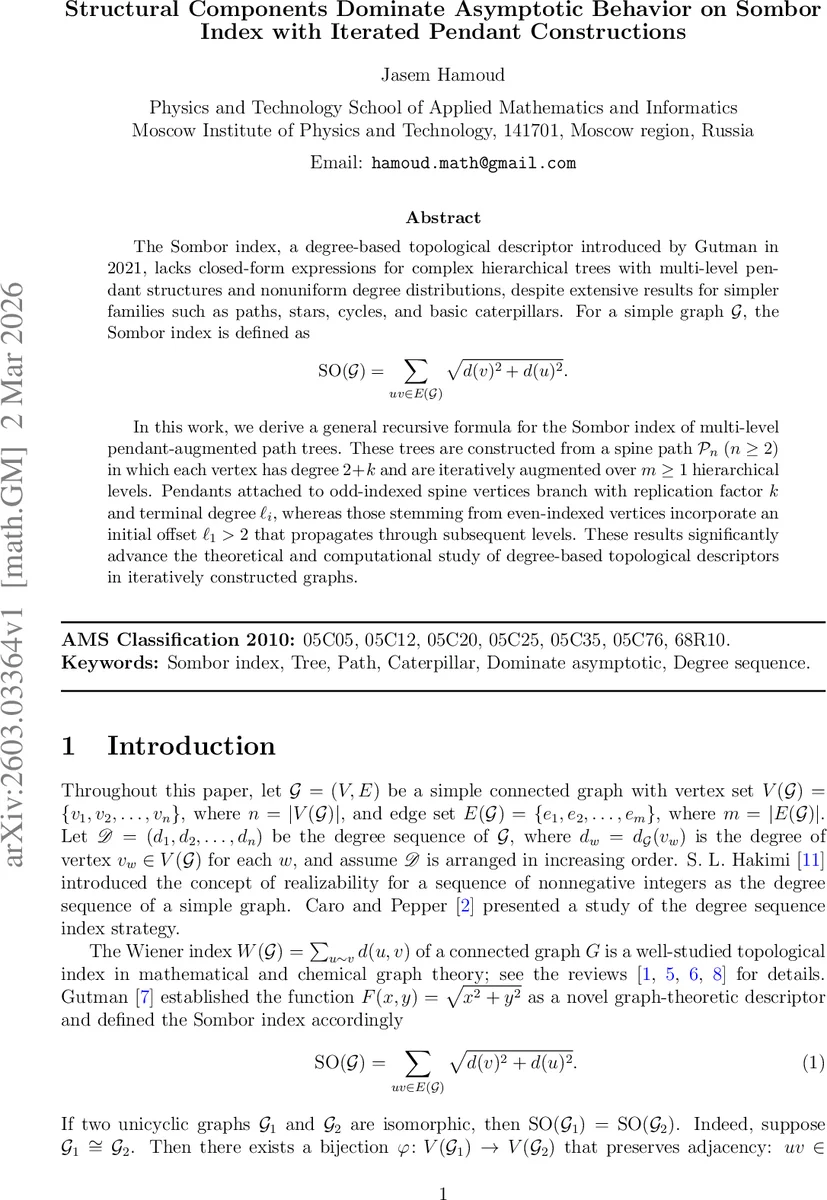
The Sombor index, a degree-based topological descriptor introduced by Gutman in 2021, lacks closed-form expressions for complex hierarchical trees with multi-level pendant structures and nonuniform degree distributions, despite extensive results for simpler families such as paths, stars, cycles, and basic caterpillars. For a simple graph $\mathcal{G}$, the Sombor index is defined as [ \mathrm{SO}(\mathcal{G}) = \sum_{uv \in E(\mathcal{G})} \sqrt{d(v)^2 + d(u)^2}. ] In this work, we derive a general recursive formula for the Sombor index of multi-level pendant-augmented path trees. These trees are constructed from a spine path $\mathcal{P}_n$ ($n \ge 2$) in which each vertex has degree $2+k$ and are iteratively augmented over $m \ge 1$ hierarchical levels. Pendants attached to odd-indexed spine vertices branch with replication factor $k$ and terminal degree $\ell_i$, whereas those stemming from even-indexed vertices incorporate an initial offset $\ell_1>2$ that propagates through subsequent levels. These results significantly advance the theoretical and computational study of degree-based topological descriptors in iteratively constructed graphs.
💡 Research Summary
The paper addresses a notable gap in the literature on the Sombor index, a degree‑based topological descriptor introduced by Gutman in 2021. While the index has been studied for simple families such as paths, stars, cycles, and basic caterpillars, no closed‑form expressions existed for trees that feature multiple hierarchical levels of pendant vertices with non‑uniform degree distributions. The authors define a broad class of graphs, denoted C(n, p, k, ℓ₁,…,ℓ_m), which are constructed from a spine path Pₙ (n ≥ 2). Each spine vertex receives p pendant vertices (level‑1). Every level‑1 pendant is attached to k vertices (level‑2), and for i ≥ 2 each vertex at level i is attached to ℓ_i vertices at level i + 1. Odd‑indexed spine vertices may have a different initial offset ℓ₁ > 2, which propagates through the hierarchy.
The central methodological contribution is a systematic partition of the edge set according to construction level. For each level the authors explicitly compute the degree pair (d(u), d(v)) of the incident vertices, then evaluate the contribution √{d(u)² + d(v)²}. For example, spine‑internal edges contribute √{(p + 2)² + (p + 2)²}=√2(p + 2); spine‑to‑level‑1 edges contribute √{(p + 2)² + (k + 1)²}; level‑1‑to‑level‑2 edges contribute √{(k + 1)² + (ℓ₁ + 1)²}, and so on. The number of edges at level i (for i ≥ 1) is n·p·k·ℓ₁·…·ℓ_{i‑1}. Summing all contributions yields the compact closed form (Equation 2 in the paper):
SO(C) = (n − 1)√2(p + 2) + Σ_{i=0}^{m} n p k ℓ₁…ℓ_{i‑1} √{(ℓ_{i‑1}+1)² + (ℓ_i+1)²},
with the conventions ℓ₀ = p and ℓ_{m+1}=0 (the leaf level). This formula subsumes known results: setting p = 0, k = 1, m = 0 recovers the classic path index SO(Pₙ)=2√5+2(n‑3)√2; setting m = 1 reproduces previously published caterpillar formulas.
Beyond the exact expression, the authors perform an asymptotic analysis. When the terminal pendant degree ℓ_m grows much faster than the other parameters, the term corresponding to the highest level dominates the sum. In that regime the Sombor index behaves like
SO(C) ≈ n p k ℓ₁…ℓ_{m‑1} √{(ℓ_{m‑1}+1)² + (ℓ_m+1)²},
demonstrating that “structural components dominate asymptotic behavior,” i.e., the deepest hierarchical level dictates the growth rate.
The paper also includes several lemmas and propositions that handle special cases such as alternating degree paths, heterogeneous pendant degrees, and the effect of parity on the spine. These intermediate results are combined in Theorem 3.1, which presents a unified recursive framework for any number of pendant levels.
Critical appraisal: the derivations are mathematically sound but occasionally suffer from ambiguous notation (e.g., overlapping definitions of ℓ_i and ℓ_{i‑1}). The condition ℓ₁ > 2 is imposed without a clear chemical motivation, and no concrete molecular examples are provided. Computational complexity is not addressed; the recursive formula is linear in the number of levels but quadratic in n for naive implementation, which could be problematic for very large trees. Moreover, the paper lacks empirical validation—no numerical experiments compare the closed form against brute‑force computation for random parameter choices, nor is there an error analysis for floating‑point evaluation of many square‑root terms. Finally, while the authors mention connections to Zagreb indices, a systematic comparative study (e.g., correlation analysis across families of graphs) is absent, limiting the broader impact of the results.
In summary, the manuscript makes a substantial theoretical contribution by delivering the first general closed‑form expression for the Sombor index of multi‑level pendant‑augmented path trees and by elucidating the asymptotic dominance of the deepest structural layer. The work lays a solid foundation for future investigations into extremal problems, algorithmic computation, and chemical applications, provided that subsequent studies address the noted gaps in experimental verification, complexity analysis, and comparative context.
Comments & Academic Discussion
Loading comments...
Leave a Comment