Rapid jet ejection from PKS 0215+015 coincident with a high-energy neutrino event
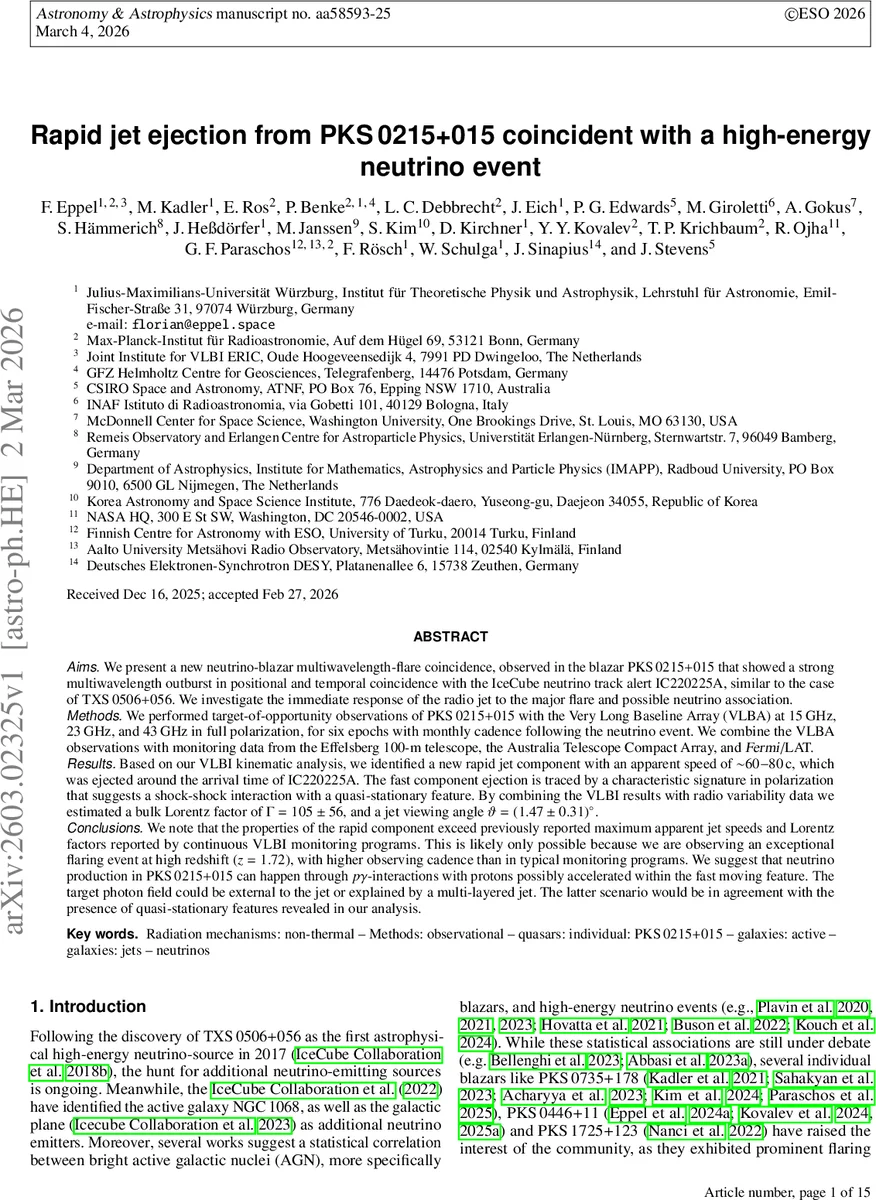
Aims. We present a new neutrino-blazar multiwavelength flare coincidence observed in the blazar PKS 0215+015, which showed a strong multiwavelength outburst in coincidence with the IceCube neutrino track alert IC220225A, similar to the case of TXS 0506+056. We investigate the immediate response of the radio jet to the major flare. Methods. We performed target-of-opportunity observations with the Very Long Baseline Array (VLBA) at 15, 23, and 43 GHz in full polarization for six epochs with monthly cadence following the neutrino event. We combine the VLBA observations with monitoring data from the Effelsberg 100-m telescope, the Australia Telescope Compact Array, and Fermi/LAT. Results. Based on our VLBI kinematic analysis, we identified a new rapid jet component with an apparent speed of ~60-80c, which was ejected around the arrival of IC220225A. The fast component ejection is traced by a characteristic signature in polarization that suggests a shock-shock interaction with a quasi-stationary feature. By combining the VLBI results with radio variability data, we estimated a bulk Lorentz factor of $Γ= 105 \pm 56$ and a jet viewing angle of $\vartheta = (1.47 \pm 0.31)^\circ$. Conclusions. We note that the properties of the rapid component exceed previously reported maximum apparent jet speeds and Lorentz factors from continuous VLBI monitoring programs. This is likely only possible because we are observing an exceptional flaring event at high redshift (z=1.72) with higher observing cadence than in typical monitoring programs. We suggest that neutrino production in PKS 0215+015 can occur through pγ-interactions with protons possibly accelerated within the fast-moving feature. The target photon field could be external to the jet or explained by a multi-layered jet. The latter scenario is consistent with the presence of quasi-stationary features revealed in our analysis.
💡 Research Summary
The paper reports a multi‑messenger study of the flat‑spectrum radio quasar PKS 0215+015, which underwent a dramatic multi‑wavelength outburst coincident with the IceCube high‑energy neutrino track event IC220225A (detected on 2022‑02‑25). By cross‑matching the IceCube localization (both AMON and GCN “box”) with the 4FGL‑DR3 gamma‑ray catalog and the Radio Fundamental Catalog, the authors identify PKS 0215+015 as the only bright gamma‑ray source within the error region, making it the prime candidate for a neutrino counterpart.
To probe the jet response, they triggered a target‑of‑opportunity (ToO) VLBA campaign at 15, 23, and 43 GHz, acquiring six epochs with roughly monthly cadence starting 2022‑03‑24. Data were calibrated with the rPICARD pipeline, including full‑polarization calibration via PolSolve and absolute EVP‑A alignment using BL Lac as a calibrator. Single‑dish fluxes from the TELAMON program were used to rescale the VLBI amplitudes, correcting for pointing and self‑calibration losses (up to ~90 % at 43 GHz). The final flux density uncertainty was set to 5 %.
Model fitting with circular Gaussian components (DIFMAP) and error estimation (VCAT) revealed a compact core plus a quasi‑stationary feature to the east. A new moving component (Component 1) emerged from the core shortly before the neutrino arrival. Its proper motion of 0.78–1.04 mas yr⁻¹ translates, given the adopted cosmology (1 mas yr⁻¹ ≈ 77 c at z = 1.72), into an apparent speed of 60–80 c. Polarization maps show a sharp rotation of the electric‑vector position angle and a spike in linear polarization when Component 1 passes the stationary feature, a signature interpreted as a shock‑shock interaction that can efficiently accelerate particles.
Combining VLBI kinematics with single‑dish radio variability (Effelsberg, ATCA, TELAMON) the authors estimate a variability timescale and use standard synchrotron‑self‑Compton arguments to derive a bulk Lorentz factor Γ = 105 ± 56 and a viewing angle θ = 1.47° ± 0.31°. These values far exceed those reported by long‑term monitoring programs (e.g., MOJAVE, TANAMI), which typically find Γ ≲ 50 and β_app ≲ 30 c. The authors argue that the extreme speed is observable only because the flare occurred at high redshift (z = 1.72) and the dense VLBA cadence captured a transient event that would be missed in sparser surveys.
Regarding neutrino production, two scenarios are discussed. In the external‑photon model, the fast component traverses a dense photon field (broad‑line region or dusty torus), boosting the photon energy in the comoving frame and enabling efficient pγ interactions that produce PeV neutrinos. In the multi‑layer jet (spine‑sheath) model, the interaction between the fast spine and a slower sheath creates internal shocks that raise the photon density and accelerate protons, again allowing pγ processes. Both scenarios are compatible with the observed shock‑shock polarization signature and the presence of a quasi‑stationary feature.
The paper concludes that PKS 0215+015 provides the first clear case of an ultra‑fast VLBI jet component temporally linked to a high‑energy neutrino, supporting the idea that blazar jets can accelerate protons to energies sufficient for PeV neutrino production. It emphasizes the importance of high‑cadence, high‑frequency VLBI with full polarization for future multi‑messenger campaigns, and calls for continued monitoring across the electromagnetic spectrum to refine jet physics and particle acceleration models.
Comments & Academic Discussion
Loading comments...
Leave a Comment