Nonlinear Response Identities and Bounds for Nonequilibrium Steady States
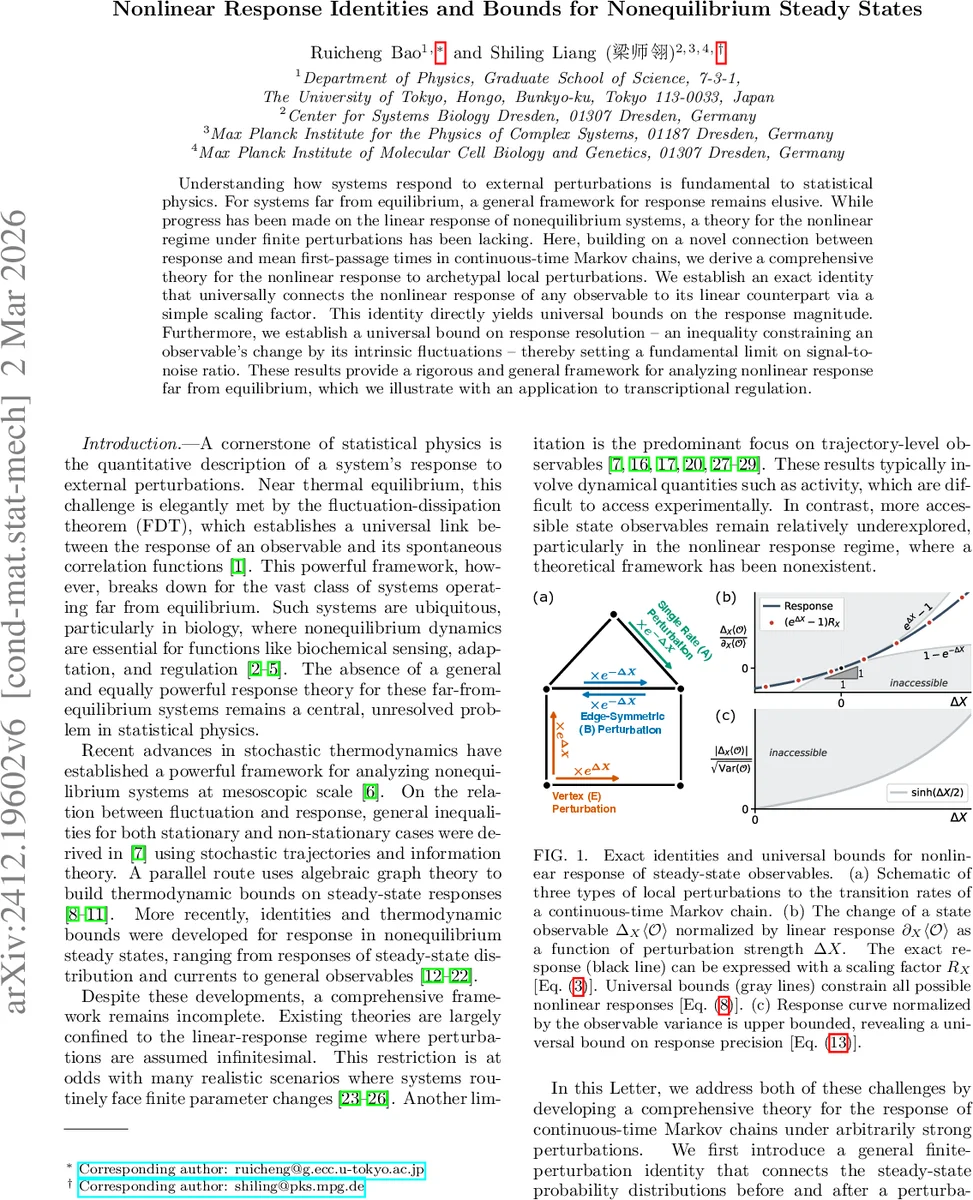
Understanding how systems respond to external perturbations is fundamental to statistical physics. For systems far from equilibrium, a general framework for response remains elusive. While progress has been made on the linear response of nonequilibrium systems, a theory for the nonlinear regime under finite perturbations has been lacking. Here, building on a novel connection between response and mean first-passage times in continuous-time Markov chains, we derive a comprehensive theory for the nonlinear response to archetypal local perturbations. We establish an exact identity that universally connects the nonlinear response of any observable to its linear counterpart via a simple scaling factor. This identity directly yields universal bounds on the response magnitude. Furthermore, we establish a universal bound on response resolution – an inequality constraining an observable’s change by its intrinsic fluctuations – thereby setting a fundamental limit on signal-to-noise ratio. These results provide a rigorous and general framework for analyzing nonlinear response far from equilibrium, which we illustrate with an application to transcriptional regulation.
💡 Research Summary
The paper addresses a long‑standing gap in statistical physics: a general theory for how nonequilibrium steady‑state (NESS) systems respond to finite, possibly large, perturbations. While linear response theory and fluctuation‑dissipation relations are well established near equilibrium, no comparable framework existed for the nonlinear regime far from equilibrium. By focusing on continuous‑time Markov jump processes, the authors derive exact relations that connect the steady‑state probability distribution before and after an arbitrary perturbation using mean first‑passage times (MFPTs) and the pseudoinverse of the generator.
Transition rates are parametrised in terms of three elementary local quantities: activation energies Aij (edge‑type), barrier heights Bij (symmetric edge‑type), and vertex well depths Ej (vertex‑type). Perturbing a single parameter X (which may be an A, B, or E type) yields exact expressions for the change in steady‑state probabilities (Eqs. 2a‑2c). These expressions involve local currents (ϕmn), edge currents (jmn), and the perturbed steady‑state probabilities themselves.
For any state observable O, the central result is the “nonlinear response identity” (Eq. 3):
ΔX⟨O⟩ / ΔX = RX · ∂X⟨O⟩,
where ΔX⟨O⟩ is the finite‑strength response, ∂X⟨O⟩ is the linear susceptibility, and the scaling factor RX depends only on the ratio of local quantities after and before the perturbation (RA = ϕ′mn/ϕmn, RB = j′mn/jmn, RE = π′m/πm). Remarkably, RX can be expressed analytically as
RX = e^{−ΔX} /
Comments & Academic Discussion
Loading comments...
Leave a Comment