Dual-Space Invariance as a Universal Criterion for Multifractal Critical States
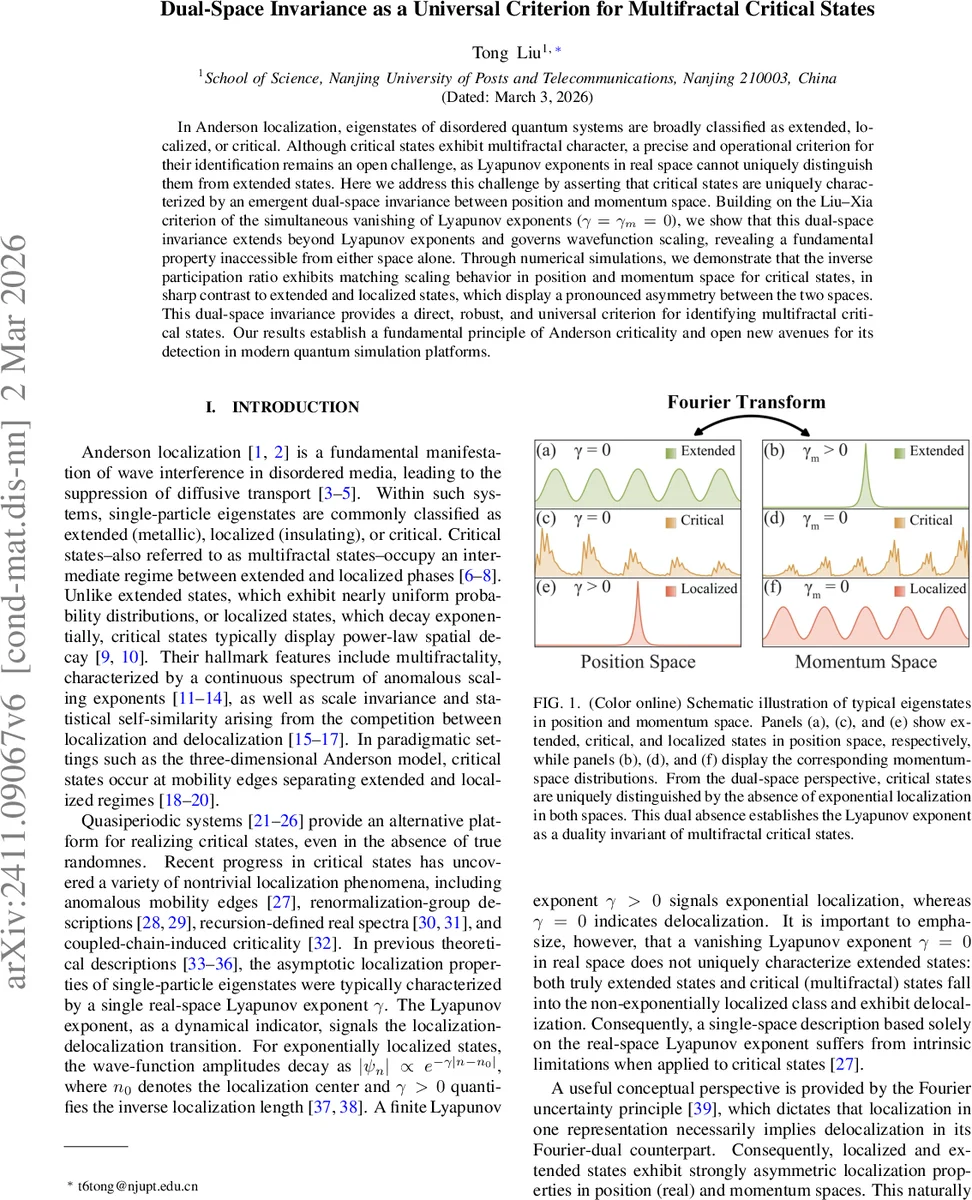
In Anderson localization, eigenstates of disordered quantum systems are broadly classified as extended, localized, or critical. Although critical states exhibit multifractal character, a precise and operational criterion for their identification remains an open challenge, as Lyapunov exponents in real space cannot uniquely distinguish them from extended states. Here we address this challenge by asserting that critical states are uniquely characterized by an emergent dual-space invariance between position and momentum space. Building on the Liu–Xia criterion of the simultaneous vanishing of Lyapunov exponents ($γ=γ_m=0$), we show that this dual-space invariance extends beyond Lyapunov exponents and governs wavefunction scaling, revealing a fundamental property inaccessible from either space alone. Through numerical simulations, we demonstrate that the inverse participation ratio exhibits matching scaling behavior in position and momentum space for critical states, in sharp contrast to extended and localized states, which display a pronounced asymmetry between the two spaces. This dual-space invariance provides a direct, robust, and universal criterion for identifying multifractal critical states. Our results establish a fundamental principle of Anderson criticality and open new avenues for its detection in modern quantum simulation platforms.
💡 Research Summary
The paper tackles a long‑standing problem in the theory of Anderson localization: how to unambiguously identify multifractal critical states, which sit between extended (metallic) and localized (insulating) phases. Traditional diagnostics rely on the real‑space Lyapunov exponent γ, which measures exponential decay of wave‑function amplitudes. While γ > 0 signals localization, γ = 0 includes both truly extended states and critical states, making it impossible to separate the two using a single‑space criterion.
Building on the Liu–Xia proposal, the authors introduce the concept of “dual‑space invariance.” They argue that critical states are uniquely characterized by the simultaneous vanishing of Lyapunov exponents in both position space (γ) and its Fourier‑dual momentum space (γₘ): γ = γₘ = 0. This condition reflects the fact that a critical wave function does not exhibit exponential localization in either representation; instead it displays power‑law decay and multifractal fluctuations. The paper formalizes this idea using the transfer‑matrix method and the Fourier uncertainty principle, showing that the dual‑space condition is a representation‑independent hallmark of criticality.
Because Lyapunov exponents are not directly measurable, the authors turn to the inverse participation ratio (IPR = ∑|ψₙ|⁴), a quantity widely used in both theory and experiment to quantify spatial confinement. Although IPR is basis‑dependent and therefore not strictly invariant under Fourier transformation, the authors demonstrate that for critical states the scaling of IPR in real space and its momentum‑space counterpart IPRₘ coincide asymptotically: IPR ∼ IPRₘ. This “scaling‑level” dual‑space invariance provides a practical diagnostic: extended states show IPR ∝ L⁻¹ while IPRₘ remains finite, localized states show the opposite asymmetry, and only critical states exhibit comparable scaling exponents in both spaces.
The theoretical claims are substantiated with extensive numerical simulations on two paradigmatic quasiperiodic models. The first is the Aubry‑André‑Harper (AAH) model, which is self‑dual at V = 2. Using Avila’s global theory, the authors compute γ = ln(V/2) and γₘ = ln(2/V), confirming that both vanish exactly at the self‑dual point, thereby reproducing the known multifractal spectrum. The second model is the Liu–Xia Quasiperiodic‑Nonlinear‑Eigenproblem (QNE), a non‑Hermitian system lacking any self‑duality. Despite its complexity, the authors analytically derive γ and γₘ from the real‑space and momentum‑space formulations and find that they become equal (and zero) over an extended parameter range 0 < V ≤ 2. This demonstrates that the dual‑space criterion works even when traditional self‑duality arguments fail.
For both models the authors calculate IPR and IPRₘ across system sizes up to L ≈ 2000. At criticality the two quantities collapse onto the same power‑law curve, while away from criticality they diverge dramatically, confirming the proposed scaling symmetry. The numerical data thus validate the dual‑space invariance of both Lyapunov exponents and IPR scaling as universal signatures of multifractal criticality.
In summary, the work establishes a robust, universal criterion—simultaneous vanishing of Lyapunov exponents and matching IPR scaling in position and momentum spaces—for identifying multifractal critical states. This criterion overcomes the ambiguities of single‑space diagnostics, applies to both self‑dual and non‑self‑dual systems, and is experimentally accessible through measurements of participation ratios in cold‑atom, photonic, or superconducting‑qubit platforms. The authors’ findings therefore provide a new foundational principle for Anderson criticality and open concrete pathways for its detection in modern quantum simulators.
Comments & Academic Discussion
Loading comments...
Leave a Comment