Trace methods for stable categories I: The linear approximation of algebraic K-theory
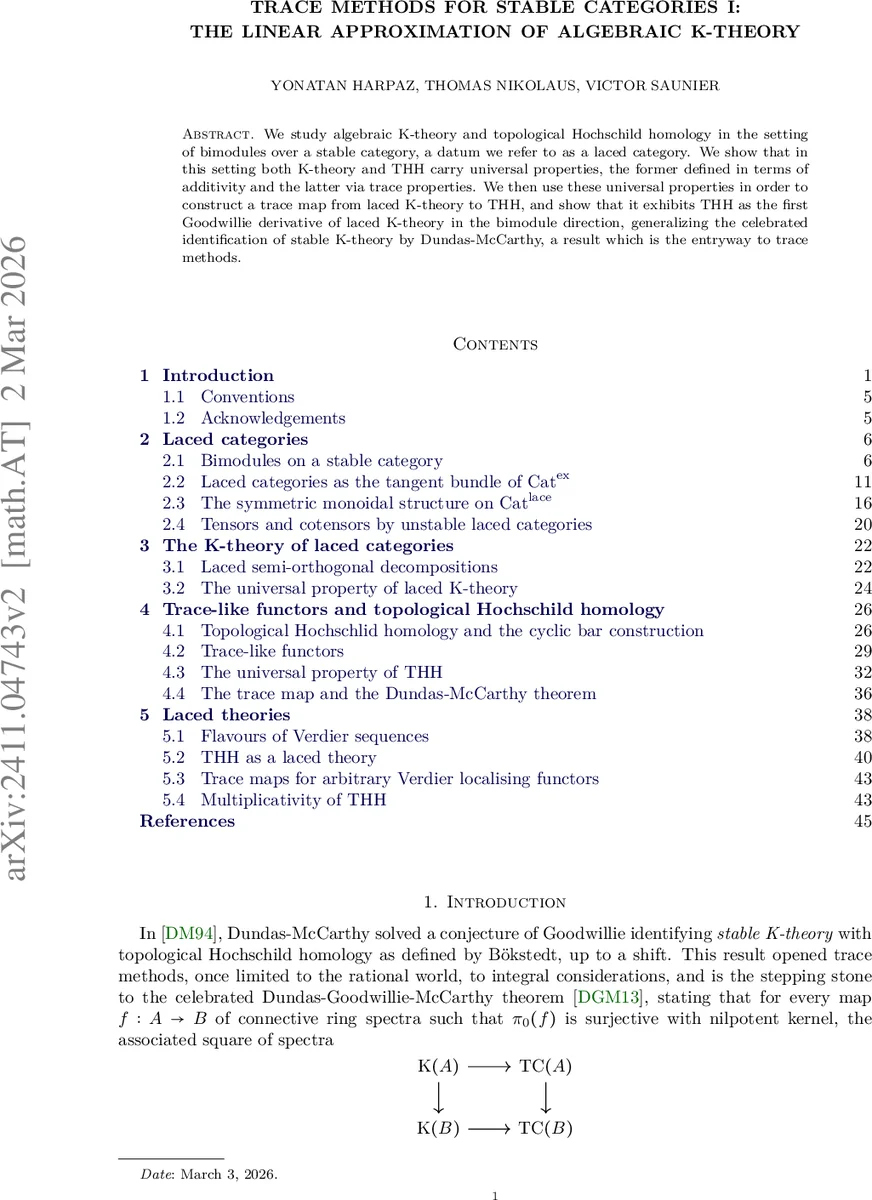
We study algebraic K-theory and topological Hochschild homology in the setting of bimodules over a stable category, a datum we refer to as a laced category. We show that in this setting both K-theory and THH carry universal properties, the former defined in terms of additivity and the latter via trace properties. We then use these universal properties in order to construct a trace map from laced K-theory to THH, and show that it exhibits THH as the first Goodwillie derivative of laced K-theory in the bimodule direction, generalizing the celebrated identification of stable K-theory by Dundas-McCarthy, a result which is the entryway to trace methods.
💡 Research Summary
The paper develops a unified categorical framework for algebraic K‑theory and topological Hochschild homology (THH) by introducing the notion of a “laced category”, a pair (C,M) consisting of a stable ∞‑category C together with a bimodule M: C^op × C → Sp. The authors first identify the tangent bundle of the ∞‑category of stable categories, T Cat^ex, with the ∞‑category of such pairs. They prove that the construction Lace(C,M) – the category of M‑laced objects (X,f:X→M(X)) – provides the stabilization of the over‑category Cat^ex/C, establishing an equivalence BiMod(C) ≃ Sp(Cat^ex/C).
Using this identification, they define laced K‑theory K_lace(C,M) := K(Lace(C,M)), where K denotes the Barwick‑Gepner‑Tabuada K‑theory functor. They show that the natural transformation Σ^∞_+ Lace ⇒ K_lace is initial among additive invariants on T Cat^ex, giving K_lace a universal additive property analogous to the classical universal property of K‑theory. The first Goodwillie derivative of K_lace, denoted Pgt₁K_lace, coincides with the stable K‑theory K_S(C,–), i.e. the exact approximation of K_lace in the sense of Goodwillie calculus.
For THH, they define an unstable version uTHH(C,M) as the co‑end ∫^X Ω^∞M(X,X) and then set THH(C,M) := Σ^∞ uTHH(C,M). They introduce the concept of “trace‑like” functors, those that invert strict trace equivalences generated by the simplicial objects (C,M)(
Comments & Academic Discussion
Loading comments...
Leave a Comment