Eigenvector decorrelation for random matrices
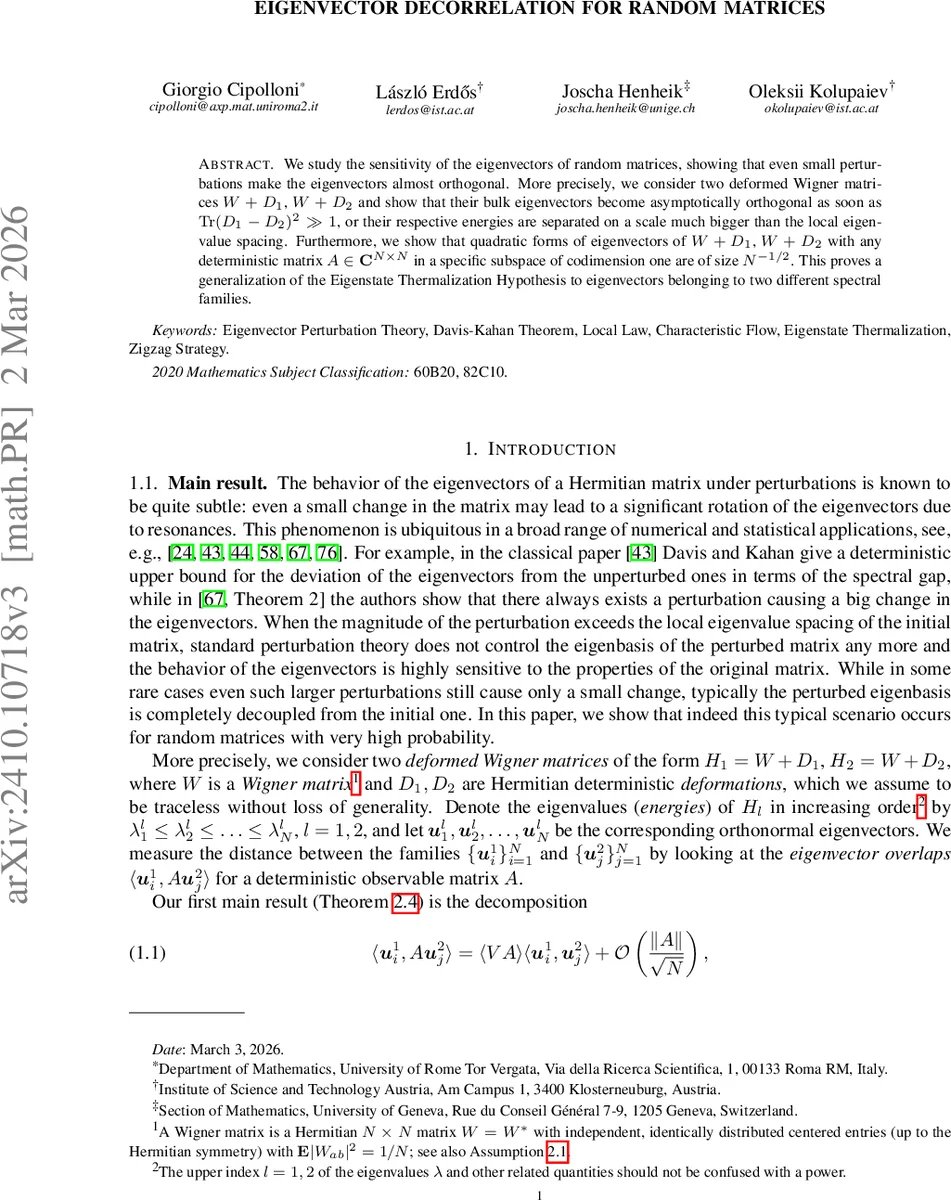
We study the sensitivity of the eigenvectors of random matrices, showing that even small perturbations make the eigenvectors almost orthogonal. More precisely, we consider two deformed Wigner matrices $W+D_1$, $W+D_2$ and show that their bulk eigenvectors become asymptotically orthogonal as soon as $\mathrm{Tr}(D_1-D_2)^2\gg 1$, or their respective energies are separated on a scale much bigger than the local eigenvalue spacing. Furthermore, we show that quadratic forms of eigenvectors of $W+D_1$, $W+D_2$ with any deterministic matrix $A\in\mathbf{C}^{N\times N}$ in a specific subspace of codimension one are of size $N^{-1/2}$. This proves a generalization of the Eigenstate Thermalization Hypothesis to eigenvectors belonging to two different spectral families.
💡 Research Summary
The paper investigates how the eigenvectors of random matrices respond to perturbations, focusing on two deformed Wigner ensembles (H_{1}=W+D_{1}) and (H_{2}=W+D_{2}). Here (W) is a standard Wigner matrix with independent, centered entries of variance (1/N), while (D_{1}) and (D_{2}) are deterministic Hermitian deformations assumed traceless for convenience. The authors study the overlap between eigenvectors of the two ensembles, measured by the quadratic form (\langle u^{(1)}{i}, A u^{(2)}{j}\rangle) for an arbitrary deterministic observable matrix (A).
The first main result (Theorem 2.4) provides a decomposition of this overlap: \
Comments & Academic Discussion
Loading comments...
Leave a Comment