Immigrant Women and the COVID-19 Pandemic: An Intersectional Analysis of Frontline Occupational Crowding in the United States
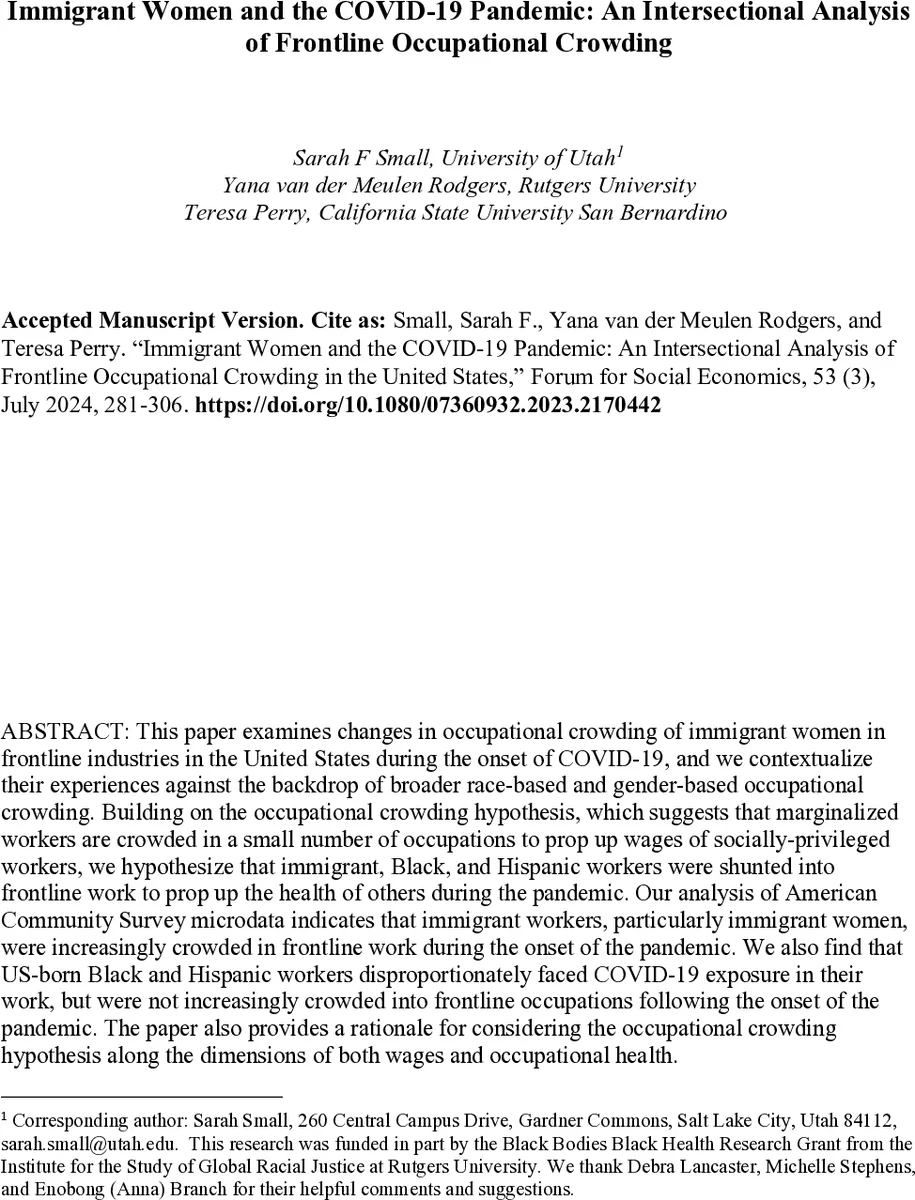
This paper examines changes in occupational crowding of immigrant women in frontline industries in the United States during the onset of COVID-19, and we contextualize their experiences against the backdrop of broader race-based and gender-based occupational crowding. Building on the occupational crowding hypothesis, which suggests that marginalized workers are crowded in a small number of occupations to prop up wages of socially-privileged workers, we hypothesize that immigrant, Black, and Hispanic workers were shunted into frontline work to prop up the health of others during the pandemic. Our analysis of American Community Survey microdata indicates that immigrant workers, particularly immigrant women, were increasingly crowded in frontline work during the onset of the pandemic. We also find that US-born Black and Hispanic workers disproportionately faced COVID-19 exposure in their work, but were not increasingly crowded into frontline occupations following the onset of the pandemic. The paper also provides a rationale for considering the occupational crowding hypothesis along the dimensions of both wages and occupational health.
💡 Research Summary
This paper investigates how occupational crowding— the concentration of marginalized workers in a limited set of jobs— changed for immigrant women in the United States during the early months of the COVID‑19 pandemic. Building on the classic occupational crowding hypothesis, which explains low wages for minority groups as a result of their over‑representation in a narrow occupational spectrum, the authors extend the framework to include occupational health risk. They argue that, in a public‑health crisis, employers and policymakers may deliberately channel immigrant, Black, and Hispanic workers into high‑exposure frontline occupations, thereby protecting the health of White and US‑born workers while preserving wage differentials.
Data and Methodology
The empirical analysis uses micro‑data from the American Community Survey (ACS) for 2019 and 2020, supplemented by Current Population Survey (CPS) data for 2021‑2022 to address potential under‑counting of Black and Hispanic respondents in the 2020 ACS. The authors construct an “occupational crowding index” for each four‑digit Standard Occupational Classification (SOC) group:
Crowding Index = (Share of immigrant workers in occupation j) ÷ (Share of all working‑age individuals with the education required for occupation j who are immigrants).
An index of 1 indicates proportional representation; values above 1 signal over‑representation (crowding), while values below 1 indicate under‑representation. To control for education, the authors calculate the 25th and 90th percentiles of educational attainment within each occupation and count only immigrants whose education falls within that range. The sample is restricted to ages 25‑64 to avoid confounding retirement or schooling effects. Frontline occupations are defined as six industry clusters that were essential during the pandemic and offered minimal opportunities for remote work or social distancing: (1) grocery, convenience, and drug stores; (2) public transit; (3) health care; (4) trucking, warehousing, and postal service; (5) building cleaning services; and (6) child care and social services.
Key Findings
- Immigrant Women’s Crowding Increases – The crowding index for immigrant workers overall rises between 2019 and 2020, with the most pronounced increase among immigrant women. This suggests that the surge in demand for essential services was met disproportionately by immigrant female labor.
- Black and Hispanic US‑Born Workers Face Exposure Without Additional Crowding – US‑born Black and Hispanic workers already held a high share of frontline jobs before the pandemic. Their crowding indices remain statistically unchanged, indicating that the pandemic amplified exposure risk for these groups without further concentrating them in additional occupations.
- Robustness Checks with CPS – Parallel analyses using CPS data for 2021‑2022 confirm the ACS patterns, mitigating concerns about under‑counting in the 2020 ACS.
Interpretation and Theoretical Contribution
The results validate an “occupational health crowding” extension of the traditional hypothesis: marginalized groups are not only squeezed into low‑wage jobs but also into high‑risk jobs during a health crisis. This dual crowding serves two functions for privileged groups: (a) it sustains wage differentials by limiting labor supply in higher‑pay occupations, and (b) it reduces the privileged groups’ exposure to disease, thereby protecting their health. The authors frame this as a form of structural discrimination rooted in stratification economics, where material benefits accrue to those in power through both economic and bodily protection.
Policy Implications
The paper recommends several interventions:
- Wage Increases for Frontline Workers – Raising pay would reduce the economic incentive for employers to rely on a cheap, exploitable immigrant labor pool.
- Enhanced Occupational Safety Standards – Mandatory protective equipment, paid sick leave, and health insurance would mitigate the health externalities imposed on marginalized workers.
- Legal Protections for Immigrant Workers – Extending labor rights and pathways to citizenship for undocumented and non‑citizen workers would diminish their vulnerability to employer abuse.
- Investment in Training and Up‑skilling – Providing immigrant women with access to education and credentialing can diversify their occupational options beyond frontline sectors.
Limitations and Future Research
The authors acknowledge that ACS does not distinguish undocumented status, potentially under‑representing the most vulnerable immigrants. Their education‑control method, while standard, cannot fully capture earlier educational discrimination (e.g., tracking of Black girls away from advanced math). Moreover, the definition of “frontline” may mask heterogeneity in exposure risk across occupations within the six industry clusters. Future work should track crowding dynamics beyond 2022, explore regional variation (state or metropolitan level), and examine the long‑term health outcomes for crowded workers.
Overall, the study offers a novel, intersectional perspective on how a public‑health emergency can exacerbate existing labor market inequities, linking wage suppression and health risk into a unified framework of occupational crowding.
Comments & Academic Discussion
Loading comments...
Leave a Comment