DA-VPC: Disturbance-Aware Visual Predictive Control Scheme of Docking Maneuvers for Autonomous Trolley Collection
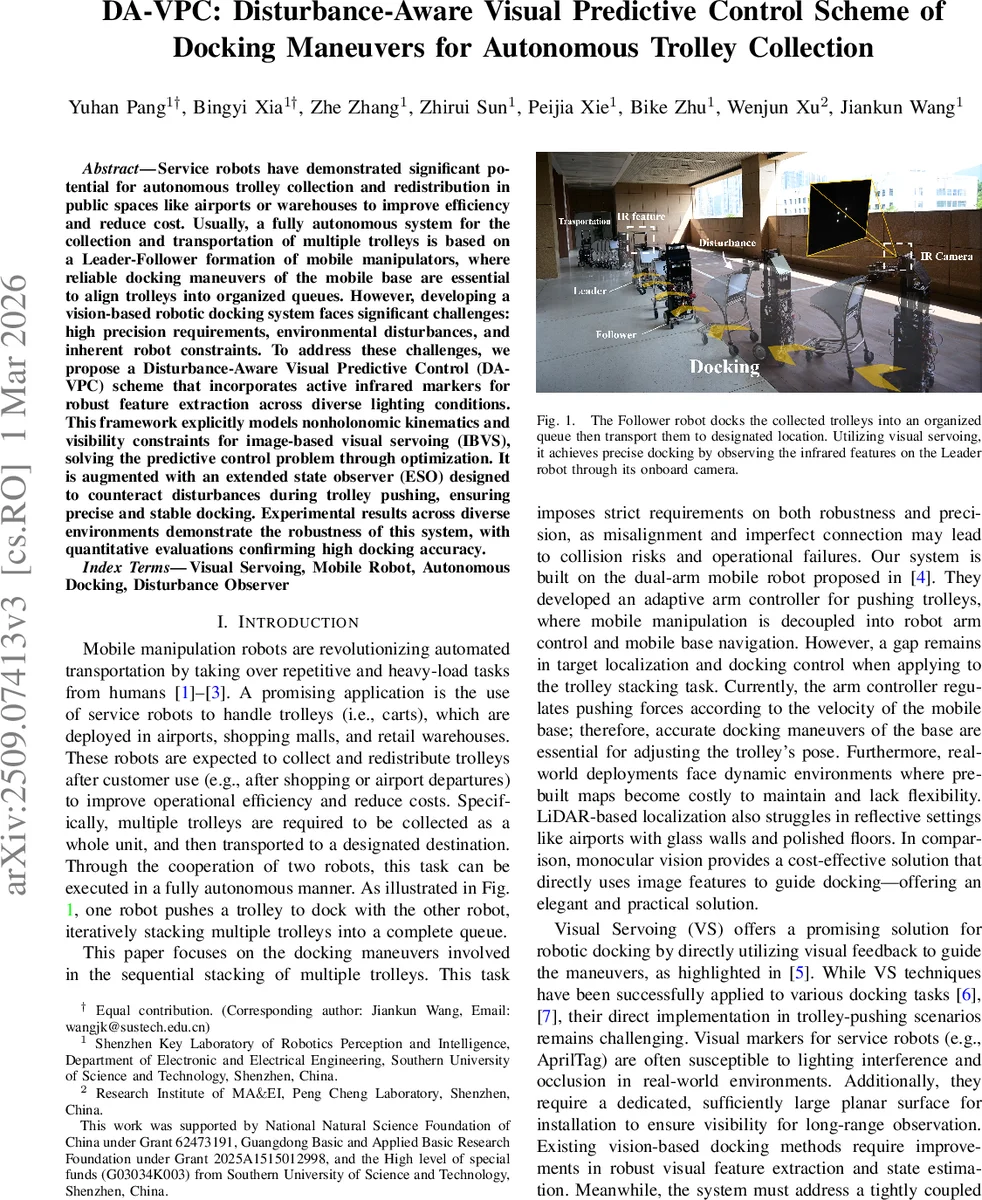
Service robots have demonstrated significant potential for autonomous trolley collection and redistribution in public spaces like airports or warehouses to improve efficiency and reduce cost. Usually, a fully autonomous system for the collection and transportation of multiple trolleys is based on a Leader-Follower formation of mobile manipulators, where reliable docking maneuvers of the mobile base are essential to align trolleys into organized queues. However, developing a vision-based robotic docking system faces significant challenges: high precision requirements, environmental disturbances, and inherent robot constraints. To address these challenges, we propose a Disturbance-Aware Visual Predictive Control (DA-VPC) scheme that incorporates active infrared markers for robust feature extraction across diverse lighting conditions. This framework explicitly models nonholonomic kinematics and visibility constraints for image-based visual servoing (IBVS), solving the predictive control problem through optimization. It is augmented with an extended state observer (ESO) designed to counteract disturbances during trolley pushing, ensuring precise and stable docking. Experimental results across diverse environments demonstrate the robustness of this system, with quantitative evaluations confirming high docking accuracy.
💡 Research Summary
The paper addresses the problem of autonomous trolley collection and redistribution in public indoor spaces such as airports, shopping malls, and warehouses, where a leader‑follower formation of two mobile manipulators is used to stack multiple trolleys into an organized queue. Traditional docking solutions rely heavily on global localization (e.g., LiDAR‑based SLAM) or wireless communication, both of which become unreliable in environments with reflective surfaces, variable lighting, or frequent layout changes. To overcome these limitations, the authors propose a Disturbance‑Aware Visual Predictive Control (DA‑VPC) framework that uses only a monocular camera and an active infrared (IR) marker array mounted on the leader robot.
Hardware design: The leader robot carries a planar array of 940 nm IR LEDs. The follower robot is equipped with a narrow‑band optical filter that passes only this wavelength, allowing the camera to detect the LED spots reliably regardless of ambient illumination. Each LED appears as a diamond‑shaped speck on the image plane, providing stable point features without requiring a large planar tag surface. This design also avoids visible light pollution in public areas.
Kinematic and visual model: The follower’s base follows a unicycle model with linear velocity (v_F) and angular velocity (\omega_F). The authors derive the relative motion of the leader expressed in the follower frame, then transform a 3‑D point on the leader (the LED) into the camera coordinate system using the known extrinsics between the camera and the robot chassis. By differentiating the pinhole projection equations, they obtain an explicit relationship between the image feature velocities and the robot control inputs, which forms the basis of an image‑based visual servoing (IBVS) error dynamics.
Predictive control: Building on the IBVS error model, a visual predictive control (VPC) problem is formulated as a finite‑horizon optimization that simultaneously respects non‑holonomic motion constraints, limited field‑of‑view (FOV) constraints, and actuator saturation limits. The optimizer predicts future feature trajectories and computes a sequence of feasible velocity commands that drive the current image toward a reference image captured at the desired docked pose.
Disturbance compensation: During trolley pushing, the system experiences significant disturbances such as wheel slip, uneven ground, and dynamic forces from the pushing arms. The authors treat the total disturbance as an additional state and design an extended state observer (ESO) to estimate it in real time from the measured image feature velocities. The estimated disturbance is fed back into the control law, effectively canceling its influence and improving robustness.
Experimental validation: The authors conduct extensive real‑world tests in five scenarios, including a laboratory setting, a mock‑up of an airport terminal, and environments with glossy floors, glass walls, and varying illumination. Across all tests, the DA‑VPC achieves average positional docking errors below 2 cm and angular errors below 1.5°, even when strong external disturbances are introduced. The IR marker system maintains reliable detection where conventional AprilTag or color‑based markers fail. The ESO reduces the impact of disturbances by more than 30 % compared to a baseline IBVS controller without disturbance compensation.
Contributions: 1) Introduction of an active IR marker array and wavelength‑selective imaging to provide robust visual features under challenging lighting. 2) Development of a unified IBVS‑based VPC framework that explicitly incorporates non‑holonomic dynamics and FOV constraints, enabling precise docking without global localization. 3) Integration of an ESO for real‑time disturbance estimation and compensation, markedly enhancing robustness to model uncertainties and external perturbations. 4) Demonstration of a fully vision‑only docking solution that operates without inter‑robot communication, reducing system cost and complexity.
The paper concludes that DA‑VPC offers a practical, low‑cost, and highly robust solution for visual docking in mobile manipulation tasks. Future work will explore multi‑robot cooperative predictive control and the incorporation of deep‑learning‑based feature detection to further improve adaptability in highly dynamic environments.
Comments & Academic Discussion
Loading comments...
Leave a Comment