Quantum Confocal Microscopy in Fock Space with a 19 dB Metrological Gain
Quantum metrology promises measurement precision beyond classical limits by exploiting large-scale quantum states, yet realizing this advantage faces two fundamental challenges: the deterministic preparation of non-trivial quantum probes and the effi…
Authors: Ziyue Hua, Chuanlong Ma, Yilong Zhou
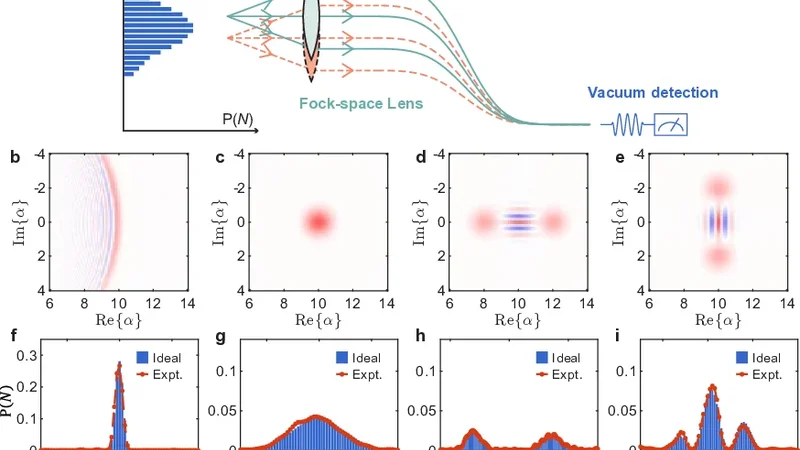
Quantum Conf ocal Microscopy in F ock Space with a 19 dB Metr ological Gain Ziyue Hua, 1 , ∗ Chuanlong Ma, 1 , ∗ Y ilong Zhou, 1 , ∗ Y if ang Xu, 1 Zi-Jie Chen, 2 W eizhou Cai, 2 Jiajun Chen, 1 Lintao Xiao, 1 Hongwei Huang, 1 W eiting W ang, 1 Hekang Li, 3, 4 Haohua W ang, 3, 4 Ming Li, 2, 4 , † Chang-Ling Zou, 2, 4 , ‡ and Luyan Sun 1, 4 , § 1 Center for Quantum Information, Institute for Inter disciplinary Information Sciences, Tsinghua University , Beijing 100084, China 2 Laboratory of Quantum Information, University of Science and T echnology of China, Hefei 230026, China 3 School of Physics and ZJU-Hangzhou Global Scientific and T ec hnological Inno vation Center , Zhejiang University , Hangzhou 310027, China 4 Hefei National Laboratory , Hefei 230088, China Quantum metrology promises measurement precision beyond classical limits by exploiting large-scale quantum states, yet realizing this advantage faces two fundamental challenges: the deterministic prepa- ration of non-trivial quantum probes and the efficient extraction of metrological information in high- dimensional Hilbert spaces. Here, we introduce quantum confocal microscopy in Fock space that simul- taneously resolv es both challenges. Drawing a direct analogy between classical wa ve optics and quantum state evolution in a bosonic mode, we construct a confocal system with two Fock-space lenses. The first lens deterministically focuses a coherent state into a quantum probe with a tightly concentrated photon- number distribution, while the second lens maps the metrological information back to the vacuum state for efficient readout. Using a superconducting circuit QED platform, we prepar e focused probe states with mean photon numbers up to N = 500 , achieving a 21.5 ± 1.1 dB compression of the photon-number uncertainty relative to a coherent state, with a scalable quantum circuit of O (1) operational depth. W e demonstrate a displacement sensitivity scaling as N − 0 . 416 , approaching the Heisenberg scaling ( N − 0 . 5 ), and achieve a r ecord metrological gain of 19.06 ± 0.13 dB beyond the standard quantum limit. This work establishes quantum confocal microscopy as a scalable and practical framework for quantum-enhanced precision measurement, readily extendable to other bosonic platforms and high-dimensional quantum many-body systems. I. INTR ODUCTION The enhancement of measurement precision holds profound significance across div erse scientific and technological do- mains, ranging from the discovery of ne w physics to the foun- dation of international standards [ 1 – 3 ]. Quantum metrology , which lev erages the superposition and entanglement of large numbers of microscopic particles or excitations, is expected to significantly improve measurement precision beyond the standard quantum limits (SQLs) [ 4 – 9 ]. T wo complemen- tary platforms hav e been exploited to validate the principles of quantum metrology . In ensembles of two-lev el systems, collectiv ely entangled quantum states, such as spin-squeezed states [ 10 , 11 ], GHZ states [ 12 , 13 ], and spin-motion entangle- ment states [ 14 , 15 ], hav e demonstrated quantum-enhanced measurement precision. Bosonic modes offer a distinct advantage of demonstrating large-scale quantum properties with reduced hardware complexity by exploiting the infinite- dimensional Hilbert space of harmonic oscillators [ 16 , 17 ]. The metrological capability of bosonic modes has been in v es- tigated utilizing Fock states and their superpositions [ 18 – 22 ], cat states [ 23 – 25 ], and NOON states [ 26 , 27 ], positioning the bosonic modes as a promising platform for practical quantum- enhanced sensing. Despite these advances, two fundamental challenges ob- struct the practical realization of large metrological gains in macroscopic quantum systems. The first is state preparation. While metrological precision improves with the number of particles or excitations N , the preparation of high non-trivial quantum probe states becomes exponentially more demand- ing as N grows [ 28 , 29 ]. In bosonic modes, for instance, photon injection [ 30 – 33 ] and pulse engineering [ 34 – 38 ], re- quire increasingly complex quantum circuits whose depth and gate count scale with N , making them highly susceptible to decoherence and practical imperfections. Non-deterministic approaches relying on ancilla qubit measurements can reach 100 photons [ 22 , 39 ], but their success probability dramati- cally drops with increasing N . The second bottleneck is in- formation extraction. Even when such large-scale quantum states can be prepared, the efficient extraction of metrologi- cal information from these complex, high-dimensional probe states after interrogation remains challenging. One possible approach is to construct a time-rev ersal evolution of the sys- tem, either through Hamiltonian in version [ 40 – 42 ] or echo- type processes [ 11 , 15 , 43 ], which maps the probe state back near a simple reference state for efficient readout. Howe ver , such approaches demand precise control over the Hamiltonian of the entire quantum system, placing stringent and often im- practical requirements on experiment. Here, we propose and experimentally demonstrate “quan- tum confocal microscopy”, a paradigm that simultaneously resolves the challenges in ef ficient generation and detection of certain non-classical states in high-dimensional Hilbert spaces. Drawing a direct analogy between classical wa ve optics and quantum state ev olution in a bosonic mode, we construct a 4f confocal system using lenses in Fock space. This architecture deterministically focuses a readily gener- ated large coherent state into a non-classical Fock-space- focused ( N -focused) state characterized by sharply com- pressed photon-number uncertainty [ 44 , 45 ]. The confocal microscopy is inherently scalable with a constant operational depth O (1) . W e experimentally prepare N -focused states with a mean photon number up to 500 and a central F ock-state pop- 2 Signal b a c d e f b. c. d. e. f. FIG. 1: Fock-space conf ocal system f or state pr eparation and detection. a, Changes of photon-number distribution during the F ock-space confocal circuit. The circuit maps a coherent state back to an approximate coherent state using two Fock-space con ve x lenses with the same focal point, analogous to the confocal con ve x lens system in optics. b-f, Close-up of photon-number distribution at various moments. b, At the starting point, the system is in the vacuum state, with all population being in the Fock state | 0 ⟩ . c, A displacement transformation maps the v acuum state to a coherent state with 500 average photons and a broad distribution. The inset shows the W igner distribution of the coherent state. d, After passing through a Fock-space con vex lens, the coherent state is focused into an N -focused state, with photon-number distribution tightly concentrated around several Fock states near N = 500 . The inset shows the W igner distribution of the N -focused state, which has fine fringes for detecting small signals. e, After passing through another Fock-space conv ex lens, the N -focused state diver ges into a coherent-like state, with a broad photon-number distribution. The inset shows its W igner distribution, which is generally similar to that of a coherent state except for slight distortions. f, A final backward displacement transformation maps the coherent-like state to a near vacuum state. Theoretically , ov er 90% of the population returns to the vacuum state, f acilitating ef ficient state measurement. ulation surpassing 20%. Crucially , by leveraging the confo- cal architecture, we achie ve approximate time-reversal via a secondary Fock-space con ve x lens, remapping the N -focused state near a coherent state for simple and ef ficient informa- tion extraction. This deterministic confocal metrology circuit achiev es an information extraction ef ficiency e xceeding 90%, showing a quantum-enhanced metrological gain of 19.06 dB beyond SQL. Our work establishes a scalable framew ork for preparing large-scale non-classical states, marking a critical step tow ard quantum-enhanced sensing technologies. II. RESUL TS A. Confocal system in F ock space Figure 1 (a) illustrates the concept of quantum confocal mi- croscopy in Hilbert space. It shows the e volution of a bosonic mode quantum state throughout the quantum circuit, with the state distribution along the photon-number basis. The inset depicts the corresponding classical 4f confocal system widely used in optical microscopy , which consists of two lenses with coincident focal points. The first lens transforms a broad col- limated beam into a tight, dif fraction-limited focal spot, while the second lens re-collimates the beam, enabling high reso- lution and efficient signal collection. Building on an equiv- alence between optical wave propagation in real space and quantum state ev olution in Fock space (Supplementary Sec- tion I A) [ 44 , 45 ], coherent states as a Gaussian beam in F ock space can be focused into N -focused states and subsequently remapped back to a coherent state near the vacuum (Supple- mentary Section I B). The principle of the quantum confocal microscopy is nu- merically simulated and illustrated in Figs. 1 (b-e), with a con- stant operation depth independent of N . Initially , the bosonic mode resides in the v acuum state, with its photon-number dis- tribution shown in Fig. 1 (b). A large displacement operation first conv erts the vacuum state into a coherent state with an av erage photon number ¯ N = 500 , with photon-number dis- tributions and W igner functions depicted in Fig. 1 (c). Sub- sequently , a Fock-space con ve x lens, composed of sequential quadratic phase accumulation followed by weak-dri ving evo- lution, transforms the coherent state into an N -focused state, as shown in Fig. 1 (d). A second lens with identical parame- ters and a common focal point then recon verts the N -focused state into a quasi-coherent state, as shown in Fig. 1 (e). These numerical results validate bidirectional state conv ersion be- tween coherent and N -focused states via the confocal archi- tecture, confirming our optical intuition. The photon-number distribution of the quasi-coherent state closely resembles the coherent state, while minor distortions in the Wigner func- tion arise from the inherent discrete nature of Fock-space (see 3 Storage Resonator Readout Ancilla Fock-space Lens Photon-number detection a b c d FIG. 2: Scaling of N -focused state. a, Schematic of the superconducting circuit QED setup: a 3D cavity coupled to a transmon qubit and a readout resonator . b, The circuit of preparing and calibrating the N -focused states. The N -focused state is prepared by compressing a coherent state through a con ve x Fock-space lens, then calibrated with a photon number selection pulse and measurement of the transmon qubit. c, Ancilla-qubit-assisted detection results for an N -focused state with an average photon number of ¯ N = 300 . d, Measured P ( N ) (dots) and Gaussian fits (solid lines) for the N -focused state at various ¯ N from 50 to 500, demonstrating deep sub-Poissonian statistics compared to coherent states (dashed lines). The peak probability and the width of the distrib ution remain nearly the same at v arious target photon numbers, confirming the scalability of the state preparation process. Supplementary Section I C). Finally , a rev erse large displace- ment operation repositions the quasi-coherent state near the vacuum origin, with the resulting photon-number distribution shown in Fig. 1 (f). The N -focused state exhibits the fundamental quantum en- hancement for metrological gain beyond SQL. As shown in Fig. 1 (d), experimental feasible parameters allow compres- sion of the photon-number distribution to a narrow full width at half maximum (FWHM) of around 4 photons for ¯ N = 500 . In particular, the population on the Fock state | N = 500 ⟩ with a deterministic photon number exceeds 20%. The W igner dis- tribution of the N -focused state (inset of Fig. 1 (d)) reveals dense, ring-like fringes analogous to those of Fock states, confirming the high-precision metrological capability [ 16 ], in contrast to the coherent state in Fig. 1 (c). Moreov er , the neg- ativity of the W igner distribution demonstrates that the N - focused state is non-Gaussian, distinguishing it from conv en- tional squeezed states. Another key advantage of this confocal design is that it resolves the information readout bottleneck. Rather than directly measuring the macroscopic post-sensing state, this approach employs a second Fock-space lens followed by a reverse displacement to implement an approximate time- rev ersal. This maps the complex state imprinted with the test perturbation back near the vacuum state | 0 ⟩ , conv erting the tiny shift at the “focus” into a simple observable change near vacuum. Simulations show that over 90% of the population returns to the vacuum state in the absence of test perturba- tion, correlating the magnitude of mid-circuit perturbations with the change in the final vacuum-state fidelity and enabling precise signal detection. Thus, information is extracted via efficient near -vacuum measurements, circumventing the need for macroscopic quantum state tomography . Crucially , un- like conv entional time-re versal protocols that require precise Hamiltonian in v ersion ( H → − H ) [ 40 – 42 ], our protocol, analogous to classical optics, requires no such in version and is inherently robust. B. Characterization of the Fock lens and conf ocal system Our circuit quantum electrodynamics (QED) system [ 46 – 48 ] consists of three ke y components: a high-quality memory res- onator stores quantum information, an ancilla transmon qubit, and a readout resonator, as shown in Fig. 2 (a). The storage resonator features a long lifetime of 2.8 ms and acquires Kerr nonlinearity via coupling with the ancilla qubit. The disper- siv e coupling between the ancilla qubit and the storage res- onator causes frequency shifts on the qubit when the stor- age resonator is in specific Fock states. Therefore, applying frequency-selecti ve dri ves on the qubit can distinguish differ - ent Fock states in the resonator [ 49 ]. The readout resonator , with a short lifetime ( < 1 µ s), is also dispersively coupled to the ancilla qubit. W e measure the state of the ancilla qubit by performing homodyne detection on the readout resonator . Detailed system parameters and wiring are giv en in Supple- 4 mentary Section II. The photon-number distribution of the N -focused state is calibrated by qubit-assisted photon-number detection. W e first prepare an N -focused state in the storage cavity using the circuit illustrated in Figs. 1 (b-d). Then, frequency-selecti ve π -pulses are applied to the ancilla qubit at varying frequen- cies, and successful qubit flips are identified by reading out the ancilla qubit through the readout resonator , as shown in Fig. 2 (b). Figure 2 (c) presents the detection results for an N - focused state with an av erage photon number of ¯ N = 300 . The qubit excitation is detectable only when the cavity has population in a specific Fock state, and the qubit drive fre- quency aligns with the transition frequency corresponding to that Fock state. By systematically preparing N -focused states with dif ferent av erage photon numbers and analyzing the qubit excitation peak positions one by one, we identify the transition frequencies of specific Fock states within the cav- ity (Supplementary Section II D). Furthermore, applying a set of distinct qubit driv e frequencies to a giv en N -focused state allows quantification of the population distribution across its Fock state components. W e demonstrate the scalability of the Fock-space focusing circuit by measuring the photon-number distributions of the N -focused states at various av erage photon numbers ¯ N , as shown in Fig. 2 (d). The solid lines represent Gaussian fits to the e xperimental data, while the dashed lines correspond to coherent states with matching ¯ N . As ¯ N increases, the pre- pared N -focused state distributions remain essentially stable, whereas the coherent state distributions broaden proportion- ally to √ ¯ N . W e fit the distrib ution of the N -focused state with Gaussian function P ( N ) = A · exp − ( N − ¯ N ) 2 / (2 σ 2 ) , as shown by the dashed lines in Fig. 2 (d). The fitted standard deviation σ is smaller than 2 photons for all ¯ N , consistent with the theoretical prediction (Supplementary Section IV A). At ¯ N = 500 , the central occupation of the N -focused state remains abov e 20%, with a fitted σ = 1 . 9 ± 0 . 3 photons, cor - responding to a 21.5 ± 1.1 dB compression compared to co- herent states. Howe ver , the measurement fidelity of the an- cilla qubit degrades with increasing photon numbers, result- ing in ele vated noise lev els in the experimental data (Supple- mentary Section II D). The limited fidelity of direct measure- ment not only restricts potential post-measurement selection operations, but also limits the precision of directly applying N -focused states for quantum metrology . As a rev ersal of the preparation of N -focused state, the Fock-space lens can be applied to detect the projection of state on a N -focused state. Figure 3 (a) shows detection channels with varying mean photon numbers, which could serve as ba- sis vectors for quantum state tomography , enabling precise photon-number distribution measurement of an input state, termed Fock-space scanning tomography ( N -tomo). In this scheme, an arbitrary initial state undergoes a conv ex lens and displacement operation. The N -focused state component within the initial state is mapped near the vacuum state, allo w- ing quantification of the N -focused component fraction in the initial state by measuring the vacuum-state proportion (Sup- plementary Section III A). W e experimentally demonstrate the reconstruction of photon-number distributions from N -tomo results for various initial states, along with their corresponding theoretical dis- tributions and Wigner distributions, as shown in Figs. 3 (b-i). W e first reconstruct the photon-number distribution of the N - focused state using its N -tomo results, as shown in Figs. 3 (b- c). Based on the reconstructed distribution of the N -focused state, we subsequently reconstruct the photon-number distri- butions of other unkno wn pure states from their N -tomo re- sults, with detailed methods provided in the Supplementary Section III D. Specifically , we apply N -tomo to the coherent state D [ √ n t ] | 0 ⟩ , parallel-displaced cat (PDC) state D [ √ n t ]( | α ⟩ + |− α ⟩ ) / √ 2 and orthogonal-displaced cat (ODC) state D [ √ n t ]( | iα ⟩ + |− iα ⟩ ) / √ 2 . The state prepara- tion protocol is detailed in Supplementary Section III B. W e choose n t = 100 and α = 2 as an example. The coherent state has a wide Gaussian-like photon-number distribution centered at n t = 100 , as shown in Figs. 3 (d-e). The PDC state has two coherent state components with significantly different average photon numbers (64 and 144 photons), as shown in Figs. 3 (f-g). The ODC state consists of two coherent states with identical average photon numbers (104 photons) but a relativ e phase difference, resulting in a characteristic triple-peak structure in the photon-number distribution, as shown in Figs. 3 (h-i). Experimentally reconstructed results for all types of states agree well with theoretical predictions, confirming that N -tomo not only possesses a broad detection range but also exhibits high resolution for fine structures in photon-number distributions arising from coherent superpositions. C. Quantum sensing of displacement W e no w integrate the preparation and detection protocols of N -focused states to achie ve quantum-enhanced metrology . The protocol employs a confocal system where a small, un- known displacement D ( β ) is applied at the focal point. The displacement magnitude information is extracted by measur- ing the final vacuum-state probability P (0) . T o calibrate the detector response, we first apply a known displacement β 0 and scan its intensity . Figure 4 (a) demonstrates the experimen- tal measurement results of P (0) , with distinct color points representing results for different average photon numbers ( ¯ N = 50 , 200 , 350 , 500 ). Black points represent coherent- state probe measurement results, corresponding to the SQL in our system. Notably , the confocal system demonstrates a significantly steeper slope than that of a coherent state. T o extract the information in the measurement result, we first fit the e xperimental data with a Gaussian func- tion P (0 | β ) = A · exp − β 2 / (2 σ 2 ) + C (dashed lines in Fig. 4 (a)). The fitting curv es agree well with the e xperimental data. W e then calculate the classical Fisher information (CFI) using the formula I c ( β ) = ( ∂ P (0 | β ) /∂ β ) 2 / ( P (0 | β )(1 − 5 P( N ) N a b c d e f g h i Fock-space Lens V acuum detection FIG. 3: Fock-space scanning tomography ( N -tomo) of various states. a, The circuit of calibrating an unknown target state with N -tomo. The target state passes through a Fock-space con ve x lens and then a displacement operation, followed by measuring the vacuum probability of the final state. The N -tomo circuit maps the N -focused state component in the target state back to the vacuum state, similar to the optical conjugation of the N -focused state preparation circuit. By adjusting the circuit parameters, the N -tomo circuit can detect the proportions of different N -focused components in the target state, thereby reconstructing the photon-number distribution. b-e, The theoretical W igner distribution of the N -focused state, the coherent state, the parallel-displaced cat (PDC) state, and the orthogonal-displaced cat (ODC) state. f-i, The ideal and reconstructed photon-number distribution of each state. The distribution of the N -focused state is used for reconstructing other unkno wn states. The PDC state has two components with different photon numbers, resulting in a two-peak photon-number distribution. The ODC state has two components with the same photon numbers, resulting in a three-peak photon-number distribution. The N -tomo results clearly capture the difference between PDC and ODC states. P (0 | β ))) , and the results are shown in Fig. 4 (b). The re- sults sho w that I c ( β ) for our confocal metrology circuit peaks at specific optimal bias points β 0 for various av erage pho- ton numbers ¯ N . At ¯ N = 350 , the maximum CFI reaches 3 . 22 ± 0 . 10 × 10 2 at β 0 = 0 . 055 , surpassing the ideal SQL ( I c = 4 ) by a factor of 80.5. T o intuiti vely visualize the origin of sensing enhancement, we characterize the population distribution of the lowest few Fock components in the final output states, as shown in Fig. 4 (c). W e select the operating point with the highest pre- cision at ¯ N = 350 and bias the system at β 0 = 0 . 055 , where the CFI is maximized. The populations of Fock components with photon numbers N ≤ 10 are presented as solid bars in Fig. 4 (c). When a test driv e differs from the bias point by ∆ β = ± 0 . 02 , the changed Fock populations are sho wn as hol- low bars in Fig. 4 (c). The vacuum-state ( | 0 ⟩ ) population ex- hibits a significant v ariation when the test driv e is applied. For comparison, Fig. 4 (d) shows the final state population changes of a coherent-state probe at its optimal bias β 0 = 0 . 515 . Un- der the same test driv e strength, the v ariation of the final state in the confocal metrology circuit is remarkably larger than that of the coherent-state circuit. Due to system imperfections such as aberrations and dissipation, not all population returns to the vacuum state after one confocal circuit, resulting in a gradually decreasing distribution across the Fock states | 1 ⟩ to | 10 ⟩ and a residual population in states | N > 10 ⟩ . W e observ e that the populations in Fock states | 1 ≤ N ≤ 10 ⟩ also vary with the test dri v e strength, suggesting that quantum informa- tion might be partially recovered via error correction or miti- gation techniques. For instance, one can construct low-F ock- number operations with numerically optimized pulse shaping to transfer more population on the Fock states | 1 ≤ N ≤ 10 ⟩ back to | 0 ⟩ , thereby enhancing the metrology performance. According to the Cram ´ er-Rao theorem, the minimum achiev able uncertainty δ β for the test small displacement β can be directly obtained from the CFI of the measurement re- sult, i.e., δ β = 1 / √ I c . Figure 4 (e) plots the measured dis- placement uncertainty , δ β , as a function of the mean pho- ton number ¯ N on a log-log scale. The sensitivity improves rapidly as ¯ N increases. For comparison, an ideal coherent state can only yield | δ β | ≥ 0 . 5 regardless of the number of photons used, representing the SQL as δ β SQL = 0 . 5 , 6 a b c d e FIG. 4: Quantum sensing of displacement. a, Measured vacuum population P (0) vs. displacement β . N -focused states ( ¯ N from 50 to 500) show a steeper slope (higher sensitivity) than the coherent state (SQL benchmark). b, Fisher Information I c (deriv ed from a ) shows a massiv e quantum enhancement for N -focused states ov er the coherent state at optimal bias points β 0 . c, Focused ¯ N = 350 state detection result. The same signal δ β (bottom) induces a dramatic, measurable change in the photon-number distribution of the final state, illustrating the mechanism of quantum gain. d, Coherent state (SQL) detection result. A small signal δ β (bottom) causes a negligible change to the final state. e, Displacement sensitivity δ β versus ¯ N . The N -focused states (blue dots) demonstrate a clear quantum advantage, surpassing the SQL (black dashed line). A maximum quantum gain of 19 . 06 ± 0 . 13 dB is achieved at ¯ N = 350 . Linear fitting (blue dashed line) reveals that the sensitivity scales as ¯ N − 0 . 416 , approaching the Heisenber g-limit scaling ( N − 0 . 5 ). This scaling is well-described by lossless simulation (yello w circles and dashed line, ¯ N − 0 . 417 ). as shown by the black dashed line in Fig. 4 (e). The ratio 10 log 10 | δ β SQL /δ β | ) 2 defines the quantum metrology gain in decibels. The minimum | δ β | measured experimentally oc- curs at ¯ N = 350 , where | δ β | ≥ 0 . 0557 , corresponding to a 19 . 06 ± 0 . 13 dB gain o ver coherent states. Further increasing the photon number leads to an increase in | δ β | , as the bene- fits of increased ¯ N are gradually ov ercome by the increased photon-loss rate within the high-photon-number range. By fitting the experimental data for ¯ N < 350 and the simu- lation data, we find that the measurement precision v aries with the av erage photon number as δ β ∝ ¯ N − 0 . 416 . This result is a clear demonstration of near-Heisenberg-limited (HL) scal- ing, which for an ideal Fock state probe is δ β HL ∝ N − 0 . 5 . W e also numerically simulate the maximum precision of the confocal circuit under lossless conditions, as shown by the cir- cles in Fig. 4 (e). The simulated measurement precision scales with ¯ N as δ β ∝ ¯ N − 0 . 417 , which agrees well with the experi- mental result. The lossless simulation indicates that the mea- surement precision can be further improv ed by extending the cavity lifetime. Our results confirm that the quantum confocal microscop in Fock space is highly ef fecti ve and scalable. III. DISCUSSION In this work, we have introduced the concept of quantum con- focal microscopy in Fock space and demonstrated it experi- mentally as a unified framew ork for the deterministic prepa- ration, manipulation, and detection of non-classical bosonic states at macroscopic photon numbers. In a superconduct- ing circuit QED platform, merely requiring Kerr nonlinear- ity and weak driving, we hav e successfully realized a 4f con- focal microscopy and prepared N -focused states with up to 500 photons, demonstrating the scalability of the approach. Utilizing the latter half of the confocal system, we imple- ment Fock-space scanning tomography to detect the photon- number distribution of unknown states, achieving excellent agreement with theory . Finally , we employ the complete con- focal circuit for displacement sensing, achieving a quantum- enhanced precision exceeding the SQL by 19 dB. Our experi- ment provides a scalable method for lev eraging high-photon- number states in quantum metrology . Requiring only the el- ementary nonlinearity of a bosonic resonator and vacuum- state detection, our approach is highly adaptable to a wide range of other bosonic architectures, such as acoustic [ 33 ], optomechanical [ 50 ], trapped ions [ 20 ], and cavity QED sys- tems [ 46 , 51 , 52 ], for quantum-enhanced sensing of di verse physical parameters. The primary source of dissipation in this experiment is single-photon loss in the high-photon-number range. Due to the bosonic nature of photons, the lifetime of a Fock state | N ⟩ scales inv ersely with photon number , T 1 ∝ 1 / N . Howe ver , the phase accumulation time of the confocal lens system is de- termined by the paraxial condition (Supplementary Section I) and scales as T L ∝ 1 / √ ¯ N [ 45 ]. Consequently , the total exe- cution time of the confocal circuit decreases with ¯ N for a fixed 7 Kerr nonlinearity , partially mitigating the impact of single- photon dissipation. W e anticipate that ev en higher metrolog- ical gain is possible by further optimizing the lifetime of the cavity [ 53 ]. In experimental systems, the Kerr nonlinearity strength often depends on ¯ N . Designing specialized nonlin- ear devices to maintain or ev en enhance the Kerr nonlinearity in the high-photon-number range [ 54 ] of fers a promising path tow ard improving circuit efficiency and metrological perfor- mance. ∗ These authors contributed equally to this w ork. † Electronic address: lmwin@ustc.edu.cn ‡ Electronic address: clzou321@ustc.edu.cn § Electronic address: luyansun@tsinghua.edu.cn [1] R. Schnabel, N. Mav alvala, D. E. McClelland, and P . K. Lam, “Quantum metrology for gravitational wave astronomy , ” Nat. Commun. 1 , 121 (2010) . [2] K. M. Backes, D. A. Palken, S. A. Kenan y , B. M. Brubaker , S. B. Cahn, A. Droster, G. C. Hilton, S. Ghosh, H. Jackson, S. K. Lamoreaux, et al. , “A quantum enhanced search for dark matter axions, ” Nature 590 , 238 (2021) . [3] Y . W ang, Y . Huang, X. Kang, D. Chang, J. Xu, Y . Chen, S. Pustelny , W . Zheng, M. Jiang, X. Peng, et al. , “Constraints on axion dark matter by distributed intercity quantum sensors, ” Nature 650 , 314 (2026) . [4] V . Giov annetti, S. Lloyd, and L. Maccone, “Quantum- enhanced measurements: Beating the standard quantum limit, ” Science 306 , 1330 (2004) . [5] V . Giov annetti, S. Llo yd, and L. Maccone, “ Advances in quan- tum metrology , ” Nat. Photonics 5 , 222 (2011) . [6] J. Huang, M. Zhuang, and C. Lee, “Entanglement-enhanced quantum metrology: From standard quantum limit to heisen- berg limit, ” Appl. Phys. Re v . 11 , 031302 (2024) . [7] L. Jiao, W . W u, S.-Y . Bai, and J.-H. An, “Quantum metrology in the noisy intermediate-scale quantum era, ” Adv . Quantum T echnol. 8 , 2300218 (2025) . [8] V . Montenegro, C. Mukhopadhyay , R. Y ousefjani, S. Sarkar, U. Mishra, M. G. A. Paris, and A. Bayat, “Revie w: Quantum metrology and sensing with many-body systems, ” Phys. Rep. 1134 , 1 (2025) . [9] C. Mukhopadhyay , V . Montenegro, and A. Bayat, “Current trends in global quantum metrology , ” J. Phys. A: Math. Theor . 58 , 063001 (2025) . [10] K. C. Cox, G. P . Grev e, J. M. W einer, and J. K. Thompson, “De- terministic squeezed states with collective measurements and feedback, ” Phys. Rev . Lett. 116 , 093602 (2016) . [11] O. Hosten, N. J. Engelsen, R. Krishnakumar, and M. A. Kase- vich, “Measurement noise 100 times lower than the quantum- projection limit using entangled atoms, ” Nature 529 , 505 (2016) . [12] D. Leibfried, M. D. Barrett, T . Schaetz, J. Britton, J. Chiav erini, W . M. Itano, J. D. Jost, C. Langer , and D. J. W ineland, “T o- ward heisenberg-limited spectroscopy with multiparticle entan- gled states, ” Science 304 , 1476 (2004) . [13] L. Pezz ` e, A. Smerzi, M. K. Oberthaler , R. Schmied, and P . Treutlein, “Quantum metrology with nonclassical states of atomic ensembles, ” Rev . Mod. Phys. 90 , 035005 (2018) . [14] G. P . Greve, C. Luo, B. W u, and J. K. Thompson, “Entanglement-enhanced matter-w av e interferometry in a high- finesse cavity , ” Nature 610 , 472 (2022) . [15] T .-W . Mao, Q. Liu, X.-W . Li, J.-H. Cao, F . Chen, W .-X. Xu, M. K. T e y , Y .-X. Huang, and L. Y ou, “Quantum-enhanced sensing by echoing spin-nematic squeezing in atomic bose- einstein condensate, ” Nat. Phys. 19 , 1585 (2023) . [16] W . H. Zurek, “Sub-planck structure in phase space and its rele- vance for quantum decoherence, ” Nature 412 , 712 (2001) . [17] S. Pirandola, B. R. Bardhan, T . Gehring, C. W eedbrook, and S. Lloyd, “ Adv ances in photonic quantum sensing, ” Nat. Pho- tonics 12 , 724 (2018) . [18] K. C. McCormick, J. Keller , S. C. Burd, D. J. W ineland, A. C. W ilson, and D. Leibfried, “Quantum-enhanced sensing of a single-ion mechanical oscillator , ” Nature 572 , 86 (2019) . [19] W . W ang, Y . Wu, Y . Ma, W . Cai, L. Hu, X. Mu, Y . Xu, Z.-J. Chen, H. W ang, Y . P . Song, et al. , “Heisenberg-limited single- mode quantum metrology in a superconducting circuit, ” Nat. Commun. 10 , 4382 (2019) . [20] F . W olf, C. Shi, J. C. Heip, M. Gessner, L. Pezz ` e, A. Smerzi, M. Schulte, K. Hammerer, and P . O. Schmidt, “Motional fock states for quantum-enhanced amplitude and phase measure- ments with trapped ions, ” Nat. Commun. 10 , 2929 (2019) . [21] W . W ang, Z. J. Chen, X. Liu, W . Cai, Y . Ma, X. Mu, X. Pan, Z. Hua, L. Hu, Y . Xu, et al. , “Quantum-enhanced radiometry via approximate quantum error correction, ” Nat. Commun. 13 , 3214 (2022) . [22] X. Deng, S. Li, Z.-J. Chen, Z. Ni, Y . Cai, J. Mai, L. Zhang, P . Zheng, H. Y u, C.-L. Zou, et al. , “Quantum-enhanced metrol- ogy with large fock states, ” Nat. Phys. 20 , 1874 (2024) . [23] B. Vlastakis, G. Kirchmair, Z. Leghtas, S. E. Nigg, L. Frun- zio, S. M. Girvin, M. Mirrahimi, M. H. De voret, and R. J. Schoelkopf, “Deterministically encoding quantum information using 100-photon schrodinger cat states, ” Science 342 , 607 (2013) . [24] X. Pan, T . Krisnanda, A. Duina, K. Park, P . Song, C. Y . Fontaine, A. Copetudo, R. Filip, and Y . Y . Gao, “Realiza- tion of versatile and ef fectiv e quantum metrology using a single bosonic mode, ” PRX Quantum 6 , 010304 (2025) . [25] P . Zheng, Y . Cai, B. Xu, S. W en, L. Zhang, Z. Ni, J. Mai, Y . Zeng, L. Lin, L. Hu, X. Deng, S. Liu, J. Shu, Y . Xu, and D. Y u, “Quantum-enhanced dark matter detection using schr ¨ odinger cat states, ” arXiv: 2507.23538 (2025) . [26] T . Nagata, R. Okamoto, J. L. O’Brien, K. Sasaki, and S. T akeuchi, “Beating the standard quantum limit with four- entangled photons, ” Science 316 , 726 (2007) . [27] S. Slussarenko, M. M. W eston, H. M. Chrzanowski, L. K. Shalm, V . B. V erma, S. W . Nam, and G. J. Pryde, “Uncon- ditional violation of the shot-noise limit in photonic quantum metrology , ” Nat. Photonics 11 , 700 (2017) . [28] B. M. Escher , R. L. de Matos Filho, and L. Davidovich, “Gen- eral frame work for estimating the ultimate precision limit in noisy quantum-enhanced metrology , ” Nat. Ph ys. 7 , 406 (2011) . [29] R. Demkowicz-Dobrza ´ nski, J. K ołody ´ nski, and M. Gut ¸ ˘ a, “The elusiv e heisenber g limit in quantum-enhanced metrology , ” Nat. Commun. 3 , 1063 (2012) . [30] M. Hofheinz, E. M. W eig, M. Ansmann, R. C. Bialczak, E. Lucero, M. Neeley , A. D. O’Connell, H. W ang, J. M. Marti- nis, and A. N. Cleland, “Generation of fock states in a super- conducting quantum circuit, ” Nature 454 , 310 (2008) . [31] H. W ang, M. Hofheinz, M. Ansmann, R. C. Bialczak, E. Lucero, M. Neeley , A. D. O’Connell, D. Sank, J. W enner , A. N. Cleland, et al. , “Measurement of the decay of fock states in a superconducting quantum circuit, ” Phys. Rev . Lett. 101 , 240401 (2008) . [32] M. Hofheinz, H. W ang, M. Ansmann, R. C. Bialczak, 8 E. Lucero, M. Neeley , A. D. O’Connell, D. Sank, J. W enner , J. M. Martinis, et al. , “Synthesizing arbitrary quantum states in a superconducting resonator , ” Nature 459 , 546 (2009) . [33] Y . Chu, P . Kharel, T . Y oon, L. Frunzio, P . T . Rakich, and R. J. Schoelkopf, “Creation and control of multi-phonon fock states in a bulk acoustic-w av e resonator , ” Nature 563 , 666 (2018) . [34] N. Khaneja, T . Reiss, C. Kehlet, T . Schulte-Herbr ¨ uggen, and S. J. Glaser , “Optimal control of coupled spin dynamics: design of nmr pulse sequences by gradient ascent algorithms, ” J. Magn. Reson. 172 , 296 (2005) . [35] R. W . Heeres, B. Vlastakis, E. Holland, S. Krastanov , V . V . Albert, L. Frunzio, L. Jiang, and R. J. Schoelkopf, “Cavity state manipulation using photon-number selecti v e phase gates, ” Phys. Re v . Lett. 115 , 137002 (2015) . [36] S. Krastanov , V . V . Albert, C. Shen, C.-L. Zou, R. W . Heeres, B. Vlastakis, R. J. Schoelkopf, and L. Jiang, “Uni versal control of an oscillator with dispersive coupling to a qubit, ” Phys. Re v . A 92 , 040303 (2015) . [37] R. W . Heeres, P . Reinhold, N. Ofek, L. Frunzio, L. Jiang, M. H. Dev oret, and R. J. Schoelkopf, “Implementing a uni versal gate set on a logical qubit encoded in an oscillator, ” Nat. Commun. 8 , 94 (2017) . [38] A. Eickbusch, V . Siv ak, A. Z. Ding, S. S. Elder , S. R. Jha, J. V enkatraman, B. Royer , S. M. Girvin, R. J. Schoelkopf, and M. H. Devoret, “Fast universal control of an oscillator with weak dispersive coupling to a qubit, ” Nat. Phys. 18 , 1464 (2022) . [39] W . W ang, L. Hu, Y . Xu, K. Liu, Y . Ma, S.-B. Zheng, R. V ijay , Y . P . Song, L. M. Duan, and L. Sun, “Con v erting quasiclassical states into arbitrary fock state superpositions in a superconduct- ing circuit, ” Phys. Rev . Lett. 118 , 223604 (2017) . [40] E. Da vis, G. Bentsen, and M. Schleier-Smith, “ Approaching the heisenberg limit without single-particle detection, ” Phys. Rev . Lett. 116 , 053601 (2016) . [41] S. Colombo, E. Pedrozo-Pe ˜ nafiel, A. F . Adiyatullin, Z. Li, E. Mendez, C. Shu, and V . V uleti ´ c, “T ime-re versal-based quan- tum metrology with many-body entangled states, ” Nat. Phys. 18 , 925 (2022) . [42] Z. Li, S. Colombo, C. Shu, G. V elez, S. Pilatowsk y-Cameo, R. Schmied, S. Choi, M. Lukin, E. Pedrozo-Pe ˜ nafiel, and V . V uleti ´ c, “Improving metrology with quantum scrambling, ” Science 380 , 1381 (2023) . [43] K. A. Gilmore, M. Affolter , R. J. Lewis-Swan, D. Barber- ena, E. Jordan, A. M. Rey , and J. J. Bollinger , “Quantum- enhanced sensing of displacements and electric fields with two- dimensional trapped-ion crystals, ” Science 373 , 673 (2021) . [44] Y . Xu, Y . Zhou, Z. Hua, L. Sun, J. Zhou, W . W ang, W . Cai, H. Huang, L. Xiao, G. Xue, et al. , “Principles of optics in the fock space: Scalable manipulation of giant quantum states, ” arXiv:2601.10325 (2026) . [45] M. Li, W . Cai, Z. Hua, Y . Xu, Y . Zhou, Z.-J. Chen, X.-B. Zou, G.-C. Guo, L. Sun, and C.-L. Zou, “Scalable gener- ation of macroscopic fock states exceeding 10,000 photons, ” arXiv:2601.05118 (2026) . [46] A. W allraf f, D. I. Schuster, A. Blais, L. Frunzio, R. S. Huang, J. Majer , S. Kumar , S. M. Girvin, and R. J. Schoelkopf, “Strong coupling of a single photon to a superconducting qubit using circuit quantum electrodynamics, ” Nature 431 , 162 (2004) . [47] J. Koch, T . M. Y u, J. Gambetta, A. A. Houck, D. I. Schuster , J. Majer , A. Blais, M. H. De voret, S. M. Girvin, and R. J. Schoelkopf, “Charge-insensiti ve qubit design deriv ed from the cooper pair box, ” Phys. Rev . A 76 , 042319 (2007) . [48] A. Blais, A. L. Grimsmo, S. M. Girvin, and A. W allraff, “Cir- cuit quantum electrodynamics, ” Rev . Mod. Phys. 93 , 025005 (2021) . [49] D. I. Schuster, A. A. Houck, J. A. Schreier, A. W allraff, J. M. Gambetta, A. Blais, L. Frunzio, J. Majer, B. Johnson, M. H. Dev oret, et al. , “Resolving photon number states in a supercon- ducting circuit, ” Nature 445 , 515 (2007) . [50] S. Barzanjeh, A. Xuereb, S. Gr ¨ oblacher , M. Paternostro, C. A. Regal, and E. M. W eig, “Optomechanics for quantum technolo- gies, ” Nat. Phys. 18 , 15 (2022) . [51] A. Blais, R.-S. Huang, A. W allraf f, S. M. Girvin, and R. J. Schoelkopf, “Cavity quantum electrodynamics for supercon- ducting electrical circuits: An architecture for quantum com- putation, ” Phys. Rev . A 69 , 062320 (2004) . [52] P . Y ang, M. Li, X. Han, H. He, G. Li, C.-L. Zou, P . Zhang, Y . Qian, and T . Zhang, “Non-reciprocal cavity polariton with atoms strongly coupled to optical ca vity , ” Laser Photonics Rev . 17 , 2200574 (2023) . [53] O. Milul, B. Guttel, U. Goldblatt, S. Hazanov , L. M. Joshi, D. Chausovsky , N. Kahn, E. C ¸ ifty ¨ urek, F . Lafont, and S. Rosen- blum, “Superconducting cavity qubit with tens of millisec- onds single-photon coherence time, ” PRX Quantum 4 , 030336 (2023) . [54] Z. Hua, Y . Xu, W . W ang, Y . Ma, J. Zhou, W . Cai, H. Ai, Y .-x. Liu, M. Li, C.-L. Zou, et al. , “Engineering the nonlinearity of bosonic modes with a multiloop squid, ” Phys. Rev . Appl. 23 , 054031 (2025) . Acknowledgment This work was funded by the National Natural Science Foun- dation of China (Grants No. 12550006, 92265210, 92365301, 92565301, 92165209, 12547179, 12574539, 12474498, 12404567, and 12504580) and the Quantum Science and T echnology-National Science and T echnology Major Project (2021ZD0300200 and 2024ZD0301500). This work is also supported by the Fundamental Research Funds for the Central Univ ersities, the USTC Research Funds of the Double First- Class Initiativ e, the supercomputing system in the Supercom- puting Center of USTC, and the USTC Center for Micro and Nanoscale Research and Fabrication. A uthor contributions Z.H., M.L., and C.-L.Z. conceived the experiment and pro- vided theoretical support. Z.H., C.M., and Y .Z. performed the experiment, analyzed the data, and carried out the numerical simulations under the supervision of L.S. Y .X., Z.C., and W .C. provided theoretical support. J.C. helped to calibrate the sys- tem. Y .X., L.X., H.H., and W .W . contributed to experimental support. Z.H. designed the 3D cavity . H.L. and H.W . fabri- cated the tantalum transmon qubits. Z.H., C.M., Y .Z., M.L., C.-L.Z., and L.S. wrote the manuscript with input from all au- thors. C.-L.Z. and L.S. supervised the project. Competing interests The authors declare no competing interests. Correspondence and requests for materials should be ad- dressed to M.L., C.-L.Z., or L.S.
Original Paper
Loading high-quality paper...
Comments & Academic Discussion
Loading comments...
Leave a Comment