Spin-Cat Qubit with Biased Noise in an Optical Tweezer Array
Bias-tailored quantum error correcting codes (QECCs) offer a higher error threshold than standard QECCs and have the potential to achieve lower logical errors with less space overhead. The spin-cat qubit, encoded in a large nuclear spin-$F$ system, i…
Authors: Toshi Kusano, Kosuke Shibata, Chih-Han Yeh
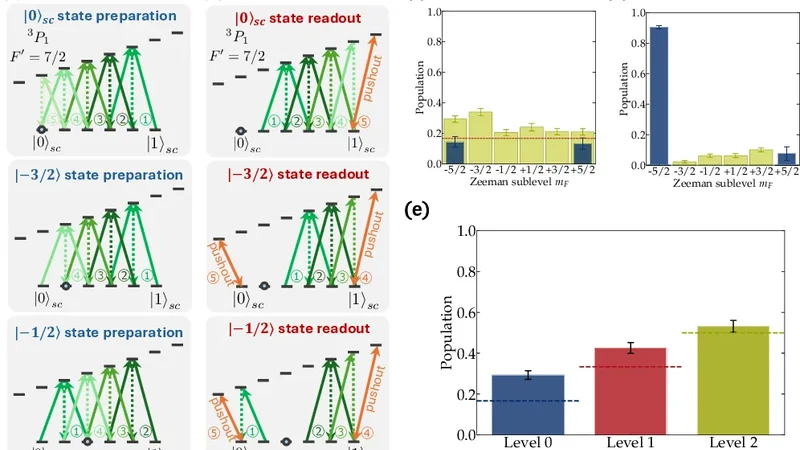
Spin-Cat Qubit with Biased Noise in an Optical Tw eezer Arra y T oshi Kusano, 1 , ∗ Kosuk e Shibata, 1 Chih-Han Y eh, 1 Keito Saito, 1 Y uma Nak am ura, 1, 2 Rei Y ok oy ama, 1 T akumi Kashimoto, 1 T etsushi T ak ano, 1, 3 Y osuk e T ak asu, 1 Ryuji T ak agi, 4 and Y oshiro T ak ahashi 1 1 Dep artment of Physics, Gr aduate Scho ol of Scienc e, Kyoto University, Kyoto 606-8502, Jap an 2 Y aqumo, Inc., 2-3-2 Marunouchi, Chiyo da-ku, T okyo 100-0005, Jap an 3 The Hakubi Center for A dvanc e d R ese ar ch, Kyoto University, Kyoto 606-8502, Jap an 4 Dep artment of Basic Scienc e, The University of T okyo, 3-8-1 Komab a, Megur o-ku, T okyo 153-8902, Jap an (Dated: F ebruary 27, 2026) Bias-tailored quan tum error correcting co des (QECCs) offer a higher error threshold than standard QECCs and hav e the p oten tial to ac hieve lo w er logical errors with less space ov erhead. The spin-cat qubit, enco ded in a large nuclear spin- F system, is a promising candidate for bias-tailored QECCs. Y et its feasibilit y is hindered by the difficulty of p erforming fast co v arian t SU(2) rotation with arbitrary rotation angles for nuclear spins and b y a lack of noise c haracterization for gate op erations in neutral atom platforms. Here we demonstrate single-qubit controls of 173 Yb spin-cat qubits with nuclear spin I = 5 / 2 in an optical tw eezer array . W e implement a cov arian t SU(2) rotation and non-linear rotations b y optical beams and achiev e an av eraged single-Clifford gate fidelit y of 0 . 961 +5 − 5 . The measuremen t of the coherence time and spin relaxation time shows that the idling error b ecomes increasingly biased to ward dephasing errors as the magnitude of the enco ded sublev el | m F | increases. F urthermore, w e b enc hmark the noise bias of rank-preserving gates on spin-cat qubits, demonstrating a finite bias of 18 +132 − 11 , in contrast to the case of the tw o-lev el system in 171 Yb, which sho ws no bias within the experimental uncertaint y . Our w ork demonstrates the feasibility of spin-cat qubits for realizing bias-tailored QECCs, pa ving the w ay for achieving hardw are-efficien t quantum error correction. I. INTR ODUCTION T o ward large-scale quan tum computation, exp erimen- tal efforts ha ve focused on scaling the num b er of physi- cal qubits [ 1 – 12 ]. In parallel, resource-efficien t quan tum error correcting co des (QECCs) hav e b een theoretically dev elop ed. P articularly , bias-tailored QECCs [ 13 – 19 ] can ac hieve high error thresholds by a simple modification to standard QECCs with a biased noise mo del tow ards dephasing errors. This approach holds the p oten tial to attain logical error rates comparable to those of stan- dard QECCs with fewer qubits, reducing the space ov er- head of fault-toleran t quan tum computation (FTQC). Sev eral candidates for qubits exhibiting a biased noise structure, suc h as erasure qubits [ 20 – 23 ] and b osonic cat qubits [ 17 , 24 , 25 ], hav e been proposed and are dev elop ed on platforms suc h as sup erconducting devices [ 26 – 29 ], trapp ed ion systems [ 30 ], and neutral atom systems [ 31 – 35 ]. Another promising candidate for a biased qubit is the spin-cat qubit enco ded in large spin- F systems [ 36 , 37 ], whic h is defined as a sup erposition of the Zeeman sub- lev els m F = ± F (Fig. 1 ). Recen t studies hav e shown that this enco ding sc heme exhibits several adv antageous prop erties for FTQC: (1) hopping errors are correctable unless m ultiple hoppings change the sign of m F [ 36 ]; (2) a measurement-free correction for these hopping errors is a v ailable [ 36 – 38 ]; and, (3) bit-flip errors are suppressed and the noise structure is biased tow ards dephasing [ 36 ]. ∗ kusano@yagura.scph ys.ky oto-u.ac.jp A significant adv an tage of the spin-cat approach is its inheren t robustness against idling errors when utilizing a nuclear spin- F system, allowing us to sim ultaneously ac hieve a long coherence time [ 39 , 40 ] and strong bit-flip error mitigation. Despite these fav orable characteristics, further inv es- tigation is required to determine the exp erimen tal fea- sibilit y of the spin-cat state for FTQC. One primary c hallenge is the realization of fast cov ariant SU(2) rota- tions [ 40 ], whic h preserv es the shape of the Wigner func- tion to ensure fault-tolerance against hopping errors, in n uclear spin- F systems. While physical systems sensi- tiv e to magnetic fields can ac hieve cov ariant SU(2) ro- tations using radio-frequency or magnetic fields [ 38 , 41 ] with Rabi frequency smaller than Zeeman splitting, fast co v arian t SU(2) rotation is challenging in nuclear spin systems with low magnetic sensitivit y . Although opti- cal lasers are exp ected to enable fast rotation operations, their use can distort the shap e of the Wigner function due to the tensor lightshift [ 39 , 41 ], making the implemen ta- tion of cov ariant SU(2) rotations for arbitrary rotation angles non-trivial. F urthermore, while the biased noise characteristics of spin-cat states against idling errors hav e b een studied in sup erconducting [ 42 , 43 ] and silicon [ 40 ] platforms, their biased noise c haracteristics against single-qubit gate op- erations hav e not b een shown. Since gate operation er- rors are the primary error source in neutral atom systems, gate operation errors, rather than idling errors, charac- terize the biased properties of the spin-cat qubit. There- fore, it is curren tly unclear whether the spin-cat qubit is feasible for bias-tailored QECCs in this platform. 2 | ⟩ 0 !" | ⟩ 1 !" | ⟩ + #/% | ⟩ − #/% ' 𝑋 ) 𝑍 (b) AAAC1XichVExT9tQEP7i0hYoLaEsSCxRU6qwRBdEoTAhWBhDQggSppHtvsATjm3sl6jB8oYYWBgZmEDqULF0bVcWFsYO+QlVRyp16cDZSVVVVehZz+/ed/fd++6d6dkyUESdlPZg4OGjx4NDw09Gnj4bTY893wjcpm+JiuXarr9pGoGwpSMqSipbbHq+MBqmLarm3kocr7aEH0jXWVdtT2w3jB1H1qVlKIZq6Zf6rqHCUvQ2zDE0HdXe6/uqndPrvmGFuiejcCaarqWzlC/MLdDsQuZfp5CnxLLoWdFN30DHO7iw0EQDAg4U+zYMBPxtoQCCx9g2QsZ89mQSF4gwzNwmZwnOMBjd4/8On7Z6qMPnuGaQsC2+xeblMzODKfpKH+mWrumSvtGvvrXCpEaspc272eUKrzZ6PFH++V9Wg3eF3T+sezUr1PEm0SpZu5cgcRdWl986OL0tL5amwld0Qd9Z/zl16Io7cFo/rA9ronTG1fsr8lhHmyPx+wX3vF7IXZqsPOJh/p5Ypr+zMcPjzb9em80uLffGOohJvECOZzePJayiiArXP8YnfMYXrapF2qF21E3VUj3OOP4y7eQOxvGpKA== ˆ R ( cat ) x ! ω 2 " AAAC1XichVExT9tQEP7i0hYoLaEsSCxRU6qwRBdEoTAhWBhDQggSppHtvsATjm3sl6jB8oYYWBgZmEDqULF0bVcWFsYO+QlVRyp16cDZSVVVVehZz+/ed/fd++6d6dkyUESdlPZg4OGjx4NDw09Gnj4bTY893wjcpm+JiuXarr9pGoGwpSMqSipbbHq+MBqmLarm3kocr7aEH0jXWVdtT2w3jB1H1qVlKIZq6Zf6rqHCUvQ2zDE0HdXe6/uqndPrvmGFuiejcCaarqWzlC/MLdDsQuZfp5CnxLLoWdFN30DHO7iw0EQDAg4U+zYMBPxtoQCCx9g2QsZ89mQSF4gwzNwmZwnOMBjd4/8On7Z6qMPnuGaQsC2+xeblMzODKfpKH+mWrumSvtGvvrXCpEaspc272eUKrzZ6PFH++V9Wg3eF3T+sezUr1PEm0SpZu5cgcRdWl986OL0tL5amwld0Qd9Z/zl16Io7cFo/rA9ronTG1fsr8lhHmyPx+wX3vF7IXZqsPOJh/p5Ypr+zMcPjzb9em80uLffGOohJvECOZzePJayiiArXP8YnfMYXrapF2qF21E3VUj3OOP4y7eQOxvGpKA== ˆ R ( cat ) x ! ω 2 " AAAC1XichVExT9tQEP7i0hYoLaEsSCxRU6qwRBdEoTAhWBhDQggSppHtvsATjm3sl6jB8oYYWBgZmEDqULF0bVcWFsYO+QlVRyp16cDZSVVVVehZz+/ed/fd++6d6dkyUESdlPZg4OGjx4NDw09Gnj4bTY893wjcpm+JiuXarr9pGoGwpSMqSipbbHq+MBqmLarm3kocr7aEH0jXWVdtT2w3jB1H1qVlKIZq6Zf6rqHCUvQ2zDE0HdXe6/uqndPrvmGFuiejcCaarqWzlC/MLdDsQuZfp5CnxLLoWdFN30DHO7iw0EQDAg4U+zYMBPxtoQCCx9g2QsZ89mQSF4gwzNwmZwnOMBjd4/8On7Z6qMPnuGaQsC2+xeblMzODKfpKH+mWrumSvtGvvrXCpEaspc272eUKrzZ6PFH++V9Wg3eF3T+sezUr1PEm0SpZu5cgcRdWl986OL0tL5amwld0Qd9Z/zl16Io7cFo/rA9ronTG1fsr8lhHmyPx+wX3vF7IXZqsPOJh/p5Ypr+zMcPjzb9em80uLffGOohJvECOZzePJayiiArXP8YnfMYXrapF2qF21E3VUj3OOP4y7eQOxvGpKA== ˆ R ( cat ) x ! ω 2 " AAAC1XichVExT9tQEP7i0hYoLaEsSCxRU6qwRBdEoTAhWBhDQggSppHtvsATjm3sl6jB8oYYWBgZmEDqULF0bVcWFsYO+QlVRyp16cDZSVVVVehZz+/ed/fd++6d6dkyUESdlPZg4OGjx4NDw09Gnj4bTY893wjcpm+JiuXarr9pGoGwpSMqSipbbHq+MBqmLarm3kocr7aEH0jXWVdtT2w3jB1H1qVlKIZq6Zf6rqHCUvQ2zDE0HdXe6/uqndPrvmGFuiejcCaarqWzlC/MLdDsQuZfp5CnxLLoWdFN30DHO7iw0EQDAg4U+zYMBPxtoQCCx9g2QsZ89mQSF4gwzNwmZwnOMBjd4/8On7Z6qMPnuGaQsC2+xeblMzODKfpKH+mWrumSvtGvvrXCpEaspc272eUKrzZ6PFH++V9Wg3eF3T+sezUr1PEm0SpZu5cgcRdWl986OL0tL5amwld0Qd9Z/zl16Io7cFo/rA9ronTG1fsr8lhHmyPx+wX3vF7IXZqsPOJh/p5Ypr+zMcPjzb9em80uLffGOohJvECOZzePJayiiArXP8YnfMYXrapF2qF21E3VUj3OOP4y7eQOxvGpKA== ˆ R ( cat ) x ! ω 2 " (a) 𝑥 𝑦 𝑧 QB2$:$556$ nm QB1$:$556$ nm Tweezer s 𝑚 ! = −5/2 −3/2 −1/2 1/2 3/2 5/2 4f 14 6s 2 1 S 0 ( 𝐹 = 5/2 ) AAACu3ichVHLSsNQED2N73fVjeBGLIqrMhVfCELRjUtfVcFKSa5XjU2TkNwWaugP+AG6cOEDXIif4caNSxd+grhUcOPCSRoQFXXCzZ17Zs7cM3cM1zJ9RfSY0Boam5pbWtvaOzq7unuSvX3rvlP2hMwJx3K8TUP3pWXaMqdMZclN15N6ybDkhlFcCOMbFen5pmOvqaort0v6nm3umkJXDOXzRakCqhUCX9QKyRSlKbKhn04mdlKIbclJ3iOPHTgQKKMECRuKfQs6fP62kAHBZWwbAWMee2YUl6ihnbllzpKcoTNa5P8en7Zi1OZzWNOP2IJvsXh5zBzCCD3QNb3QHd3QE73/WiuIaoRaqrwbda50Cz1HA6tv/7JKvCvsf7L+1Kywi5lIq8na3QgJuxB1fuXw5GV1dmUkGKVLemb9F/RIt9yBXXkVV8ty5ZSr/67IZR1VjoTv5//xegF3abDycJiZ76P76ayPpzNT6cnliVR2Ph5rKwYxjDGe3TSyWMQSclzfxTHOcK7NaUI70Kx6qpaIOf34Ylr5A2HSnrI= | 0 → sc AAACu3ichVG7SgNBFD2ur/hM1EawEYNiFWbFF4Ig2lj6igpJCLvjqGv2xe4kEJf8gB+ghYUPsBA/w8bG0sJPEEsFGwvvbhZEQ/Qus3Pn3HvunDtXd03Dl4w9tyitbe0dnYmu7p7evv5kamBw23fKHhdZ7piOt6trvjANW2SlIU2x63pCs3RT7OillTC+UxGebzj2lqy6omBpB7axb3BNEpTPl4QM1Fox8HmtmEqzDItstNFRYyeN2Nac1CPy2IMDjjIsCNiQ5JvQ4NOXgwoGl7ACAsI88owoLlBDN3HLlCUoQyO0RP8DOuVi1KZzWNOP2JxuMWl5xBzFOHtit+yNPbA79sI+m9YKohqhlirtep0r3GLyZHjz41+WRbvE4TfrT80S+5iPtBqk3Y2QsAte51eOz942FzbGgwl2zV5J/xV7ZvfUgV155zfrYuOcqjdX5JKOKkXC9/P/eL2AutRJeThM9ffoGp3tqYw6m5lZn04vLcdjTWAEY5ik2c1hCatYQ5bquzjFBS6VRYUrR4pZT1VaYs4QfphS/gJkJJ6z | 1 → sc -1 0 1 Spin Wigner distribution FIG. 1. Overview of spin-cat state controls in an optical tw eezer array . (a) Sc hematic illustration of the control b eam geometries. The qubit is enco ded in the nuclear-spin stretched states of the 173 Yb atom ground state as | 0 ⟩ sc = |− 5 / 2 ⟩ and | 1 ⟩ sc = | +5 / 2 ⟩ . This enco ding scheme suppresses hopping errors by lev eraging the redundant states b et w een the enco ded qubit states. The spin-cat states |±⟩ 5 / 2 are generated as sup erpositions of the stretched states. W e con trol single atoms trapp ed in an optical tw eezer arra y by using a single-beam Raman technique. QB1 and QB2 are used for spin-cat state preparation and co v arian t SU(2) rotation, respectively , with differen t laser detunings. (b) Wigner function representation of the coherent manipulations for the spin-5/2 system. The spin-cat state rotations, denoted as ˆ R ( cat ) x ( π / 2), cyclically map the basis states: | 0 ⟩ sc → | + ⟩ 5 / 2 → | 1 ⟩ sc → |−⟩ 5 / 2 → | 0 ⟩ sc . The cen tral arro ws indicate the application of the ˆ X gate and the ˆ Z gate. Additionally , optical tw eezer arra y platforms, offering scalabilit y [ 1 – 12 ], high-fidelity gates [ 44 – 49 ], and all-to- all connectivity [ 34 ], ha v e primarily been fo cusing on t w o- lev el systems. Utilizing a multi-lev el system for spin- cat qubit on this platform, together with efficien t FTQC sc hemes with reduced ov erhead [ 50 – 54 ], high-threshold QECCs by biased noise [ 16 , 17 , 22 ] are exp ected to low er the requirements for utilit y-scale quantum computation. Motiv ated by these considerations, in this paper w e demonstrate single-qubit controls of spin-cat qubits en- co ded in the 1 S 0 ground state of 173 Yb atoms with n u- clear spin I = 5 / 2 trapp ed in an optical tw eezer ar- ra y . W e characterize the gate fidelity and noise bias structure utilizing the Clifford randomized b enc hmark- ing (CRB) [ 55 – 57 ] and D 8 dihedral randomized b enc h- marking (DRB) [ 29 , 58 ], resp ectiv ely . The single-qubit gates for the spin-cat qubit is realized by combining three comp onen ts: optical laser-driven cov ariant SU(2) rota- tion (used as the P auli gate), non-linear rotation (used as the Hadamard gate), and arbitrary Z -axis rotation (in- cluding the ˆ T gate). By employing the cov ariant SU(2) and non-linear rotations, we achiev e high-fidelit y single- qubit gates, demonstrated by an av eraged Clifford gate fidelit y of 0 . 961 +5 − 5 using a coarse-grained (CG) measure- men t [ 59 , 60 ] for m F < 0 states. The results indicate that the Clifford gate fidelity impro ves with increasing CG level, v alidating the redundancy in the qudit system. F urthermore, the measuremen t of the dep endence of co- herence times T ∗ 2 and spin-relaxation times T 1 on the enco ded Zeeman sublevels reveals that the idling error in the large spin- F system is biased to ward the Z -error. Finally , we directly characterize the noise bias using the DRB metho d. Results show a finite bias of η = 18 +132 − 11 with a non-dephasing error probability of 3 . 7 +3 . 3 − 3 . 2 × 10 − 4 and a dephasing error probability of 6 . 7 +1 . 7 − 1 . 5 × 10 − 3 , in go od con trast to the case of the t w o-level system of 171 Yb whic h sho ws no bias within the exp erimen tal uncertain t y . These measuremen ts establish the feasibilit y of the spin- cat qubit for realizing bias-tailored QECCs, facilitating the realization of hardw are-efficient quan tum error cor- rection. The pap er is organized as follows. Section I I introduces the theoretical framework of single-b eam Raman transi- tions in large-spin systems and presen ts the necessary and sufficient conditions for implemen ting high-fidelit y single-qubit gates. In Sec. I I I , w e exp erimen tally demon- strate the coheren t manipulation of the spin-cat qubit using the single-b eam Raman technique and b enc hmark the a verage Clifford gate fidelit y . Section IV character- izes the idling error bias by measuring the coherence and spin-relaxation times for v arious enco ded sublevels. In Sec. V , we ev aluate the noise bias of single-qubit gates using the noise-bias dihedral randomized b enc hmarking metho d. Section VI provides a detailed error budget analysis for the single-qubit gate op erations. Finally , Sec. VI I concludes the pap er with a summary and an outlo ok. 3 I I. SINGLE-BEAM RAMAN TRANSITION F OR A LAR GE SPIN SYSTEM In this work, we employ a single-b eam Raman tech- nique for multi-spin con trol, an extension of a technique implemen ted previously in a tw o-lev el system [ 61 ]. The metho d is reformulated for a six-level system. W e as- sume a control laser that is detuned from the 1 S 0 - 3 P 1 resonance is applied to the atoms. In this case, the ligh t- shift exp erienced by 173 Yb atoms in the 1 S 0 n uclear-spin manifold can b e written as: ˆ H LS / ℏ = 2 F X k =0 δ k | F , m F = − F + k ⟩⟨ F, m F = − F + k | , (1) where ℏ is the reduced Planck constan t, and F = 5 / 2. The magnitude of these lightshifts δ k ( k = 0 , 1 , . . . , 2 F ) is controllable by the intensit y , detuning, and the p olar- ization of the laser. F or the details, see App endix B 1 . The unitary time evolution for the single-b eam Raman transition is written as: ˆ U ( F ) rot ( t ) = ˆ d ( F ) ( β ) exp − it ˆ H LS ℏ ! ˆ d ( F ) † ( β ) , (2) where the ˆ d ( F ) ( β ) is the rotational op erator. This op er- ator is called the Wigner small d -matrix [ 62 ]: d ( F ) m ′ m ( β ) = ⟨ F , m ′ | exp − i β ℏ ˆ J y | F , m ⟩ , (3) where the rotational angle β is the angle b etw een the quan tization axis defined by the magnetic field and the con trol laser, and is set to 90 ◦ ( β = π / 2) from exp er- imen tal conditions. Note that while the original light- shift Hamiltonian Eq. ( 1 ) has only diagonal comp onen ts, the single-b eam Raman op erator Eq. ( 2 ) acquires non- zero off-diagonal components due to the rotational trans- formation, thereb y allo wing for coherent transitions b e- t ween different Zeeman sublevels. Qualitativ ely , this ro- tational transformation can be understoo d as a switc hing of the quantization axis from the one determined by the magnetic field to the one determined by the ligh tshift originating from the control laser. Therefore, the de- scrib ed formulation for the dynamics of this single-b eam Raman transition is w ell justified when the ligh tshift is sufficien tly larger than the Zeeman splitting caused by the magnetic field. Unlik e the tw o-level system, p erforming a single-b eam Raman transition in a multi-spin system necessitates a differ ential lightshift engine ering to control the multi- comp onen ts differential ligh tshifts (DLSs) b et w een the Zeeman sublevels, where DLSs are defined by ∆ k +1 = δ k +1 − δ k ( k = 0 , 1 , . . . , 2 F − 1). T o construct single- qubit Clifford gates, we develop ˆ R x ( π ) and R ( cat ) x ( π / 2) gates given as follo wing, ˆ R x ( π ) = 2 F X k =0 | F , − F + k ⟩⟨ F , F − k | , (4) ˆ R ( cat ) x ( π / 2) = 1 √ 2 2 F X k =0 | F , − F + k ⟩⟨ F , − F + k | ± i √ 2 2 F X k =0 | F , − F + k ⟩⟨ F , F − k | . (5) The unitary time ev olution op erator ˆ U ( F ) rot ( t ) for a single- b eam Raman transition Eq. ( 2 ) generally has non-zero matrix elemen ts betw een an y spin states. T o mak e matrix elements zero except for specific components (Eqs. ( 4 ) and ( 5 )) at a certain gate op eration time t , ap- propriate DLSs m ust b e c hosen. F or F = 5 / 2, we presen t the ne c essary and sufficient conditions for these DLSs as follo ws: ∆ 1 : ∆ 2 : ∆ 3 : ∆ 4 : ∆ 5 = (2 n 1 + 1) : (2 n 2 + 1) : (2 n 3 + 1) : (2 n 4 + 1) : (2 n 5 + 1) , (6) for the ˆ R x ( π ) gate, and ∆ 1 : ∆ 2 : ∆ 3 : ∆ 4 : ∆ 5 = (4 n 1 ± 1) : (4 n 2 ∓ 1) : (4 n 3 ± 1) : (4 n 4 ∓ 1) : (4 n 5 ± 1) , (7) for the ˆ R ( cat ) x ( π / 2) gate. Here n k ( k = 1 , 2 , . . . , 2 F ) are in tegers. F or the pro of, see App endix B 3 . In addition to analytically deriving the optimal laser detunings, we numerically in vestigate the optimal laser detunings for the ab o ve tw o t yp es of gates under a more realistic setting that includes the effects of photon scat- tering, by computing the gate infidelity using a quan tum master equation (see Appendix B 4 ). W e find that there are sev eral detunings where the gate infidelity is signifi- can tly suppressed, and confirm that these all satisfy the conditions stated in Eqs. ( 6 ) and ( 7 ). I II. COHERENT MANIPULA TION OF SPIN-CA T QUBIT The generalized conditions given by Eqs. ( 6 ) and ( 7 ) pro vide a p o werful guideline when w e use a multi-spin system for a spin-cat qubit. Here, w e exp erimen tally demonstrate the multi-spin dynamics via a single-b eam Raman transition and b enc hmark the a verage single- qubit Clifford gate fidelity of the spin-cat qubit. A. Co v arian t SU(2) Rotation Co v arian t SU(2) rotations play an essen tial role in preserving the w eight of hopping errors for the spin-cat 4 (a) 𝑥 𝑦 QB1 𝐵 0 10 20 30 40 50 Pulse width ( µ s) -5/2 -3/2 -1/2 +1/2 +3/2 +5/2 Zeeman sublevel m F 0 25 50 75 100 Population (%) 0 10 20 30 40 50 Pulse width ( µ s) -5/2 -3/2 -1/2 +1/2 +3/2 +5/2 Zeeman sublevel m F 0 25 50 75 100 Population (%) 0 10 20 30 40 50 Pulse width ( µ s) -5/2 -3/2 -1/2 +1/2 +3/2 +5/2 h m F i (b) 𝑥 𝑦 QB2 𝐵 0 100 200 300 Pulse width ( µ s) -5/2 -3/2 -1/2 +1/2 +3/2 +5/2 Zeeman sublevel m F 0 25 50 75 100 Population (%) 0 100 200 300 Pulse width ( µ s) -5/2 -3/2 -1/2 +1/2 +3/2 +5/2 Zeeman sublevel m F 0 25 50 75 100 Population (%) 0 100 200 300 Pulse width ( µ s) -5/2 -3/2 -1/2 +1/2 +3/2 +5/2 h m F i (c) Time Cat- pulse 𝑍(𝜃 ) Cat- pulse 𝑥 𝐵 𝑦 QB2 QB1 0 5 10 15 20 25 Pulse width ( µ s) -5/2 -3/2 -1/2 +1/2 +3/2 +5/2 Zeeman sublevel m F 0 25 50 75 100 Population (%) 0 5 10 15 20 25 Pulse width ( µ s) -5/2 -3/2 -1/2 +1/2 +3/2 +5/2 Zeeman sublevel m F 0 25 50 75 100 Population (%) 0 5 10 15 20 25 Pulse width ( µ s) -5/2 -3/2 -1/2 +1/2 +3/2 +5/2 h m F i FIG. 2. Spin-cat qubit manipulations. Time evolution of the | m F ⟩ state p opulation as a function of pulse duration for (a) a cov ariant SU(2) rotation, (b) a non-linear rotation, and (c) a z -axis rotation. All control lasers are applied in the horizontal plane with circular polarization. QB1 is utilized for the cov ariant SU(2) and z -axis rotations, and QB2 is used for the non-linear rotations. A bias magnetic field is applied orthogonally to the propagation axis of both QB1 and QB2 for the cov arian t SU(2) and non-linear rotations. In contrast, the magnetic field is aligned parallel to QB1 for the z -axis rotation. The simulated dynamics computed from the master equation (middle panels) show go od agreement with the exp erimen tal data (top panels) for all rotations. The exp ectation v alue of the dynamics of the magnetization ⟨ m F ⟩ (b ottom panels) sho ws (a) a sin usoidal curv e with a Rabi frequency of 2 π × 43 . 0 kHz, (b) a b eat signal with fiv e distinct frequencies, and (c) a sinusoidal curve with a Ramsey frequency of 2 π × 90 . 5 kHz. F or the non-linear rotation, the spin-cat state is generated with a pulse duration of 85 . 1 µ s. In the b ottom panels, the solid red lines represen t the simulated curves, and error bars represen t 1 σ confidence interv als. qubits utilized for FTQC. It fulfills the r ank-pr eserving condition against hopping errors, since the o ccurrence of one hopping error do es not induce an y additional ones [ 36 ]. The con trol laser for the ˆ R x ( π ) gate is circularly polar- ized and irradiated from a direction p erpendicular to the magnetic field (sho wn as QB1 in Fig. 2 ). This laser is de- tuned from the 1 S 0 ( F = 5 / 2) − 3 P 1 ( F ′ = 7 / 2) resonance b y +11 . 217 GHz. Under these conditions, the lightshift, whic h is proportional to m F , acts as a fictitious mag- netic field. It th us equalizes the magnitudes of the DLSs b et w een the Zeeman sublevels. The fact that the ligh tshift acts as a fictitious magnetic field ensures that this coherent op eration is a cov ariant SU(2) rotation [ 40 ] (or spin- F SU(2) rotation [ 36 ]), where the spin state is rotated around a quan tization axis while the shap e of the Wigner function is preserv ed. Under this co v arian t SU(2) rotation, each Zeeman sublev el is most strongly coupled to its nearest neighboring sublevel. W e confirmed this behavior exp erimen tally b y measuring the p opulation in eac h sublev el as a function of the pulse duration after initializing the atom in the | m F = − 5 / 2 ⟩ state, denoted as | 0 ⟩ sc . The top panel in Fig. 2 (a) shows that the population initialized in the | 0 ⟩ sc state is trans- ferred to different Zeeman sublev els as a function of the pulse duration. Moreov er, the spin p opulation in the | 0 ⟩ sc is transp orted to the opp osite Zeeman sublev el of | m F = +5 / 2 ⟩ , defined as | 1 ⟩ sc , at a pulse duration of 11 . 6 µ s, realizing the coheren t operation corresponding to the ˆ R x ( π ) gate. The exp erimen tal results agree well with the sim ulation (middle panel) using the master equation (see App endix B 2 for details). T o further characterize the dynamics of the cov ariant SU(2) rotation, we reconstruct the exp ectation v alue of the magnetization ⟨ m F ⟩ from the spin dynamics data of eac h Zeeman sublevel (bottom panel in Fig. 2 (a)). The dynamics of ⟨ m F ⟩ from exp erimen ts (dots) sho w go od agreemen t with the simulation results (solid line). No- tably , although the 173 Yb atom in the 1 S 0 ground state has six spin comp onen ts, the magnetization dynamics ex- 5 hibits a single-frequency sin usoidal curv e whic h is similar to that observ ed in tw o-level systems [ 61 ]. This indi- cates that the realized single-b eam Raman transition is a cov ariant SU(2) rotation. The successful realization of the cov ariant SU(2) rotations in our exp erimen t demon- strates the feasibility of the spin-cat qubit for FTQC. B. Spin-Cat State Generation The negativ e v alue in the Wigner function of the spin-cat state (Fig. 1 (b)) suggests that the cat genera- tion gate ˆ R ( cat ) x ( π / 2) cannot b e a cov ariant SU(2) rota- tion. T o p erform this gate, w e utilize a different laser b eam (shown as QB2 in Fig. 2 ) with circular p olariza- tion, and is irradiated from a direction orthogonal to the magnetic field with a detuning of − 5 . 005 GHz from the 1 S 0 ( F = 5 / 2) − 3 P 1 ( F ′ = 7 / 2) transition frequency . Under this detuning condition, the DLS ratios b ecome ∆ 1 : ∆ 2 : ∆ 3 : ∆ 4 : ∆ 5 = 7 : 9 : 11 : 13 : 15, which satisfies the generalized condition in Eq. ( 7 ). The dynamics of the spin states induced b y the spin- cat generation pulse exhibit a non-linear behavior (shown in Fig. 2 (b)), in the sense that a spin state is coupled not only to the nearest neighboring Zeeman sublevels but also to others. This b eha vior is in contrast to the co v arian t SU(2) rotation. F rom the measuremen ts, atoms initially prepared in the | 0 ⟩ sc state are conv erted to the spin-cat state, | + ⟩ 5 / 2 = ( | 0 ⟩ sc + i | 1 ⟩ sc ) / √ 2 , (8) at a pulse duration of 85 . 1 µ s, where the pulse corre- sp onds to the ˆ R ( cat ) x ( π / 2) gate. The experimental v alues of this non-linear rotation and the sim ulation results com- puted from the master equation (top and middle panels in Fig. 2 (b), resp ectiv ely) also show goo d agreement. The complex magnetization dynamics shown in the b ottom panel of Fig. 2 (b) can be decomp osed in to si- n usoidal curv es characterized b y fiv e different frequen- cies. The resulting frequencies are in close agreement with the magnitude of the five DLSs ∆ k / (2 π ) ( k = 1 , 2 , . . . , 2 F ). Moreov er, w e find that the non-linear rota- tion sp eed is c haracterized b y the fundamen tal frequency f k = | ∆ k / (2 π × (4 n k ± 1)) | ( k = 1 , 2 , . . . , 2 F ), where f k should ideally ha v e the same v alue for all k . In- deed, the a v erage v alue of the fiv e f k calculated from our model is 2 . 939 kHz, which closely matches the in- v erse of the exp erimen tally observed 2 π pulse time for the non-linear rotation, 2 . 934(3) kHz. F urthermore, the discussion abov e suggests that a smaller DLS ratio would b e fav orable for fast non-linear rotation, as the sp eed is in versely prop ortional to the magnitude of the ratio. W e b eliev e that our analysis here w ould help to select the op- timal control laser detuning when p erforming non-linear rotation in other atomic species with larger spin- F , such as 87 Sr [ 63 , 64 ]. C. Phase Con trol of Spin-Cat State A rotation along the z -axis is one of the essential gates for universal single-qubit gate op erations. In this exp er- imen t, w e align the direction of the magnetic field to the propagation axis of the con trol laser beam. This av oids the mixing b et w een differen t spin states, allowing us to con trol only the phase of each spin state. As shown in Fig. 2 (c), we implem en t a Ramsey-type exp erimen t and sandwich the z -axis rotation pulse with t wo ˆ R ( cat ) x ( π / 2) pulses to observ e the phase dynamics of the spin comp onen ts. When the initial state is prepared in the | + ⟩ 5 / 2 state, only the m F = ± 5 / 2 states oscil- late. The sp eed of phase oscillation is characterized b y the energy difference b et ween the | 0 ⟩ sc and | 1 ⟩ sc state, resulting in a rotation of the spin-cat state phase at an angular frequency of 2 π × 90 . 5 kHz. The corresp onding Levels : 0 ,( 1 ,( 2 (a) (b) (c) 0 20 40 60 Number of Clifford gates 0.2 0.4 0.6 0.8 1.0 Return probability Level 0 Level 1 Level 2 0.91 0.92 0.93 0.94 0.95 0.96 0.97 Detected Fidelity AAACu3ichVHLSsNQED2N73fVjeBGLIqrMhVfCELRjUtfVcFKSa5XjU2TkNwWaugP+AG6cOEDXIif4caNSxd+grhUcOPCSRoQFXXCzZ17Zs7cM3cM1zJ9RfSY0Boam5pbWtvaOzq7unuSvX3rvlP2hMwJx3K8TUP3pWXaMqdMZclN15N6ybDkhlFcCOMbFen5pmOvqaort0v6nm3umkJXDOXzRakCqhUCX9QKyRSlKbKhn04mdlKIbclJ3iOPHTgQKKMECRuKfQs6fP62kAHBZWwbAWMee2YUl6ihnbllzpKcoTNa5P8en7Zi1OZzWNOP2IJvsXh5zBzCCD3QNb3QHd3QE73/WiuIaoRaqrwbda50Cz1HA6tv/7JKvCvsf7L+1Kywi5lIq8na3QgJuxB1fuXw5GV1dmUkGKVLemb9F/RIt9yBXXkVV8ty5ZSr/67IZR1VjoTv5//xegF3abDycJiZ76P76ayPpzNT6cnliVR2Ph5rKwYxjDGe3TSyWMQSclzfxTHOcK7NaUI70Kx6qpaIOf34Ylr5A2HSnrI= | 0 → sc AAACu3ichVG7SgNBFD2ur/hM1EawEYNiFWbFF4Ig2lj6igpJCLvjqGv2xe4kEJf8gB+ghYUPsBA/w8bG0sJPEEsFGwvvbhZEQ/Qus3Pn3HvunDtXd03Dl4w9tyitbe0dnYmu7p7evv5kamBw23fKHhdZ7piOt6trvjANW2SlIU2x63pCs3RT7OillTC+UxGebzj2lqy6omBpB7axb3BNEpTPl4QM1Fox8HmtmEqzDItstNFRYyeN2Nac1CPy2IMDjjIsCNiQ5JvQ4NOXgwoGl7ACAsI88owoLlBDN3HLlCUoQyO0RP8DOuVi1KZzWNOP2JxuMWl5xBzFOHtit+yNPbA79sI+m9YKohqhlirtep0r3GLyZHjz41+WRbvE4TfrT80S+5iPtBqk3Y2QsAte51eOz942FzbGgwl2zV5J/xV7ZvfUgV155zfrYuOcqjdX5JKOKkXC9/P/eL2AutRJeThM9ffoGp3tqYw6m5lZn04vLcdjTWAEY5ik2c1hCatYQ5bquzjFBS6VRYUrR4pZT1VaYs4QfphS/gJkJJ6z | 1 → sc FIG. 3. Clifford randomized b enc hmarking (CRB) for the spin-cat qubit. (a) Sc hematic illustration of coarse-grained (CG) measuremen t in the spin-cat encod- ing. F or simplicity , we denote 1 S 0 , m F = k as | k ⟩ , where k ∈ {− 5 / 2 , − 3 / 2 , − 1 / 2 , +1 / 2 , +3 / 2 , +5 / 2 } . CG levels are defined by the measured states: (Level 0) only the | 0 ⟩ sc state; (Lev el 1) the | 0 ⟩ sc and |− 3 / 2 ⟩ states; (Lev el 2) the | 0 ⟩ sc , |− 3 / 2 ⟩ and |− 1 / 2 ⟩ states. (b) Decay of the return probabil- it y after CRB circuits, measured using the CG measurements of level 0 (yello w triangle), level 1 (red square), and lev el 2 (blue circle). Solid curv es are fits to the function ap m + b i , where m is the circuit depth. F or each lev el i , we use fixed noise flo ors b i , whic h are determined by supplemen tary ex- p erimen ts on state-selectiv e readout (see App endix A 2 ). (c) Av eraged Clifford gate fidelities extracted from the CRB mea- suremen ts. The fidelity improv es as the CG lev el increases due to the redundancy in the qudit system. W e obtain fidelities of 0 . 935 +10 − 12 , 0 . 945 +8 − 9 , and 0 . 961 +5 − 5 for level 0 (y ellow), level 1 (red), and lev el 2 (blue), resp ectiv ely . Shaded regions in (b) represen t 1 σ -confidence in terv als of the fit, and error bars in (b) and (c) represen t 1 σ confidence interv als. 6 ˆ R z ( π ) pulse time is 5 . 5 µ s. D. Benc hmarking Clifford Gates W e c haracterize the fidelity of the single Clifford gates using the basic coherent rotations demonstrated ab o v e. The Clifford gates are generated by comp osing the ˆ R ( cat ) x ( π / 2) and ˆ R z ( π / 2) pulses, and the bias mag- netic field and laser b eam geometry are the same as those depicted in Fig. 2 (c). T o ev aluate the av eraged Clifford gate fidelity , we emplo y CRB sequence [ 55 – 57 ]. This b enc hmarking tec hnique measures the dependence of the return probabilit y on the initial state as a function of the circuit depth m , where m gates within the Clifford group are randomly sampled. Unlik e a tw o-lev el system, the spin-cat enco ding in- v olves additional energy levels b et w een the qubit states. These in termediate energy levels provide the spin-cat qubit with redundancy against hopping errors, whic h are correctable unless they change the sign of m F [ 36 , 38 , 65 ]. T o verify this redundancy , we p erform CG measure- men t [ 59 , 60 ] at the end of the CRB circuit. F or simplic- it y , we denote from now on 1 S 0 , m F = k as | k ⟩ , where k ∈ {− 5 / 2 , − 3 / 2 , − 1 / 2 , +1 / 2 , +3 / 2 , +5 / 2 } . W e define CG measurement lev els as follows (Fig. 3 (a)): • Lev el 0: Only the | 0 ⟩ sc state is readout. • Lev el 1: Both the | 0 ⟩ sc and the |− 3 / 2 ⟩ states are readout. • Lev el 2: All spin states within the m F < 0 manifold are readout. As the CG lev el increases, the final measurement of the CRB circuit accepts errors that wrongly distribute the spin population to the |− 3 / 2 ⟩ or |− 1 / 2 ⟩ state, and th us the detected gate fidelity improv es. Our observ ations demonstrate that the Clifford gate fidelity improv es as the CG level increases (Figs. 3 (b) and (c)). W e obtain the a v eraged Clifford gate fidelities of 0 . 935 +10 − 12 , 0 . 945 +8 − 9 , and 0 . 961 +5 − 5 for Level 0 (yello w triangle), Lev el 1 (red square), and Level 2 (blue circle), resp ectiv ely . IV. LIFETIME CHARA CTERIZA TION A unique feature of the spin-cat qubit is its biased noise structure, whic h originates from the redundan t sub- lev els b et ween the qubit states. In this structure, the bit-flip error is suppressed while the phase-flip error in- creases as the magnitude of the enco ded spin state | m F | increases, leading to a noise that is biased to ward Z - error [ 36 , 65 ]. T o quantitativ ely characterize the noise structure for idling errors, w e measure the coherence time T ∗ 2 and the spin relaxation time T 1 . 10 0 10 1 10 2 10 3 0.00 0.15 0.30 10 0 10 1 10 2 10 3 0.00 0.25 0.50 Ramsey contrast 10 0 10 1 10 2 10 3 Holding time (ms) 0.0 0.5 1.0 (a) (c) (b) (d) (e) 𝑇 ! ∗ = 94 10 ms 𝑇 ! ∗ = 227 58 ms 𝑇 ! ∗ = 482 114 ms 10 35 60 5 45 85 Population (%) 0.0 0.4 0.8 1.2 1.6 Holding time (ms) 0 50 100 1/2 3/2 5/2 Encoded sublevel | m F | 0 2 4 Frequency (kHz) 1/2 3/2 5/2 Encoded sublevel | m F | 0 200 400 600 Coherence time (ms) ° 1/2 ° 3/2 ° 5/2 Initial sublevel m F 10 20 30 40 T 1 (s) FIG. 4. Coherence time T ∗ 2 and spin relaxation time T 1 measuremen ts. (a) Ramsey oscillations of the spin-cat and kitten states at a short holding time. The spin-cat state | + ⟩ 5 / 2 (blue, bottom) and kitten states | + ⟩ 3 / 2 (red, middle), and | + ⟩ 1 / 2 (green, top) are prepared, and their resp ectiv e phase accum ulations are measured. (b) Scaling of Ramsey frequency with the enco ded sublevel | m F | . The Ramsey fre- quency extracted from (a) is prop ortional to the magnitude of the enco ded sublev el | m F | , showing a slop e of 1 . 651(6) kHz. (c) Decay of the Ramsey con trasts as a function of holding time t , where the | + ⟩ 5 / 2 (blue, b ottom), | + ⟩ 3 / 2 (red, middle), and | + ⟩ 1 / 2 (green, top) are initially prepared. The coherence time T ∗ 2 is extracted from a fitting function ∝ exp ( − t/T ∗ 2 ), yielding T ∗ 2 = 94(10) ms for the spin-cat qubit. (d) Scaling of the coherence time T ∗ 2 . The coherence time scales with 1 / | m F | , with a co efficien t of 251(21) ms. (e) Scaling of the T 1 time. The |− 1 / 2 ⟩ , |− 3 / 2 ⟩ , and |− 5 / 2 ⟩ states are prepared, and the population of the m F > 0 states is measured after a v arying holding time at a near-zero magnetic field. W e ob- serv e that spin relaxation is suppressed for larger | m F | enco d- ing. Error bars in (a) represent 1 σ confidence in terv als, and shaded regions and error bars in (b-e) represen t 1 σ -confidence in terv als of the fit. A. Coherence time measurement W e ev aluate the coherence time using a Ramsey se- quence by measuring the dependence of the Ramsey con trast on a v ariable holding time betw een the t w o ˆ R ( cat ) x ( π / 2) pulses. T o c haracterize the | m F | dep endence 7 on coherence time, we use the spin-cat state | + ⟩ 5 / 2 and the kitten states | + ⟩ 3 / 2 and | + ⟩ 1 / 2 as the initial states, where the kitten states are giv en as follows: | + ⟩ 3 / 2 = ( |− 3 / 2 ⟩ + i | +3 / 2 ⟩ ) / √ 2 , | + ⟩ 1 / 2 = ( |− 1 / 2 ⟩ + i | +1 / 2 ⟩ ) / √ 2 . (9) The preparation of these cat and kitten states b egins with a state-selectiv e optical pumping using a linearly p olarized b eam to p opulate the | 0 ⟩ sc , |− 3 / 2 ⟩ , and |− 1 / 2 ⟩ states, resp ectiv ely . W e note that the subsequently ap- plied ˆ R ( cat ) x ( π / 2) pulse can generate the kitten states with equal pulse duration. The Ramsey oscillations for the spin-cat state and the kitten states at a short hold- ing time are shown in Fig. 4 (a). The phase of the cat and kitten qubits oscillates at a frequency corresp onding to the Zeeman splitting b et w een each qubit state. The Ramsey frequency is prop ortional to | m F | , with a slope of 1 . 651(6) kHz (Fig. 4 (b)). F rom the time dependence of the Ramsey con trast for a long holding time (Fig. 4 (c)), we extract the coher- ence time of the spin-cat state as T ∗ 2 = 94(10) ms. W e compare the coherence time of the spin-cat qubit and that of the kitten qubits and observe that T ∗ 2 is inv ersely prop ortional to | m F | , with a coefficient of 251(21) ms (Fig. 4 (d)). Although the spin-cat state exhibits en- hanced sensitivity to magnetic field fluctuations as shown here, w e exp ect to ac hieve a coherence time exceeding 10 s, similar to simple t w o-level systems, b y implement- ing magnetic field stabilization [ 39 ] or applying dynami- cal decoupling sequences [ 66 ]. B. Spin relaxation time measurement In the spin-cat enco ding scheme, bit-flip errors, which are uncorrectable for this enco ding, originate from hop- ping errors that change the sign of m F . T o inv estigate ho w the spin relaxation time T 1 scales with | m F | , we separately prepared | 0 ⟩ sc , |− 3 / 2 ⟩ , and |− 1 / 2 ⟩ as initial states. F ollowing a v ariable time dela y , w e apply a selec- tiv e pulse to remo v e atoms in the m F > 0 manifold from the trap. This selectiv e remov al pulse enables us to de- tect hopping errors into the m F > 0 manifold as atomic loss. A t near-zero magnetic field, the spin relaxation time T 1 b ecomes longer as the magnitude of the | m F | of the initial state increases (Fig. 4 (e)). The measured relax- ation time T 1 follo ws a linear relation with a slop e of 7 . 5(1 . 6) s, reaching T 1 = 26 +36 − 10 s for m F = − 5 / 2. This result substantiates the efficacy of the spin-cat qubit’s redundancy against bit-flip errors. Although the demon- strated T 1 time for the spin-cat qubit is already s uffi- cien tly long, further impro vemen t can b e achiev able at higher magnetic fields, as previously demonstrated in a t wo-lev el system [ 61 ]. (b) (c) 171 Yb nuclear-spin qubit 173 Yb spin-cat qubit 10 ° 4 10 ° 3 10 ° 2 Detected Errors 171 Yb nuclear-spin qubit 173 Yb spin-cat qubit 1 10 100 Noise Bias h 𝑧 -basis 𝑥 -basis AAACtnichVE7TwJBEB7OF+ID1MbEhkgwVmQwPogV0caShzwSQHJ3rnjhuLvcLSR44Q/YWZlIpYmF8WfY2Fha8BOMJSY2Fs4dlxgl4Fz2dvab+Wa/2ZEMVbE4Ys8nTExOTc/4ZwNz8wuLwdDSct7Sm6bMcrKu6mZREi2mKhrLcYWrrGiYTGxIKitI9UMnXmgx01J07Zi3DVZpiDVNOVNkkRNUKNcZt7FTDUUwhq6Fh52450TAs5QeeoEynIIOMjShAQw04OSrIIJFXwnigGAQVgGbMJM8xY0z6ECAuE3KYpQhElqnf41OJQ/V6OzUtFy2TLeotExihiGKr/iAfXzGR3zDr5G1bLeGo6VNuzTgMqMavFzNfv7LatDO4fyHNVYzhzNIuFoV0m64iNOFPOC3Lq772f1M1N7AO3wn/bfYwyfqQGt9yPdplulS9dGKDNLRpojzftaY17OpS4mUO8OM/x3dsJPfisV3Yzvp7UjywBurH9ZgHTZpdnuQhCNIQc6tfwU30BUSwonAhNogVfB5nBX4ZYLxDZNSnFM= | 0 → AAACtnichVE7TwJBEB7OF+ID1MbEhkgwVmQxPogV0caShzwSQHJ3LnDhHpu7hQQv/AE7KxOpNLEw/gwbG0sLfoKxxMTGwrnjEqMEnMvezn4z3+w3OxJTFYsT0vcJU9Mzs3P++cDC4tJyMLSymreMlinTnGyohlmURIuqik5zXOEqLTKTipqk0oLUPHbihTY1LcXQT3mH0Yom1nWlpsgiR6hQbojcTnWroQiJEdfCo07ccyLgWcoIvUAZzsEAGVqgAQUdOPoqiGDhV4I4EGCIVcBGzERPceMUuhBAbguzKGaIiDbxX8dTyUN1PDs1LZct4y0qLhOZYYiSV/JABuSZPJI38jW2lu3WcLR0cJeGXMqqwcv17Oe/LA13Do0f1kTNHGqQcLUqqJ25iNOFPOS3L64H2cNM1N4id+Qd9d+SPnnCDvT2h3yfppkeVh+viKGODkac97MmvJ6NXUqo3Blm/O/oRp38Tiy+H9tL70aSR95Y/bABm7CNszuAJJxACnJu/Su4gZ6QEM4EKtSHqYLP46zBLxPYN8y/nGw= ˆ P AAAC0XichVE9T+NAEH0YDnLhK3DNSddERKDQRBvEl6giaK6EhASkJBfZZhNWOLZlbyKCZQldQQE/4Iqr7iQKBC38ARoaSgp+AqLkpGuuuLFjCQECxlrv7Jt5s292NNsQrmTstkfp7fvQPxD7GB8cGh4ZTYyNl1yr5ei8qFuG5WxqqssNYfKiFNLgm7bD1aZm8A1tZyWIb7S54wrLXJcdm1ebasMUdaGrkqBaIlnZVqWX92u737w0gdN+ulJ3VN2r2ML3ZvzpWiLFMiy05EsnGzkpRLZqJa5RwRYs6GihCQ4TknwDKlz6ysiCwSasCo8whzwRxjl8xInboixOGSqhO/Rv0KkcoSadg5puyNbpFoOWQ8wkJtkNO2EP7Iqdsjv279VaXlgj0NKhXetyuV0bPfxc+Psuq0m7xPYj603NEnUshloFabdDJOhC7/Lbez8eCkv5SW+K/Wb3pP8Xu2WX1IHZ/qMfr/H8T6r+uiKbdHQoEryf+8bredSlRsp9Gmb2+eheOqWZTHY+M7c2m8otR2ON4QsmkKbZLSCHr1hFkeof4AznuFAKSkfZV753U5WeiPMJT0w5+g8/yKbv ˆ R ( cat ) x ( ω 2 ) AAACtnichVE7SwNBEJ6crxgfidoINsEQsTo24iNYBWws8zAPSGK4O9e45B7L3SUYj/wBOyvBVAoW4s+wsbG0yE8Qywg2Fs5dDkRD4hx7O/vNfLPf7MhcZZZNSC8gTExOTc8EZ0Nz8wuL4cjScsEymqZC84qhGmZJliyqMp3mbWartMRNKmmySoty48CNF1vUtJihH9ltTquaVNfZKVMkG6FiReLcNM5rkRgRiWfRYSfhOzHwLW1EXqACJ2CAAk3QgIIONvoqSGDhV4YEEOCIVcFBzESPeXEKHQght4lZFDMkRBv4r+Op7KM6nt2alsdW8BYVl4nMKMTJK3kgffJMHskb+RpZy/FquFrauMsDLuW18OVq7vNfloa7DWc/rLGabTiFpKeVoXbuIW4XyoDfurju5/azcWeD3JF31H9LeuQJO9BbH8p9hma7WH20Io462hhx388a83oOdimj8g4OM/F3dMNOYUtM7Io7me1YSvTHGoQ1WIdNnN0epOAQ0pD36l/BDXSFpHAsUKE+SBUCPmcFfpnAvwH3EZxt → AAACuHichVE7SwNBEP483/GRqI1gIwbFKuyJL1IFtLBUY3ygEu/ONVlyL+42gXjkD9haWKiFgoX4M2xsLC38CWKpYGPh3OVAVNQ59nb2m/lmv9nRXVP4krHHFqW1rb2js6s70dPb159MDQyu+07VM3jBcEzH29Q1n5vC5gUppMk3XY9rlm7yDb2yEMY3atzzhWOvybrLdy2tZIsDYWiSoK2dsiaDxUZRLabSLMMiG/3pqLGTRmzLTuoeO9iHAwNVWOCwIck3ocGnbxsqGFzCdhEQ5pEnojhHAwniVimLU4ZGaIX+JTptx6hN57CmH7ENusWk5RFzFOPsgV2zF3bHbtgTe/+1VhDVCLXUadebXO4Wk0fD+bd/WRbtEuVP1p+aJQ4wH2kVpN2NkLALo8mvHZ685LOr48EEu2TPpP+CPbJb6sCuvRpXK3z1lKr/rsglHXWKhO/n//F6AXWpk/IGDVP9PrqfzvpURp3NzKxMp3OZeKxdGMEYJml2c8hhCcsoUH0LxzjDuZJV9pSSIpqpSkvMGcIXU7wPR3ic8A== ˆ D 1 AAACuHichVE7SwNBEP483/EVtRFsxKBYhY34wkrQwtIkxiga4t25Jov34m4TiEf+gK2FhVooWIg/w8bG0sKfIJYRbCycuxyIBnWOvZ39Zr7Zb3Y0xxCeZOy5TWnv6Ozq7umN9fUPDA7Fh0e2PLvi6jyn24btbmuqxw1h8ZwU0uDbjstVUzN4XjtaDeL5Knc9YVubsubwgqmWLHEodFUStLNXVqW/Vi+axXiCJVloE61OKnISiGzDjj9iDwewoaMCExwWJPkGVHj07SIFBoewAnzCXPJEGOeoI0bcCmVxylAJPaJ/iU67EWrROajphWydbjFoucScwBR7YreswR7YHXthH7/W8sMagZYa7VqTy53i0MlY9v1flkm7RPmL9admiUMshVoFaXdCJOhCb/Krx2eN7HJmyp9m1+yV9F+xZ3ZPHVjVN/0mzTPnVP13RQ7pqFEkeD/vj9fzqUuNlNdpmKmfo2t1tmaTqYXkfHousZKMxtqDcUxihma3iBWsYwM5qm/iFBe4VJaVfaWkiGaq0hZxRvHNFPcT0UidLA== ˆ D m AAACvHichVHLSsNAFD2Nr1ofrboR3IhFEYQyEV+4kIIuXLbWqqClJHFsQ/MymRZq6A/4A124UcGF+Blu3Lh04SeISwU3LrxJA6Ki3jCZO+fec+fcuapj6J5g7DEmdXX39PbF+xMDg0PDydTI6I5n112NFzXbsN09VfG4oVu8KHRh8D3H5YqpGnxXra0H8d0Gdz3dtrZF0+ElU6lY+pGuKYKg0kFVEf5Gq+ybc3KrnEqzDAtt8qcjR04akeXs1D0OcAgbGuowwWFBkG9AgUffPmQwOISV4BPmkqeHcY4WEsStUxanDIXQGv0rdNqPUIvOQU0vZGt0i0HLJeYkptkDu2Yv7I7dsCf2/mstP6wRaGnSrna43CknT8cLb/+yTNoFqp+sPzULHGEl1KqTdidEgi60Dr9x0n4prG5N+zPskj2T/gv2yG6pA6vxql3l+dYZVf9dkUM6mhQJ3s/74/V86lIl5cEw5e+j++nszGfkpcxifiGdzURjjWMCU5il2S0ji03kUKT6x2jjHBfSmnQo1SSzkyrFIs4YvpjU+ACF+p6o ˆ D m +1 AAAC0XichVE9T+NAEH0YDnLhK3DNSddERKDQRBvEl6giaK6EhASkJBfZZhNWOLZlbyKCZQldQQE/4Iqr7iQKBC38ARoaSgp+AqLkpGuuuLFjCQECxlrv7Jt5s292NNsQrmTstkfp7fvQPxD7GB8cGh4ZTYyNl1yr5ei8qFuG5WxqqssNYfKiFNLgm7bD1aZm8A1tZyWIb7S54wrLXJcdm1ebasMUdaGrkqBaIlnZVqWX92u737w0gdN+ulJ3VN2r2ML3ZvzpWiLFMiy05EsnGzkpRLZqJa5RwRYs6GihCQ4TknwDKlz6ysiCwSasCo8whzwRxjl8xInboixOGSqhO/Rv0KkcoSadg5puyNbpFoOWQ8wkJtkNO2EP7Iqdsjv279VaXlgj0NKhXetyuV0bPfxc+Psuq0m7xPYj603NEnUshloFabdDJOhC7/Lbez8eCkv5SW+K/Wb3pP8Xu2WX1IHZ/qMfr/H8T6r+uiKbdHQoEryf+8bredSlRsp9Gmb2+eheOqWZTHY+M7c2m8otR2ON4QsmkKbZLSCHr1hFkeof4AznuFAKSkfZV753U5WeiPMJT0w5+g8/yKbv ˆ R ( cat ) x ( ω 2 ) AAACtnichVE7TwJBEB7OF+ID1MbEhkgwVmQwPogV0caShzwSQHJ3rnjhuLvcLSR44Q/YWZlIpYmF8WfY2Fha8BOMJSY2Fs4dlxgl4Fz2dvab+Wa/2ZEMVbE4Ys8nTExOTc/4ZwNz8wuLwdDSct7Sm6bMcrKu6mZREi2mKhrLcYWrrGiYTGxIKitI9UMnXmgx01J07Zi3DVZpiDVNOVNkkRNUKNcZt7FTDUUwhq6Fh52450TAs5QeeoEynIIOMjShAQw04OSrIIJFXwnigGAQVgGbMJM8xY0z6ECAuE3KYpQhElqnf41OJQ/V6OzUtFy2TLeotExihiGKr/iAfXzGR3zDr5G1bLeGo6VNuzTgMqMavFzNfv7LatDO4fyHNVYzhzNIuFoV0m64iNOFPOC3Lq772f1M1N7AO3wn/bfYwyfqQGt9yPdplulS9dGKDNLRpojzftaY17OpS4mUO8OM/x3dsJPfisV3Yzvp7UjywBurH9ZgHTZpdnuQhCNIQc6tfwU30BUSwonAhNogVfB5nBX4ZYLxDZNSnFM= | 0 → AAACtnichVE7TwJBEB7OF+ID1MbEhkgwVmQxPogV0caShzwSQHJ3LnDhHpu7hQQv/AE7KxOpNLEw/gwbG0sLfoKxxMTGwrnjEqMEnMvezn4z3+w3OxJTFYsT0vcJU9Mzs3P++cDC4tJyMLSymreMlinTnGyohlmURIuqik5zXOEqLTKTipqk0oLUPHbihTY1LcXQT3mH0Yom1nWlpsgiR6hQbojcTnWroQiJEdfCo07ccyLgWcoIvUAZzsEAGVqgAQUdOPoqiGDhV4I4EGCIVcBGzERPceMUuhBAbguzKGaIiDbxX8dTyUN1PDs1LZct4y0qLhOZYYiSV/JABuSZPJI38jW2lu3WcLR0cJeGXMqqwcv17Oe/LA13Do0f1kTNHGqQcLUqqJ25iNOFPOS3L64H2cNM1N4id+Qd9d+SPnnCDvT2h3yfppkeVh+viKGODkac97MmvJ6NXUqo3Blm/O/oRp38Tiy+H9tL70aSR95Y/bABm7CNszuAJJxACnJu/Su4gZ6QEM4EKtSHqYLP46zBLxPYN8y/nGw= ˆ P AAACtnichVE7SwNBEJ6crxgfidoINsEQsTo24iNYBWws8zAPSGK4O9e45B7L3SUYj/wBOyvBVAoW4s+wsbG0yE8Qywg2Fs5dDkRD4hx7O/vNfLPf7MhcZZZNSC8gTExOTc8EZ0Nz8wuL4cjScsEymqZC84qhGmZJliyqMp3mbWartMRNKmmySoty48CNF1vUtJihH9ltTquaVNfZKVMkG6FiReLcNM5rkRgRiWfRYSfhOzHwLW1EXqACJ2CAAk3QgIIONvoqSGDhV4YEEOCIVcFBzESPeXEKHQght4lZFDMkRBv4r+Op7KM6nt2alsdW8BYVl4nMKMTJK3kgffJMHskb+RpZy/FquFrauMsDLuW18OVq7vNfloa7DWc/rLGabTiFpKeVoXbuIW4XyoDfurju5/azcWeD3JF31H9LeuQJO9BbH8p9hma7WH20Io462hhx388a83oOdimj8g4OM/F3dMNOYUtM7Io7me1YSvTHGoQ1WIdNnN0epOAQ0pD36l/BDXSFpHAsUKE+SBUCPmcFfpnAvwH3EZxt → AAACuHichVE7SwNBEP483/GRqI1gIwbFKuyJL1IFtLBUY3ygEu/ONVlyL+42gXjkD9haWKiFgoX4M2xsLC38CWKpYGPh3OVAVNQ59nb2m/lmv9nRXVP4krHHFqW1rb2js6s70dPb159MDQyu+07VM3jBcEzH29Q1n5vC5gUppMk3XY9rlm7yDb2yEMY3atzzhWOvybrLdy2tZIsDYWiSoK2dsiaDxUZRLabSLMMiG/3pqLGTRmzLTuoeO9iHAwNVWOCwIck3ocGnbxsqGFzCdhEQ5pEnojhHAwniVimLU4ZGaIX+JTptx6hN57CmH7ENusWk5RFzFOPsgV2zF3bHbtgTe/+1VhDVCLXUadebXO4Wk0fD+bd/WRbtEuVP1p+aJQ4wH2kVpN2NkLALo8mvHZ685LOr48EEu2TPpP+CPbJb6sCuvRpXK3z1lKr/rsglHXWKhO/n//F6AXWpk/IGDVP9PrqfzvpURp3NzKxMp3OZeKxdGMEYJml2c8hhCcsoUH0LxzjDuZJV9pSSIpqpSkvMGcIXU7wPR3ic8A== ˆ D 1 AAACuHichVE7SwNBEP483/EVtRFsxKBYhY34wkrQwtIkxiga4t25Jov34m4TiEf+gK2FhVooWIg/w8bG0sKfIJYRbCycuxyIBnWOvZ39Zr7Zb3Y0xxCeZOy5TWnv6Ozq7umN9fUPDA7Fh0e2PLvi6jyn24btbmuqxw1h8ZwU0uDbjstVUzN4XjtaDeL5Knc9YVubsubwgqmWLHEodFUStLNXVqW/Vi+axXiCJVloE61OKnISiGzDjj9iDwewoaMCExwWJPkGVHj07SIFBoewAnzCXPJEGOeoI0bcCmVxylAJPaJ/iU67EWrROajphWydbjFoucScwBR7YreswR7YHXthH7/W8sMagZYa7VqTy53i0MlY9v1flkm7RPmL9admiUMshVoFaXdCJOhCb/Krx2eN7HJmyp9m1+yV9F+xZ3ZPHVjVN/0mzTPnVP13RQ7pqFEkeD/vj9fzqUuNlNdpmKmfo2t1tmaTqYXkfHousZKMxtqDcUxihma3iBWsYwM5qm/iFBe4VJaVfaWkiGaq0hZxRvHNFPcT0UidLA== ˆ D m AAACvHichVHLSsNAFD2Nr1ofrboR3IhFEYQyEV+4kIIuXLbWqqClJHFsQ/MymRZq6A/4A124UcGF+Blu3Lh04SeISwU3LrxJA6Ki3jCZO+fec+fcuapj6J5g7DEmdXX39PbF+xMDg0PDydTI6I5n112NFzXbsN09VfG4oVu8KHRh8D3H5YqpGnxXra0H8d0Gdz3dtrZF0+ElU6lY+pGuKYKg0kFVEf5Gq+ybc3KrnEqzDAtt8qcjR04akeXs1D0OcAgbGuowwWFBkG9AgUffPmQwOISV4BPmkqeHcY4WEsStUxanDIXQGv0rdNqPUIvOQU0vZGt0i0HLJeYkptkDu2Yv7I7dsCf2/mstP6wRaGnSrna43CknT8cLb/+yTNoFqp+sPzULHGEl1KqTdidEgi60Dr9x0n4prG5N+zPskj2T/gv2yG6pA6vxql3l+dYZVf9dkUM6mhQJ3s/74/V86lIl5cEw5e+j++nszGfkpcxifiGdzURjjWMCU5il2S0ji03kUKT6x2jjHBfSmnQo1SSzkyrFIs4YvpjU+ACF+p6o ˆ D m +1 (a) FIG. 5. Benchmarking noise bias c haracteristic for single-qubit gates. (a) Circuit diagrams for the z -basis and x -basis measuremen ts in the noise-bias dihedral randomized b enc hmarking (DRB) protocol. (b) Detected non-dephasing errors (orange, right bars in each qubit) and dephasing errors (cy an, left bars in each qubit) extracted from DRB results. F or the 173 Yb atom, we p erform the level 2 CG measurement in the last readout. (c) Noise bias comparison b et w een a n uclear-pin qubit consisting of only tw o ground sublev els in 171 Yb, and the spin-cat qubit with six Zeeman sublevels in 173 Yb. The quan tification of the noise bias, η , is extracted from the ratio of the dephasing error probabilit y to the non- dephasing error probability . While the nuclear-spin qubit ex- hibits no noise bias ( η = 0 . 8 +0 . 4 − 0 . 3 ), the spin-cat qubit has a significan t and finite noise bias of η = 18 +132 − 11 . Error bars represen t 1 σ confidence in terv als. V. BENCHMARKING NOISE-BIAS STR UCTURE In neutral atom quan tum pro cessors, gate errors are t ypically larger than the idling errors. Thus, gate errors, rather than idling errors, should b e the primary con tri- bution to the noise bias feature of the spin-cat qubit. T o in vestigate the noise bias characteristic for single-qubit gates, we p erform noise-bias DRB sequence [ 29 , 58 ] to measure the dephasing error probability ( p D ) and non- dephasing error probabilit y ( p N D ) of the D 8 dihedral gates [ 67 ]. These gates b elong to single-qubit D 8 dihe- dral group which is generated by ˆ X and ˆ T gates. The ˆ T gate is a π / 4 rotation around the z -axis, defined as ˆ T = | 0 ⟩ sc ⟨ 0 | sc + e iπ / 4 | 1 ⟩ sc ⟨ 1 | sc . The DRB proto col follo ws a procedure similar to CRB, with the key difference b eing the use of random sequences from the D 8 group instead of the Clifford group. F or 8 noise-bias characterization, the noise-bias DRB protocol in volv es tw o separate exp erimen ts: one with preparation and measuremen t in the z -basis and the other in the x - basis. The tw o DRB circuits for the z -basis and the x - basis measurements are illustrated in Fig. 5 (a). By com- paring the decay curv es from these tw o circuits, one can separately extract the dephasing and non-dephasing er- ror probabilities, enabling the characterization of biased noise channels. The DRB circuit includes a gate ˆ P randomly sampled from the Pauli group, follo w ed by m gates ˆ D k randomly sampled from the D 8 dihedral group, and an inv erse gate ˆ D m +1 = ( ˆ D m . . . ˆ D 2 ˆ D 1 ˆ P ) − 1 to return the p opulation to the initial state. T o construct all 22 gates in the D 8 di- hedral group, we decomp ose them into the ˆ R x ( π ) and ˆ R z (5 π / 4) pulse. A complete list of these 22 gates is pro- vided in App endix D . Figure 5 (b) shows the extracted non-dephasing and de- phasing errors using level 2 CG measurement. The ex- tracted non-dephasing and dephasing errors are p N D = 3 . 7 +3 . 3 − 3 . 2 × 10 − 4 and p D = 6 . 7 +1 . 5 − 1 . 7 × 10 − 3 , resp ectiv ely , sho wing that the non-dephasing errors are suppressed more than the dephasing errors b y a factor of η = 18 +132 − 11 (Fig. 5 (c)). The measuremen t results quan titatively demonstrate the existence of a biased noise structure in the spin-cat qubit. Notably , when p erforming DRB using the 1 S 0 n uclear spin qubit of 171 Yb (a tw o-lev el system) instead of the spin-cat qubit of 173 Yb, w e find that the non-dephasing and dephasing error probabilities are con- sisten t within the exp erimen tal uncertain ty , resulting in η = 0 . 8 +0 . 4 − 0 . 3 . This suggests that the noise bias structure is absent for single-qubit gate errors in simple t wo-lev el systems, and that the biased noise structure observed in the spin-cat qubit is protected b y its redundan t sublevels. VI. SINGLE-QUBIT GA TE ERROR ANAL YSIS The spin-cat qubit, possessing the noise bias structure, is exp ected to reduce the space ov erhead for FTQC in comparison to standard qubits enco ded in un biased t w o- lev el systems [ 13 – 19 , 22 , 68 , 69 ]. How ev er, as sho wn in Fig. 5 (b), the spin-cat qubit exhibits a higher single-qubit gate error probability than standard qubits, making the actual b enefit provided by the bias structure currently uncertain. W e anticipate that the spin-cat qubit will hold an ad- v an tage ov er unbiased qubits b y considering three aspects and assuming that its single-qubit gate fidelity can exceed > 0 . 999. The three asp ects are: (1) that the tw o-qubit gates limit the o v erall error characteristics of the compu- tation in curren t neutral atom quan tum pro cessors, (2) that the state-of-the-art t w o-qubit gate fidelity is limited to around 0.999 due to the limited lifetime of the Ryd- b erg state [ 44 – 49 ], and (3) that the Rydb erg state life- time of the large spin- F system is on the same order as those of simple 2-lev el qubit systems. In this high-fidelit y scenario, a quantum pro cessor utilizing spin-cat qubits (b) (a) 10 ° 8 10 ° 5 10 ° 2 A veraged gate errors Frequency Fluctuation Intensity Fluctuation Photon Scattering Dephasing FiniteSplitting Orthogonality Imperfection Polarization Fluctuation Simulation T otal Experiment 10 0 10 1 10 2 10 3 10 4 Noise bias h 10 ° 4 10 ° 3 10 ° 2 10 ° 1 A veraged Clifford gate errors Frequency Fluctuation Dephasing Photon Scattering Orthogonality Imperfection FiniteSplitting Intensity Fluctuation Polarization Fluctuation Simulation T otal Experiment FIG. 6. Single-qubit gates error budgets. (a) Clifford gate error budget. The a veraged Clifford gate error is ana- lyzed for the level 2 CG measuremen t. This budget predicts that suppressing the technical imp erfections would allow a Clifford gate fidelity exceeding 0.999. These imp erfections include p olarization and intensit y fluctuations of the control laser, the finite Zeeman splitting, and imp erfections in the orthogonalit y betw een the magnetic field and the laser prop- agation axis. (b) D 8 dihedral gate error budget and noise bias analysis. The av eraged p N D errors (orange, lo wer bars) and p D errors (cyan, upp er bars) are analyzed for the lev el 2 CG measurement. The experimentally measured noise bias η is exp ected to be limited by dominan t technical error sources, whose inheren t bias is smaller than the measured result. Near- future exp erimen tal upgrades are pro jected to achiev e a noise bias exceeding 100. “Exp erimen t” in b oth figures refers to the a veraged gate error derived from either the Clifford random- ized or the D 8 dihedral randomized benchmarking. Simulated errors in (a) and (b) are based on experimentally determined parameters (see Appendix E ), and the individual errors are added in quadrature to form the total sim ulated error, de- noted as “Sim ulation total”. Error bars represent 1 σ confi- dence interv als. w ould exhibit the same ov erall ph ysical error probabilit y of 0 . 999 as an unbiased tw o-lev el system. How ev er, by emplo ying bias-tailored QECCs, it is p ossible to achiev e a higher error threshold than that of the unbiased t wo- lev el system, thereb y benefiting from the biased noise structure. 9 T o provide a pathw a y to achiev e > 0 . 999 single-qubit gate fidelit y , we construct an error budget for b oth the Clifford gates and the D 8 dihedral gates (see App endix E for details). The current limitation on gate fidelity stems from technical factors, such as shot-to-shot polarization and intensit y fluctuations of the con trol laser, the finite Zeeman splitting effect due to a slow gate control, and the imp erfect orthogonality b et ween the applied magnetic field and the laser irradiation axis (Fig. 6 (a)). W e exp ect that a fidelit y of 0.999 could b e realistically achiev able through engineering improv emen ts. The DRB exp erimen tal results rev eal that the spin-cat qubit exhibits a finite noise bias; how ev er, a larger noise bias is preferable for obtaining a higher error thresh- old. Figure 6 (b) shows that the magnitude of the bias is limited by dominan t technical noise sources, which ha ve a relativ ely small bias structure. By suppressing er- rors originating from these w eakly biased noise sources, a larger ov erall bias is exp ected to b e ac hiev ed. VI I. SUMMAR Y AND OUTLOOK The demonstration of single-qubit gates for the spin- cat qubit in an optical tw eezer array establishes it as a promising candidate for bias-tailored QECCs. Our com- prehensiv e measurements, including lifetime characteri- zation, the Clifford randomized b enc hmarking, and the D 8 dihedral randomized b enc hmarking, reveal that the Z -biased noise structure is protected by the redundan t in termediate energy levels b et w een the qubit states, man- ifesting a distinct difference from t wo-lev el systems. This work also achiev es unique milestones in control- ling a large spin- F system. The single-b eam Raman tec h- nique, generalized for a large spin- F system, pro vides the condition to engineer high-fidelit y single-qubit gates for the spin-cat qubit. Utilizing this generalized form ula, w e ac hiev e a fast co v arian t SU(2) rotation for arbitrary rotation angles using an optical laser b eam. This co- v arian t SU(2) rotation satisfies the rank-preserving con- dition, highlighting the feasibility of a spin-cat qubit for FTQC. These results pav e the wa y for hardware-efficien t QEC with biased qubits. A remaining gadget required for the practical usage of the biased qubit asso ciated with the rank-preserving CNOT gate could b e implemen ted via a fast ˆ X gate while shelving atoms to the Rydb erg manifold [ 20 , 36 ]. The demonstrated single-beam Raman SU(2) rotation facilitates this feasibility . W e also envi- sion that employing erasure conv ersions [ 22 ] will allow us to use the same gate set as unbiased qubit systems for the spin-cat qubit. This will enable us to ac hieve b oth a high-fidelit y gate set and a high error threshold. F urthermore, controlling larger spin systems op ens the do or for exploring nov el high-dimensional spin QECCs in single-particle systems [ 70 – 73 ]. A CKNOWLEDGMENTS W e ackno wledge T oshihiko Shimasaki for earlier con- tributions to the buildout of the optical systems. W e thank T ak a y a Matsuura, Jonathan A. Gross, Shubham P . Jain, Milad Marvian, Vik as Buchemma v ari, Iv an H. Deutsc h, and Siv aprasad Omanakuttan for insigh t- ful discussions. W e also thank Koki Ono, Luca Aste- ria, Amar V utha, and Sebastian Hofferb erth for helpful con versations. This work was supp orted by Grants-in- Aid for Scientific Research of JSPS (No. JP22K20356, JP24K16975, JP24H00943, JP25K00924), JST CREST (No. JPMJCR1673 and No. JPMJCR23I3), MEXT Quan tum Leap Flagship Program (MEXT Q-LEAP) Gran t No. JPMXS0118069021, JST Moonshot R&D (Gran ts No. JPMJMS2268 and No. JPMJMS2269), JST ASPIRE (No. JPMJAP24C2), JST PRESTO (No. JP- MJPR23F5), the Matsuo F oundation, and JST SPRING (Gran t No. JPMJSP2110). D A T A A V AILABILITY The data that supp ort the plots within this pap er and other findings of this study are a v ailable from the corre- sp onding author upon reasonable request. App endix A: METHOD 1. T rapping and Imaging of 173 Yb A toms The exp erimen tal sequence is similar to that describ ed in our previous w orks [ 74 , 75 ], but here w e use the 173 Yb isotop e. After a 0.8 s loading perio d into a 3D magneto- optical trap (MOT) performed on the 1 S 0 - 3 P 1 electric dip ole transition near 556 nm with a natural linewidth of ab out 2 π × 182 kHz, 173 Yb atoms are loaded into an opti- cal tw eezer array produced by a laser near 532 nm (V erdi V-10, Coherent). A phase-only spatial light mo dulator (X15213-L16, Hamamatsu) and a 0.6-numerical aperture (NA) ob jectiv e lens (Sp ecial Optics) are used to form a 6 × 6 tw eezer arra y with site separation of 6 µ m. T o prepare a single atom p er tw eezer site, we apply light- assisted collision (LAC) b eams, the same laser b eams as those for the 3D MOT, for 100 ms with a magnetic field (p erpendicular to the tw eezer beam propagating axis) of 0.13 mT and a trap depth of 1.09 mK. The LA C beams is red-detuned from the 1 S 0 ( F = 5 / 2)- 3 P 1 ( F ′ = 7 / 2) res- onance frequency . After the LAC, w e image single 173 Yb atoms utilizing the 1 S 0 - 1 P 1 electric dipole transition near 399 nm with a natural linewidth of ab out 2 π × 29 MHz. The 399 nm and the 556 nm laser beams irradiate the atoms for 12 ms, simultaneously . The 556 nm b eams share the same path as the 3D MOT b eams and are used to co ol the atoms during imaging. The emitted pho- tons are collected by another 0.6-NA ob jectiv e lens (Sp e- cial Optics) and subsequen tly fo cused onto an electron- 10 (a) 0 20 40 60 Detected photon count 10 ° 4 10 ° 3 10 ° 2 10 ° 1 Occurrence 0 200 400 600 800 1000 T weezer holding time (ms) 0.90 0.92 0.94 0.96 0.98 Survival probability (b) FIG. 7. Imaging c haracterization for 173 Yb atom. (a) Histogram of detected photons from 173 Yb with an exp osure time of 12 ms. The discrimination fidelity is 0.99984(6). (b) Extrap olation of the actual surviv al probabilit y of imaging. Tw eezer holding time betw een t wo images degrades the de- tected surviv al probability . The surviv al probability at zero holding time is extrapolated to be 0.982(2). The shaded re- gion represen ts 1 σ -confidence in terv als from the linear fit, and error bars represent 1 σ confidence interv als from the measure- men ts. m ultiplying charge-coupled-device camera (iXon-Ultra- 897, Andor). After the imaging, the atoms are co oled with the laser b eams near 556 nm to 34(2) µ K in a trap depth of 1.09 mK at nearly zero magnetic field. W e characterize the imaging p erformance using a mo del-free metho d [ 8 ], which enables us to ev aluate the fidelit y precisely without imp osing any assumptions. With this approac h, w e obtain a discrimination fidelit y of 0.99984(6) with a surviv al probabilit y of 0.9751(4) under an exp osure time of 12 ms in a 1.09 mK trap. W e find that the holding time during each imaging session causes heating and underestimates the surviv al probabilit y dur- ing the imaging. T o obtain the actual imaging surviv al probabilit y , we measure the dep endence of the surviv al probabilit y on the holding time during eac h imaging and extrap olate the actual probability at zero holding time with the v alue of 0.982(2) (shown in Fig. 7 ). The mea- sured discrimination fidelity and surviv al probability for imaging are almost comparable with the v alues stated in Ref. [ 76 ], where a deep er trap was utilized. 2. Optical Pumping for State-Selective Readout and Initialization The imaging metho d describ ed ab o v e can only deter- mine whether the atoms are in the 1 S 0 ground state or not, but is unable to acquire the information on the p opulation of each substate. T o p erform state-selectiv e readout (SSR) and the initialization of the 6-spin compo- nen ts in the 1 S 0 state, we utilize optical pumping (OP) in a large magnetic field setting (Fig. 8 ). A magnetic field of 4.6 mT is applied, resulting in a Zeeman shift of 27 . 6 × m F ′ MHz within the 3 P 1 , F ′ = 7 / 2 manifold. This shift enables selective optical pumping to the de- sired Zeeman sublev els in the 1 S 0 manifold via the 1 S 0 - 3 P 1 ( F ′ = 7 / 2) transition. W e apply the pump light at a wa velength of 556 nm with linear p olarization oriented p erpendicular to the di- rection of the applied magnetic field. By applying OP pulses with different frequencies tuned to each | m F ′ − m F | = 1 transition sequen tially , we can pump the p opu- lation into the desired state. The schematic illustration of OP pulse sequences is sho wn in Fig. 8 (a). By exploiting this selectiv e OP approac h, we p erform a destructiv e SSR, where the spin populations other than the target spin state are conv erted to atomic loss from the trap, and the target spin state remaining in the trap is read out via atomic fluorescence imaging. The pushout b eams for introducing the atomic loss mechanism are p erformed with frequencies on resonance with either the 1 S 0 ( F = 5 / 2 , m F = − 5 / 2)- 3 P 1 ( F ′ = 7 / 2 , m F ′ = − 7 / 2) transition or the 1 S 0 ( F = 5 / 2 , m F = +5 / 2)- 3 P 1 ( F ′ = 7 / 2 , m F ′ = +7 / 2) transition. T o remov e p opulation in the spin states other than 1 S 0 , F = 5 / 2 , m F = ± 5 / 2 states, a selectiv e OP sequence that pumps the p opula- tion to the m F = +5 / 2 or m F = − 5 / 2 state is performed b efore irradiating the pushout b eam. The schematic il- lustration of the SSR sequences is sho wn in Fig. 8 (b). T o address the | m F ′ − m F | = 1 transitions in 1 S 0 - 3 P 1 ( F ′ = 7 / 2), whic h are distributed across a wide frequency range of up to 193 . 2 MHz at a magnetic field of 4.6 mT, we use a double-pass Acousto-Optic Mo dula- tor configuration to derive the laser frequency near each corresp onding resonance. When p erforming the selectiv e OPs, each OP pulse is red-detuned b y a differen t v alue from its corresp onding transition frequency to suppress atom loss due to the pumping pro cess. Additionally , the OP pulse for each Zeeman transition is applied with a dif- feren t pulse width and a different num ber of iterations. The trap is set to a deep depth of 1 . 09 mK to suppress atom loss during OP , and is reduced to 0 . 1 mK to facili- tate atom loss when p erforming the pushout pro cedure. The pushout b eam is a single pulse with a duration of 20 ms. The results of the state-selective readout without spin state initialization are shown in Fig. 8 (c), which is reconstructed from six individual spin state mea- suremen ts. When performing the destructiv e SSR, a p opulation larger than the exp ected v alue of 1 / 6 is 11 (c) (d) (e) (a) AAACu3ichVHLSsNQED2N73fVjeBGLIqrMhVfCELRjUtfVcFKSa5XjU2TkNwWaugP+AG6cOEDXIif4caNSxd+grhUcOPCSRoQFXXCzZ17Zs7cM3cM1zJ9RfSY0Boam5pbWtvaOzq7unuSvX3rvlP2hMwJx3K8TUP3pWXaMqdMZclN15N6ybDkhlFcCOMbFen5pmOvqaort0v6nm3umkJXDOXzRakCqhUCX9QKyRSlKbKhn04mdlKIbclJ3iOPHTgQKKMECRuKfQs6fP62kAHBZWwbAWMee2YUl6ihnbllzpKcoTNa5P8en7Zi1OZzWNOP2IJvsXh5zBzCCD3QNb3QHd3QE73/WiuIaoRaqrwbda50Cz1HA6tv/7JKvCvsf7L+1Kywi5lIq8na3QgJuxB1fuXw5GV1dmUkGKVLemb9F/RIt9yBXXkVV8ty5ZSr/67IZR1VjoTv5//xegF3abDycJiZ76P76ayPpzNT6cnliVR2Ph5rKwYxjDGe3TSyWMQSclzfxTHOcK7NaUI70Kx6qpaIOf34Ylr5A2HSnrI= | 0 → sc AAACu3ichVG7SgNBFD2ur/hM1EawEYNiFWbFF4Ig2lj6igpJCLvjqGv2xe4kEJf8gB+ghYUPsBA/w8bG0sJPEEsFGwvvbhZEQ/Qus3Pn3HvunDtXd03Dl4w9tyitbe0dnYmu7p7evv5kamBw23fKHhdZ7piOt6trvjANW2SlIU2x63pCs3RT7OillTC+UxGebzj2lqy6omBpB7axb3BNEpTPl4QM1Fox8HmtmEqzDItstNFRYyeN2Nac1CPy2IMDjjIsCNiQ5JvQ4NOXgwoGl7ACAsI88owoLlBDN3HLlCUoQyO0RP8DOuVi1KZzWNOP2JxuMWl5xBzFOHtit+yNPbA79sI+m9YKohqhlirtep0r3GLyZHjz41+WRbvE4TfrT80S+5iPtBqk3Y2QsAte51eOz942FzbGgwl2zV5J/xV7ZvfUgV155zfrYuOcqjdX5JKOKkXC9/P/eL2AutRJeThM9ffoGp3tqYw6m5lZn04vLcdjTWAEY5ik2c1hCatYQ5bquzjFBS6VRYUrR4pZT1VaYs4QfphS/gJkJJ6z | 1 → sc ② | ⟩ −𝟏/𝟐 st ate readout ① ③ pushout ④ pushout ⑤ AAACu3ichVHLSsNQED2N73fVjeBGLIqrMhVfCELRjUtfVcFKSa5XjU2TkNwWaugP+AG6cOEDXIif4caNSxd+grhUcOPCSRoQFXXCzZ17Zs7cM3cM1zJ9RfSY0Boam5pbWtvaOzq7unuSvX3rvlP2hMwJx3K8TUP3pWXaMqdMZclN15N6ybDkhlFcCOMbFen5pmOvqaort0v6nm3umkJXDOXzRakCqhUCX9QKyRSlKbKhn04mdlKIbclJ3iOPHTgQKKMECRuKfQs6fP62kAHBZWwbAWMee2YUl6ihnbllzpKcoTNa5P8en7Zi1OZzWNOP2IJvsXh5zBzCCD3QNb3QHd3QE73/WiuIaoRaqrwbda50Cz1HA6tv/7JKvCvsf7L+1Kywi5lIq8na3QgJuxB1fuXw5GV1dmUkGKVLemb9F/RIt9yBXXkVV8ty5ZSr/67IZR1VjoTv5//xegF3abDycJiZ76P76ayPpzNT6cnliVR2Ph5rKwYxjDGe3TSyWMQSclzfxTHOcK7NaUI70Kx6qpaIOf34Ylr5A2HSnrI= | 0 → sc AAACu3ichVG7SgNBFD2ur/hM1EawEYNiFWbFF4Ig2lj6igpJCLvjqGv2xe4kEJf8gB+ghYUPsBA/w8bG0sJPEEsFGwvvbhZEQ/Qus3Pn3HvunDtXd03Dl4w9tyitbe0dnYmu7p7evv5kamBw23fKHhdZ7piOt6trvjANW2SlIU2x63pCs3RT7OillTC+UxGebzj2lqy6omBpB7axb3BNEpTPl4QM1Fox8HmtmEqzDItstNFRYyeN2Nac1CPy2IMDjjIsCNiQ5JvQ4NOXgwoGl7ACAsI88owoLlBDN3HLlCUoQyO0RP8DOuVi1KZzWNOP2JxuMWl5xBzFOHtit+yNPbA79sI+m9YKohqhlirtep0r3GLyZHjz41+WRbvE4TfrT80S+5iPtBqk3Y2QsAte51eOz942FzbGgwl2zV5J/xV7ZvfUgV155zfrYuOcqjdX5JKOKkXC9/P/eL2AutRJeThM9ffoGp3tqYw6m5lZn04vLcdjTWAEY5ik2c1hCatYQ5bquzjFBS6VRYUrR4pZT1VaYs4QfphS/gJkJJ6z | 1 → sc ② ③ ① | ⟩ −𝟏/𝟐 st ate preparat ion ④ | ⟩ −𝟑/𝟐 st ate preparat ion AAACu3ichVHLSsNQED2N73fVjeBGLIqrMhVfCELRjUtfVcFKSa5XjU2TkNwWaugP+AG6cOEDXIif4caNSxd+grhUcOPCSRoQFXXCzZ17Zs7cM3cM1zJ9RfSY0Boam5pbWtvaOzq7unuSvX3rvlP2hMwJx3K8TUP3pWXaMqdMZclN15N6ybDkhlFcCOMbFen5pmOvqaort0v6nm3umkJXDOXzRakCqhUCX9QKyRSlKbKhn04mdlKIbclJ3iOPHTgQKKMECRuKfQs6fP62kAHBZWwbAWMee2YUl6ihnbllzpKcoTNa5P8en7Zi1OZzWNOP2IJvsXh5zBzCCD3QNb3QHd3QE73/WiuIaoRaqrwbda50Cz1HA6tv/7JKvCvsf7L+1Kywi5lIq8na3QgJuxB1fuXw5GV1dmUkGKVLemb9F/RIt9yBXXkVV8ty5ZSr/67IZR1VjoTv5//xegF3abDycJiZ76P76ayPpzNT6cnliVR2Ph5rKwYxjDGe3TSyWMQSclzfxTHOcK7NaUI70Kx6qpaIOf34Ylr5A2HSnrI= | 0 → sc AAACu3ichVG7SgNBFD2ur/hM1EawEYNiFWbFF4Ig2lj6igpJCLvjqGv2xe4kEJf8gB+ghYUPsBA/w8bG0sJPEEsFGwvvbhZEQ/Qus3Pn3HvunDtXd03Dl4w9tyitbe0dnYmu7p7evv5kamBw23fKHhdZ7piOt6trvjANW2SlIU2x63pCs3RT7OillTC+UxGebzj2lqy6omBpB7axb3BNEpTPl4QM1Fox8HmtmEqzDItstNFRYyeN2Nac1CPy2IMDjjIsCNiQ5JvQ4NOXgwoGl7ACAsI88owoLlBDN3HLlCUoQyO0RP8DOuVi1KZzWNOP2JxuMWl5xBzFOHtit+yNPbA79sI+m9YKohqhlirtep0r3GLyZHjz41+WRbvE4TfrT80S+5iPtBqk3Y2QsAte51eOz942FzbGgwl2zV5J/xV7ZvfUgV155zfrYuOcqjdX5JKOKkXC9/P/eL2AutRJeThM9ffoGp3tqYw6m5lZn04vLcdjTWAEY5ik2c1hCatYQ5bquzjFBS6VRYUrR4pZT1VaYs4QfphS/gJkJJ6z | 1 → sc ① ② ③ ④ | ⟩ 𝟎 𝒔𝒄 state preparation AAACu3ichVHLSsNQED2N73fVjeBGLIqrMhVfCELRjUtfVcFKSa5XjU2TkNwWaugP+AG6cOEDXIif4caNSxd+grhUcOPCSRoQFXXCzZ17Zs7cM3cM1zJ9RfSY0Boam5pbWtvaOzq7unuSvX3rvlP2hMwJx3K8TUP3pWXaMqdMZclN15N6ybDkhlFcCOMbFen5pmOvqaort0v6nm3umkJXDOXzRakCqhUCX9QKyRSlKbKhn04mdlKIbclJ3iOPHTgQKKMECRuKfQs6fP62kAHBZWwbAWMee2YUl6ihnbllzpKcoTNa5P8en7Zi1OZzWNOP2IJvsXh5zBzCCD3QNb3QHd3QE73/WiuIaoRaqrwbda50Cz1HA6tv/7JKvCvsf7L+1Kywi5lIq8na3QgJuxB1fuXw5GV1dmUkGKVLemb9F/RIt9yBXXkVV8ty5ZSr/67IZR1VjoTv5//xegF3abDycJiZ76P76ayPpzNT6cnliVR2Ph5rKwYxjDGe3TSyWMQSclzfxTHOcK7NaUI70Kx6qpaIOf34Ylr5A2HSnrI= | 0 → sc AAACu3ichVG7SgNBFD2ur/hM1EawEYNiFWbFF4Ig2lj6igpJCLvjqGv2xe4kEJf8gB+ghYUPsBA/w8bG0sJPEEsFGwvvbhZEQ/Qus3Pn3HvunDtXd03Dl4w9tyitbe0dnYmu7p7evv5kamBw23fKHhdZ7piOt6trvjANW2SlIU2x63pCs3RT7OillTC+UxGebzj2lqy6omBpB7axb3BNEpTPl4QM1Fox8HmtmEqzDItstNFRYyeN2Nac1CPy2IMDjjIsCNiQ5JvQ4NOXgwoGl7ACAsI88owoLlBDN3HLlCUoQyO0RP8DOuVi1KZzWNOP2JxuMWl5xBzFOHtit+yNPbA79sI+m9YKohqhlirtep0r3GLyZHjz41+WRbvE4TfrT80S+5iPtBqk3Y2QsAte51eOz942FzbGgwl2zV5J/xV7ZvfUgV155zfrYuOcqjdX5JKOKkXC9/P/eL2AutRJeThM9ffoGp3tqYw6m5lZn04vLcdjTWAEY5ik2c1hCatYQ5bquzjFBS6VRYUrR4pZT1VaYs4QfphS/gJkJJ6z | 1 → sc ① ② ③ ④ ⑤ AAACtXichVE7SwNBEP48X/EdtRFsxOCjinuiRgQhKIilGhOFGOTu3MQz9+JuE4ghf8DKTtRKwUL8GTY2lhb5CWKpYGPh3OVANKhz7O3sN/PNfrOjOobuCcbqLVJrW3tHZ6Sru6e3r38gOjiU8eySq/G0Zhu2u6sqHjd0i6eFLgy+67hcMVWD76jFVT++U+aup9vWtqg4PGcqBUvP65oiCMqsTS0nZmb3ozEWZ4GNNTty6MQQ2oYdfcQeDmBDQwkmOCwI8g0o8OjLQgaDQ1gOVcJc8vQgzlFDN3FLlMUpQyG0SP8CnbIhatHZr+kFbI1uMWi5xBzDBHtit+yVPbA79sw+fq1VDWr4Wiq0qw0ud/YHTkZS7/+yTNoFDr9Yf2oWyGMx0KqTdidA/C60Br98fPaaWtqaqE6ya/ZC+q9Ynd1TB1b5TbvZ5FuXVP13RQ7pqFDEfz/vj9erUpcqKa/RMOWfo2t2MrNxeSE+vzkXS66EY41gFOOYptklkMQ6NpCm+kc4xTkupISUkw6kfCNVagk5w/hmkv0J6JGaww== F → =7 / 2 AAACtnichVE7TwJBEB7OF+ID1MbEhkgwVmTPJ7Ei2ljykEeCQO7OBTccd5u7gwQv/AE7KxOpNLEw/gwbG0sLfoKxxMTGwrnjEqMEnMvezn4z3+w3OzJXmWkR0vMJE5NT0zP+2cDc/MJiMLS0nDP1pqHQrKKrulGQJZOqTKNZi1kqLXCDSg1ZpXm5fuTE8y1qmEzXTqw2p6WGVNNYlSmShVDe7pS3kxWxEoqQGHEtPOyInhMBz5J66AVO4Qx0UKAJDaCggYW+ChKY+BVBBAIcsRLYiBnoMTdOoQMB5DYxi2KGhGgd/zU8FT1Uw7NT03TZCt6i4jKQGYYoeSUPpE+eySN5I18ja9luDUdLG3d5wKW8ErxczXz+y2rgbsH5D2usZguqEHe1MtTOXcTpQhnwWxfX/cxBOmpvkDvyjvpvSY88YQda60O5T9F0F6uPVsRRRxsjzvuZY17Pxi5lVN7BYYp/Rzfs5LZi4l5sN7UTSRx6Y/XDGqzDJs5uHxJwDEnIuvWv4Aa6QlwoC1SoDVIFn8dZgV8m8G+5HZv0 3 P 1 (b) | ⟩ 𝟎 𝒔𝒄 state readout AAACu3ichVHLSsNQED2N73fVjeBGLIqrMhVfCELRjUtfVcFKSa5XjU2TkNwWaugP+AG6cOEDXIif4caNSxd+grhUcOPCSRoQFXXCzZ17Zs7cM3cM1zJ9RfSY0Boam5pbWtvaOzq7unuSvX3rvlP2hMwJx3K8TUP3pWXaMqdMZclN15N6ybDkhlFcCOMbFen5pmOvqaort0v6nm3umkJXDOXzRakCqhUCX9QKyRSlKbKhn04mdlKIbclJ3iOPHTgQKKMECRuKfQs6fP62kAHBZWwbAWMee2YUl6ihnbllzpKcoTNa5P8en7Zi1OZzWNOP2IJvsXh5zBzCCD3QNb3QHd3QE73/WiuIaoRaqrwbda50Cz1HA6tv/7JKvCvsf7L+1Kywi5lIq8na3QgJuxB1fuXw5GV1dmUkGKVLemb9F/RIt9yBXXkVV8ty5ZSr/67IZR1VjoTv5//xegF3abDycJiZ76P76ayPpzNT6cnliVR2Ph5rKwYxjDGe3TSyWMQSclzfxTHOcK7NaUI70Kx6qpaIOf34Ylr5A2HSnrI= | 0 → sc AAACu3ichVG7SgNBFD2ur/hM1EawEYNiFWbFF4Ig2lj6igpJCLvjqGv2xe4kEJf8gB+ghYUPsBA/w8bG0sJPEEsFGwvvbhZEQ/Qus3Pn3HvunDtXd03Dl4w9tyitbe0dnYmu7p7evv5kamBw23fKHhdZ7piOt6trvjANW2SlIU2x63pCs3RT7OillTC+UxGebzj2lqy6omBpB7axb3BNEpTPl4QM1Fox8HmtmEqzDItstNFRYyeN2Nac1CPy2IMDjjIsCNiQ5JvQ4NOXgwoGl7ACAsI88owoLlBDN3HLlCUoQyO0RP8DOuVi1KZzWNOP2JxuMWl5xBzFOHtit+yNPbA79sI+m9YKohqhlirtep0r3GLyZHjz41+WRbvE4TfrT80S+5iPtBqk3Y2QsAte51eOz942FzbGgwl2zV5J/xV7ZvfUgV155zfrYuOcqjdX5JKOKkXC9/P/eL2AutRJeThM9ffoGp3tqYw6m5lZn04vLcdjTWAEY5ik2c1hCatYQ5bquzjFBS6VRYUrR4pZT1VaYs4QfphS/gJkJJ6z | 1 → sc ① ② ③ ④ pushout ⑤ AAACtXichVE7SwNBEP48X/EdtRFsxOCjinuiRgQhKIilGhOFGOTu3MQz9+JuE4ghf8DKTtRKwUL8GTY2lhb5CWKpYGPh3OVANKhz7O3sN/PNfrOjOobuCcbqLVJrW3tHZ6Sru6e3r38gOjiU8eySq/G0Zhu2u6sqHjd0i6eFLgy+67hcMVWD76jFVT++U+aup9vWtqg4PGcqBUvP65oiCMqsTS0nZmb3ozEWZ4GNNTty6MQQ2oYdfcQeDmBDQwkmOCwI8g0o8OjLQgaDQ1gOVcJc8vQgzlFDN3FLlMUpQyG0SP8CnbIhatHZr+kFbI1uMWi5xBzDBHtit+yVPbA79sw+fq1VDWr4Wiq0qw0ud/YHTkZS7/+yTNoFDr9Yf2oWyGMx0KqTdidA/C60Br98fPaaWtqaqE6ya/ZC+q9Ynd1TB1b5TbvZ5FuXVP13RQ7pqFDEfz/vj9erUpcqKa/RMOWfo2t2MrNxeSE+vzkXS66EY41gFOOYptklkMQ6NpCm+kc4xTkupISUkw6kfCNVagk5w/hmkv0J6JGaww== F → =7 / 2 AAACtnichVE7TwJBEB7OF+ID1MbEhkgwVmTPJ7Ei2ljykEeCQO7OBTccd5u7gwQv/AE7KxOpNLEw/gwbG0sLfoKxxMTGwrnjEqMEnMvezn4z3+w3OzJXmWkR0vMJE5NT0zP+2cDc/MJiMLS0nDP1pqHQrKKrulGQJZOqTKNZi1kqLXCDSg1ZpXm5fuTE8y1qmEzXTqw2p6WGVNNYlSmShVDe7pS3kxWxEoqQGHEtPOyInhMBz5J66AVO4Qx0UKAJDaCggYW+ChKY+BVBBAIcsRLYiBnoMTdOoQMB5DYxi2KGhGgd/zU8FT1Uw7NT03TZCt6i4jKQGYYoeSUPpE+eySN5I18ja9luDUdLG3d5wKW8ErxczXz+y2rgbsH5D2usZguqEHe1MtTOXcTpQhnwWxfX/cxBOmpvkDvyjvpvSY88YQda60O5T9F0F6uPVsRRRxsjzvuZY17Pxi5lVN7BYYp/Rzfs5LZi4l5sN7UTSRx6Y/XDGqzDJs5uHxJwDEnIuvWv4Aa6QlwoC1SoDVIFn8dZgV8m8G+5HZv0 3 P 1 pu s h o u t ⑤ | ⟩ −𝟑/𝟐 st ate readout AAACu3ichVHLSsNQED2N73fVjeBGLIqrMhVfCELRjUtfVcFKSa5XjU2TkNwWaugP+AG6cOEDXIif4caNSxd+grhUcOPCSRoQFXXCzZ17Zs7cM3cM1zJ9RfSY0Boam5pbWtvaOzq7unuSvX3rvlP2hMwJx3K8TUP3pWXaMqdMZclN15N6ybDkhlFcCOMbFen5pmOvqaort0v6nm3umkJXDOXzRakCqhUCX9QKyRSlKbKhn04mdlKIbclJ3iOPHTgQKKMECRuKfQs6fP62kAHBZWwbAWMee2YUl6ihnbllzpKcoTNa5P8en7Zi1OZzWNOP2IJvsXh5zBzCCD3QNb3QHd3QE73/WiuIaoRaqrwbda50Cz1HA6tv/7JKvCvsf7L+1Kywi5lIq8na3QgJuxB1fuXw5GV1dmUkGKVLemb9F/RIt9yBXXkVV8ty5ZSr/67IZR1VjoTv5//xegF3abDycJiZ76P76ayPpzNT6cnliVR2Ph5rKwYxjDGe3TSyWMQSclzfxTHOcK7NaUI70Kx6qpaIOf34Ylr5A2HSnrI= | 0 → sc AAACu3ichVG7SgNBFD2ur/hM1EawEYNiFWbFF4Ig2lj6igpJCLvjqGv2xe4kEJf8gB+ghYUPsBA/w8bG0sJPEEsFGwvvbhZEQ/Qus3Pn3HvunDtXd03Dl4w9tyitbe0dnYmu7p7evv5kamBw23fKHhdZ7piOt6trvjANW2SlIU2x63pCs3RT7OillTC+UxGebzj2lqy6omBpB7axb3BNEpTPl4QM1Fox8HmtmEqzDItstNFRYyeN2Nac1CPy2IMDjjIsCNiQ5JvQ4NOXgwoGl7ACAsI88owoLlBDN3HLlCUoQyO0RP8DOuVi1KZzWNOP2JxuMWl5xBzFOHtit+yNPbA79sI+m9YKohqhlirtep0r3GLyZHjz41+WRbvE4TfrT80S+5iPtBqk3Y2QsAte51eOz942FzbGgwl2zV5J/xV7ZvfUgV155zfrYuOcqjdX5JKOKkXC9/P/eL2AutRJeThM9ffoGp3tqYw6m5lZn04vLcdjTWAEY5ik2c1hCatYQ5bquzjFBS6VRYUrR4pZT1VaYs4QfphS/gJkJJ6z | 1 → sc ① ② ③ pushout ④ pushout ⑤ -5/2 -3/2 -1/2 +1/2 +3/2 +5/2 Zeeman sublevel m F 0.0 0.2 0.4 0.6 0.8 1.0 Population -5/2 -3/2 -1/2 +1/2 +3/2 +5/2 Zeeman sublevel m F 0.0 0.2 0.4 0.6 0.8 1.0 Population Level 0 Level 1 Level 2 Coarse-grained level 0.0 0.2 0.4 0.6 0.8 1.0 Population FIG. 8. State-selectiv e optical pumping (a) Schematic illustration of state-selective initialization of the | 0 ⟩ sc , | m F = − 3 / 2 ⟩ , and | m F = − 1 / 2 ⟩ states. Multiple optical pumping pulses with different frequencies tuned to eac h | m F ′ − m F | = 1 transition can pump the p opulation to the desired state. (b) Sc hematic illustration of state-selective destructiv e readout of the | 0 ⟩ sc , | m F = − 3 / 2 ⟩ , and | m F = − 1 / 2 ⟩ states. Spin p opulations other than the target spin state are conv erted to atomic loss from the trap. The p opulation in the target spin state is then detected via atomic fluorescence imaging. The state-selective pump b eam is linearly p olarized, and only resonan t transitions by such a b eam are sho wn. (c) Population of all spin states in the 1 S 0 manifold without optical pumping. Fluor esc enc e (L oss) dete ction results are sho wn as yello w bars (blue narrow bars). The red dashed line represen ts the population of the spin states within the 1 S 0 manifold when maximally mixed. (d) P opulation of all spin states in the 1 S 0 manifold after the initialization to the | 0 ⟩ sc state. The measured | 0 ⟩ sc p opulation is 0.904(10). Fluorescence (loss) detection results are shown as y ellow (blue) bars. (e) Coarse-grained measuremen t result without state-initialization. The dashed lines are the exp ected p opulations for the maximally mixed 1 S 0 state. These measurements emplo y fluorescence detection with the error bars representing 1 σ confidence in terv als. observ ed. This suggests that the deficient selective OP causes states other than the desired readout state to remain in the trap, instead of b eing pump ed to 1 S 0 , F = 5 / 2 , m F = ± 5 / 2 . Therefore, we perform the loss dete ction , which is capable of state readout with- out selectiv e OP , by directly irradiating a pushout b eam and detecting the atomic state distribution as atom loss. Under this loss detection sc heme, the p opulations of m F = +5 / 2 and m F = − 5 / 2 are observed to b e 0.132(37) and 0.144(34), respectively , agreeing with the ideal uni- form distribution of 1 / 6 (red-dashed line) within the un- certain ty . T o av oid ambiguit y , w e categorize the state-selective measuremen t techniques used in this work in to fluor es- c enc e dete ction and loss dete ction . All measuremen ts for the p opulation in the m F = ± 3 / 2 and ± 1 / 2 states re- p orted in this paper rely on fluor esc enc e dete ction that exploits the destructiv e SSR. Similarly , all coarse-grained (CG) measurements (Level 0, 1, and 2) shown in Figs. 3 , 5 and 8 (e) use fluor esc enc e dete ction . The m F = ± 5 / 2 state measurements in Figs. 2 (a-c), 4 (b), and 8 (d, e) uti- lize loss dete ction . Moreo ver, to accurately determine spin populations, w e calibrate the spin-selectiv e readout results b y ac- coun ting for the surviv al probabilities during both state-selectiv e initialization and state-insensitive imag- ing. This calibration is p erformed b y comparing tw o distinct measuremen ts: one including the state-selective readout pulse and another omitting it. Since b oth se- quences are sub ject to background atomic loss during the initialization and imaging stages, comparing the surviv al probabilities from these tw o cases allows us to decouple the spin p opulation from the atomic loss. This normal- ization metho d is applied to all p opulation measurements 12 presen ted in this w ork. Next, w e measure the spin state distribution after ini- tializing the system to state 1 S 0 , F = 5 / 2 , m F = − 5 / 2 . In this exp erimen t, we use selective OP to prepare the initial state m F = − 5 / 2, follow ed by state-selectiv e mea- suremen t, and the resulting state distribution is shown in Fig. 8 (d). The v alues are also reconstructed from six individual measuremen ts of the spin state. T o ac- curately determine the p opulation in the states, fluores- cence detection and loss detection are used for measuring the population in the m F = ± 3 / 2 , ± 1 / 2 states and the m F = ± 5 / 2 states, resp ectiv ely . W e observe that 90.4(1.0) % of the p opulation is ini- tialized into the m F = − 5 / 2 state after pumping. F or the intermediate states ( | m F | ≤ 3 / 2), w e exp ect their true p opulation to b e ev en low er than observed, also due to ov erestimation caused by the non-optimal selec- tiv e OP . F urthermore, the m F = +5 / 2 state retains a finite p opulation of 7 . 5(4 . 5) % due to pumping error to the m F = +3 / 2 state. W e emphasize that while spin-selective measurement of m ulti-spin ensembles has b een con ven tionally performed in cold atom exp erimen ts using the Stern-Gerlach tech- nique [ 77 , 78 ], this w ork marks the first attempt to mea- sure multi-spin states on a single atom state-selectively . Although the ac hiev ed fidelity for b oth SSR and initial- ization is not optimal, it is sufficient for characterizing the m ulti-spin dynamics, as shown in Fig. 2 . W e anticipate that the demonstrated state-selective method will op en the door for exploring SU( N ) physics utilizing m ulti-spin qudit systems [ 79 , 80 ] within the optical tw eezer arra y platform. 3. Limitation of state-selective pumping fidelity As sho wn in Fig. 8 , discrepancies b et w een the exp eri- men tal and ideal distributions are observed. W e attribute this infidelit y of the selectiv e optical pumping to the gen- eration of dark states b y the linearly p olarized pumping ligh t. T o see this, w e consider a simple model where the OP laser frequency is near-resonant with a sp ecific sublev el m F ′ within the | m F ′ | < 5 / 2 manifold. While the Zeeman shift sp ectrally resolves the sublev els of the 3 P 1 state at a magnetic field of 4.6 mT, owing to the low magnetic sensitivit y of the ground-state nuclear spin (Zeeman shift: 9 . 5 kHz/mT × m F ), the application of linearly p olarized pumping light generates a coheren t coupling among the three states: m F = m F ′ ± 1 and m ′ F (Fig. 9 (a)). Under these conditions, a dark state that do es not cou- ple to the pumping light is generated: | D ⟩ = 1 p Ω 2 a + Ω 2 c (Ω c | a ⟩ − Ω a | c ⟩ ) , (A1) where | a ⟩ = 1 S 0 , m F = m F ′ − 1 , | c ⟩ = 1 S 0 , m F = m F ′ + 1 , and Ω a (Ω c ) is the Rabi fre- quency b et w een states | a ⟩ ( | c ⟩ ) and | e ⟩ = 3 P 1 , m F ′ . This dark state do es not include the excited state | e ⟩ , and th us the population in this state is not pump ed to the target state | b ⟩ = 1 S 0 , m F = m F ′ . The quantitativ e effect of this dark state is ev aluated using the master equation under the following Hamilto- nian and collapse op erators: ˆ H = ℏ ∆ | e ⟩⟨ e | + ℏ Ω a ( | e ⟩⟨ a | + | a ⟩⟨ e | ) + ℏ Ω c ( | e ⟩⟨ c | + | c ⟩⟨ e | )) , (A2) ˆ C n = √ γ n | n ⟩⟨ e | , for n = a, b, c, (A3) where γ n is the spontaneous deca y rate from the excited state to the ground states. Figure 9 (c) sho ws the p opulation dynamics for a four- lev el system spanned b y | a ⟩ = | 1 S 0 , m F = − 1 / 2 ⟩ , | b ⟩ = 1 S 0 , m F = +1 / 2 , | c ⟩ = 1 S 0 , m F = +3 / 2 and | e ⟩ = 3 P 1 , F ′ = 7 / 2 , m F ′ = +1 / 2 states. The sim u- lation b egins with a uniform distribution across states | a ⟩ , | b ⟩ and | c ⟩ . As the pumping pro cess pro ceeds, pop- ulation is transferred to the target state | b ⟩ . How ev er, a fraction of the spin p opulation remains trapp ed in the dark state formed by | a ⟩ and | c ⟩ , resulting in incomplete pumping to the target state | b ⟩ . In the steady state, the p opulation ratio b et ween the | a ⟩ and | c ⟩ states is deter- mined by: P a P c = Ω 2 c Ω 2 a = ⟨ F ′ m F ′ | F m F = m F ′ + 1; 1 − 1 ⟩ ⟨ F ′ m F ′ | F m F = m F ′ − 1; 1 + 1 ⟩ 2 , (A4) where the second equalit y is derived from the Clebsc h-Gordan co efficien ts for the resp ectiv e transitions (Fig. 9 (b)). Note that the second equality assumes a simple mo del where state mixing in the excited lev els is neglected. F or instance, when the tensor ligh tshift is non-negligible, the actual Rabi frequencies deviate from those characterized b y the Clebsch-Gordan co efficients. While the steady-state ratio P a /P c is determined by the dark state, the ov erall pumping ratio P b / ( P a + P c ) dep ends on the initial distribution when coherence b e- t ween the ground states is lost. Therefore, by rep eat- ing the pumping cycle and allowing the coherence to de- ca y b et w een iterations, the final p opulation pump ed to the target state | b ⟩ can b e increased (Fig. 9 (d)). W e exp erimen tally confirmed this impro vemen t in pump- ing fidelity through repeated selectiv e OP sequences. A single iteration of the sequence shown in Fig. 8 (a) yields a population of approximately 80% in the | 0 ⟩ sc state, whereas multiple iterations achiev e a fidelity of 90.4(1.0)% (Fig. 8 (d)). Finally , w e ev aluate the contribution of the dark state to the initialization to the | 0 ⟩ sc state. W e p erform numer- ical simulations of the selective optical pumping pro cess for the six-lev el system. In accordance with the exp eri- men tal parameters, w e apply the pumping ligh t to each m F ′ excitation for 1-30 iterations. The results are sho wn in Fig. 9 (e), where we plot the p opulation in the | 0 ⟩ sc state after applying the selectiv e OP sequence shown in Fig. 8 (a) as a function of the num ber of OP iterations. 13 (a) (b) (c) AAACtnichVE7SwNBEJ6crxgfidoINsEQsQp74iNYBW0s8zAPSGK4O9e45F7cbQLxyB+wsxJMpWAh/gwbG0uL/ASxjGBj4dzlQDQkzrG3s9/MN/vNjmyqzOaE9ALCxOTU9ExwNjQ3v7AYjiwtF2yjaSk0rxiqYZVkyaYq02meM67SkmlRSZNVWpQbh2682KKWzQz9mLdNWtWkus7OmCJxhIqVBuWO1KlFYiRBPIsOO6LvxMC3tBF5gQqcggEKNEEDCjpw9FWQwMavDCIQMBGrgoOYhR7z4hQ6EEJuE7MoZkiINvBfx1PZR3U8uzVtj63gLSouC5lRiJNX8kD65Jk8kjfyNbKW49VwtbRxlwdcatbCl6u5z39ZGu4czn9YYzVzOIOkp5WhdtND3C6UAb91cd3P7Wfjzga5I++o/5b0yBN2oLc+lPsMzXax+mhFJupoY8R9P3vM6znYpYzK3WGKf0c37BS2EuJuYiezHUsd+GMNwhqswybObg9ScARpyHv1r+AGukJSOBGoUB+kCgGfswK/TDC/AQQenIQ= | a → AAACtnichVE7SwNBEJ6crxgfidoINsEQsQp74iNYBW0s8zAPSGK4O9e45F7cbQLxyB+wsxJMpWAh/gwbG0uL/ASxjGBj4dzlQDQkzrG3s9/MN/vNjmyqzOaE9ALCxOTU9ExwNjQ3v7AYjiwtF2yjaSk0rxiqYZVkyaYq02meM67SkmlRSZNVWpQbh2682KKWzQz9mLdNWtWkus7OmCJxhIqVBuWO3KlFYiRBPIsOO6LvxMC3tBF5gQqcggEKNEEDCjpw9FWQwMavDCIQMBGrgoOYhR7z4hQ6EEJuE7MoZkiINvBfx1PZR3U8uzVtj63gLSouC5lRiJNX8kD65Jk8kjfyNbKW49VwtbRxlwdcatbCl6u5z39ZGu4czn9YYzVzOIOkp5WhdtND3C6UAb91cd3P7Wfjzga5I++o/5b0yBN2oLc+lPsMzXax+mhFJupoY8R9P3vM6znYpYzK3WGKf0c37BS2EuJuYiezHUsd+GMNwhqswybObg9ScARpyHv1r+AGukJSOBGoUB+kCgGfswK/TDC/AQZrnIU= | b → AAACtnichVE7SwNBEJ6crxgfidoINsEQsQp74iNYBW0s8zAPSGK4O9e45F7cbQLxyB+wsxJMpWAh/gwbG0uL/ASxjGBj4dzlQDQkzrG3s9/MN/vNjmyqzOaE9ALCxOTU9ExwNjQ3v7AYjiwtF2yjaSk0rxiqYZVkyaYq02meM67SkmlRSZNVWpQbh2682KKWzQz9mLdNWtWkus7OmCJxhIqVBuWO0qlFYiRBPIsOO6LvxMC3tBF5gQqcggEKNEEDCjpw9FWQwMavDCIQMBGrgoOYhR7z4hQ6EEJuE7MoZkiINvBfx1PZR3U8uzVtj63gLSouC5lRiJNX8kD65Jk8kjfyNbKW49VwtbRxlwdcatbCl6u5z39ZGu4czn9YYzVzOIOkp5WhdtND3C6UAb91cd3P7Wfjzga5I++o/5b0yBN2oLc+lPsMzXax+mhFJupoY8R9P3vM6znYpYzK3WGKf0c37BS2EuJuYiezHUsd+GMNwhqswybObg9ScARpyHv1r+AGukJSOBGoUB+kCgGfswK/TDC/AQi4nIY= | c → AAACtnichVE7SwNBEJ6crxgfidoINsEQsQp74iNYBW0s8zAPSGK4O9e45F7cbQLxyB+wsxJMpWAh/gwbG0uL/ASxjGBj4dzlQDQkzrG3s9/MN/vNjmyqzOaE9ALCxOTU9ExwNjQ3v7AYjiwtF2yjaSk0rxiqYZVkyaYq02meM67SkmlRSZNVWpQbh2682KKWzQz9mLdNWtWkus7OmCJxhIqVBuUO7dQiMZIgnkWHHdF3YuBb2oi8QAVOwQAFmqABBR04+ipIYONXBhEImIhVwUHMQo95cQodCCG3iVkUMyREG/iv46nsozqe3Zq2x1bwFhWXhcwoxMkreSB98kweyRv5GlnL8Wq4Wtq4ywMuNWvhy9Xc578sDXcO5z+ssZo5nEHS08pQu+khbhfKgN+6uO7n9rNxZ4PckXfUf0t65Ak70Fsfyn2GZrtYfbQiE3W0MeK+nz3m9RzsUkbl7jDFv6MbdgpbCXE3sZPZjqUO/LEGYQ3WYRNntwcpOII05L36V3ADXSEpnAhUqA9ShYDPWYFfJpjfDVKciA== | e → AAACt3ichVE7TwJBEB7OF+ID1MbEhkgwVmTP+K6INnbykEcC5LJ3LnDhXt4dJHjhD1jaWGCjiYXxZ9jYWFrwE4wlJjYWzh2XGCXoXPZ29pv5Zr/ZEQ1FtmxCegFubHxicio4HZqZnZsPRxYW85beNCWWk3RFN4sitZgiayxny7bCiobJqCoqrCA2Dt14ocVMS9a1E7ttsIpKa5pclSVqI1QsH6usRgUqRGIkQTyLDju878TAt5QeeYYynIIOEjRBBQYa2OgrQMHCrwQ8EDAQq4CDmIme7MUZdCCE3CZmMcygiDbwX8NTyUc1PLs1LY8t4S0KLhOZUYiTF3JP+uSJPJBX8jmyluPVcLW0cRcHXGYI4Yvl7Me/LBV3G+rfrD8121CFXU+rjNoND3G7kAb81vlVP7ufiTtr5Ja8of4b0iOP2IHWepfu0izTxeqjFRmoo40R9/2sP17PwS5FVN7BYfK/Rzfs5DcS/HZiK70ZSx74Yw3CCqzCOs5uB5JwBCnIeTO7hC5cc3ucwFW5+iCVC/icJfhh3NkXR0mcmg== ! a AAACt3ichVE7TwJBEB7OF+ID1MbEhkgwVmTP+K6INnbykEcC5HJ3LrDhXt4dJHjhD1jaWGCjiYXxZ9jYWFrwE4wlJjYWzh2XGCXoXPZ29pv5Zr/ZkQyFWTYhvQA3Nj4xORWcDs3Mzs2HIwuLeUtvmjLNybqim0VJtKjCNJqzma3QomFSUZUUWpAah2680KKmxXTtxG4btKKKNY1VmSzaCBXLxyqtiYIsRGIkQTyLDju878TAt5QeeYYynIIOMjRBBQoa2OgrIIKFXwl4IGAgVgEHMRM95sUpdCCE3CZmUcwQEW3gv4anko9qeHZrWh5bxlsUXCYyoxAnL+Se9MkTeSCv5HNkLcer4Wpp4y4NuNQQwhfL2Y9/WSruNtS/WX9qtqEKu55WhtoND3G7kAf81vlVP7ufiTtr5Ja8of4b0iOP2IHWepfv0jTTxeqjFRmoo40R9/2sP17PwS4lVN7BYfK/Rzfs5DcS/HZiK70ZSx74Yw3CCqzCOs5uB5JwBCnIeTO7hC5cc3ucwFW5+iCVC/icJfhh3NkXS+GcnA== ! c AAACtXichVE7SwNBEP5yvmJ8JGoj2ASDYhU24gsrUQtLTUwUNMjdudEzew/uNoF45A9Y2YlaKViIP8PGxtLCnyCWCjYWzl0OREWdY29nv5lv9psdzRGGJxl7jClt7R2dXfHuRE9vX38yNTBY8uyaq/Oibgvb3dRUjwvD4kVpSME3HZerpib4hlZdCuIbde56hm2ty4bDy6a6ZxkVQ1clQaXtZS6kupPKsCwLLf3TyUVOBpGt2ql7bGMXNnTUYILDgiRfQIVH3xZyYHAIK8MnzCXPCOMcTSSIW6MsThkqoVX679FpK0ItOgc1vZCt0y2ClkvMNMbYA7tmL+yO3bAn9v5rLT+sEWhp0K61uNzZSR4NF97+ZZm0S+x/sv7ULFHBXKjVIO1OiARd6C1+/fDkpTCfH/PH2SV7Jv0X7JHdUgdW/VW/WuP5c6r+uyKHdDQoEryf98fr+dSlRsqbNMzc99H9dEqT2dxMdnptKrOwGI01jhGMYoJmN4sFrGAVRap/gGOc4kyZVcrKrlJppSqxiDOEL6bYHz/3m8c= ! AAACt3ichVE7TwJBEB7OF+ID1MbEhkgwVmTP+K6INpY85JEAueydC1y4l3cHCV74A5Y2FthoYmH8GTY2lhb8BGOJiY2Fc8clRgk4l72d/Wa+2W92REORLZuQXoCbmJyangnOhubmFxbDkaXlvKU3TYnlJF3RzaJILabIGsvZsq2womEyqooKK4iNYzdeaDHTknXt1G4brKLSmiZXZYnaCBXLNaqqVKBCJEYSxLPosMP7Tgx8S+mRFyjDGeggQRNUYKCBjb4CFCz8SsADAQOxCjiImejJXpxBB0LIbWIWwwyKaAP/NTyVfFTDs1vT8tgS3qLgMpEZhTh5JQ+kT57JI3kjXyNrOV4NV0sbd3HAZYYQvlzNfv7LUnG3of7DGqvZhirse1pl1G54iNuFNOC3Lq772cNM3Nkgd+Qd9d+SHnnCDrTWh3SfZpkuVh+tyEAdbYy472eNeT0HuxRReQeHyf8d3bCT30rwu4md9HYseeSPNQhrsA6bOLs9SMIJpCDnzewKunDDHXACV+Xqg1Qu4HNW4Jdx59+Dh5y0 ω a AAACt3ichVE7TwJBEB7OF+ID1MbEhkgwVmTP+K6INpY85JEAudydC1y4l3cLCV74A5Y2FthoYmH8GTY2lhb8BGOJiY2Fc8clRgk4l72d/Wa+2W92JFNVbEZIL8BNTE5NzwRnQ3PzC4vhyNJy3jaalkxzsqEaVlESbaoqOs0xham0aFpU1CSVFqTGsRsvtKhlK4Z+ytomrWhiTVeqiiwyhIrlmqhpoiAJkRhJEM+iww7vOzHwLWVEXqAMZ2CADE3QgIIODH0VRLDxKwEPBEzEKuAgZqGneHEKHQght4lZFDNERBv4r+Gp5KM6nt2atseW8RYVl4XMKMTJK3kgffJMHskb+RpZy/FquFrauEsDLjWF8OVq9vNfloY7g/oPa6xmBlXY97QqqN30ELcLecBvXVz3s4eZuLNB7sg76r8lPfKEHeitD/k+TTNdrD5akYk62hhx388e83oOdimh8g4Ok/87umEnv5XgdxM76e1Y8sgfaxDWYB02cXZ7kIQTSEHOm9kVdOGGO+AErsrVB6lcwOeswC/jzr8BhdOctQ== ω b AAACt3ichVE7TwJBEB7OF+ID1MbEhkgwVmTP+K6INpY85JEAudydC1y4l3cLCV74A5Y2FthoYmH8GTY2lhb8BGOJiY2Fc8clRgk4l72d/Wa+2W92JFNVbEZIL8BNTE5NzwRnQ3PzC4vhyNJy3jaalkxzsqEaVlESbaoqOs0xham0aFpU1CSVFqTGsRsvtKhlK4Z+ytomrWhiTVeqiiwyhIrlmqhpoiALkRhJEM+iww7vOzHwLWVEXqAMZ2CADE3QgIIODH0VRLDxKwEPBEzEKuAgZqGneHEKHQght4lZFDNERBv4r+Gp5KM6nt2atseW8RYVl4XMKMTJK3kgffJMHskb+RpZy/FquFrauEsDLjWF8OVq9vNfloY7g/oPa6xmBlXY97QqqN30ELcLecBvXVz3s4eZuLNB7sg76r8lPfKEHeitD/k+TTNdrD5akYk62hhx388e83oOdimh8g4Ok/87umEnv5XgdxM76e1Y8sgfaxDWYB02cXZ7kIQTSEHOm9kVdOGGO+AErsrVB6lcwOeswC/jzr8BiB+ctg== ω c (d) (e) F=5/2 1 S 0 F’=7/2 3 P 1 m F =- 5/2 - 3/2 - 1/2 +1/ 2 +3/2 +5/2 - 5/2 - 3/ 2 - 1/2 +1/2 +3/2 +5/2 +7/2 m F’ =- 7/2 ! " #$ !# % " % " #$ !# ! " & " #$ !# ! " # " # !# # # !# # " ! " #$ !# & " # 0 10 20 30 Ti m e W eff t 0.0 0.2 0.4 0.6 0.8 1.0 Population r aa r bb r cc r aa + r cc 0 5 10 15 20 Iteration 0.2 0.4 0.6 0.8 1.0 Population r aa r bb r cc r aa + r cc 0 20 40 60 80 Pumping Cycles 0.0 0.2 0.4 0.6 0.8 1.0 Population -5/2 +5/2 -3/2 +3/2 -1/2 +1/2 FIG. 9. Selectiv e optical pumping limitation due to dark state generation. (a) Schematic of the four-lev el system in volv ed in the selectiv e optical pumping pro cess. The linearly p olarized pumping ligh t couples the three states: | a ⟩ , | c ⟩ and | e ⟩ . A dark state | D ⟩ = (Ω c | a ⟩ − Ω a | c ⟩ ) / √ Ω 2 a + Ω 2 c do es not couple to the pumping ligh t. (b) Squared v alues of the Clebsch-Gordan co efficien ts for the 1 S 0 ( F = 5 / 2) - 3 P 1 ( F ′ = 7 / 2) transitions. (c) Numerical simulation of the selective optical pumping pro cess for the four-level system spanned by | a ⟩ = 1 S 0 , m F = − 1 / 2 , | b ⟩ = 1 S 0 , m F = +1 / 2 , | c ⟩ = 1 S 0 , m F = +3 / 2 and | e ⟩ = 3 P 1 , F ′ = 7 / 2 , m F ′ = +1 / 2 states. In this sim ulation, we simply use parameters characterized by Clebsch-Gordan co efficien ts: { ∆ , Ω a , Ω c , γ a , γ b , γ c } = { 0 , p 2 / 7 , p 1 / 7 , 2 / 7 , 4 / 7 , 1 / 7 } . The effective Rabi frequency is given b y Ω eff = √ Ω 2 a + Ω 2 c . (d) Populations after multiple iterations of the selectiv e optical pumping pro cess. When coherence b et w een the ground states is lost, rep eating the pumping pro cess m ultiple times increases the final p opulation of the target state | b ⟩ . (e) Numerical sim ulation results of the selective optical pumping process for initializing to the | 0 ⟩ sc state after multiple pumping cycles. The horizon tal axis represents the accumulated pumping cycles for each m F ′ excitation. The OP sequence used here is the same as that in Fig. 8 (a). In accordance with the exp erimen tal parameters associated with Fig. 8 (d), the repetitions of OP pulses for eac h excitation ( m F ′ = +3 / 2 , +1 / 2 , − 1 / 2 , − 3 / 2 , − 5 / 2) are 30, 5, 5, 15, and 1, resp ectiv ely . The sim ulated final population in the | 0 ⟩ sc state is 0.964. After the initialization, the p opulation in the | 0 ⟩ sc state reac hes 0.964, suggesting that the dark state generation is one of the dominan t factors limiting the fidelity of state initialization in our exp erimen t. In near-future exp er- imen ts, this limitation can be o vercome by optimizing the selective OP iterations, or by employing circularly p olarized pumping light under a strong magnetic field, whic h eliminates the formation of dark states. App endix B: Single-Beam Raman T ransition for a Large Spin- F System 1. Ligh tshift b y a Detuned Laser Here, we pro vide a detailed formulation of the single- b eam Raman transition and in troduce the quan tum mas- ter equation used for n umerical simulations in this paper. First, consider the control laser to be detuned from the 1 S 0 - 3 P 1 resonance with an in tensity of I L and p olarized in the e L direction. The p olarization vector is given in the spherical co ordinate represen tation as e L = sin 2 φ cos χ + π 4 e +1 + sin 2 φ cos χ − π 4 e − 1 + cos 2 φ e 0 , (B1) 0 ≤ φ < π, − π / 2 ≤ χ ≤ π / 2 , where φ represents the azimuth and χ represen ts the ellipticit y angle. The laser is linearly p olarized when | χ | = 0 or π / 2, and circularly p olarized when φ = π / 4 14 and χ = ± π / 4. When this con trol laser illuminates the atom, the light shift imparted b y the laser beam is given b y the following expression [ 81 ], ˆ H LS = 3 π c 2 Γ 2 ω 3 0 × X q =0 , ± 1 X F ′ m e ⟨ F m b | e ∗ L · ˆ D ( q ) F F ′ | F ′ m e ⟩⟨ F ′ m e | e L · ˆ D † ( q ) F ′ F | F m a ⟩ ∆ L − ∆ HFS ( F ′ ) ! I ( q ) L × | F m b ⟩⟨ F m a | . (B2) Here, c is the sp eed of ligh t, ω 0 is the resonan t frequency of the 1 S 0 - 3 P 1 transition, Γ is the natural linewidth of the 3 P 1 state, ∆ L is the control laser frequency , and ∆ HFS ( F ′ ) is the resonan t frequency for F ′ . F urthermore, ˆ D ( q ) F F ′ is the orbital annihilation op erator, which can be written as ˆ D ( q ) F F ′ = e q ( − 1) F ′ + J +1+ I p (2 F ′ + 1)(2 J + 1) × X m g m e ⟨ F m g | F ′ m e ; 1 − q ⟩ J ′ J 1 F F ′ I | F m g ⟩⟨ F ′ m e | , (B3) where { ... } denotes the Wigner 6 j symbol. The Clebsc h- Gordan co efficien ts are given b y ⟨ F m g | F ′ m e ; 1 − q ⟩ =( − 1) F ′ − 1+ m g √ 2 F + 1 F ′ 1 F m e − q − m g , (B4) where ( ... ) is the Wigner 3 j symbol. The Hamiltonian Eq. ( B2 ) can b e engineered using three parameters: the control laser in tensit y I L , the laser frequency detuned from the transitions’ resonance fre- quency ∆ L , and the laser polarization e L . In this work, w e adjust the laser frequency . Also, since Eq. ( B2 ) repre- sen ts a diagonal matrix, the Hamiltonian can b e simply written as Eq. ( 1 ). 2. Quan tum Master Equation for Spin Dynamics The m ulti-spin dynamics induced by the laser b eam used for the qubit manipulation via the single-b eam Ra- man transition tec hnique (Fig. 2 ) are mo deled b y the follo wing quantum master equation, ∂ ˆ ρ ( t ) ∂ t = − i ℏ h ˆ H rot , ˆ ρ ( t ) i + X n 1 2 2 ˆ C n ˆ ρ ( t ) ˆ C † n − ˆ ρ ( t ) ˆ C † n ˆ C n − ˆ C † n ˆ C n ˆ ρ ( t ) , (B5) ˆ H rot = ˆ d ( F ) π 2 ˆ H LS ˆ d ( F ) † π 2 . (B6) Here, ˆ C n represen ts the collapse op erator resulting from photon scattering coming from the control laser ligh t, whic h is defined as [ 81 ] ˆ C q = √ Γ X F ′ Ω / 2 ∆ L − ∆ HFS ( F ′ ) + i Γ / 2 × e ∗ q · ˆ D ( q ) F F ′ e L · ˆ D † ( q ) F ′ F . (B7) F or the simulation shown in Fig. 2 , w e employ a fixed con- trol laser detuning of +11 . 217 GHz (for co v arian t SU(2) rotation) or − 5 . 005 GHz (for non-linear rotation) with resp ect to the 1 S 0 - 3 P 1 ( F ′ = 7 / 2) transition frequency . The laser is σ + circularly p olarized. T o incorp orate the imp erfection of the initialization, we utilize an exp eri- men tally obtained spin p opulation after the initialization to the | 0 ⟩ sc state as ˆ ρ (0). The laser intensit y in the simu- lation is determined by minimizing the difference b et w een the sim ulation curve and the exp erimen tal data p oin ts for the m F = − 5 / 2 state dynamics. 3. Optimal Differen tial Ligh tshift Conditions In this section, w e deriv e the necessary differen tial ligh tshift (DLS) conditions for realizing the ˆ R x ( π ) and ˆ R ( cat ) x ( π / 2) gates, whic h are given as follo ws: ∆ 1 : ∆ 2 : ∆ 3 : ∆ 4 : ∆ 5 = (2 n 1 + 1) : (2 n 2 + 1) : (2 n 3 + 1) : (2 n 4 + 1) : (2 n 5 + 1) , (B8) for the ˆ R x ( π ) gate, and ∆ 1 : ∆ 2 : ∆ 3 : ∆ 4 : ∆ 5 = (4 n 1 ± 1) : (4 n 2 ∓ 1) : (4 n 3 ± 1) : (4 n 4 ∓ 1) : (4 n 5 ± 1) , (B9) for the ˆ R ( cat ) x ( π / 2) gate ( n k ∈ Z , for k = 1 , 2 , . . . , 2 F ). W e then presen t argumen ts that these conditions are suf- ficien t to pro duce the gates. F or notational simplicity , w e use the relativ e ligh tshifts to that of the | 0 ⟩ sc state throughout this section. That is, we define δ ′ k = δ k − δ 0 ( k = 0 , 1 , . . . , 2 F ) and sub- sequen tly omit the prime notation, treating δ ′ k and δ k in terchangeably . Ne c essity – First, we prov e that Eqs. ( 6 ) and ( 7 ) are necessary conditions. W e demand that the unitary time ev olution op erator ˆ U ( F ) rot ( t ) resulting from the single- b eam Raman transition equals to a target unitary op- erator ˆ U at some op eration time t . The op erator ˆ U con- sists of constan ts A and B that satisfies the condition of | A | 2 + | B | 2 = 1: ˆ U ( t ) = B 0 0 0 0 A 0 B 0 0 A 0 0 0 B A 0 0 0 0 A B 0 0 0 A 0 0 B 0 A 0 0 0 0 B . (B10) 15 The unitary time ev olution op erator ˆ U ( F ) rot ( t ) can b e expressed explicitly expression with Wigner small d - matrix [ 62 ]: d ( k ) m ′ m ( β ) := ⟨ k , m ′ | exp − i β ℏ ˆ J y | k , m ⟩ = X j ( − 1) j − m + m ′ × p ( k + m )!( k − m )!( k + m ′ )!( k − m ′ )! ( k + m − j )! j !( k − j − m ′ )!( j − m + m ′ )! × cos β 2 2 k − 2 j + m − m ′ sin β 2 2 j − m + m ′ , (B11) where the summation ov er j is p erformed such that all the factorials in the paren theses remain non-negativ e. Then, by demanding all matrix elements of ˆ U ( F ) rot ( t ) to coincide with those of ˆ U , the following equations can b e obtained: − √ 5 32 − 3 √ 5 32 − 2 √ 5 32 2 √ 5 32 3 √ 5 32 √ 5 32 √ 5 32 − 3 √ 5 32 2 √ 5 32 2 √ 5 32 − 3 √ 5 32 √ 5 32 − √ 10 32 √ 10 32 2 √ 10 32 − 2 √ 10 32 − √ 10 32 √ 10 32 √ 10 32 √ 10 32 − 2 √ 10 32 − 2 √ 10 32 √ 10 32 √ 10 32 − 5 √ 2 32 − 3 √ 2 32 2 √ 2 32 − 2 √ 2 32 3 √ 2 32 5 √ 2 32 5 √ 2 32 − 3 √ 2 32 − 2 √ 2 32 − 2 √ 2 32 − 3 √ 2 32 5 √ 2 32 1 e − itδ 1 e − itδ 2 e − itδ 3 e − itδ 4 e − itδ 5 = 0 , (B12) 1 32 5 32 10 32 10 32 5 32 1 32 5 32 9 32 2 32 2 32 9 32 5 32 5 16 1 16 2 16 2 16 1 16 5 16 − 1 32 5 32 − 10 32 10 32 − 5 32 1 32 − 5 32 9 32 − 2 32 2 32 − 9 32 5 32 − 5 16 1 16 − 2 16 2 16 − 1 16 5 16 1 e − itδ 1 e − itδ 2 e − itδ 3 e − itδ 4 e − itδ 5 = B B B A A A , (B13) Solving for Eq. ( B12 ), we obtain e − itδ 1 = e − itδ 3 = e − itδ 5 , e − itδ 2 = e − itδ 4 = 1 . (B14) Substituting Eq. ( B14 ) into Eq. ( B13 ), we arriv e at e − itδ 1 = e − itδ 3 = e − itδ 5 = B + A, e − itδ 2 = e − itδ 4 = 1 , A = B − 1 . (B15) T o p erform the ˆ R x ( π ) gate, it requires that B = 0. The DLS ∆ k +1 = δ k +1 − δ k ( k = 0 , 1 , . . . , 2 F − 1) can then be written using integers n 1 , n 2 , n 3 , n 4 , n 5 as ∆ k +1 = (2 n k +1 + 1) π /t (for k = 0 , 1 , . . . , 2 F − 1). There- fore, to realize the ˆ R x ( π ) gate, the ratio of the fiv e DLSs m ust satisfy the condition of ∆ 1 : ∆ 2 : ∆ 3 : ∆ 4 : ∆ 5 = (2 n 1 + 1) : (2 n 2 + 1) : (2 n 3 + 1) : (2 n 4 + 1) : (2 n 5 + 1) . F or the ˆ R ( cat ) x ( π / 2) gate, it requires that | A | = | B | . This leads to the solutions A = − 1 ± i 2 , B = 1 ± i 2 . F rom these, the DLSs ∆ k can b e again written using in tegers as ∆ k +1 = (4 n k +1 ∓ ( − 1) k +1 ) π /t (for k = 0 , 1 , . . . , 2 F − 1). The ratio of the fiv e DLSs must therefore fulfill the condition of ∆ 1 : ∆ 2 : ∆ 3 : ∆ 4 : ∆ 5 = (4 n 1 ± 1) : (4 n 2 ∓ 1) : (4 n 3 ± 1) : (4 n 4 ∓ 1) : (4 n 5 ± 1) . Sufficiency – Next, we demonstrate that Eqs. ( 6 ) and ( 7 ) are sufficient conditions. If the five DLSs sat- isfy Eq. ( 6 ), the unitary time ev olution ˆ U ( F ) rot ( t ) coincides with ˆ R x ( π ) at t = (2 n 1 + 1) π/ ∆ 1 . F urthermore, if the fiv e DLSs satisfy Eq. ( 7 ), ˆ U ( F ) rot ( t ) coincides with ˆ R ( cat ) x ( π / 2) at t = (4 n 1 ∓ 1) π / (2∆ 1 ). While these optimal DLS conditions are demonstrated only for F = 5 / 2, it is also applicable to other spin- F systems, such as the 1 S 0 ground state F = 9 / 2 of 87 Sr. 4. Numerical determination of Optimal Laser Detuning Here, we n umerically inv estigate the optimal laser de- tunings for the ab o ve t wo types of gates under a more realistic setting that includes the effects of photon scat- tering and deviation from the optimal DLS ratio. W e calculate the gate infidelities for v arious laser de- tunings on the 1 S 0 - 3 P 1 transition of 173 Yb atoms. The gate infidelities are ev aluated b y sim ulating the spin state dynamics using the quan tum master equation that incor- p orates the effects of photon scattering (Eq. ( B5 )). The initial state is set to | 0 ⟩ sc for this sim ulation. The gate fidelit y used here is defined as [ 82 ]: F ( ˆ ρ 1 , ˆ ρ 2 ) := T r q p ˆ ρ 1 ˆ ρ 2 p ˆ ρ 1 2 . (B16) As sho wn in Fig. 10 (a,b), and T ables I and I I , we find that there are several detunings where the gate infidelity is significan tly suppressed, and confirm that these all sat- isfy the conditions stated in Eqs. 6 and 7 . These findings strongly supp ort the v alidity of the derived optimal DLS conditions for realizing high-fidelity single-qubit gates in large-spin systems using single-b eam Raman transitions. 5. Robustness against deviation from optimal differen tial ligh tshift ratios While the analytical formula demand the DLS ratios to b e in tergers, realizing a strictly intergral DLS ratios is c hallenging in practical exp erimen ts. T o inv estigate the robustness of the gate fidelit y against the deviation from the optimal DLS ratios, we compare the gate infidelities and the deviation around the optimal detuning. Here 16 (a) -60 -40 -20 0 20 40 60 Detuning from F 0 = 7/2 resonance (GHz) 10 ° 5 10 ° 4 10 ° 3 10 ° 2 10 ° 1 10 0 ˆ R x ( p ) gate infidelity -60 -40 -20 0 20 40 60 Detuning from F 0 = 7/2 resonance (GHz) 10 ° 5 10 ° 4 10 ° 3 10 ° 2 10 ° 1 10 0 ˆ R ( cat ) x ( p /2 ) gate infidelity (b) ° 9.1 ° 9.0 ° 8.9 10 ° 3 10 ° 2 10 ° 1 s H ° 5.20 ° 4.95 ° 4.70 10 ° 3 10 ° 2 10 ° 1 s H 17.30 17.45 17.60 10 ° 3 10 ° 2 10 ° 1 s H 18.1 18.3 18.5 10 ° 3 10 ° 2 10 ° 1 s H 10 ° 4 10 ° 3 Infidelity 10 ° 4 10 ° 3 Infidelity 10 ° 4 10 ° 3 Infidelity 10 ° 4 10 ° 3 Infidelity Detuning from F 0 = 7 /2 (GHz) ° 14.8 ° 14.6 ° 14.4 10 ° 3 10 ° 2 10 ° 1 s X ° 12.2 ° 11.9 ° 11.6 10 ° 3 10 ° 2 10 ° 1 s X 10.6 11.3 12.0 10 ° 3 10 ° 2 10 ° 1 s X 19.20 19.35 19.50 10 ° 3 10 ° 2 10 ° 1 s X 10 ° 3 10 ° 2 Infidelity 10 ° 4 10 ° 3 Infidelity 10 ° 5 10 ° 4 10 ° 3 Infidelity 10 ° 3 10 ° 2 Infidelity Detuning from F 0 = 7 /2 (GHz) (c) (d) FIG. 10. Optimal laser detuning for ˆ R x ( π ) and ˆ R ( cat ) x ( π / 2) gates on the 1 S 0 - 3 P 1 transition in 173 Yb . Dep endences of the ˆ R x ( π ) gate infidelity ( a ) and the ˆ R ( cat ) x ( π / 2) gate infidelity ( b ) on the con trol laser detuning are plotted as green curv es. The red, vertical, solid line for both plots indicates the optimal laser detuning of +11 . 217 GHz and − 5 . 005 GHz used in the exp erimen t for the ˆ R x ( π ) and ˆ R ( cat ) x ( π / 2) gates, resp ectiv ely . The infidelit y plotted in the figure is extracted from the spin state dynamics calculated using the quantum master equation. The yello w, dashed, vertical lines indicate the resonance frequencies b et w een the 1 S 0 manifold and 3 P 1 manifold for F ′ = 7 / 2, 5 / 2, and 3 / 2 (from left to right). The frequency ranges where the infidelit y is below 10 − 3 (indicated b y the gra y dashed line) are shaded in green. (c) Dep endences of the ˆ R x ( π ) gate infidelity (green dashdot line) and the standard deviation σ X of the DLS ratio (red solid line) on the laser detuning from the 3 P 1 , F ′ = 7 / 2 resonance. (b) Dep endences of the ˆ R ( cat ) x ( π / 2) gate infidelit y (green dashdot line) and the standard deviation σ H of the DLS ratio (blue solid line) on the laser detuning from the 3 P 1 , F ′ = 7 / 2 resonance. the deviation is c haracterized by the standard deviation of the five DLS ratios as follows: σ X = v u u t 1 2 F 2 F X k =2 ∆ k ∆ 1 / (2 n 1 + 1) − (2 n k + 1) 2 , (B17) for the ˆ R x ( π ) gate, and σ H = v u u t 1 2 F 2 F X k =2 ∆ k ∆ 1 / (4 n 1 ± 1) − (4 n k ∓ ( − 1) k ) 2 , (B18) for the ˆ R ( cat ) x ( π / 2) gate. As shown in Fig. 10 (c,d), we confirm that the stan- dard deviations σ X and σ H are approximately less than 0 . 01 around the optimal detunings where the gate in- fidelities are b elo w 10 − 3 . While the optimal detunings for minimizing the DLS ratio deviation and the gate in- fidelities do not p erfectly coincide, we can achiv e high- fidelit y gates as long as the laser detuning is within a few h undred MHz of the optimal detunings. This robustness against the DLS ratio deviation relaxes the exp erimen tal requiremen ts for implemen ting high-fidelit y single-qubit gates using single-b eam Raman transitions in large-spin systems. While the DLS ratio deviation characterizes the infi- delit y of single-qubit gates, photon scattering also sig- nifican tly con tributes to the infidelity . F or instance, al- though the DLS ratio deviations σ X are comparable at detunings of -11.9 GHz and 11.2 GHz, the gate infidelity at -11.9 GHz is appro ximately one order of magnitude larger than at 11.2 GHz (Fig. 10 (c)). This discrepancy arises from the difference in the num b er of photon scat- tering ev ents during the gate. T o quan tify the effect of photon scattering, w e define the scattering strength as ΓΩ 2 L / (∆ L + Γ / 2) 2 . By multiplying this v alue by the gate duration, w e can estimate the total num b er of photon scattering even ts during the op eration. F or a laser p o wer of 100 mW and a b eam w aist of 100 µ m with circular po- larization, the estimated num b er of scattering ev ents at - 17 11.9 GHz is 0 . 052 kHz × 1 . 24 ms = 6 . 4 × 10 − 2 . In con trast, at 11.2 GHz, it is 0 . 058 kHz × 0 . 02697 ms = 1 . 6 × 10 − 3 . The difference in these v alues explains the difference in the gate infidelities at these t wo detunings. App endix C: Rank-preserving condition for single-qubit gates The implementation of fault-toleran t quan tum gates is essen tial for the realization of large-scale quantum com- putation. In general, a pro cedure is defined as fault- toler ant if a single comp onen t failure within the pro- cedure results in at most one error in eac h enco ded blo c k [ 83 ]. These comp onen ts in the pro cedure include noisy state preparation, noisy gate op erations, noisy mea- suremen ts. While the lo calit y of errors on a specific ph ys- ical qubit ensures that errors do not propagate to other qubits during single-qubit gates, in spin-cat enco ding, certain ideal single-qubit gates may increase the num- b er of hopping errors. This can transform correctable er- rors in to uncorrectable ones, making fault-tolerance dif- ficult to achiev e. Therefore, it is crucial to design single- qubit gates that do not propagate suc h hopping errors. In the following, we discuss the r ank-pr eserving c ondi- tion , which is a criterion for gates that do not propa- gate correctable hopping errors in to uncorrectable errors. Here, we sp ecifically fo cus on the rank-preserving nature of single-qubit gates. W e b egin by c haracterizing the correctable errors for the spin-cat co de concatenated with a rep etition co de. F or this concatenated co de, the set of correctable errors E K is given b y [ 36 ]: E K = span n ˆ S ( k ) q , ˆ A ( k ) q | 0 ≤ k ≤ K, − k ≤ q ≤ k o , (C1) where K = ⌊ 2 F − 1 2 ⌋ is the maximum num b er of cor- rectable hopping errors. The operators ˆ S ( k ) q and ˆ A ( k ) q are defined as the following linear com binations of spherical tensor op erators: ˆ S ( k ) q = 1 √ 2 h ˆ T ( k ) q + ( − 1) k ˆ T ( k ) − q i , ˆ A ( k ) q = 1 √ 2 h ˆ T ( k ) q − ( − 1) k ˆ T ( k ) − q i , ˆ S ( k ) 0 = ˆ T ( k ) 0 , (C2) where 0 ≤ k ≤ 2 F and q = 1 , 2 , . . . , k . When applied to the spin-cat states |±⟩ F , these op erators induce hop- ping and phase-flip errors. Specifically , ˆ S ( k ) q with q > 0 induces hopping errors b et w een the spin-cat and kitten states, ˆ S ( k ) 0 induces phase-flip errors within these states, and ˆ A ( k ) q induces b oth hopping and phase-flip errors. The following pro vides a criterion for gate op erations that do not propagate correctable hopping errors into uncorrectable ones. Given the set of correctable errors E K sho wn in Eq. C1 , a gate op eration ˆ U is required to satisfy the following rank-preserving condition: ˆ U ˆ E ˆ U † ⊂ E K (C3) for every op erator ˆ E ∈ E K . As shown in Ref. [ 36 ], the spin- F SU(2) rotations (i.e. cov ariant SU(2) rotations) satisfy this rank-preserving condition. T he spin- F SU(2) rotational matrix D ( k ) q ′ q ( α, β , γ ) is giv en by: D ( k ) q ′ q ( α, β , γ ) := ⟨ k , q ′ | exp − i α ℏ ˆ J z exp − i β ℏ ˆ J y exp − i γ ℏ ˆ J z | k , q ⟩ = e − i ( q ′ α + q γ ) ⟨ k , q ′ | exp − i β ℏ ˆ J y | k , q ⟩ (C4) where α , β , and γ are the Euler angles, and ˆ J y and ˆ J z are the spin- F angular momentum operators. This rota- tional matrix is known as the Wigner D-matrix. When omitting the phase factors, this matrix is same as the wigner small d -matrix given as Eq. ( B11 ). The pro of of the rank-preserving of the spin- F SU(2) rotation is directly derived from the definition of spheri- cal tensor op erators [ 82 ], ˆ D ( ζ ) ˆ T ( k ) q ˆ D ( ζ ) † = k X q ′ = − k ˆ T ( k ) q ′ D ( k ) q ′ q ( ζ ) , (C5) where an op erator of rank k is transformed into a linear com bination of spherical tensor op erators of the same rank k under spin- F SU(2) rotations. Consequently , the P auli gates ˆ X , ˆ Y , and ˆ Z can b e implemented in a rank- preserving manner using spin- F SU(2) rotations: ˆ X = ˆ D ( π, π , 0) , ˆ Y = ˆ D (0 , π , 0) , ˆ Z = ˆ D ( π, 0 , 0) . (C6) While spin- F SU(2) rotations satisfy the rank- preserving condition, it remains unclear whether single- qubit gates that cannot b e represen ted solely by SU(2) rotations can satisfy this criterion. An example of suc h an op eration is the Hadamard gate, as noted in Ref. [ 36 ]. F or completeness, we pro vide a pro of b elo w that fully identifies the set of logical single-qubit gates implemen table by a spin- F SU(2) rotation for F > 1 / 2. The Hadamard gate is shown to b e outside this set. Prop osition 1. Supp ose F > 1 / 2 . Then, the set of lo gi- c al single-qubit gates implemente d by r otational op er ators ˆ D ( α, β , γ ) is gener ate d by ˆ X and ˆ R z ( θ ) for an arbitr ary θ ∈ [0 , 2 π ) . Pr o of. W e first show that for ˆ D ( α, β , γ ) to b e a logical gate, it must hold either β = 0 or β = π . T o see this, let | ψ ⟩ b e the state obtained by applying the rotation op erator ˆ D ( α, β , γ ) to an initial state prepared in | 0 ⟩ = 18 | F , m F = − F ⟩ , which is giv en by: | ψ ⟩ = X m ′ F e − im ′ F α + iF γ ( − 1) F + m ′ F s (2 F )! ( F + m ′ F )!( F − m ′ F )! × cos β 2 F − m ′ F sin β 2 F + m ′ F | F , m ′ F ⟩ . (C7) F or this to b e a logical state of the spin-cat co de, all terms with m ′ F = ± F must v anish. One can directly see that, if β = 0 or β = π , there exists m ′ F = ± F (b ecause F > 1 / 2) suc h that the amplitude for suc h m ′ F is non- zero. Therefore, it m ust b e the case that β = 0 or β = π for ˆ D ( α, β , γ ) to b e a logical gate. It now suffices to analyze the matrix elements ⟨ F , ± F | ˆ D ( α, β , γ ) | F , ± F ⟩ and ⟨ F , ± F | ˆ D ( α, β , γ ) | F , ∓ F ⟩ for β = 0 and β = π . Recall that: ˆ D ( α, β , γ ) | k , m ⟩ = X m ′ D ( k ) m ′ m ( α, β , γ ) | k, m ′ ⟩ (C8) where D ( k ) q ′ q ( ζ ) for the Euler angles ( α, β , γ ) is the Wigner D-matrix defined in Eq. ( C4 ). When the ˆ J z terms of the Wigner D-matrix are omitted, the matrix can also b e expressed as Wigner small d -matrix ˆ d ( k ) defined in Eq. ( B11 ). With these quantities, the matrix elements of interest can b e written as ⟨ F , ± F | ˆ D ( α, β , γ ) | F , ± F ⟩ = e ∓ iF ( α + γ ) d ( F ) ± F, ± F ( β ) , ⟨ F , ± F | ˆ D ( α, β , γ ) | F , ∓ F ⟩ = e ∓ iF ( α − γ ) d ( F ) ± F, ∓ F ( β ) . (C9) The Wigner small d -matrix elemen ts can b e explicitly ev aluated as d ( F ) F F ( β = 0) = d ( F ) − F, − F ( β = 0) = 1 d ( F ) F, − F ( β = 0) = d ( F ) − F,F ( β = 0) = 0 d ( F ) F F ( β = π ) = d ( F ) − F, − F ( β = π ) = 0 d ( F ) F, − F ( β = π ) = ( − 1) 2 F d ( F ) − F,F ( β = π ) = 1 . (C10) This, together with ( C9 ), particularly means that when β = 0, the rotation op erator becomes a z -axis rotational gate ˆ R z ( θ ) with some angle θ , and an arbitrary θ can b e realized b y choosing appropriate α and γ . On the other hand, when β = π , the rotation operator b ecomes a bit flip follow ed by an additional phase gate, which is written as ˆ R z ( θ ) ˆ X . In this case to o, an arbitrary θ can b e realized by choosing α and γ appropriately . This means that the set of implemen table gates are the ones that can b e realized by combining ˆ R z ( θ ) and ˆ R z ( θ ) ˆ X , whic h coincides with the set generated b y ˆ R z ( θ ) and ˆ X . Sp ecifically , this indicates that gates capable of cre- ating sup erpositions, suc h as the Hadamard gate, can- not b e implemented b y a cov ariant SU(2) rotation for ° p 0 p a ° p 0 p b F =1/2 0.2 0.2 0.2 0.4 0.4 0.4 0.6 0.6 0.6 0.8 0.8 0.8 ° p 0 p a ° p 0 p b F =3/2 0.1 0.1 0.1 0.1 0.1 0.1 0.1 0.2 0.2 0.2 0.2 0.2 0.2 0.2 0.3 0.3 0.3 0.3 0.4 0.4 0.4 0.4 ° p 0 p a ° p 0 p b F =5/2 0.1 0.1 0.1 0.1 0.2 0.2 0.2 0.2 0.3 0.3 0.3 0.3 0.4 0.4 0.4 0.4 ° p 0 p a ° p 0 p b F =9/2 0.1 0.1 0.1 0.1 0.2 0.2 0.2 0.2 0.3 0.3 0.3 0.3 0.4 0.4 0.4 0.4 0.00 0.25 0.50 0.75 1.00 Fidelity F 0.00 0.25 0.50 0.75 1.00 Fidelity F 0.00 0.25 0.50 0.75 1.00 Fidelity F 0.00 0.25 0.50 0.75 1.00 Fidelity F FIG. 11. Cat Fidelity solely with SU(2) Op erator. Fidelit y b et ween the cat state | + ⟩ and the state resulting from applying the (2 F + 1)-dimensional rotation op erator ˆ D ( α, β , γ ) to the initial state | 0 ⟩ = | F , m F = − F ⟩ . The sim- ulation results show that the Hadamard gate can b e repre- sen ted b y a single rotation op erator only when F = 1 / 2. F > 1 / 2. This conclusion is further supp orted by the fidelit y F = |⟨ + | ψ ⟩| 2 b et w een the spin-cat state | + ⟩ and the state | ψ ⟩ obtained by applying the rotation op erator ˆ D ( α, β , γ ) to the initial state | 0 ⟩ = | F, m F = − F ⟩ : F = 1 2 cos β 2 2 F + e − 2 iF α ( − 1) 2 F sin β 2 2 F 2 . (C11) While there exist angles α and β in the range 0 ≤ α ≤ 2 π and 0 ≤ β ≤ 2 π for whic h F = 1 when F = 1 / 2, the Hadamard gate cannot b e represented by a single rotation op erator in systems with dimensions higher than t wo ( F > 1 / 2) (Fig. 11 ). Although the Hadamard gate cannot b e implemen ted solely by an SU(2) rotation, there is still a p ossibilit y that it can be implemented in a rank-preserving manner b y another tec hnique, e.g., utilizing measurements. W e lea ve further in v estigation to future w ork. App endix D: Details of Noise-Bias Dihedral Randomized Benc hmarking While CRB is effective for characterizing Clifford gate errors, it cannot b e directly applied to non-Clifford op er- ations, such as the ˆ T gate. F urthermore, to characterize the bias prop erties of noise, the Hadamard gate m ust b e a voided b ecause it maps ˆ Z errors to ˆ X errors, thereby mixing different error types. T o address this, dihedral randomized b enc hmarking (DRB) has b een developed to estimate the fidelit y of non-Clifford gates [ 67 , 84 ] and to c haracterize noise-bias structures [ 29 , 58 ] by utilizing the 19 D 8 dihedral group. The single-qubit D 8 dihedral group is generated b y the ˆ T and ˆ X gates. The DRB proto col fol- lo ws a procedure similar to CRB, with the k ey difference b eing the use of random sequences from the D 8 group instead of the Clifford group. F or noise-bias character- ization, the DRB proto col inv olv es tw o separate exp er- imen ts: one with preparation and measurement in the z -basis and the other in the x -basis. The steps for the single-qubit noise-bias DRB proto col are as follows [ 58 ]: 1. Prepare the qubit in an eigenstate of the ˆ Z (or ˆ X ) op erator, t ypically | 0 ⟩ (or | + ⟩ ). 2. Apply a unitary op eration ˆ P randomly sampled from the single-qubit Pauli group. 3. Apply a sequence of m gates randomly sampled from the D 8 dihedral group. 4. Apply an inv erse unitary that returns the qubit to the initial state. 5. Measure the final state in the z - (or x -) basis and record 1 if the measurement outcome matches the initial state, and 0 otherwise. 6. Rep eat the steps ab o ve for v arious sequence lengths m + 2. 7. Av erage the outcomes to determine the surviv al probabilit y for each length m + 2. The t wo DRB circuits for the z -basis and the x -basis measuremen ts are illustrated in Fig. 5 (a). Note that the original noise-bias DRB proto col [ 58 ] includes only the in verse gate for the length- m random sequence presen ted in Step 3, while post-pro cessing the measurement results b y a factor of ± 1 depending on the initially applied P auli gate ˆ P . T o simplify the exp erimen tal implemen tation, w e include the inv erse of the entire sequence, up to ˆ P . The a v erage return probabilities P 1 ( m ) for z -basis DRB and P 2 ( m ) for x -basis DRB follo w exp onen tial de- ca y mo dels: P 1 ( m ) = A 1 λ m +2 1 + B 1 , P 2 ( m ) = A 2 λ m +4 2 + B 2 , (D1) where co efficien ts A j and B j absorb state preparation and measurement errors. In this work, we fix B 1 and B 2 to the p opulation v alues measured in Fig. 8 (e) to reduce the fitting uncertaint y . The decay parameters λ j are related to the av erage dephasing error probability p D and the a v erage non-dephasing error probabilit y p N D b y: p D = 2 N − 1 4 N 1 + (2 N − 1) λ 1 − 2 N λ 2 , (D2) p N D = 2 N − 1 2 N (1 − λ 1 ) , (D3) where 2 N is the Hilb ert space dimension ( N = 1 for a single qubit). The bias parameter η is defined as the ratio: η = p D p N D . (D4) T o implement the DRB proto col, w e identify the com- plete set of gates comprising the D 8 dihedral group. This group consists of 22 distinct elemen ts generated by ˆ T and ˆ X gates. A comprehensive list of these 22 gates, including their decomp ositions into ˆ R z ( π / 4) and ˆ R x ( π ) rotations, is pro vided in T able I II . In our DRB implementation, the a verage n um b er of pulses p er dihedral gate is 1.0(3). App endix E: Construction of Error Budgets The effects of the error sources on the single-qubit gate errors are extracted from simulated randomized b enc h- marking (RB). In this RB, the dynamics of eac h gate pulse are sampled using the quan tum master equation. The single-qubit gate error sources considered in our analysis are listed below with the corresp onding Clifford gate errors, the non-dephasing probability p N D , and the dephasing probability p D listed in T able IV . • L aser Intensity Fluctuation. The laser intensit y fluctuation is monitored by measuring the fluctu- ation of the pulse area. The measured standard deviation σ of the pulse area is 0.2% of the mean pulse area for QB1 (used for SU(2) rotation) and 0.56% for QB2 (used for cat generation pulse) o ver the course of the exp erimen t of ab out 40 minutes. • L aser Polarization Fluctuation. The laser p olar- ization fluctuation is monitored using a p olarime- ter (P AX1000, Thorlabs) by measuring the stan- dard deviation of the azim uth φ and ellipticity χ (Eq. ( B1 )). The measured standard deviations for φ and χ for QB1 (QB2) are 3 . 1 ◦ (0 . 8 ◦ ) and 0 . 13 ◦ (0 . 02 ◦ ), resp ectiv ely . • L aser F r e quency Fluctuation. The control laser fre- quency is stabilized by a wa v emeter (WS8-10, High- Finesse), and the laser linewidth (standard devia- tion, σ ) is less than 1 MHz for b oth b eams QB1 and QB2. In the simulation, the laser frequency is sam- pled from a Gaussian distribution with σ = 1 MHz. • Ortho gonality Imp erfe ction. The deviation of the crossing angle b et w een QB1 and QB2 from 90 ◦ , deriv ed from the optical path design, is 2 ◦ . F or the CRB experiment, we align the magnetic field paral- lel to the QB1 propagation axis, and then only QB2 is deviated by 2 ◦ . F or the DRB exp erimen t, the magnetic field is applied orthogonal to b oth QB1 and QB2, and the simulation sets the misalignmen t suc h that both QB1 and QB2 are 2 ◦ a wa y from the magnetic field direction. • Finite Ze eman Splitting. The single-b eam Raman transition assumes that the magnitude of the light shift induced by the con trol laser is sufficien tly larger than the Zeeman splitting. A finite Zeeman splitting causes deviations from the ideal rotation ac hieved b y the single-beam Raman transition. W e 20 sim ulate this effect on the gate fidelity via the mas- ter equation. In our exp erimen t, a magnetic field of 1 . 01 mT is applied for the CRB measurement, and 1 . 35 mT for the DRB measurement. In the simu- lation, the master equation calculation is mo dified b y using the Hamiltonian, ˆ H rot = ˆ d ( F ) π 2 ˆ H LS ˆ d ( F ) † π 2 + µ B g F B 2 F X k =0 ( − F + k ) |− F + k ⟩⟨− F + k | , (E1) where B is the magnitude of the magnetic field, µ B is the Bohr magneton and the Land´ e g-facor is calculated as g F = − µ I / ( µ B | I | ) [ 85 ]. The n uclear magnetic moment µ I of the 1 S 0 state of 173 Yb is − 0 . 6776 µ N [ 86 ], where µ N is the n uclear magne- ton. • Dephasing. A finite coherence time sets a up- p er b ound on the accuracy with which an y quan- tum gate can b e executed. T o simulate the up- p er limit of from this, w e use the coherence times T ∗ 2 ,k = 251(21) ms / ( F − k ) ( k = 0 , 1 , 2) obtained from the measuremen ts shown in Fig. 4 . The mas- ter equation is calculated b y setting the collapse op erator ˆ C as: ˆ C = 2 F − 1 2 X k =0 s 1 T ∗ 2 ,k ( |− F + k ⟩⟨− F + k | − | F − k ⟩⟨ F − k | ) . (E2) • Photon Sc attering. T o account for the effect of pho- ton scattering caused b y the control laser light, the master equation is calculated by setting the col- lapse op erator as Eq. ( B7 ). Fig. 6 in the main text shows the comparison b et w een the contribution of eac h error source and the experimen- tal results. W e anticipate that a gate fidelity exceeding 0 . 999 can b e achiev ed through tec hnical upgrades, in- cluding stabilization of the laser intensit y and p olariza- tion, improv emen t in the orthogonality alignment, and the reduction of the finite Zeeman splitting contribution b y realizing faster gate op erations. [1] P . Scholl, M. Sch uler, H. J. Williams, A. A. Eberharter, D. Barredo, K.-N. Sch ymik, V. Lienhard, L.-P . Henry , T. C. Lang, T. Lahay e, et al. , Quantum simulation of 2d an tiferromagnets with hundreds of rydb erg atoms, Na- ture 595 , 233 (2021) . [2] S. Ebadi, T. T. W ang, H. Levine, A. Keesling, G. Se- meghini, A. Omran, D. Bluvstein, R. Sama jdar, H. Pich- ler, W. W. Ho, et al. , Quantum phases of matter on a 256-atom programmable quan tum simulator, Nature 595 , 227 (2021) . [3] K.-N. Sch ymik, B. Ximenez, E. Blo c h, D. Dreon, A. Sig- noles, F. Nogrette, D. Barredo, A. Brow aeys, and T. La- ha ye, In situ equalization of single-atom loading in large- scale optical t weezer arra ys, Ph ys. Rev. A 106 , 022611 (2022) . [4] L. Pause, L. Sturm, M. Mittenb¨ uhler, S. Amann, T. Preuschoff, D. Sch¨ affner, M. Sc hlosser, and G. Birkl, Sup erc harged t wo-dimensional t weezer arra y with more than 1000 atomic qubits, Optica 11 , 222 (2024) . [5] R. T ao, M. Ammen werth, F. Gyger, I. Blo c h, and J. Zei- her, High-fidelit y detection of large-scale atom arrays in an optical lattice, Ph ys. Rev. Lett. 133 , 013401 (2024) . [6] F. Gyger, M. Ammen werth, R. T ao, H. Timme, S. Sni- girev, I. Blo c h, and J. Zeiher, Con tinuous op eration of large-scale atom arrays in optical lattices, Ph ys. Rev. Res. 6 , 033104 (2024) . [7] M. A. Norcia, H. Kim, W. B. Cairncross, M. Stone, A. Ry ou, M. Jaffe, M. O. Bro wn, K. Barnes, P . Battaglino, T. C. Bohdano wicz, A. Brown, K. Cas- sella, C.-A. Chen, R. Coxe, D. Crow, J. Epstein, C. Griger, E. Halp erin, F. Hummel, A. M. W. Jones, J. M. Kindem, J. King, K. Kotru, J. Lauigan, M. Li, M. Lu, E. Megidish, J. Marjanovic, M. Mc- Donald, T. Mittiga, J. A. Muniz, S. Naray anaswami, C. Nishiguchi, T. P aule, K. A. Pa wlak, L. S. Peng, K. L. Pudenz, D. Ro dr ´ ıguez P ´ erez, A. Sm ull, D. Stack, M. Urbanek, R. J. M. v an de V eerdonk, Z. V endeiro, L. W adleigh, T. Wilk ason, T.-Y. W u, X. Xie, E. Zalys- Geller, X. Zhang, and B. J. Blo om, Iterativ e Assem bly of 171 Yb Atom Arra ys with Cavit y-Enhanced Optical Lat- tices, PRX Quantum 5 , 030316 (2024) . [8] H. J. Manetsc h, G. Nomura, E. Bataille, X. Lv, K. H. Leung, and M. Endres, A tw eezer array with 6100 highly coheren t atomic qubits, Nature , 1 (2025) . [9] G. Pichard, D. Lim, E. Blo c h, J. V aneeclo o, L. Boura- c hot, G.-J. Both, G. M´ eriaux, S. Dutartre, R. Hostein, J. Paris, B. Ximenez, A. Signoles, A. Bro waeys, T. La- ha ye, and D. Dreon, Rearrangemen t of individual atoms in a 2000-site optical-tw eezer array at cryogenic temp er- atures, Phys. Rev. Appl. 22 , 024073 (2024) . [10] Y. Li, Y. Bao, M. Peper, C. Li, and J. D. Thompson, F ast, con tinuous and coherent atom replacement in a neutral atom qubit array , arXiv:2506.15633 (2025) . [11] N.-C. Chiu, E. C. T rapp, J. Guo, M. H. Ab obeih, L. M. Stew art, S. Hollerith, P . L. Stroganov, M. Kalinowski, A. A. Geim, S. J. Evered, et al. , Contin uous op eration of a coherent 3,000-qubit system, Nature , 1 (2025) . [12] J. Zhu, C. Chen, L. Zhou, X. Xie, C. Jiang, Z. Ding, F. W u, F. Y ang, G. W ang, Q. Gong, et al. , High-efficiency loading of 2,400 ytterbium atoms in optical tw eezer ar- ra ys, arXiv:2512.19795 (2025) . [13] P . Aliferis and J. Preskill, F ault-tolerant quan tum com- putation against biased noise, Phys. Rev. A 78 , 052331 (2008) . [14] D. K. T uck ett, S. D. Bartlett, and S. T. Flammia, Ultra- high error threshold for surface codes with biased noise, 21 Ph ys. Rev. Lett. 120 , 050505 (2018) . [15] O. Higgott, T. C. Bohdanowicz, A. Kubica, S. T. Flam- mia, and E. T. Campbell, Improv ed deco ding of circuit noise and fragile b oundaries of tailored surface codes, Ph ys. Rev. X 13 , 031007 (2023) . [16] J. P . Bonilla Ataides, D. K. T uck ett, S. D. Bartlett, S. T. Flammia, and B. J. Bro wn, The xzzx surface code, Nat. Comm un. 12 , 2172 (2021) . [17] A. S. Darmaw an, B. J. Brown, A. L. Grimsmo, D. K. T uck ett, and S. Puri, Practical quantum error correction with the xzzx co de and kerr-cat qubits, PRX Quan tum 2 , 030345 (2021) . [18] E. Huang, A. Pesah, C. T. Chubb, M. V asmer, and A. Dua, T ailoring three-dimensional top ological co des for biased noise, PRX Quan tum 4 , 030338 (2023) . [19] D. Ruiz, J. Guillaud, A. Leverrier, M. Mirrahimi, and C. V uillot, LDPC-cat co des for low-o verhead quantum computing in 2d, Nat. Commun. 16 , 1040 (2025) . [20] I. Cong, H. Levine, A. Keesling, D. Bluvstein, S.- T. W ang, and M. D. Lukin, Hardware-efficien t, fault- toleran t quantum computation with rydb erg atoms, Ph ys. Rev. X 12 , 021049 (2022) . [21] Y. W u, S. Kolko witz, S. Puri, and J. D. Thompson, Era- sure conv ersion for fault-tolerant quantum computing in alk aline earth rydb erg atom arrays, Nat. Comm un. 13 , 4657 (2022) . [22] K. Sahay , J. Jin, J. Claes, J. D. Thompson, and S. Puri, High-threshold codes for neutral-atom qubits with biased erasure errors, Phys. Rev. X 13 , 041013 (2023) . [23] A. Kubica, A. Haim, Y. V aknin, H. Levine, F. Brand˜ ao, and A. Retzk er, Erasure qubits: Overcoming the T 1 limit in superconducting circuits, Ph ys. Rev. X 13 , 041022 (2023) . [24] P . T. Cochrane, G. J. Milburn, and W. J. Munro, Macro- scopically distinct quan tum-superp osition states as a b osonic co de for amplitude damping, Phys. Rev. A 59 , 2631 (1999) . [25] S. Puri, L. St-Jean, J. A. Gross, A. Grimm, N. E. F rat- tini, P . S. Iyer, A. Krishna, S. T ouzard, L. Jiang, A. Blais, S. T. Flammia, and S. M. Girvin, Bias-preserving gates with stabilized cat qubits, Sci. Adv. 6 , eaa y5901 (2020) . [26] K. S. Chou, T. Shemma, H. McCarrick, T.-C. Chien, J. D. T eoh, P . Winkel, A. Anderson, J. Chen, J. C. Cur- tis, S. J. de Graaf, et al. , A sup erconducting dual-rail ca vity qubit with erasure-detected logical measurements, Nat. Phys. 20 , 1454 (2024) . [27] A. Grimm, N. E. F rattini, S. Puri, S. O. Mundhada, S. T ouzard, M. Mirrahimi, S. M. Girvin, S. Shank ar, and M. H. Devoret, Stabilization and operation of a kerr-cat qubit, Nature 584 , 205 (2020) . [28] U. R ´ eglade, A. Bo cquet, R. Gautier, J. Cohen, A. Marquet, E. Alb ertinale, N. Pankrato v a, M. Hall ´ en, F. Rautschk e, L.-A. Sellem, et al. , Quantum control of a cat qubit with bit-flip times exceeding ten seconds, Na- ture 629 , 778 (2024) . [29] B. Qing, A. Ha jr, K. W ang, G. Ko olstra, L. B. Nguy en, J. Hines, I. Huang, B. Bhandari, Z. Padram- razi, L. Chen, et al. , Quantum benchmarking of high- fidelit y noise-biased op erations on a detuned-k err-cat qubit, arXiv:2411.04442 (2024) . [30] A. Quinn, G. Gregory , I. Mo ore, S. Brudney , J. Met- zner, E. Ritchie, J. O’Reilly , D. Wineland, and D. Allcock, High-fidelit y en tanglement of metastable trapp ed-ion qubits with integrated erasure conv ersion, arXiv:2411.12727 (2024) . [31] P . Scholl, A. L. Sha w, R. B.-S. Tsai, R. Finkelstein, J. Choi, and M. Endres, Erasure conv ersion in a high- fidelit y rydb erg quantum simulator, Nature 622 , 273 (2023) . [32] S. Ma, G. Liu, P . Peng, B. Zhang, S. Jandura, J. Claes, A. P . Burgers, G. Pupillo, S. Puri, and J. D. Thompson, High-fidelit y gates and mid-circuit erasure conv ersion in an atomic qubit, Nature 622 , 279 (2023) . [33] M. N. H. Chow, V. Buchemma v ari, S. Omanakuttan, B. J. Little, S. Pandey , I. H. Deutsch, and Y.-Y. Jau, Circuit-based leak age-to-erasure conv ersion in a neutral- atom quantum processor, PRX Quantum 5 , 040343 (2024) . [34] D. Bluvstein, A. A. Geim, S. H. Li, S. J. Ev- ered, J. Ataides, G. Baranes, A. Gu, T. Mano vitz, M. Xu, M. Kalinowski, et al. , Arc hitectural mec ha- nisms of a universal fault-tolerant quantum computer, arXiv:2506.20661 (2025) . [35] B. Zhang, G. Liu, G. Bornet, S. P . Horv ath, P . Peng, S. Ma, S. Huang, S. Puri, and J. D. Thompson, Leverag- ing erasure errors in logical qubits with metastable 171 Yb atoms, arXiv:2506.13724 (2025) . [36] S. Omanakuttan, V. Buc hemmav ari, J. A. Gross, I. H. Deutsc h, and M. Marvian, F ault-tolerant quantum com- putation using large spin-cat co des, PRX Quantum 5 , 020355 (2024) . [37] A. Kruck enhauser, M. Y uan, H. Zheng, M. Mamaev, P . Zeng, X. M ao, Q. Xu, T. V. Zac he, L. Jiang, R. v an Bi- jnen, and P . Zoller, Dark spin-cat states as biased qubits, Ph ys. Rev. Lett. 135 , 020601 (2025) . [38] K. DeBry , N. Meister, A. V. Martinez, C. D. Bruzewicz, X. Shi, D. Reens, R. McConnell, I. L. Chuang, and J. Chi- a verini, Error correction of a logical qubit enco ded in a single atomic ion, arXiv:2503.13908 (2025) . [39] Y. Y ang, W.-T. Luo, J.-L. Zhang, S.-Z. W ang, C.-L. Zou, T. Xia, and Z.-T. Lu, Minute-scale schr¨ odinger-cat state of spin-5/2 atoms, Nat. Photon. 19 , 89 (2025) . [40] X. Y u, B. Wilhelm, D. Holmes, A. V aartjes, D. Sch wien- bac her, M. Nurizzo, A. Kringhøj, M. R. v. Blankenstein, A. M. Jakob, P . Gupta, et al. , Sc hr¨ odinger cat states of a n uclear spin qudit in silicon, Nat. Phys. 21 , 362 (2025) . [41] T. Chalopin, C. Bouazza, A. Evrard, V. Makhalov, D. Dreon, J. Dalibard, L. A. Sidorenko v, and S. Nascim- b ene, Quantu m-enhanced sensing using non-classical spin states of a highly magnetic atom, Nat. Commun. 9 , 4955 (2018) . [42] S. Roy , A. Senanian, C. S. W ang, O. C. W etherbee, L. Zhang, B. Cole, C. P . Larson, E. Y elton, K. Arora, P . L. McMahon, B. L. T. Plourde, B. Roy er, and V. F atemi, Syn thetic high angular momen tum spin dy- namics in a microw av e oscillator, Phys. Rev. X 15 , 021009 (2025) . [43] E. Champion, Z. W ang, R. W. Park er, and M. S. Blok, Efficien t control of a transmon qudit using effective spin- 7 / 2 rotations, Phys. Rev. X 15 , 021096 (2025) . [44] S. J. Ev ered, D. Bluvstein, M. Kalinowski, S. Ebadi, T. Mano vitz, H. Zhou, S. H. Li, A. A. Geim, T. T. W ang, N. Mask ara, H. Levine, G. Semeghini, M. Greiner, V. V uleti´ c, and M. D. Lukin, High-fidelit y parallel en tan- gling gates on a neutral-atom quan tum computer, Nature 622 , 268 (2023) . [45] M. P ep er, Y. Li, D. Y. Knapp, M. Bilesk a, S. Ma, G. Liu, P . Peng, B. Zhang, S. P . Horv ath, A. P . Burgers, and J. D. 22 Thompson, Sp ectroscop y and Mo deling of 171 Yb Ryd- b erg States for High-Fidelity Two-Qubit Gates, Ph ys. Rev. X 15 , 011009 (2025) . [46] R. B.-S. Tsai, X. Sun, A. L. Shaw, R. Finkelstein, and M. Endres, Benc hmarking and Fidelity Response Theory of High-Fidelity Rydb erg Entangling Gates, PRX Quan- tum 6 , 010331 (2025) . [47] A. Radnaev, W. Chung, D. Cole, D. Mason, T. Bal- lance, M. Bedalov, D. Belknap, M. Berman, M. Blakely , I. Blo omfield, P . Buttler, C. Campb ell, A. Chopinaud, E. Cop enha ver, M. Daw es, S. Eubanks, A. F riss, D. Gar- cia, J. Gilb ert, M. Gillette, P . Goip oria, P . Gokhale, J. Goldwin, D. Go odwin, T. Graham, C. Guttormsson, G. Hickman, L. Hurtley , M. Iliev, E. Jones, R. Jones, K. Kup er, T. Lewis, M. Lich tman, F. Ma jdeteimouri, J. Mason, J. McMaster, J. Miles, P . Mitchell, J. Mur- phree, N. Neff-Mallon, T. Oh, V. Omole, C. P arlo Simon, N. Pederson, M. Perlin, A. Reiter, R. Rines, P . Romlo w, A. Scott, D. Stiefv ater, J. T anner, A. T uck er, I. Vino- grado v, M. W arter, M. Y eo, M. Saffman, and T. No el, Univ ersal neutral-atom quantum computer with individ- ual optical addressing and nondestructiv e readout, PRX Quan tum 6 , 030334 (2025) . [48] J. A. Muniz, M. Stone, D. T. Stack, M. Jaffe, J. M. Kindem, L. W adleigh, E. Zalys-Geller, X. Zhang, C.-A. Chen, M. A. Norcia, J. Epstein, E. Halperin, F. Hum- mel, T. Wilk ason, M. Li, K. Barnes, P . Battaglino, T. C. Bohdanowicz, G. Booth, A. Bro wn, M. O. Brown, W. B. Cairncross, K. Cassella, R. Co xe, D. Cro w, M. F eldk amp, C. Griger, A. Heinz, A. M. W. Jones, H. Kim, J. King, K. Kotru, J. Lauigan, J. Marjanovic, E. Megidish, M. Meredith, M. McDonald, R. Mor- shead, S. Naray anasw ami, C. Nishiguchi, T. Paule, K. A. P awlak, K. L. Pudenz, D. R. P´ erez, A. Ryou, J. Si- mon, A. Smull, M. Urbanek, R. J. M. v an de V eerdonk, Z. V endeiro, T.-Y. W u, X. Xie, and B. J. Blo om, High- fidelit y univ ersal gates in the 171 Yb ground-state n uclear- spin qubit, PRX Quan tum 6 , 020334 (2025) . [49] A. Seno o, A. Baumg¨ artner, J. W. Lis, G. M. V aidya, Z. Zeng, G. Giudici, H. Pic hler, and A. M. Kauf- man, High-fidelit y en tanglemen t and coheren t m ulti- qubit mapping in an atom array , (2025) . [50] H. Zhou, C. Zhao, M. Cain, D. Bluvstein, N. Mask ara, C. Duck ering, H.-Y. Hu, S.-T. W ang, A. Kubica, and M. D. Lukin, Low-o v erhead transversal fault tolerance for universal quantum computation, Nature , 1 (2025). [51] H. Zhou, C. Duck ering, C. Zhao, D. Bluvstein, M. Cain, A. Kubica, S.-T. W ang, and M. D. Lukin, Resource anal- ysis of lo w-ov erhead transv ersal architectures for recon- figurable atom arrays, Proceedings of the 52nd Annual In ternational Symp osium on Computer Architecture , 1432–1448 (2025) . [52] S. Sunami, A. Goban, and H. Y amasaki, T ransv er- sal surface-co de game p o w ered by neutral atoms, arXiv:2506.18979 (2025) . [53] K. Sahay , P .-K. Tsai, K. Chang, Q. Su, T. B. Smith, S. Singh, and S. Puri, F old-transversal surface co de cul- tiv ation, arXiv:2509.05212 (2025) . [54] J. Claes, Cultiv ating t states on the surface co de with only tw o-qubit gates, arXiv:2509.05232 (2025) . [55] E. Knill, D. Leibfried, R. Reichle, J. Britton, R. B. Blak estad, J. D. Jost, C. Langer, R. Ozeri, S. Seidelin, and D. J. Wineland, Randomized benchmarking of quan- tum gates, Phys. Rev. A 77 , 012307 (2008) . [56] E. Magesan, J. M. Gambetta, and J. Emerson, Scalable and robust randomized b enc hmarking of quantum pro- cesses, Phys. Rev. Lett. 106 , 180504 (2011) . [57] E. Magesan, J. M. Gambetta, and J. Emerson, Charac- terizing quantum gates via randomized b enc hmarking, Ph ys. Rev. A 85 , 042311 (2012) . [58] J. Claes and S. Puri, Estimating the bias of CX gates via c haracter randomized b enc hmarking, PRX Quantum 4 , 010307 (2023) . [59] J. Kofler and i. c. v. Brukner, Classical world arising out of quantum ph ysics under the restriction of coarse- grained measurements, Ph ys. Rev. Lett. 99 , 180403 (2007) . [60] C. Duarte, G. D. Carv alho, N. K. Bernardes, and F. de Melo, Emerging dynamics arising from coarse- grained quan tum systems, Phys. Rev. A 96 , 032113 (2017) . [61] A. Jenkins, J. W. Lis, A. Seno o, W. F. McGrew, and A. M. Kaufman, Ytterbium nuclear-spin qubits in an op- tical tw eezer arra y , Ph ys. Rev. X 12 , 021027 (2022) . [62] J. Sakurai and J. Nap olitano, Mo dern Quantum Me chan- ics , 3rd ed. (Cam bridge Universit y Press, 2020). [63] K. Barnes, P . Battaglino, B. J. Bloom, K. Cassella, R. Co xe, N. Crisosto, J. P . King, S. S. Kondov, K. Kotru, S. C. Larsen, et al. , Assem bly and coherent control of a register of nuclear spin qubits, Nat. Comm un. 13 , 2779 (2022) . [64] H. Ahmed, A. Litvinov, P . Guesdon, E. Mar´ ec hal, J. Huck ans, B. Pasquiou, B. Laburthe-T olra, and M. Rob ert-de Saint-Vincen t, Coheren t control ov er the high-dimensional space of the n uclear spin of alk aline- earth atoms, PRX Quan tum 6 , 020352 (2025) . [65] A. Kruck enhauser, M. Y uan, H. Zheng, M. Mamaev, P . Zeng, X. M ao, Q. Xu, T. V. Zac he, L. Jiang, R. v an Bi- jnen, and P . Zoller, Dark spin-cat states as biased qubits, Ph ys. Rev. Lett. 135 , 020601 (2025) . [66] A. M. Souza, G. A. ´ Alv arez, and D. Suter, Robust dy- namical decoupling, Philosophical T ransactions of the Ro yal So ciet y A: Mathematical, Physical and Engineer- ing Sciences 370 , 4748 (2012) . [67] A. Carignan-Dugas, J. J. W allman, and J. Emerson, Characterizing univ ersal gate sets via dihedral bench- marking, Phys. Rev. A 92 , 060302 (2015) . [68] D. K. T uck ett, A. S. Darmaw an, C. T. Chubb, S. Bravyi, S. D. Bartlett, and S. T. Flammia, T ailoring surface co des for highly biased noise, Phys. Rev. X 9 , 041031 (2019) . [69] D. K. T uck ett, S. D. Bartlett, S. T. Flammia, and B. J. Bro wn, F ault-toleran t thresholds for the surface co de in excess of 5% under biased noise, Phys. Rev. Lett. 124 , 130501 (2020) . [70] V. V. Alb ert, J. P . Co vey , and J. Preskill, Robust enco d- ing of a qubit in a molecule, Phys. Rev. X 10 , 031050 (2020) . [71] J. A. Gross, Designing co des around interactions: The case of a spin, Phys. Rev. Lett. 127 , 010504 (2021) . [72] S. P . Jain, E. R. Hudson, W. C. Campb ell, and V. V. Al- b ert, Absorption-emission co des for atomic and molec- ular quantum information platforms, Ph ys. Rev. Lett. 133 , 260601 (2024) . [73] A. Aydin, V. V. Alb ert, and A. Barg, Quan tum error cor- rection b ey ond SU(2): spin, b osonic, and permutation- in v arian t codes from conv ex geometry , 23 (2025) . [74] Y. Nak am ura, T. Kusano, R. Y oko yama, K. Saito, K. Hi- gashi, N. Ozaw a, T. T ak ano, Y. T ak asu, and Y. T ak a- hashi, Hybrid atom tw eezer array of nuclear spin and optical clo c k qubits, Phys. Rev. X 14 , 041062 (2024) . [75] T. Kusano, Y. Nak am ura, R. Y oko yama, N. Ozaw a, K. Shibata, T. T ak ano, Y. T ak asu, and Y. T ak ahashi, Plane-selectiv e manipulations of nuclear spin qubits in a three-dimensional optical t weezer array , Ph ys. Rev. Res. 7 , L022045 (2025) . [76] O. A. Karim, A. M. F alconi, R. Panza, W. Liu, and F. Scazza, Single-atom imaging of 173 Yb in optical t w eez- ers loaded by a five-beam magneto-optical trap, Quan- tum Sci. T echnol. 10 , 045019 (2025) . [77] T. Sleator, T. Pfau, V. Balykin, O. Carnal, and J. Mlynek, Exp erimen tal demonstration of the optical stern-gerlac h effect, Phys. Rev. Lett. 68 , 1996 (1992) . [78] S. T aie, Y. T ak asu, S. Sugaw a, R. Y amazaki, T. Tsuji- moto, R. Murak ami, and Y. T ak ahashi, Realization of a SU(2) × SU(6) system of fermions in a cold atomic gas, Ph ys. Rev. Lett. 105 , 190401 (2010) . [79] S. T aie, E. Ibarra-Garc ´ ıa-P adilla, N. Nishizaw a, Y. T ak asu, Y. Kuno, H.-T. W ei, R. T. Scalettar, K. R. Hazzard, and Y. T ak ahashi, Observ ation of an tiferromag- netic correlations in an ultracold SU (N) h ubbard mo del, Nat. Phys. 18 , 1356 (2022) . [80] L. Sonderhouse, C. Sanner, R. B. Hutson, A. Goban, T. Bilitewski, L. Y an, W. R. Milner, A. M. Rey , and J. Y e, Thermo dynamics of a deeply degenerate su (n)- symmetric fermi gas, Nat. Phys. 16 , 1216 (2020) . [81] I. H. Deutsc h and P . S. Jessen, Quantum control and measurement of atomic spins in p olarization sp ec- troscop y , Optics Communications 283 , 681 (2010) . [82] D. A. Steck, Quantum and atom optics (2007). [83] M. A. Nielsen and I. L. Chuang, Quantum c omputation and quantum information (Cambridge Universit y Press, 2000). [84] A. W. Cross, E. Magesan, L. S. Bishop, J. A. Smolin, and J. M. Gam b etta, Scalable randomised b enc hmarking of non-clifford gates, np j Quan tum Information 2 , 1 (2016) . [85] R. M. Kro eze, S. L. Kristensen, and S. Pucher, 171 Yb reference data, arXiv:2509.04416 (2025) . [86] S. G. P orsev, A. Derevianko, and E. N. F ortson, Possibil- it y of an optical clo c k using the 6 1 S 0 → 6 3 P o 0 transition in 171 , 173 Yb atoms held in an optical lattice, Ph ys. Rev. A 69 , 021403 (2004) . 24 T ABLE I. Optimal laser detuning for ˆ R x ( π ) gate on the 1 S 0 - 3 P 1 transition of 173 Yb . T able lists the frequency detuning from the 1 S 0 - 3 P 1 ( F ′ = 7 / 2) resonant frequency that yields the minimum infidelit y together with the corresp onding infidelit y . The frequency detuning region where the gate infidelity is ≤ 10 − 3 , as illustrated in Extended Data Fig. 10 (a), is also listed. The ˆ R x ( π ) gate time is sp ecified for a laser p o w er of 100 mW and a beam w aist of 100 µ m. F urthermore, the ratio of the differential light shifts ∆ k (for k = 1 , . . . , 2 F ) induced by the con trol laser satisfies Eq. ( 6 ). Index Detuning (GHz) Range (GHz) Infidelity Gate time (ms) ∆ 1 : ∆ 2 : ∆ 3 : ∆ 4 : ∆ 5 1 -38.09 -39.16 ∼ -37.14 1 . 57 × 10 − 4 23.43 23:27:31:35:39 2 -28.91 -30.08 ∼ -27.70 1 . 12 × 10 − 4 6.80 11:13:15:17:19 3 -22.73 -23.10 ∼ -22.31 3 . 23 × 10 − 4 8.50 21:25:29:33:37 4 -21.03 -21.21 ∼ -20.83 5 . 49 × 10 − 4 10.97 31:37:43:49:55 5 -15.696 -15.770 ∼ -15.60 8 . 35 × 10 − 4 6.25 29:35:41:47:53 6 -14.632 -14.792 ∼ -14.466 6 . 16 × 10 − 4 3.65 19:23:27:31:35 7 -11.890 -12.197 ∼ -11.572 4 . 19 × 10 − 4 1.24 9:11:13:15:17 8 11.217 10.595 ∼ 11.951 3 . 59 × 10 − 5 0.02697 1:1:1:1:1 9 19.354 19.318 ∼ 19.389 8 . 84 × 10 − 4 3.66 27:29:31:33:35 10 20.8 20.71 ∼ 20.88 7 . 04 × 10 − 4 4.07 25:27:29:31:33 11 22.85 22.72 ∼ 23.00 5 . 26 × 10 − 4 4.74 23:25:27:29:31 12 26.05 25.81 ∼ 26.30 3 . 67 × 10 − 4 5.94 21:23:25:27:29 13 31.68 31.18 ∼ 32.16 2 . 28 × 10 − 4 8.51 19:21:23:25:27 14 43.99 42.84 ∼ 45.34 1 . 15 × 10 − 4 15.92 17:19:21:23:25 T ABLE I I. Optimal laser detuning for ˆ R ( cat ) x ( π / 2) gate on the 1 S 0 - 3 P 1 transition in 173 Yb . T able lists the frequency detuning from the 1 S 0 - 3 P 1 ( F ′ = 7 / 2) resonant frequency that yields the minimum infidelit y together with the corresp onding infidelit y . The frequency detuning region where the gate infidelity is ≤ 10 − 3 , as illustrated in Extended Data Fig. 10 (b), is also listed. The ˆ R ( cat ) x ( π / 2) gate time is sp ecified for a laser p o w er of 100 mW and a b eam waist of 100 µ m. F urthermore, the ratio of the differential ligh t shifts ∆ k (for k = 1 , . . . , 2 F ) induced by the con trol laser satisfies Eq. ( 7 ). Index Detuning (GHz) Range (GHz) Infidelity Gate time (ms) ∆ 1 : ∆ 2 : ∆ 3 : ∆ 4 : ∆ 5 1 -28.91 -32.01 ∼ -26.42 4 . 14 × 10 − 5 3.40 11:13:15:17:19 2 -21.00 -21.53 ∼ -20.51 2 . 03 × 10 − 4 5.47 31:37:43:49:55 3 -15.696 -16.018 ∼ -15.376 3 . 09 × 10 − 4 3.13 29:35:41:47:53 4 -11.891 -12.652 ∼ -11.184 1 . 55 × 10 − 4 0.618 9:11:13:15:17 5 -9.004 -9.11 ∼ -8.903 6 . 92 × 10 − 4 1.11 25:31:37:43:49 6 -5.005 -5.227 ∼ -4.758 5 . 15 × 10 − 4 0.134 7:9:11:13:15 7 17.463 17.351 ∼ 17.586 4 . 57 × 10 − 4 1.60 31:33:35:37:39 8 18.295 18.137 ∼ 18.440 3 . 87 × 10 − 4 1.70 29:31:33:35:37 9 19.354 19.156 ∼ 19.549 3 . 15 × 10 − 4 1.83 27:29:31:33:35 10 20.78 20.54. ∼ 21.06 2 . 53 × 10 − 4 2.03 25:27:29:31:33 11 22.88 22.49 ∼ 23.25 1 . 90 × 10 − 4 2.38 23:25:27:29:31 12 26.05 25.48 ∼ 26.66 1 . 30 × 10 − 4 2.97 21:23:25:27:29 13 31.61 30.63 ∼ 32.78 8 . 17 × 10 − 5 4.23 19:21:23:25:27 14 44.14 41.62 ∼ 46.80 4 . 05 × 10 − 4 8.02 17:19:21:23:25 25 T ABLE I II. Single-qubit D 8 dihedral gates and their decomp ositions. Single-qubit D 8 dihedral gates are presented alongside their corresp onding matrix representations and decomp ositions in to ˆ R z ( π / 4) and ˆ R x ( π ) rotations. Global phase factors are omitted. F or simplicity , ˆ R z ( θ ) and ˆ R x ( θ ) are denoted as Z ( θ ) and X ( θ ), resp ectiv ely . Index Label Gate matrix Pulse decomp osition Index Lab el Gate matrix Pulse decomp osition 1 ˆ I 1 0 0 1 ! - 11 ˆ X ˆ T 0 e iπ/ 4 1 0 ! X ( π ) Z ( π 4 ) 2 ˆ X 0 1 1 0 ! X ( π ) 12 ˆ X ˆ S 0 i 1 0 ! X ( π ) Z ( π 2 ) 3 ˆ Y 0 − i i 0 ! X ( π ) Z ( π ) 13 ˆ X ˆ T ˆ S 0 e i 3 π/ 4 1 0 ! X ( π ) Z ( 3 π 4 ) 4 ˆ Z 1 0 0 − 1 ! Z ( π ) 14 ˆ X ˆ T † 0 e − iπ/ 4 1 0 ! X ( π ) Z ( 7 π 4 ) 5 ˆ T 1 0 0 e iπ/ 4 ! Z ( π 4 ) 15 ˆ X ˆ S † 0 − i 1 0 ! X ( π ) Z ( 3 π 2 ) 6 ˆ S 1 0 0 i ! Z ( π 2 ) 16 ˆ X ˆ T † ˆ S † 0 e − i 3 π/ 4 1 0 ! X ( π ) Z ( 5 π 4 ) 7 ˆ T ˆ S 1 0 0 e i 3 π/ 4 ! Z ( 3 π 4 ) 17 ˆ T ˆ X 0 e − iπ/ 4 1 0 ! Z ( π 4 ) X ( π ) 8 ˆ T † 1 0 0 e − iπ/ 4 ! Z ( 7 π 4 ) 18 ˆ S ˆ X 0 − i 1 0 ! Z ( π 2 ) X ( π ) 9 ˆ S † 1 0 0 − i ! Z ( 3 π 2 ) 19 ˆ T ˆ S ˆ X 0 e − i 3 π/ 4 1 0 ! Z ( 3 π 4 ) X ( π ) 10 ˆ T † ˆ S † 1 0 0 e − i 3 π/ 4 ! Z ( 5 π 4 ) 20 ˆ T † ˆ X 0 e iπ/ 4 1 0 ! Z ( 7 π 4 ) X ( π ) 21 ˆ S † ˆ X 0 i 1 0 ! Z ( 3 π 2 ) X ( π ) 22 ˆ T † ˆ S † ˆ X 0 e 3 iπ/ 4 1 0 ! Z ( 5 π 4 ) X ( π ) T ABLE IV. List of error sources on the single-qubit gate with the corresponding Clifford gate error the source produces, the non-dephasing probability p N D , and the dephasing probability p D . Error source Clifford gate error p N D p D Laser intensit y fluctuation 7 . 6(3) × 10 − 3 5 . 5(1) × 10 − 8 8 . 1(4) × 10 − 6 Laser p olarization fluctuation 5 . 6(3) × 10 − 2 1 . 8(1) × 10 − 3 4 . 8(3) × 10 − 3 Laser frequency fluctuation 7 . 1(3) × 10 − 5 5 . 1(2) × 10 − 8 2 . 1(3) × 10 − 6 Orthogonalit y imperfection 3 . 4(3) × 10 − 3 6 . 8(7) × 10 − 4 2 . 0(2) × 10 − 3 Finite Zeeman splitting 5 . 0(4) × 10 − 3 3 . 1(3) × 10 − 4 1 . 2(1) × 10 − 3 Dephasing 5 . 8(1) × 10 − 4 3 . 1(0) × 10 − 7 7 . 5(1) × 10 − 4 Photon scattering 7 . 8(1) × 10 − 4 7 . 7(1) × 10 − 8 3 . 4(0) × 10 − 5
Original Paper
Loading high-quality paper...
Comments & Academic Discussion
Loading comments...
Leave a Comment