Imperfect Graphs from Unitary Matrices -- I
Matrix representations of quantum operators are computationally complete but often obscure the structural topology of information flow within a quantum circuit \cite{nielsen2000}. In this paper, we introduce a generalized graph-theoretic framework fo…
Authors: Wesley Lewis, Darsh Pareek, Umesh Kumar
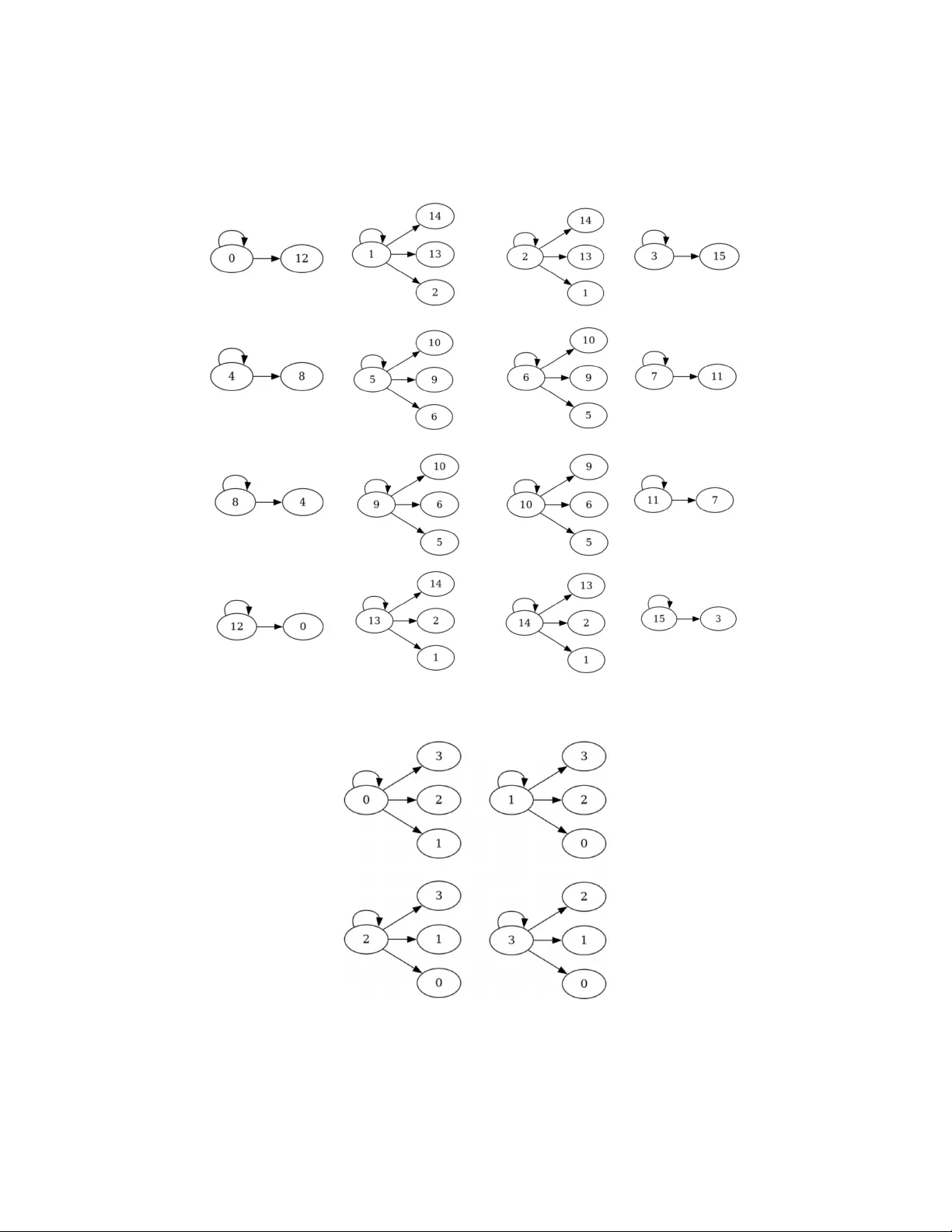
Imp erfect Graphs from Unitary Matrices - I W esley Lewis 1 , Darsh P areek 1 , Umesh Kumar 1 , and Ra vi Janjam 1,2 1 Researc her 2 Principal In v estigator / Chief of R&D 1 Numerik al Labs , 1942 Broadw a y St, Suite 314C, Boulder, CO 80302 F ebruary 26, 2026 Abstract Matrix represen tations of quantum operators are computationally com- plete but often obscure the structural top ology of information flow within a quan tum circuit [ 13 ]. In this pap er, we in troduce a generalized graph- theoretic framew ork for analyzing quantum op erators b y mapping unitary matrices to directed graphs; w e term these structures Imp erfe ct Gr aphs or more formally as T op olo gic al Structure of Sup erp ositions (TSS) as a to ol to devise b etter Quantum Algorithms. In this framew ork, we represen t computational basis states as vertices. A directed edge exists b etw een tw o vertices if and only if there is a non- zero amplitude transition b et w een them, effectiv ely mapping the supp ort of the unitary op erator. In this pap er we delib erately discard probability amplitudes and phase information to isolate the connectivity and reacha- bilit y prop erties of the op erator. W e demonstrate how TSS intuitiv ely helps describ e gates such as the Hadamard, P auli-(X,Y,Z) gates, etc [ 13 ]. This framew ork provides a no v el p erspective for viewing quantum circuits as discrete dynamical systems [ 6 , 3 ]. Keyw ords : Quan tum Algorithms, Unitary Matrix Approac h, T op ologi- cal Structure of Sup erpositions (TSS), Graph Theory 1 1 In tro duction Quan tum computing is fundamen tally describ ed by linear algebra, where quan- tum states are vectors in a Hilb ert space and op erations also referred to as Quan tum Gates are represented by unitary matrices [ 13 ]. While this matrix form ulation is essen tial for sim ulation, it lacks intuitiv e transparency regard- ing the structural b eha vior of a circuit. As the n um ber of qubits n increases, the Hilbert space grows to 2 n for t w o state realizations of qubits, making the in terpretation of unitary matrices through visual insp ection alone increasingly difficult. T o address this complexit y , w e can categorize the analysis of quan tum opera- tions in to tw o primary approaches. First, the Circuit Elements Approac h (CEA) constructs the system via indep enden t, lo cal op erators (gates) added sequen- tially . While amenable to lo cal mo difications and hardware implemen tations, CEA often obscures the global top ological prop erties of the final transforma- tion when all state combinatorics are to b e taken into account. Second, the Unitary Matrix Approach (UMA) analyzes the prop erties of the final unitary matrix U encompassing the entire circuit. While UMA ”natively” describ es the global computational structure, extracting meaningful patterns from these high-dimensional matrices remains a c hallenge. F or instance, the Solov a y-Kitaev theorem [ 7 ] pro vides a widely used algorithm for appro ximating a unitary ma- trix in to smaller circuit elemen ts [ 16 , 20 ]. Ho w ev er, while effectiv e for compi- lation, these decomp osition metho ds do not inherently reveal the algorithmic substructures or the top ological information flow that a practitioner seeks to understand. In classical computing, state-transition diagrams and control flo w graphs are standard to ols. These visualizations allo w researc hers to iden tify lo ops, dead ends, and connectivit y properties at a glance. In the quantum do- main ho w ev er, constructing such representations is non-trivial, as a single basis state can evolv e into a linear combination of all possible states with complex- v alued amplitudes [ 13 ]. In this pap er, we prop ose topological abstraction of quan tum circuits that lev erages the Unitary Matrix Approac h w here all p ossible state transition com- binatorics is considered. W e in troduce a framew ork to map unitary op erators to directed graphs, which w e term the T op ological Structure of Superp ositions (TSS). By treating the non-zero supp ort of a unitary matrix as an adjacency matrix for a directed graph, we analyze quantum gates as discrete dynamical systems [ 6 , 3 ], isolating the connectivity prop erties of the op erator from its probabilistic factors. 2 2 Metho dology 2.1 Theoretical Basis W e consider a quantum system describ ed b y a Hilb ert Space H of dimension N = 2 n (for n qubits) [ 13 ]. The computational basis B = { e 0 , e 1 , . . . , e N − 1 } forms an orthonormal set spanning H . A general quan tum state vector | ψ ⟩ is defined as a linear combination of these basis vectors: | ψ ⟩ = N − 1 X i =0 c i e i where c i ∈ C are complex probability amplitudes satisfying P | c i | 2 = 1 [ 13 ]. Quan tum gates are represented by unitary matrices U of size N × N that trans- form an input state to an output state: | ψ out ⟩ = U | ψ in ⟩ [ 13 ]. While the final state v ector | ψ out ⟩ is mathematically defined b y orthogonality , its ph ysical in- terpretation is often multifaceted. The distribution of non-zero basis states in the output allows for v arious structural in terpretations, including en tanglemen t [ 12 ], where the system admits multiple representations for the same quan tum prop ert y . Our top ological approach aims to visualize these representations ex- plicitly . 2.2 Graph Represen tation T o analyze the top ological structure of these op erators, we construct a directed graph that maps the non-zero supp ort of the unitary matrix. Unlik e standard state-space visualizations which often require con tin uous parameters [ 19 , 15 ], our mapping is discrete and top ological. W e define a mapping ϕ that asso ciates eac h basis v ector e i with a unique integer v ertex index: ϕ ( e i ) = i for i ∈ { 0 , . . . , N − 1 } This strictly limits our v ertices to fundamen tal basis states. W e delib erately exclude sup erposed states (linear com binations where m ultiple c i = 0) from the vertex set to av oid the com binatorial explosion asso ciated with p ow er-set constructions. 2.3 TSS Construction W e construct the T opological Structure of Superp ositions (TSS) , denoted as G TSS = ( V , E ), as follows: • V ertices ( V ): The set of integers representing the computational basis states. V = { 0 , 1 , . . . , N − 1 } The graph size corresp onds linearly to the Hilb ert space dimension N . 3 • Edges ( E ): A directed edge ( j, i ) exists from v ertex j to v ertex i if the unitary op erator U facilitates a transition from basis state | j ⟩ to basis state | i ⟩ with non-zero amplitude. E = { ( j, i ) | | ⟨ i | U | j ⟩ | > 0 } 3 Statistical Analysis of TSS In this section, we presen t the topological analysis of TSS graphs generated by v arious fundamental unitary op erators. Our metho d is univ ersally applicable to an y unitary matrix. W e observ ed that the top ological ”shap e” of the graph correlates strongly with the op erator’s role in quantum algorithms [ 6 , 3 ]. One should also understand that TSS is constructed based on the Gate’s op eration on the operand only once and on a single qubit. Analyzing the out- come on entangle d vs sup erp osition states would lead to a different structure completely . So, this TSS is the fundamental variant of TSS for an ything that’s exp ected to come in the future. 3.1 Sparsit y vs. Connectivit y A key observ ation from our analysis is the trade-off b et ween graph sparsit y and connectivit y . W e choose t w o unique and widely studied matrices for demon- strating the idea. While the matrices themselv es don’t necessarily imply m uc h, they how ever hav e some prop erties that are global in scop e. • Algorithmic Sparsity: W e observe that op erators used for logical ma- nipulation (suc h as con trol sequences or arithmetic functions) typically exhibit sparse TSS connections . F or devising complex algorithms, high connectivity is often undesirable; if a single state vector immediately transitions in to a sup erp osition of all p ossible states, the system loses the structural sp ecificit y required for logical op erations [ 8 , 2 ]. • Data Loading Efficiency: Conv ersely , highly connected graphs are ad- v antageous for ”Data Loading” phases. If a single input vector intro- duces transitions to a v ast num ber of states (high out-degree), tangled con trolled-gate op erations can b e utilized to load data efficien tly into the system. 3.2 Hadamard Matrices: The Normalizer The Hadamard operator is top ologically distinct due to its densit y [ 13 ]. Since Hadamard matrices are constructed primarily of ± 1 entries (up to a normaliza- tion factor), the op eration on a basis state results in a final v ector with non-zero en tries at nearly every index. 4 • T op ology: The TSS of a Hadamard op erator approaches a fully con- nected graph (or clique). Every node has a directed edge to almost ev ery other no de. • Interpretation: The Hadamard matrix in troduces the prop ert y of nor- malization to the TSS of any graph. It maximizes the top ological en- trop y , ensuring the state is distributed across the entire Hilb ert space. 3.3 P auli Matrices: Island Graphs P auli gates ( X, Y , Z ) and their tensor products pro vide the most structured TSS top ologies [ 13 ]. • T op ology: The TSS per state for Pauli matrices generally manifests as ”forks.” Mathematically , this corresp onds to sparsely connected b et w een an y tw o edges edges ( i → j and j → i ) or disjoin t cycles of length 2. • Interpretation: This structure confirms the Pauli group’s role as re- v ersible, classical-lik e p erm utations [ 8 ]. An y tensor pro duct of other ma- trices with a set of Pauli gates will inherit this structure with, sparse top ology . 3.4 In terpretation of Entanglemen t While the orthogonality of the final state vector is the primary mathematical constrain t [ 13 ], the TSS allows for broader ph ysical interpretations. The sp e- cific connectivity pattern—where a single no de branches into a specific subset of no des—can b e in terpreted as a structural represen tation of entanglemen t [ 12 , 9 ]. The graph topology reveals how the system maintains multiple repre- sen tations (or paths) for the same quantum prop ert y , a feature not visible in the raw matrix v alues alone. 3.5 TSS Examples In this section, we’ll discuss some of the TSS graphs pro duced from widely used circuits and also some matrices that don’t yet ha v e a circuit represen tation or rather purely abstract in nature. W e made a deliberate c hoice of the unitary matrices for this paper to demon- strate how TSS c hanges. Complete TSS of fully connected graph of just 3 or 4 qubits is sufficien tly complicated that we need a completely new visualization tec hnique, and me asur es for analysis. So, we only show a few samples in this pap er. P x ⊗ P x ⊗ P x ⊗ P x 5 W e get a matrix whose dimensions are 2 4 × 2 4 with the highest state v ector represen ted in quan tum state notation | 1111 ⟩ ∼ | 15 ⟩ P x refers to the Pauli-X matrix. This construction is an arbitrary choice without a circuit representation and no known functional utilit y either. The TSS graph [ 11 ] provides a rich structure with pairs of nodes connected in b oth w a ys. It is also noticeable that, the sum of the states equals 15 no matter which pair we choose, where each state has some complementary state that completes the sum to 15. This prop ert y can be used for some purp ose. Berk eley ⊗ P x W e get a matrix whose dimensions are 2 3 × 2 3 with the highest state vector represen ted in quan tum state notation | 111 ⟩ ∼ | 7 ⟩ . TSS structure [ 8 ] for all the nodes are isomorphic to eac h other, and it seems more lik e that of the TSS of a simple Hadamard matrix. It’s worth noting that P x didn’t introduce an y sparsity . Berk eley ⊗ Berk eley W e get a matrix whose dimensions are 2 4 × 2 4 with the highest state vector represen ted in quan tum state notation | 1111 ⟩ ∼ | 15 ⟩ . TSS structure [ 3 , 7 ] for all no des are isomorphic to eac h other where we ha v e quadruples in the outputs. The reason for suc h a symmetric structure is easy to understand. Berk eley matrix is symmetric in shap e with not man y unique elemen ts which implies, any v ector multiplied to this gate will lead to unit v al- ues showing up in the state vector in p ositions that are symmetric as well. Berk eley matrix has a structure as given below with t w o unique v alues com- plex conjugated. When a m ultiplication with a state v ector happens, it’s easily seen ho w things sho w up depending on the position where the unit in the decimal notation of qubit is lo cated. a 0 0 b 0 c d 0 0 e f 0 g 0 0 h Gro v er ⊗ P x W e get a matrix whose dimensions are 2 3 × 2 3 with the highest state v ector represen ted in quan tum state notation | 111 ⟩ ∼ | 7 ⟩ . TSS graph [ 5 ] is fully connected and has bidirectional connectivity to every no de which implies, every state is reac hable from ev ery other state. The basic Gro v er state is also fully connected, but the newer gate seems to not share the self lo op structure. 6 name bb [ 3.5 ] saneg [ A ] gr4 [ A ] had16 [ A ] p xp xp xp x [ 3.5 ] no. of sinks 16 4 4 16 16 no. of sources 16 4 4 16 16 sink to source ratio 1 1 1 1 1 no. of self lo ops 16 4 4 16 0 no. of lo ops 96 5 24 1M+ 8 m ultiplicit y 4 1.5 1.5 16 1 P z ⊗ Grov er W e get a matrix whose dimensions are 2 3 × 2 3 with the highest state v ector represen ted in quan tum state notation | 111 ⟩ ∼ | 7 ⟩ . TSS graph [ 6 ] is brok en in to t w o island graphs and self lo ops exist which seems to ha v e b een inherited from the basic Grov er state. Prop erties of TSS Graphs • Sink , refers to the no de where the arrow head ends in an output state v ector • Source , refers to the no de where the arro w starts from an input state v ector • Self Lo op , where the source no de p oints to the same sink, and is the smallest p ossible lo op in a TSS graph • Lo op , where directed arrows start and end at the same no de cov ering more than one no de • Multiplicity , the ratio of n um b er of inw ard p oin ting arrows to a no de to that of the no of sources av eraged o v er the en tire TSS graph The histograms[ 1 ] pro vide insigh ts into how the property of m ultiplicit y helps understand TSS graph structure. Along the X-axis we hav e the input states, and Y-axis w e hav e the no of times the outputs o ccurred for that particular input aggregated o v er all the outputs i.e for the entire TSS graphs. If the shap e is a flat square, it indicates all output states are o ccurring same no of times, but if they are not, then the quantum gate happ ens to pro duce only some of the states. Histograms don’t reveal connectivity patterns in TSS, for which w e to devise another measure. The num b er of measures we’v e tabulated ab o ve can’t b e limited. As we get more matrices, and interesting TSS graphs, we hav e to come up with other measures for analyzing richer substructures in these graphs. These measures help understand the structure of the graph, p otentially infer the kind of matrix and hence get a sense of their usefulness in devising Quan tum Algorithms. One can notice that TSS graphs hav e the p oten tial to understand ho w the matrix 7 Figure 1: Multiplicity histogram for tensor pro duct of Berkeley ⊗ Berkeley [ 3.5 , 3 , 7 ] should b e mo dified tow ards an algorithm. 4 Conclusion In this pap er, we introduced a new measure called as T op ological Structure of Sup erpositions (TSS) —collo quially termed ”Imp erfect Graphs”—as a no v el top ological analysis approac h for unitary op erators. W e call the graphs imp er- fe ct b ecause of lack of any kind of app ealing global prop ert y . By mapping basis states to v ertices and non-zero transitions to edges, w e constructed a discrete dynamical view of quantum circuits [ 6 , 3 ] that isolates structural connectivit y from probabilistic amplitude. TSS graph contains information about all the qubit combinatorics for that particular op erator providing a global transition path graph. Our framework reveals a fundamental top ological dic hotom y b et w een classical- rev ersible op erations and quantum-in terference op erations. W e demonstrated that classical gates manifest as sparse, 1-regular p ermutation graphs, whereas k ey quantum subroutines, such as the Hadamard manifest as dense, highly con- nected graphs. This confirms that the computational pow er of quan tum algo- rithms is topologically link ed to the density of state-space connectivity [ 1 ]. This visualization tec hnique v alidates the Unitary Matrix Approac h (UMA) 8 Figure 2: Multiplicity histogram for Berkeley ⊗ Swap Alpha 1/2 b y pro viding a tractable metho d for analyzing global op erator structure [ 16 , 20 ]. The TSS framework complements existing metho ds for quantum circuit analysis, including stabilizer formalism [ 8 , 2 ] and graph state representations [ 12 , 19 , 15 ], by offering a purely top ological p erspective. F uture work will extend this framework to include probabilit y and phase analysis, p oten tially connecting TSS top ology with kno wn complexity classes [ 1 , 5 ]. Additionally , we plan to inv estigate whether TSS patterns can inform automated circuit syn thesis [ 7 ] and pro vide new insights in to quan tum algorithm design. On a final note it should b e understo od that the TSS method originated to describ e Unitary Matrices. It can how ever b e applied to matrices of any kind to understand the properties as Mathematical abstractions for constructing ho- momorphisms b et w een matric es and gr aphs . References [1] Scott Aaronson. Quantum Computing sinc e Demo critus . Cambridge Uni- v ersit y Press, 2013. [2] Scott Aaronson and Daniel Gottesman. “Impro v ed sim ulation of stabilizer circuits”. In: Physic al R eview A 70.5 (Nov. 2004). issn : 1094-1622. doi : 9 10 . 1103 / physreva . 70 . 052328 . url : http : / / dx . doi . org / 10 . 1103 / PhysRevA.70.052328 . [3] Dorit Aharonov et al. Quantum Walks On Gr aphs . 2002. arXiv: quant - ph / 0012090 [quant-ph] . url : https : / / arxiv . org / abs / quant - ph / 0012090 . [4] M Blaaub oer and RL De Visser. “An analytical decomp osition proto col for optimal implementation of tw o-qubit entangling gates”. In: Journal of Physics A: Mathematic al and The or etic al 41.39 (2008), p. 395307. [5] Sergey Bra vyi and Da vid Gosset. “Improv ed Classical Simulation of Quan- tum Circuits Dominated b y Clifford Gates”. In: Physic al R eview L etters 116.25 (June 2016). issn : 1079-7114. doi : 10 . 1103 / physrevlett . 116 . 250501 . url : http://dx.doi.org/10.1103/PhysRevLett.116.250501 . [6] Andrew M. Childs. “Universal Computation b y Quantum W alk”. In: Phys- ic al R eview L etters 102.18 (May 2009). issn : 1079-7114. doi : 10 . 1103 / physrevlett . 102 . 180501 . url : http : / / dx . doi . org / 10 . 1103 / PhysRevLett.102.180501 . [7] Christopher M. Da wson and Michael A. Nielsen. The Solovay-Kitaev al- gorithm . 2005. arXiv: quant - ph / 0505030 [quant-ph] . url : https : / / arxiv.org/abs/quant- ph/0505030 . [8] Daniel Gottesman. Stabilizer Co des and Quantum Err or Corr e ction . 1997. arXiv: quant- ph /9705052 [quant-ph] . url : https :/ /arxiv .org/ abs/ quant- ph/9705052 . [9] D. Gross, S. T. Flammia, and J. Eisert. “Most Quantum States Are T o o Entangled T o Be Useful As Computational Resources”. In: Physi- c al R eview L etters 102.19 (Ma y 2009). issn : 1079-7114. doi : 10 . 1103 / physrevlett . 102 . 190501 . url : http : / / dx . doi . org / 10 . 1103 / PhysRevLett.102.190501 . [10] Lo v K. Grov er. A fast quantum me chanic al algorithm for datab ase se ar ch . 1996. arXiv: quant- ph/9605043 [quant-ph] . url : abs/quant- ph/9605043 . [11] Jacques Hadamard. “R ´ esolution d’une question relative aux d´ eterminan ts”. In: Bul letin des Scienc es Math´ ematiques 2.1 (1893), pp. 240–246. [12] M. Hein, J. Eisert, and H. J. Briegel. “Multiparty en tanglemen t in graph states”. In: Physic al R eview A 69.6 (June 2004). issn : 1094-1622. doi : 10 . 1103 / physreva . 69 . 062311 . url : http : / / dx . doi . org / 10 . 1103 / PhysRevA.69.062311 . [13] Mic hael A. Nielsen and Isaac L. Chuang. Quantum Computation and Quantum Information . Cambridge: Cambridge Univ ersit y Press, 2000. [14] W. Pauli. “The Connection Bet w een Spin and Statistics”. In: Phys. R ev. 58 (8 Oct. 1940), pp. 716–722. doi : 10 . 1103 / PhysRev . 58 . 716 . url : https://link.aps.org/doi/10.1103/PhysRev.58.716 . 10 [15] Rob ert Raussendorf and Hans J. Briegel. “A One-W a y Quantum Com- puter”. In: Phys. R ev. L ett. 86 (22 May 2001), pp. 5188–5191. doi : 10 . 1103 / PhysRevLett . 86 . 5188 . url : https : / / link . aps . org / doi / 10 . 1103/PhysRevLett.86.5188 . [16] V.V. Shende, S.S. Bullo c k, and I.L. Marko v. “Syn thesis of quantum-logic circuits”. In: IEEE T r ansactions on Computer-Aide d Design of Inte gr ate d Cir cuits and Systems 25.6 (June 2006), pp. 1000–1010. issn : 1937-4151. doi : 10 .1109 /tcad .2005 .855930 . url : http :/ / dx . doi. org/ 10. 1109/ TCAD.2005.855930 . [17] Neil JA Sloane. “A library of Hadamard matrices”. In: available at the website: http://www. r ese ar ch. att. c om/˜ njas/hadamar d (1999). [18] W o jciech T adej and Karol ˙ Zyczk o wski. “A concise guide to complex Hadamard matrices”. In: Op en Systems & Information Dynamics 13.2 (2006), pp. 133– 177. [19] Maarten V an den Nest, Jero en Dehaene, and Bart De Mo or. “Graphical description of the action of local Clifford transformations on graph states”. In: Physic al R eview A 69.2 (F eb. 2004). issn : 1094-1622. doi : 10 . 1103 / physreva . 69 . 022316 . url : http : / / dx . doi . org / 10 . 1103 / PhysRevA . 69.022316 . [20] F arrokh V atan and Colin Williams. “Optimal quan tum circuits for general t w o-qubit gates”. In: Physic al R eview A 69.3 (Mar. 2004). issn : 1094-1622. doi : 10 . 1103 / physreva . 69 . 032315 . url : http : / / dx . doi . org / 10 . 1103/PhysRevA.69.032315 . [21] Jennifer Seb erry W allis. “Hadamard matrices”. In: Combinatorics: R o om Squar es, Sum-fr e e Sets, Hadamar d Matric es . Berlin, Heidelb erg: Springer, 2006, pp. 274–489. [22] Jun Zhang et al. “Minimum Construction of Tw o-Qubit Quan tum Op era- tions”. In: Physic al R eview L etters 93.2 (July 2004). issn : 1079-7114. doi : 10.1103/physrevlett . 93.020502 . url : http://dx. doi.org/10.1103/ PhysRevLett.93.020502 . 11 A Unitary Matrices In this app endix, we are describing the basic gates used to construct more so- phisticated gates that expand the dimensionality and more importantly under- standing ho w these operations can inherit the prop erties for a ric her TSS graph. P auli Matrices P auli Matrices w ere devised b y W olfgang Pauli [ 14 ] to theoretically represent the effects of quantization of magnetic interactions. It was later extended to other areas, and generalizations were attempted. One tends to study them in the context of Sup er Unitary group, SU(n) as w ell The basic Pauli Matrices ha v e b eautiful prop erties when op erated on other matrices esp ecially relev ant to Quantum Computing op erators. P x = 0 1 1 0 , P y = 1 − i i 0 , P z = 1 0 0 − 1 Hadamard Matrices They were devised [ 11 ] during the late 1800s and used in a wide v ariet y of areas in b oth science and engineering. Due to their ubiquity , an attempt w as made to generalize and deduce all p ossible matrices. As of to da y a lot of databases are a v ailable with suc h matrices of increasing orders discov ered as more and more computing p o w er [ 21 ] is a v ailable. On a similar note, a new class of Hadamard matrices called as Complex Hadamard matrices [ 18 ] hav e been more recently pursued which hav e o dd or- ders. These are particularly relev ant to Quantum Computing unlik e their real coun terparts which hav e b een used in applications p ertaining more to the do- main of Signal Pro cessing, Image Pro cessing or the like. F or the purp ose of this analysis, we’v e selected one matrix amongst the sev eral matrices do cumen ted by Neil Sloane [ 17 ]. Note that, this is not a unique Hadamard matrix of order 16, because one can hav e plent y suc h of same order. had16 = 1 1 1 1 1 1 1 1 1 1 1 1 1 1 1 1 1 − 1 1 − 1 1 − 1 1 − 1 1 − 1 1 − 1 1 − 1 1 − 1 1 1 − 1 − 1 1 1 − 1 − 1 1 1 − 1 − 1 1 1 − 1 − 1 1 − 1 − 1 1 1 − 1 − 1 1 1 − 1 − 1 1 1 − 1 − 1 1 1 1 1 1 − 1 − 1 − 1 − 1 1 1 1 1 − 1 − 1 − 1 − 1 1 − 1 1 − 1 − 1 1 − 1 1 1 − 1 1 − 1 − 1 1 − 1 1 1 1 − 1 − 1 − 1 − 1 1 1 1 1 − 1 − 1 − 1 − 1 1 1 1 − 1 − 1 1 − 1 1 1 − 1 1 − 1 − 1 1 − 1 1 1 − 1 1 1 1 1 1 1 1 1 − 1 − 1 − 1 − 1 − 1 − 1 − 1 − 1 1 − 1 1 − 1 1 − 1 1 − 1 − 1 1 − 1 1 − 1 1 − 1 1 1 1 − 1 − 1 1 1 − 1 − 1 − 1 − 1 1 1 − 1 − 1 1 1 1 − 1 − 1 1 1 − 1 − 1 1 − 1 1 1 − 1 − 1 1 1 − 1 1 1 1 1 − 1 − 1 − 1 − 1 − 1 − 1 − 1 − 1 1 1 1 1 1 − 1 1 − 1 − 1 1 − 1 1 − 1 1 − 1 1 1 − 1 1 − 1 1 1 − 1 − 1 − 1 − 1 1 1 − 1 − 1 1 1 1 1 − 1 − 1 1 − 1 − 1 1 − 1 1 1 − 1 − 1 1 1 − 1 1 − 1 − 1 1 12 Sw ap Alpha This is a tw o qubit gate [ 4 ] which has a phase parameter inherently attac hed to the matrix. By modifying the parameters we get quite a v ariety of gates with in teresting prop erties e iπ / 2 α e − iπ / 2 α 0 0 0 0 cos( π / 2 α ) i sin( π/ 2 α ) 0 0 i sin( π/ 2 α ) cos( π / 2 α ) 0 0 0 0 e − iπ / 2 α Berk eley Gate B-Gate [ 22 ] as it is often referred to is a t w o qubit gate that shares its place as an imp ortan t gates whose applications are y et to b e discov ered. b = cos( a ) 0 0 i sin( a ) 0 cos( b ) i sin( b ) 0 0 i sin( b ) cos( b ) 0 i sin( a ) 0 0 cos( a ) , a = π / 8; b = 3 π / 8 Sw ap Alpha(-1/2) saneg12 = 1 0 0 0 0 0 . 5 − 0 . 5 i 0 . 5 + 0 . 5 i 0 0 0 . 5 + 0 . 5 i 0 . 5 − 0 . 5 i 0 0 0 0 1 Sw ap Alpha(1/2) This is the square ro ot of SW AP alpha gate, where α = π / 4 sap os12 = 1 0 0 0 0 0 . 5 + 0 . 5 i 0 . 5 − 0 . 5 i 0 0 0 . 5 − 0 . 5 i 0 . 5 + 0 . 5 i 0 0 0 0 1 Gro v er 2-qubit Gate This is a 2-qubit Grov er’s gate constructed just to chec k how TSS lo oks lik e. Gro v er’s algorithm [ 10 ] is a fundamen tal algorithm and p ossibly the only al- gorithm that mo difies the probability factors iterativ ely on a giv en sup erp osed state without modifying the sup erpo sed states. The generalization of this algorithm in v olv es constructing a Quan tum Gate that doesn’t parameterize the gate to contain the state b eing searc hed for. Con- structing an operator agnostic Gate in volv es more sophisticated heuristics where 13 feedbac k lo ops migh t be necessary . Such a Quan tum Operator as of writing this pap er hasn’t b een devised yet. g r 4 = − 0 . 5 0 . 5 0 . 5 0 . 5 0 . 5 − 0 . 5 0 . 5 0 . 5 0 . 5 0 . 5 − 0 . 5 0 . 5 0 . 5 0 . 5 0 . 5 − 0 . 5 14 B TSS Graphs The w ord ”full” in a figure caption indicates that all the states are com bined to form the c omplete TSS gr aph as opp osed to no de level TSS gr aph . In some cases b oth types are similar b ecause there’s not muc h connectivit y amongst the individual no des. Figure 3: TSS Graph: Berkeley ⊗ Berkeley Figure 4: TSS Graph: Grov er 2-qubit [ A ] 15 Figure 5: TSS Graph: Grov er [ A ] ⊗ P x 16 Figure 6: TSS Graph: P z ⊗ Grov er [ A ] 17 Figure 7: No de Level TSS: Berkeley ⊗ Berkeley 18 Figure 8: No de Level TSS: Berkeley ⊗ P x 19 Figure 9: No de Level TSS: Berkeley ⊗ Swap Alpha(1/2) Figure 10: No de Level TSS: Grov er [ A ] 20 Figure 11: TSS Graph N 4 i =1 P auli X Figure 12: TSS Graph Sw ap Alpha(-1/2) 21
Original Paper
Loading high-quality paper...
Comments & Academic Discussion
Loading comments...
Leave a Comment