An Equation of State for Turbulence in the Gross-Pitaevskii model
We report the numerical observation of a far-from-equilibrium equation of state (EOS) in the Gross-Pitaevskii model. We first show that the momentum distribution of the turbulent cascade is well described by wave-turbulent kinetic theory in the appropriate limits. Calculating the energy and particle fluxes $Π_\varepsilon(k)$ and $Π_N(k)$, we show that the turbulent state possesses the hallmarks of a direct energy cascade. Building on this, we show that the GP model encodes a universal EOS in the form of a relationship between the turbulent cascade’s momentum distribution amplitude $n_0$ and the energy flux $ε$ in the steady state. We find that in our regime of `mixed’ turbulence - where both vortices and waves play a significant role - $n_0\propto ε^{0.67(2)}$, a result that is not captured by any existing theory of turbulence but that agrees with a recent experimental measurement for large energy fluxes. Finally, we find that the concept of quasi-static thermodynamic processes between equilibrium states extends to far-from-equilibrium steady states.
💡 Research Summary
In this work the authors investigate far‑from‑equilibrium turbulence in the three‑dimensional Gross‑Pitaevskii (GP) model, which describes a weakly interacting Bose‑Einstein condensate (BEC). By adding a time‑periodic driving potential that injects energy at the system size scale, a high‑momentum dissipative term that mimics evaporative loss above a threshold energy, and a hard‑wall cylindrical box confinement, they reproduce the experimental conditions of recent ultracold‑atom turbulence studies. The simulations start from the ground‑state BEC in a box of length L = 50 µm and radius R = 15 µm, with atom numbers N≈2×10⁵ and s‑wave scattering lengths a ranging from 25 a₀ to 400 a₀. Natural GP scales – the interaction energy ζ = gn, the healing length ξ, and the time scale τ = ħ/ζ – are used to render all quantities dimensionless.
Energy is injected by the drive V_drive = U_s sin(ωt) z/L; the input power ε_in is measured as the time‑averaged product ⟨F v n⟩, where F = −∂_zV_drive and v is the centre‑of‑mass velocity. Dissipation occurs when particles acquire momenta k > k_D and leave the trap; the corresponding loss rate ˙N multiplied by the threshold energy U_D underestimates the true energy dissipation because the dissipation spectrum D_ε(k) has a pronounced tail beyond k_D. By evaluating the average dissipative momentum ⟨k_diss⟩≈1.15 k_D the authors find a correction factor α≈1.3, i.e. ε_in ≈ 1.3 · (˙N U_D/V), in excellent agreement with the numerical data.
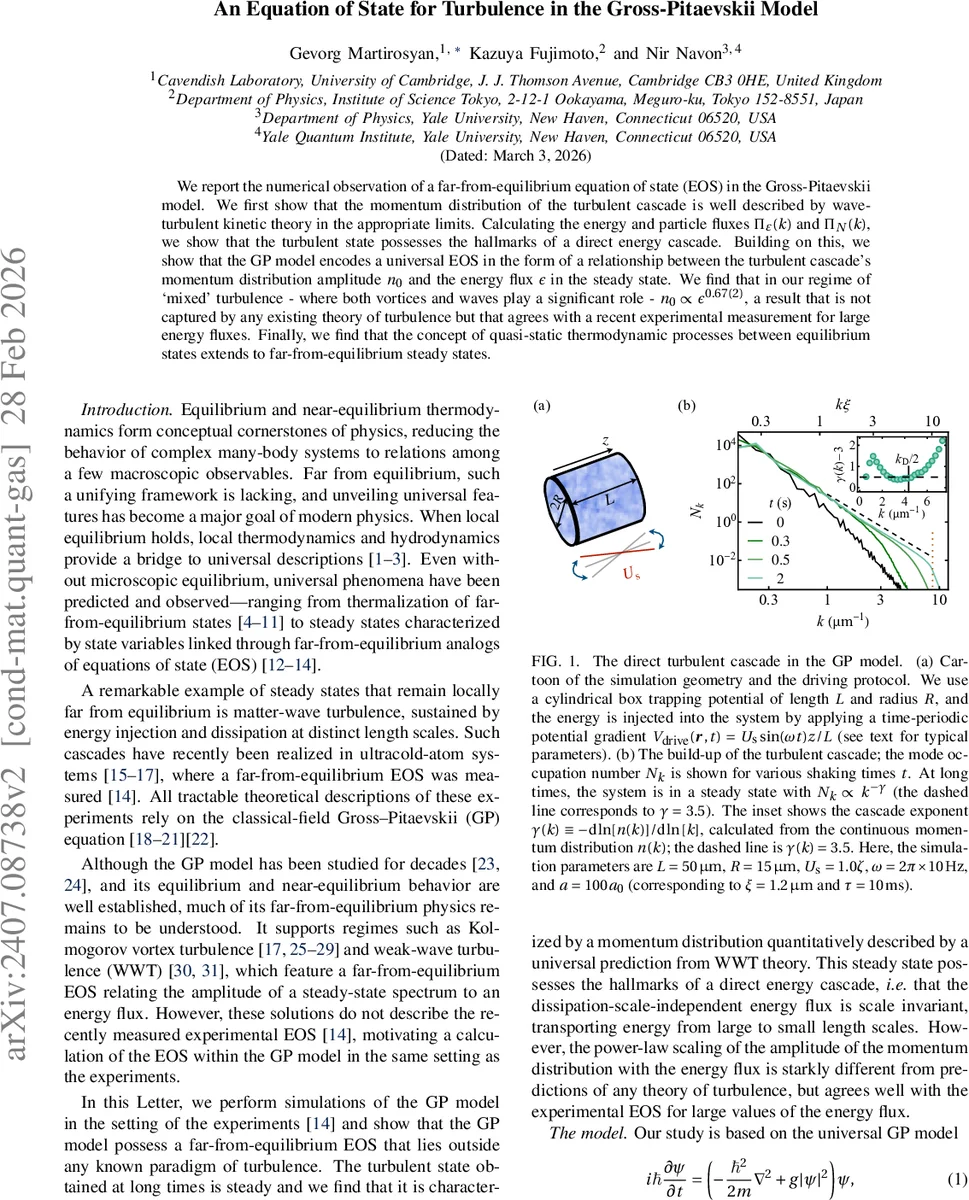
In the steady state a direct cascade develops: the mode occupation N_k follows a power law N_k ∝ k^−γ with γ≈3.5 over an inertial range bounded by the forcing scale (∼L^−1) and the dissipation scale k_D. The exponent matches the prediction of four‑wave weak‑turbulence (WWT) theory once the effective injection scale is identified as k₀≈1.64 /ξ, rather than the physical forcing wave number. The authors therefore fix the momentum distribution to n(k)=n₀ k^−γ₀ with γ₀≈3.5 and define the amplitude n₀ via n₀ ≡ N_k k³ (k ξ)^{γ₀−3}.
Scale‑resolved fluxes are computed directly. The energy flux Π_ε(k) is flat across the inertial range, confirming a scale‑independent cascade and equating to the injected power ε ≡ ε_in. The particle flux Π_N(k) also shows a plateau but decays as k^−2 with the dissipation scale, reflecting the quadratic dispersion of the particles. Thus the system exhibits the hallmarks of a direct energy cascade while simultaneously transporting particles.
The central result is an empirical equation of state (EOS) linking the turbulent amplitude n₀ to the energy flux ε. When both quantities are expressed in terms of the instantaneous GP scales (density n, healing length ξ_t, interaction energy ζ_t, and time τ_t), all data for different interaction strengths collapse onto a single curve: \
Comments & Academic Discussion
Loading comments...
Leave a Comment