On the block Eberlein diagonalization method
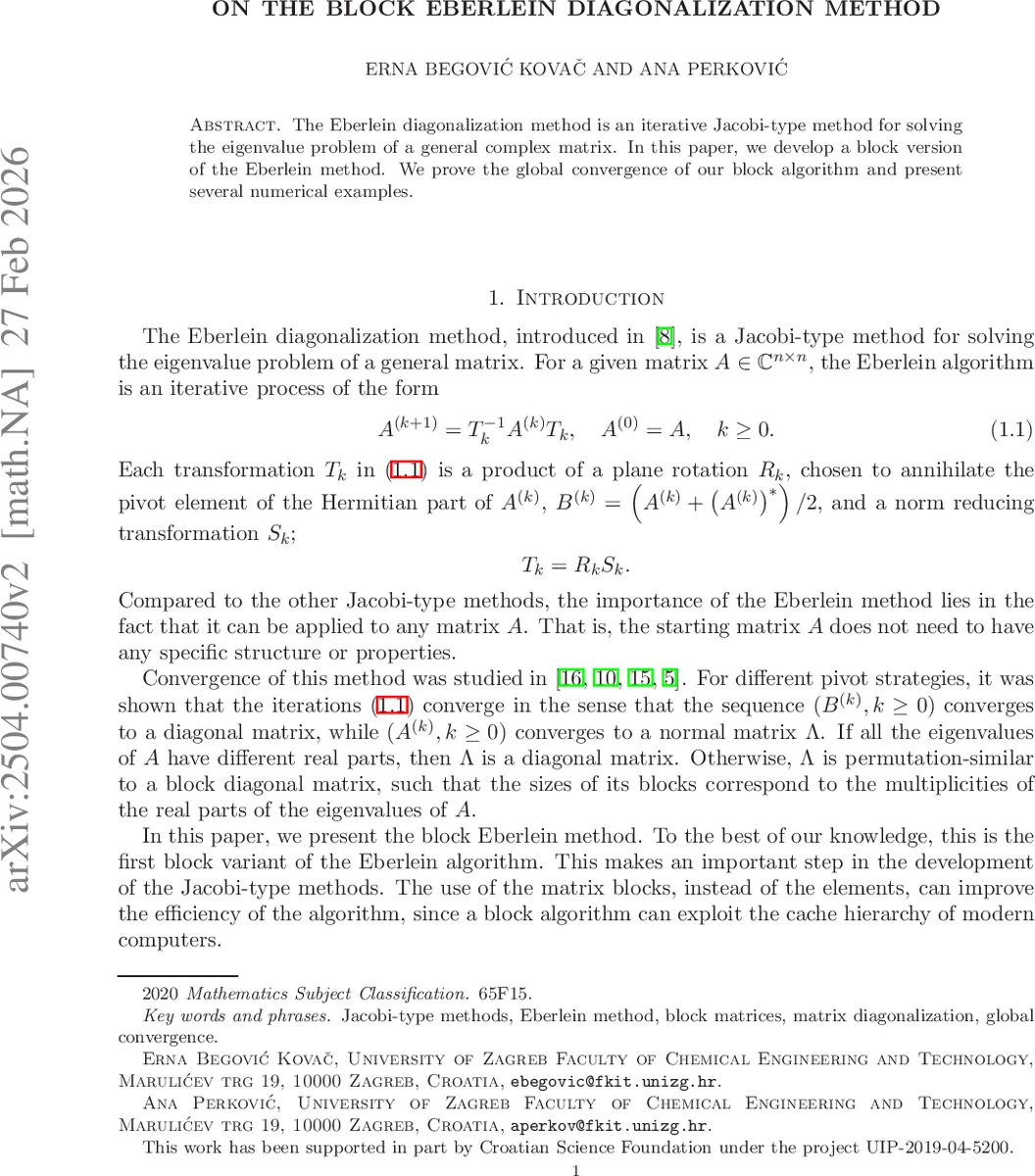
The Eberlein diagonalization method is an iterative Jacobi-type method for solving the eigenvalue problem of a general complex matrix. In this paper we develop the block version of the Eberlein method. We prove the global convergence of our block method and present several numerical examples.
💡 Research Summary
The paper introduces a block‑wise extension of the Eberlein diagonalization method, a Jacobi‑type iterative algorithm for solving the eigenvalue problem of a general complex matrix. The original Eberlein method updates a matrix A through similarity transformations A(k+1)=T_k^{-1} A(k) T_k, where each T_k is a product of a plane rotation R_k that annihilates a pivot element of the Hermitian part of A(k) and a norm‑reducing transformation S_k. The authors generalize this scheme by partitioning the matrix into blocks according to a fixed partition π=(n₁,…,n_m) and applying block elementary transformations instead of scalar‑level rotations.
The algorithm proceeds as follows. At each iteration a block pivot pair (p,q) is selected according to a prescribed pivot ordering (the paper focuses on the generalized serial orderings B_{sg} introduced in earlier work). The Hermitian part B(k)=½(A(k)+A(k)*) is formed, and the sub‑matrix corresponding to blocks p and q is diagonalized by a unitary block transformation R_k. To guarantee convergence, R_k is required to be a UBC (Uniformly Bounded Cosine) matrix: after a suitable permutation of the block rows/columns, the smallest singular value of the leading diagonal block is bounded below by a positive constant that depends only on the block sizes (or on n). This property extends the classic lower bound on the cosine of Jacobi rotation angles to the block setting.
After the unitary step, a non‑unitary block transformation S_k is constructed to reduce the Frobenius norm of the current matrix. The authors adopt the same norm‑reduction formulas used in the scalar Eberlein method, but apply them to the entire (n_p+n_q)×(n_p+n_q) pivot block. Angles β_l and hyperbolic angles ψ_l are computed from the entries of the pivot block according to equations (3.8)–(3.9), guaranteeing a maximal decrease of the Frobenius norm for each sub‑pair (r,s) within the pivot block. The reduction is quantified by Δ_l ≥ (1/3) |c̃(l)_{rs}|² ‖A(k)‖_F², ensuring a strictly positive decrease as long as the block is not already diagonal.
The convergence analysis (Section 4) shows that the off‑diagonal Frobenius norm of the Hermitian part, off(B(k)), is monotonically decreasing and converges to zero. Consequently, the full sequence A(k) converges to a normal matrix Λ; if the eigenvalues of the original matrix have distinct real parts, Λ is diagonal, otherwise it is block‑diagonal with block sizes matching the multiplicities of equal real parts. The proof relies on the UBC property of R_k, the guaranteed norm reduction of S_k, and the fact that the pivot ordering belongs to the generalized serial class, which is closed under permutations, shifts, and reversals.
Numerical experiments (Section 5) illustrate the practical benefits. The authors test matrices of various sizes and block partitions (e.g., 2×2, 4×4, 8×8 blocks) and compare three pivot strategies: row‑wise, column‑wise, and random permutations within the generalized serial set. Results demonstrate that the block version reduces the number of iterations and total floating‑point operations compared with the element‑wise Eberlein method, especially for large matrices where cache‑friendly block accesses dominate performance. Moreover, the block algorithm shows good scalability on multi‑core architectures because each block transformation can be performed independently, suggesting straightforward parallelization.
In the concluding section the authors emphasize that this work is, to the best of their knowledge, the first block formulation of the Eberlein method. They argue that the block approach bridges the gap between classical Jacobi algorithms and modern high‑performance computing requirements, offering both theoretical convergence guarantees and practical speedups. Future research directions include adaptive block partitioning, GPU‑accelerated implementations, and extensions to non‑square or indefinite block structures.
Overall, the paper makes a solid contribution by extending a known globally convergent eigenvalue algorithm to a block framework, providing rigorous convergence analysis, and demonstrating tangible computational advantages. The methodology is clearly presented, the proofs are sound, and the numerical evidence supports the theoretical claims, making it a valuable addition to the literature on Jacobi‑type eigenvalue solvers.
Comments & Academic Discussion
Loading comments...
Leave a Comment