Positively Identifying HEFT or SMEFT
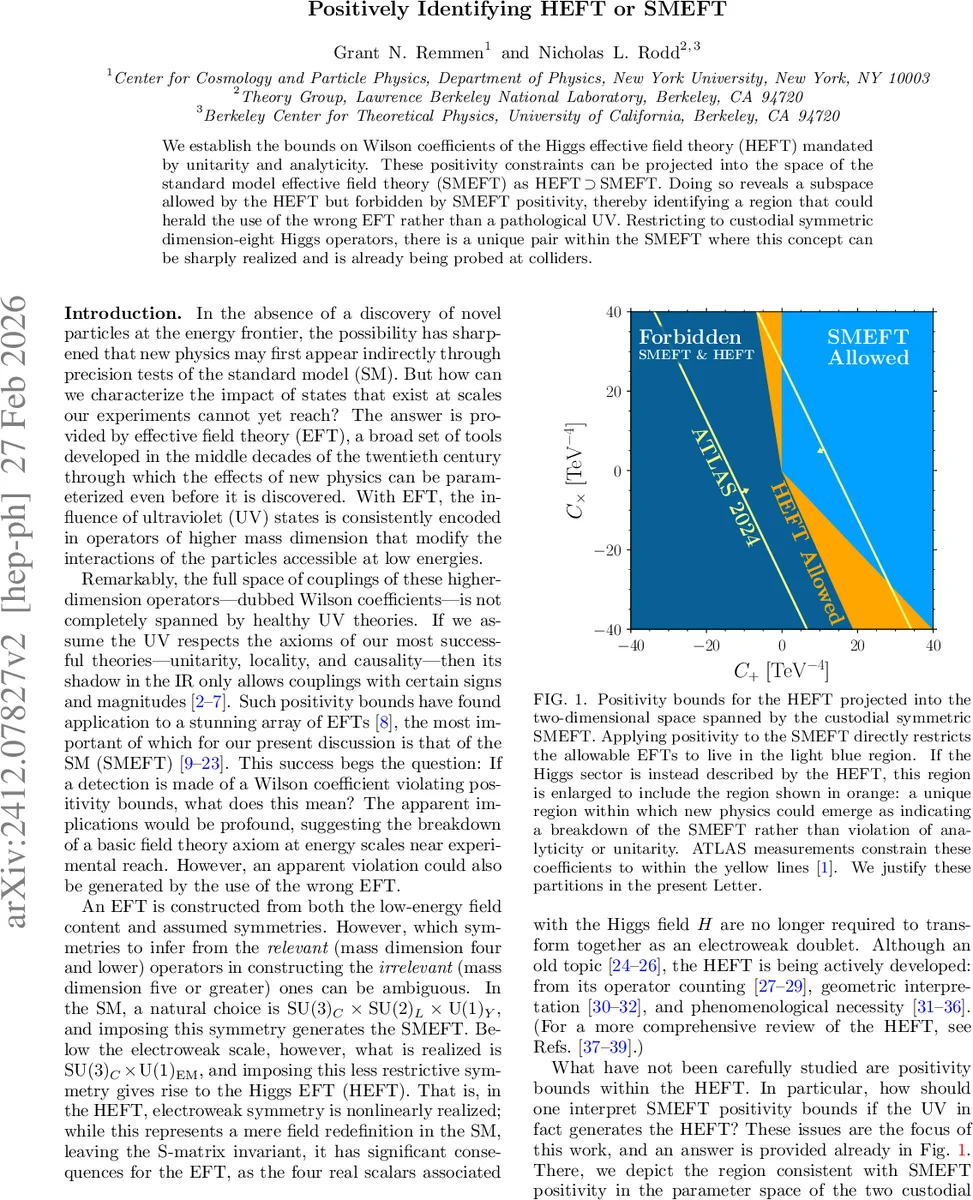
We establish the bounds on Wilson coefficients of the Higgs effective field theory (HEFT) mandated by unitarity and analyticity. These positivity constraints can be projected into the space of the standard model effective field theory (SMEFT) as HEFT$,\supset,$SMEFT. Doing so reveals a subspace allowed by the HEFT but forbidden by SMEFT positivity, thereby identifying a region that could herald the use of the wrong EFT rather than a pathological UV. Restricting to custodial symmetric dimension-eight Higgs operators, there is a unique pair within the SMEFT where this concept can be sharply realized and is already being probed at colliders.
💡 Research Summary
The paper investigates how positivity bounds—constraints that follow from unitarity, locality, and causality of any ultraviolet (UV) completion—can be used to distinguish between two effective field theory (EFT) descriptions of the Higgs sector: the Higgs Effective Field Theory (HEFT) and the Standard Model Effective Field Theory (SMEFT). While both EFTs aim to capture the low‑energy effects of heavy new physics, they differ in how electroweak symmetry is realized. SMEFT assumes a linear realization of SU(2)ₗ×U(1)ᵧ, treating the Higgs doublet H as a fundamental field, whereas HEFT adopts a nonlinear realization, describing the four real scalar degrees of freedom (the physical Higgs h and the three Goldstone bosons πᵢ) independently.
The authors focus on custodial‑symmetric dimension‑8 operators of the schematic form (∂H)⁴, which dominate two‑to‑two scattering amplitudes at leading order in the EFT expansion. In SMEFT there are three such operators, but imposing custodial symmetry eliminates one, leaving two independent operators with Wilson coefficients C₊ and C×. In HEFT, after imposing the same custodial O(4) symmetry, the operator basis reduces to five independent structures with coefficients (c_h1, c_hπ1, c_hπ2, c_π1, c_π2).
Positivity bounds are derived by considering forward elastic scattering of arbitrary superpositions of the scalar states. The forward amplitude A(s) is analytic in the complex s‑plane apart from cuts, and the classic dispersion relation yields A″(0)=4π∫₀^∞ ds σ(s)/s²>0, where σ(s) is the total cross‑section of the UV theory. Expressing A″(0) in terms of the HEFT Wilson coefficients and the superposition parameters (α,β) leads to a set of inequalities that must hold for any choice of α,β. These are: c_h1>0, c_hπ2>0, c_π1+c_π2>0, c_π2>0, and a bounded range for c_hπ1 given by –c_hπ2–q⁴c_h1(c_π1+c_π2) < c_hπ1 < q⁴c_h1(c_π1+c_π2), where q=α·β.
For SMEFT, the known positivity constraints reduce to C₊>0 and C₊+C×>0. The authors then project the full HEFT positivity region onto the SMEFT subspace. This is done by constructing an orthonormal basis V that spans the SMEFT plane in the five‑dimensional HEFT coefficient space, and decomposing any HEFT coefficient vector into a component within the plane (ˆc) and a perpendicular component (d_i V_i). The projection yields ˆc expressed directly in terms of (C₊, C×). When the perpendicular components vanish, the HEFT bounds collapse to the SMEFT bounds. However, allowing non‑zero perpendicular components enlarges the allowed region in the (C₊, C×) plane beyond the SMEFT positivity triangle. This enlarged “orange” region is precisely the set of points that are consistent with a unitary, causal UV completion of HEFT but would be ruled out if one incorrectly assumes SMEFT.
Importantly, this region is already probed by LHC measurements of anomalous quartic gauge couplings (aQGC), specifically ATLAS searches for same‑sign WW scattering with two jets. The ATLAS constraints, shown as yellow bands in the paper’s Figure 1, intersect the orange region, indicating that current data can already test the hypothesis that the Higgs sector is better described by HEFT rather than SMEFT.
The paper concludes that positivity bounds are not merely diagnostics of pathological UV physics; they also serve as a practical tool to detect the misuse of an EFT framework. Even with a minimal set of two dimension‑8 custodial‑symmetric operators, a clear, experimentally accessible parameter space exists where HEFT and SMEFT make distinct predictions. Future measurements, possibly involving higher‑dimensional operators or more precise aQGC analyses, will sharpen the discrimination between the two EFTs and help determine the appropriate low‑energy description of the Higgs sector.
Comments & Academic Discussion
Loading comments...
Leave a Comment