Imprints of primordial magnetic fields on the late-time Universe
Primordial magnetic fields (PMFs) generated in the early Universe may leave observable imprints in the present-day large-scale structure. However, it remains unclear on which spatial scales primordial
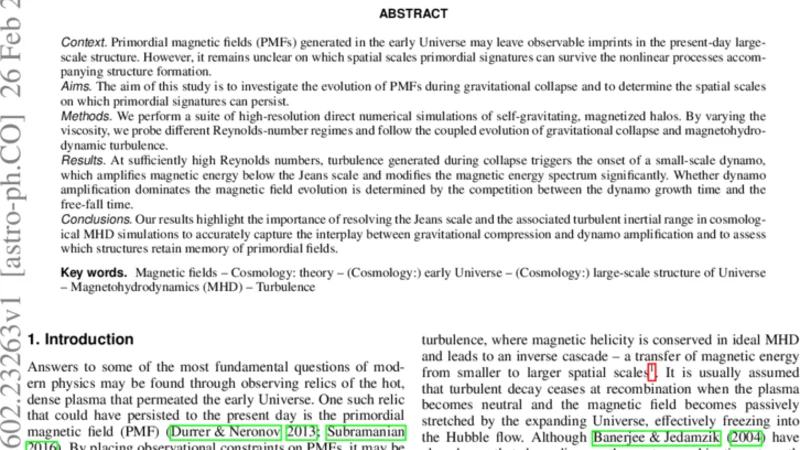
Primordial magnetic fields (PMFs) generated in the early Universe may leave observable imprints in the present-day large-scale structure. However, it remains unclear on which spatial scales primordial signatures can survive the nonlinear processes accompanying structure formation. The aim of this study is to investigate the evolution of PMFs during gravitational collapse and to determine the spatial scales on which primordial signatures can persist. We perform a suite of high-resolution direct numerical simulations of self-gravitating, magnetized halos. By varying the viscosity, we probe different Reynolds-number regimes and follow the coupled evolution of gravitational collapse and magnetohydrodynamic turbulence. At sufficiently high Reynolds numbers, turbulence generated during collapse triggers the onset of a small-scale dynamo, which amplifies magnetic energy below the Jeans scale and modifies the magnetic energy spectrum significantly. Whether dynamo amplification dominates the magnetic field evolution is determined by the competition between the dynamo growth time and the free-fall time. Our results highlight the importance of resolving the Jeans scale and the associated turbulent inertial range in cosmological MHD simulations to accurately capture the interplay between gravitational compression and dynamo amplification and to assess which structures retain memory of primordial fields.
💡 Research Summary
The paper investigates how primordial magnetic fields (PMFs), generated in the early Universe, evolve during the nonlinear phase of structure formation and whether their signatures can survive to the present day. Using a suite of high‑resolution direct numerical simulations of self‑gravitating, magnetized halos, the authors vary the kinematic viscosity to explore a wide range of Reynolds numbers (Re ≈ 10²–10⁴). Each simulation resolves the Jeans length with at least 32 cells, ensuring that the turbulent inertial range associated with gravitational collapse is captured.
Two distinct regimes emerge. In low‑Re runs, turbulence fails to develop appreciably; magnetic amplification is dominated by simple compressional scaling (B ∝ ρ²⁄³) and the magnetic energy spectrum retains its initial power‑law shape. In high‑Re runs, the rapid compression generates strong shear and vorticity, producing a Kolmogorov‑like inertial cascade (E ∝ k⁻⁵⁄³). Within this cascade, a small‑scale dynamo is triggered for wavenumbers larger than the Jeans wavenumber (k > k_J). The dynamo growth time τ_dyn becomes shorter than the free‑fall time t_ff (τ_dyn/t_ff ≈ 0.3–0.7), allowing exponential magnetic energy growth that far exceeds pure compression. Consequently, the magnetic spectrum steepens in the dynamo‑active range, transitioning from the initial kⁿ form to approximately k³⁄² or k², reflecting the tangled field structures typical of dynamo action.
The authors quantify the competition between τ_dyn and t_ff as the decisive factor governing whether dynamo amplification dominates the magnetic field evolution. When τ_dyn < t_ff, magnetic energy can increase by more than an order of magnitude, and the field retains memory of its primordial configuration while being stretched to observable scales (tens of kiloparsecs). Conversely, if turbulence is insufficient (large viscosity, low Re), the primordial imprint is largely erased by compressional dilution.
These findings have direct implications for cosmological magnetohydrodynamic simulations. Current large‑scale simulations often lack the resolution to resolve the Jeans scale and the associated turbulent inertial range, potentially underestimating dynamo‑driven amplification of PMFs. The paper therefore recommends that future simulations allocate sufficient grid resolution (≥ 64–128 cells per Jeans length) and incorporate sub‑grid models capable of reproducing high‑Re turbulence. Only with such fidelity can we reliably predict observable consequences of PMFs, such as Far‑aday rotation signatures, synchrotron emission in galaxy clusters, or subtle imprints on the cosmic microwave background anisotropies. In summary, the work demonstrates that the survival of primordial magnetic signatures hinges on the interplay between gravitational compression and small‑scale dynamo activity, and it provides quantitative criteria for when and where these signatures are expected to persist in the late‑time Universe.
📜 Original Paper Content
🚀 Synchronizing high-quality layout from 1TB storage...