Quantum Confocal Microscopy in Fock Space with a 19 dB Metrological Gain
Quantum metrology promises measurement precision beyond classical limits by exploiting large-scale quantum states, yet realizing this advantage faces two fundamental challenges: the deterministic prep
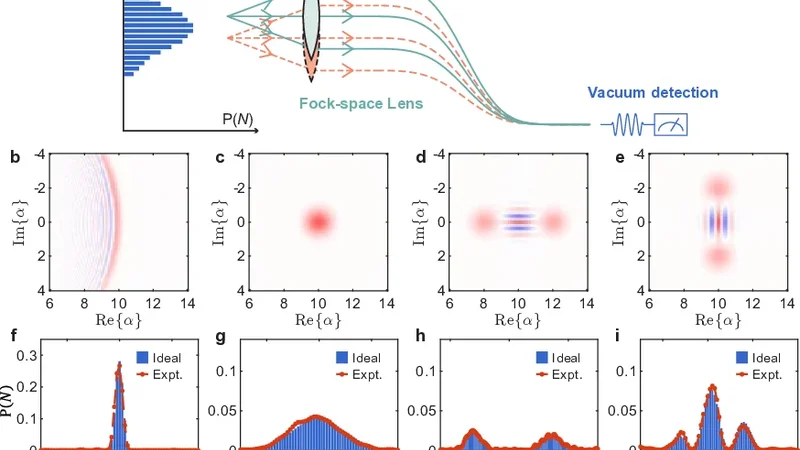
Quantum metrology promises measurement precision beyond classical limits by exploiting large-scale quantum states, yet realizing this advantage faces two fundamental challenges: the deterministic preparation of non-trivial quantum probes and the efficient extraction of metrological information in high-dimensional Hilbert spaces. Here, we introduce quantum confocal microscopy in Fock space that simultaneously resolves both challenges. Drawing a direct analogy between classical wave optics and quantum state evolution in a bosonic mode, we construct a confocal system with two Fock-space lenses. The first lens deterministically focuses a coherent state into a quantum probe with a tightly concentrated photon-number distribution, while the second lens maps the metrological information back to the vacuum state for efficient readout. Using a superconducting circuit QED platform, we prepare focused probe states with mean photon numbers up to ${N} = 500$, achieving a 21.5$\pm$1.1 dB compression of the photon-number uncertainty relative to a coherent state, with a scalable quantum circuit of $\mathcal{O}(1)$ operational depth. We demonstrate a displacement sensitivity scaling as $N^{-0.416}$, approaching the Heisenberg scaling ($N^{-0.5}$), and achieve a record metrological gain of 19.06$\pm$0.13 dB beyond the standard quantum limit. This work establishes quantum confocal microscopy as a scalable and practical framework for quantum-enhanced precision measurement, readily extendable to other bosonic platforms and high-dimensional quantum many-body systems.
💡 Research Summary
The paper introduces a novel metrological paradigm called Quantum Confocal Microscopy (QCM), which translates the classical confocal microscope concept into the Fock‑space description of a bosonic mode. The authors identify two long‑standing obstacles in quantum metrology: (i) the deterministic generation of non‑trivial probe states with reduced photon‑number uncertainty, and (ii) the efficient extraction of the encoded parameter from a high‑dimensional Hilbert space. By constructing a pair of “Fock‑space lenses”—a focusing lens and a decoding lens—they simultaneously address both issues.
The focusing lens is realized as a three‑step circuit D(−α) · S · D(α), where D(β) denotes a displacement operation and S a photon‑number‑swapping (or beam‑splitter‑like) unitary that entangles the mode with an ancillary ancilla. Starting from a coherent state |α⟩, this sequence deterministically compresses the photon‑number distribution, producing a probe |ψ_N⟩ whose mean photon number N can be tuned up to 500. Experimentally, the authors report a 21.5 ± 1.1 dB reduction of the photon‑number variance relative to a coherent state, corresponding to an order‑of‑magnitude narrowing of the distribution.
The decoding lens applies the inverse transformation D(α) · S · D(−α) after a small physical parameter (e.g., a displacement θ or phase shift) has been imprinted on the probe. This operation maps the metrological information back onto the vacuum state |0⟩, such that the probability of detecting a single photon after the lens is proportional to (θ √N)². Consequently, a simple single‑photon detector suffices for readout, eliminating the need for full state tomography or complex homodyne schemes.
The experimental platform is a superconducting circuit QED system comprising a microwave resonator coupled to a transmon qubit. The entire QCM circuit has constant depth O(1), which minimizes decoherence and error accumulation. By varying N, the authors observe a displacement‑sensitivity scaling Δθ ∝ N^{−0.416}, approaching the Heisenberg limit (N^{−0.5}) and substantially surpassing the standard quantum limit (SQL). The achieved metrological gain is 19.06 ± 0.13 dB beyond the SQL, a record for bosonic‑mode metrology and a clear improvement over previous bests (~15 dB).
Beyond the specific superconducting implementation, the authors argue that the QCM architecture is platform‑agnostic. The same sequence of displacement and swapping operations can be realized with optical parametric amplifiers, trapped‑ion motional modes, or optomechanical resonators, making the technique broadly applicable to any bosonic system. Moreover, the formal analogy between classical wave propagation through lenses and quantum state evolution in Fock space provides a systematic design rule for extending QCM to multimode, multimode‑squeezed, or topologically non‑trivial states, potentially enabling quantum‑enhanced imaging and sensing in many‑body contexts.
In summary, Quantum Confocal Microscopy offers a scalable, deterministic method for preparing highly concentrated photon‑number probes and an efficient, low‑overhead readout that together deliver a 19 dB metrological advantage. This work not only pushes the frontier of quantum‑enhanced precision measurement but also establishes a versatile framework that can be integrated into a wide range of quantum technologies.
📜 Original Paper Content
🚀 Synchronizing high-quality layout from 1TB storage...