A Scaling Law for Bandwidth Under Quantization
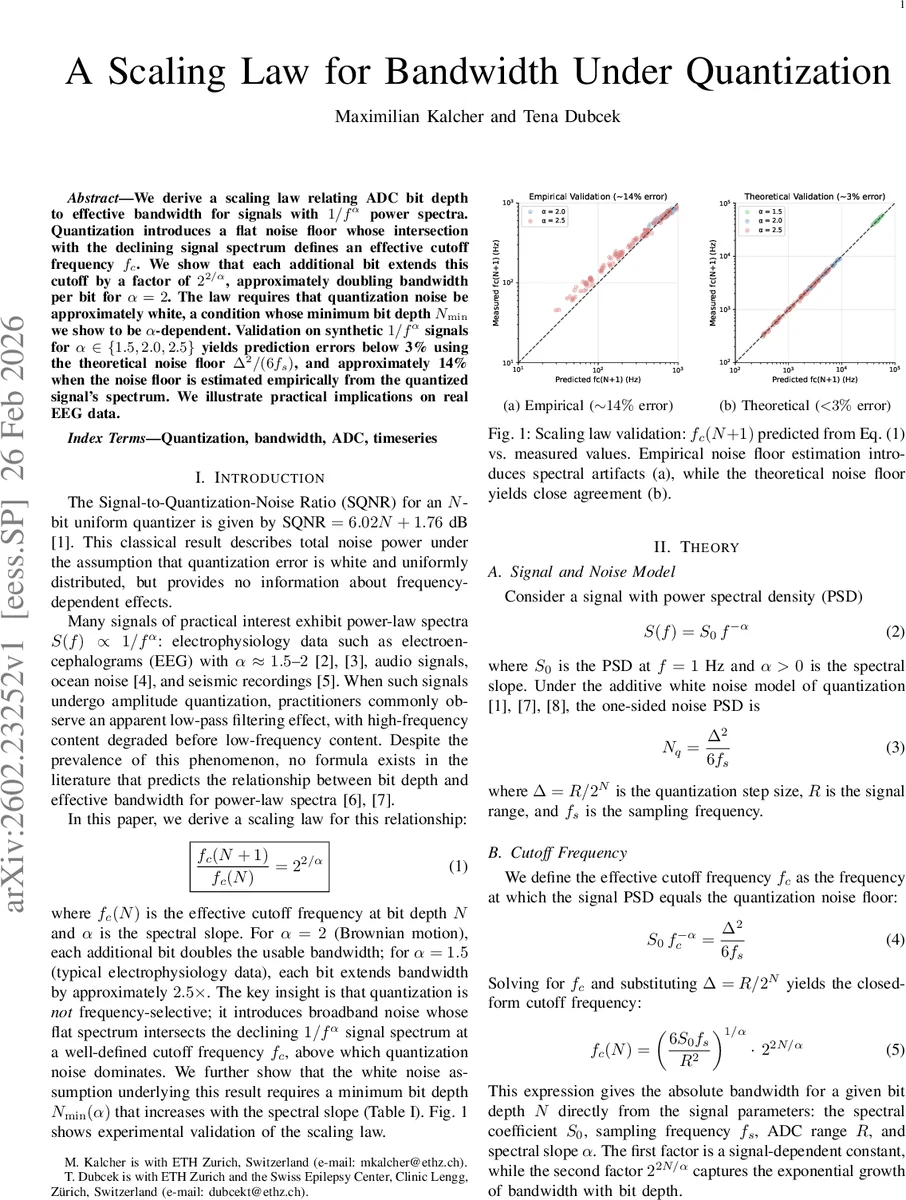
We derive a scaling law relating ADC bit depth to effective bandwidth for signals with $1/f^α$ power spectra. Quantization introduces a flat noise floor whose intersection with the declining signal spectrum defines an effective cutoff frequency $f_c$. We show that each additional bit extends this cutoff by a factor of $2^{2/α}$, approximately doubling bandwidth per bit for $α= 2$. The law requires that quantization noise be approximately white, a condition whose minimum bit depth $N_{\min}$ we show to be $α$-dependent. Validation on synthetic $1/f^α$ signals for $α\in {1.5, 2.0, 2.5}$ yields prediction errors below 3% using the theoretical noise floor $Δ^2/(6f_s)$, and approximately 14% when the noise floor is estimated empirically from the quantized signal’s spectrum. We illustrate practical implications on real EEG data.
💡 Research Summary
The paper addresses a practical yet under‑explored problem: how the resolution of an analog‑to‑digital converter (ADC) limits the usable bandwidth of signals whose power spectral density follows a power‑law, S(f) ∝ f⁻ᵅ. Classical quantization theory (e.g., Bennett’s SQNR formula) tells us that each additional bit improves the overall signal‑to‑quantization‑noise ratio by about 6 dB, but it does not describe how this improvement is distributed across frequency. Many real‑world signals—electroencephalograms (EEG), ocean acoustic background, seismic recordings—exhibit exactly such 1/fᵅ spectra, and engineers often notice that low‑resolution ADCs appear to act like low‑pass filters, attenuating high‑frequency content more severely than low‑frequency content. Prior to this work, no analytical expression existed to predict the relationship between bit depth and the “effective cutoff” frequency at which quantization noise overtakes the signal.
Theoretical development
The authors model the signal PSD as S(f)=S₀ f⁻ᵅ (α > 0) and the quantization error as additive white noise with one‑sided PSD N_q = Δ²/(6 f_s), where Δ = R/2ᴺ is the quantization step, R the full‑scale range, and f_s the sampling rate. Defining the effective cutoff frequency f_c as the point where signal power equals the noise floor (S(f_c)=N_q) yields
f_c(N) =
Comments & Academic Discussion
Loading comments...
Leave a Comment