Gaussian mode coupling of spectrally broadband photons from bulk spontaneous parametric down-conversion: A spatial-spectral mode analysis of fiber coupling
Photon sources based on spontaneous parametric down-conversion (SPDC) are central to experimental quantum optics and quantum technologies. Their performance is commonly quantified by three metrics: pa
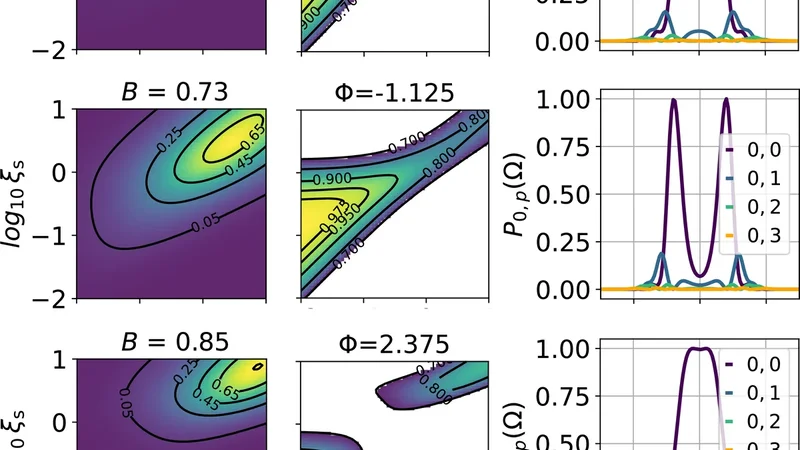
Photon sources based on spontaneous parametric down-conversion (SPDC) are central to experimental quantum optics and quantum technologies. Their performance is commonly quantified by three metrics: pair-collection probability, heralding efficiency, and spectral purity. In bulk-crystal SPDC, these metrics are known to be mutually constrained, yet the physical origin of the resulting trade-offs is often obscured. We show that these trade-offs originate from the frequency-dependent population of discrete spatial modes in the SPDC emission. By performing a Laguerre-Gauss mode decomposition at each frequency component, we show how spectral-spatial non-separability impacts collection probability, heralding efficiency, and purity. We apply this framework to two widely used quasi-phase-matching configurations: collinear degenerate type-0 and type-II SPDC in periodically poled bulk crystals, and quantify how different phase-matching functions shape the spectral-spatial mode structure. In particular, for type-II SPDC we compare standard periodically poled and aperiodically poled Gaussian phase matching. We experimentally validate some of our theoretical results using spatial- and spectral-projection measurements. This spectral-spatial mode analysis provides a quantitative and predictive framework for understanding and engineering bulk-crystal photon sources, enabling systematic multi-parameter optimization beyond qualitative design guidelines.
💡 Research Summary
This paper addresses a long‑standing puzzle in bulk‑crystal spontaneous parametric down‑conversion (SPDC) sources: why the three most commonly used performance metrics—pair‑collection probability, heralding efficiency, and spectral purity—cannot be simultaneously maximized. The authors demonstrate that the root cause lies in the frequency‑dependent occupation of discrete transverse spatial modes. By expanding the biphoton field at each angular frequency into a Laguerre‑Gauss (LG) basis, they obtain mode‑weight functions (c_{p,\ell}(\omega)) that encode how the phase‑matching function, pump beam profile, crystal length, and poling pattern distribute energy among radial index (p) and azimuthal index (\ell).
In the LG decomposition the electric‑field operator reads
\
📜 Original Paper Content
🚀 Synchronizing high-quality layout from 1TB storage...