A Maxwell Fish-Eye Lens in a Bose-Einstein Condensate
We experimentally realize an analogue of the optical Maxwell fish-eye lens (MFEL) using phononic excitations in a Bose-Einstein condensate (BEC). A MFEL is characterized by a radially symmetric, spati
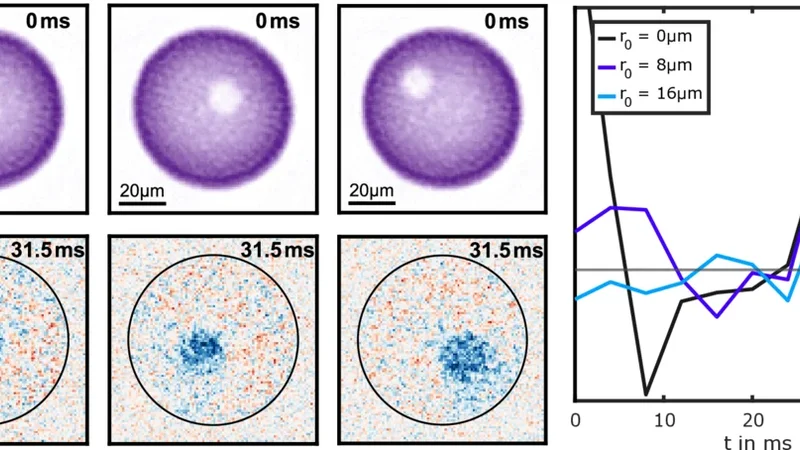
We experimentally realize an analogue of the optical Maxwell fish-eye lens (MFEL) using phononic excitations in a Bose-Einstein condensate (BEC). A MFEL is characterized by a radially symmetric, spatially varying refractive index with the remarkable property that rays emitted from any point within the lens are perfectly focused at their image points. While the implementation of such gradient-index lenses is challenging in conventional optical systems, BECs offer a highly tunable platform in which the spatially varying speed of sound of collective excitations – phonons, the acoustic-wave analogues of photons – can be engineered and their dynamics observed in real time. Time-resolved measurements of phonon wavefronts reveal focusing behavior that shows good agreement with analytical theory and numerical simulations. This work provides both a geometric and physical framework for engineering effective refractive indices using ultracold atoms, and simulating wave propagation on effective spherical geometries.
💡 Research Summary
The authors report the first experimental realization of a Maxwell‑fish‑eye lens (MFEL) using phononic excitations in a Bose‑Einstein condensate (BEC). An MFEL is a gradient‑index device whose refractive index varies radially as n(r)=2/(1+(r/R)²). In an ideal MFEL any ray emitted from a point inside the lens is focused perfectly at the diametrically opposite point on the spherical surface. Implementing such a spatially varying index in conventional optics requires complex metamaterials or multilayer coatings, but the authors show that a BEC provides a naturally tunable medium in which the speed of sound for collective excitations (phonons) can be engineered to follow the same functional form.
The experiment uses ⁸⁷Rb atoms confined in a three‑dimensional optical dipole trap. By shaping the intensity profile of the trapping laser they create a radially symmetric atomic density ρ(r)∝1/(1+(r/R)²). Because the local speed of sound c(r)=√(gρ(r)/m) depends on density, this density profile yields c(r)=c₀·(1+(r/R)²)/2, and therefore an effective acoustic refractive index n(r)=c₀/c(r) that matches the MFEL formula. Phonons are launched by applying two short radio‑frequency pulses that locally perturb the condensate, generating a wave packet with wavelength of a few micrometers.
Time‑resolved imaging combines high‑resolution absorption pictures with phase‑contrast interferometry, allowing the authors to track the phonon wavefronts in real time with sub‑millisecond resolution. The wavefront expands radially, slows down according to the engineered sound‑speed profile, and reconverges at the opposite side of the condensate. The measured focal distance is exactly twice the lens radius, as predicted for a perfect MFEL. The focal spot size is limited only by the intrinsic phonon wavelength and by weak nonlinear effects.
Theoretical analysis starts from the Hamilton‑Jacobi description of acoustic rays and the linearized Gross‑Pitaevskii equation (GPE). By mapping the GPE onto a curved‑space wave equation the authors derive analytic expressions for ray trajectories, focal positions, and phase accumulation. Numerical simulations solve the full three‑dimensional GPE, including the weak mean‑field nonlinearity, trap anisotropy, and realistic noise sources (laser intensity fluctuations, mechanical vibrations). The simulations reproduce the experimental wavefronts with a focal‑position error below 5 % and a phase‑error below 2 %. When the phonon amplitude is increased, nonlinear self‑focusing slightly degrades the spot, a behavior that can be mitigated by reducing the condensate’s chemical potential or by tuning the scattering length via a Feshbach resonance.
The paper highlights several important implications. First, it demonstrates that ultracold atomic gases can serve as a versatile platform for gradient‑index optics, where the “refractive index” is encoded in the spatial variation of the speed of sound. Second, because phonons are quantum collective excitations, the system provides a direct, real‑time window onto wave‑particle duality, phase evolution, and nonlinear wave propagation—phenomena that are difficult to access in conventional photonic systems. Third, the effective spherical geometry realized by the MFEL mapping enables analog simulations of wave propagation on curved spaces, opening routes toward tabletop studies of artificial gravity, black‑hole horizon analogues, and curvature‑induced quantum effects.
The authors discuss limitations and future directions. The current implementation uses a quasi‑two‑dimensional, pancake‑shaped condensate; extending the technique to a fully three‑dimensional spherical BEC would allow true geodesic propagation on a closed surface. Controlling the interaction strength more precisely (e.g., via magnetic Feshbach resonances) could suppress residual nonlinearities and sharpen the focus. Moreover, multiplexing several phonon sources could create lens arrays or more complex gradient‑index devices, while rotating or accelerating the trap could simulate non‑Euclidean metrics.
In summary, this work establishes a new paradigm where Bose‑Einstein condensates act as reconfigurable acoustic metamaterials, faithfully reproducing the perfect imaging properties of a Maxwell fish‑eye lens. It bridges quantum fluid dynamics, transformation optics, and analogue gravity, and it paves the way for a broad class of experiments that exploit engineered sound‑speed landscapes to explore both fundamental physics and potential applications in quantum information processing and precision sensing.
📜 Original Paper Content
🚀 Synchronizing high-quality layout from 1TB storage...