Magnetized BPS lumps in the $CP^1$ model with Maxwell coupling
We investigate Bogomolnyi-Prasad-Sommerfield (BPS) topological configurations in the $CP^1$ model minimally coupled to a Maxwell gauge field. Starting from the nonlinear $O(3)$ sigma model, we explici
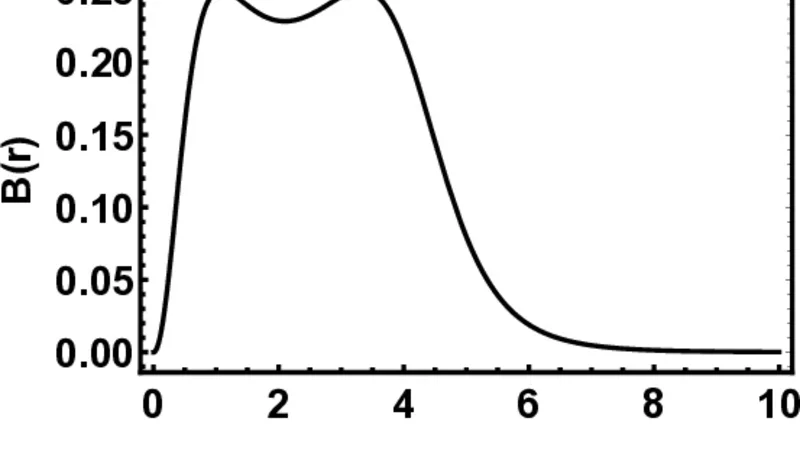
We investigate Bogomolnyi-Prasad-Sommerfield (BPS) topological configurations in the $CP^1$ model minimally coupled to a Maxwell gauge field. Starting from the nonlinear $O(3)$ sigma model, we explicitly construct its classical mapping to the $CP^1$ formulation, emphasizing the emergence of a local $U(1)$ gauge symmetry intrinsically linked to the Fubini-Study target-space geometry. Focusing on the static sector, we analyze magnetized BPS lump configurations. By examining the topological boundary conditions, we show that the magnetic flux is quantized and fully determined by the asymptotic behavior of the gauge field. Within the BPS framework, we identify the specific self-interaction potential required for the existence of self-dual configurations. A detailed analysis of the asymptotic behavior, both near the lump core and at spatial infinity, demonstrates that finite-energy solutions necessarily correspond to lump-like BPS configurations in the $CP^1$ target space, with the scalar field vanishing asymptotically. The resulting BPS equations are solved numerically, and the main physical properties of the solutions are presented. We find that these configurations are regular, magnetically localized, and energetically stable, with their internal structure rigidly controlled by the geometry of the $CP^1$ target space. In contrast to Abelian Higgs vortices, the configurations discussed here do not rely on spontaneous symmetry breaking but arise purely from the geometry of the $CP^1$ target space.
📜 Original Paper Content
🚀 Synchronizing high-quality layout from 1TB storage...