Spin-Cat Qubit with Biased Noise in an Optical Tweezer Array
Bias-tailored quantum error correcting codes (QECCs) offer a higher error threshold than standard QECCs and have the potential to achieve lower logical errors with less space overhead. The spin-cat qu
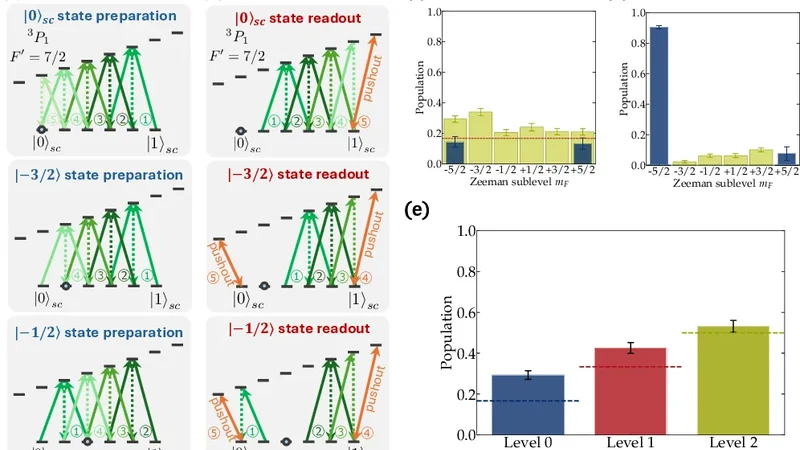
Bias-tailored quantum error correcting codes (QECCs) offer a higher error threshold than standard QECCs and have the potential to achieve lower logical errors with less space overhead. The spin-cat qubit, encoded in a large nuclear spin-$F$ system, is a promising candidate for bias-tailored QECCs. Yet its feasibility is hindered by the difficulty of performing fast covariant SU(2) rotation with arbitrary rotation angles for nuclear spins and by a lack of noise characterization for gate operations in neutral atom platforms. Here we demonstrate single-qubit controls of ${}^{173}\mathrm{Yb}$ spin-cat qubits with nuclear spin $I=5/2$ in an optical tweezer array. We implement a covariant SU(2) rotation and non-linear rotations by optical beams and achieve an averaged single-Clifford gate fidelity of $0.961_{-5}^{+5}$. The measurement of the coherence time and spin relaxation time shows that the idling error becomes increasingly biased toward dephasing errors as the magnitude of the encoded sublevel $|m_F|$ increases. Furthermore, we benchmark the noise bias of rank-preserving gates on spin-cat qubits, demonstrating a finite bias of $18_{-11}^{+132}$, in contrast to the case of the two-level system in ${}^{171}\mathrm{Yb}$, which shows no bias within the experimental uncertainty. Our work demonstrates the feasibility of spin-cat qubits for realizing bias-tailored QECCs, paving the way for achieving hardware-efficient quantum error correction.
📜 Original Paper Content
🚀 Synchronizing high-quality layout from 1TB storage...