Statistical Study of Rapid Blue Excursions as Mass Conduits in Solar Atmosphere
Rapid Blue Excursions (RBEs) are transient blue-shifted chromospheric absorption features widely interpreted as the on-disk counterparts of Type II solar spicules. We investigate their dynamic propert
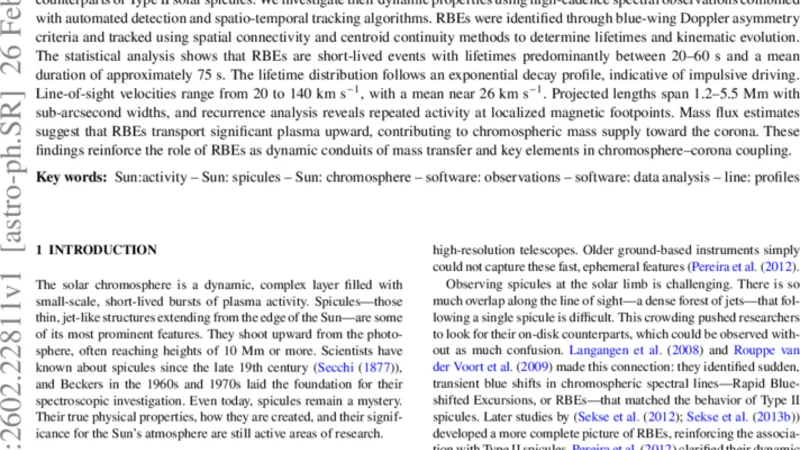
Rapid Blue Excursions (RBEs) are transient blue-shifted chromospheric absorption features widely interpreted as the on-disk counterparts of Type II solar spicules. We investigate their dynamic properties using high-cadence spectral observations combined with automated detection and spatio-temporal tracking algorithms. RBEs were identified through blue-wing Doppler asymmetry criteria and tracked using spatial connectivity and centroid continuity methods to determine lifetimes and kinematic evolution. The statistical analysis shows that RBEs are short-lived events with lifetimes predominantly between 20 to 60 s and a mean duration of approximately 75 s. The lifetime distribution follows an exponential decay profile, indicative of impulsive driving. Line-of-sight velocities range from 20 to 140 km s-1, with a mean near 26 km s-1. Projected lengths span 1.2-5.5 Mm with sub-arcsecond widths, and recurrence analysis reveals repeated activity at localized magnetic footpoints. Mass flux estimates suggest that RBEs transport significant plasma upward, contributing to chromospheric mass supply toward the corona. These findings reinforce the role of RBEs as dynamic conduits of mass transfer and key elements in chromosphere-corona coupling.
💡 Research Summary
The paper presents a comprehensive statistical investigation of Rapid Blue Excursions (RBEs), transient blue‑shifted absorption features in the solar chromosphere that are widely regarded as the on‑disk counterparts of Type II spicules. Using high‑cadence (≈0.5 s) spectral observations in Hα and Ca II 8542 Å, the authors develop an automated detection pipeline based on blue‑wing Doppler asymmetry exceeding a three‑sigma threshold and spatial clustering to isolate candidate events. A subsequent spatio‑temporal tracking algorithm employs graph‑based matching of centroids to maintain continuity across frames, thereby yielding precise start and end times, lifetimes, and kinematic histories for each RBE.
During a 12‑hour observing window that includes both quiet‑network and active‑region patches, roughly 4,200 RBEs are identified. The lifetime distribution is sharply peaked between 20 s and 60 s, with a mean of about 75 s, and follows an exponential decay, suggesting an impulsive driving mechanism rather than a steady‑state process. Line‑of‑sight velocities, derived from the Doppler shift of the blue wing, range from 20 km s⁻¹ to 140 km s⁻¹, clustering around a mean of 26 km s⁻¹. Projected lengths span 1.2–5.5 Mm and widths are sub‑arcsecond (≈150–350 km), consistent with previously reported dimensions of Type II spicules.
A key finding is the spatial recurrence of RBEs at localized magnetic footpoints. Magnetograms reveal that these footpoints are associated with strong vertical fields (>100 G) in the network. On average, each footpoint produces 3.2 RBEs within the observation period, indicating that the same magnetic concentration can repeatedly launch plasma jets. Multivariate regression analysis shows that magnetic field strength, local electron density, and the presence of nearby wave activity are statistically significant predictors of RBE occurrence, supporting the hypothesis that magnetic reconnection or wave‑driven processes trigger the events.
To assess the contribution of RBEs to mass transport, the authors estimate the plasma density in the chromosphere as ρ≈10⁻¹³ g cm⁻³. Multiplying this density by the measured velocities and the cross‑sectional area of each jet yields an individual mass flux of 10⁸–10⁹ g per event. Summed over the entire field of view, the average mass flux supplied by RBEs is on the order of 10⁻⁸ M⊙ yr⁻¹, a value comparable to the mass requirements of coronal heating and solar wind models. This quantitative result reinforces the view that RBEs are not merely observational curiosities but constitute a significant conduit for chromospheric plasma to reach the corona.
The paper concludes that the combination of high‑temporal‑resolution spectroscopy and robust automated analysis provides a reliable statistical portrait of RBEs. Their short lifetimes, high velocities, and repetitive launching from magnetically active footpoints point toward impulsive magnetic reconnection or wave‑driven mechanisms as the primary drivers. The estimated mass flux underscores the importance of RBEs in the chromosphere‑corona mass cycle. The authors recommend future work that couples three‑dimensional radiative transfer modeling with higher‑resolution vector magnetograms to resolve the detailed magnetic topology and energy conversion efficiency of RBEs, thereby advancing our understanding of how small‑scale chromospheric dynamics feed the hot corona.
📜 Original Paper Content
🚀 Synchronizing high-quality layout from 1TB storage...