Hourglass Dirac chains enable intrinsic topological superconductivity in nonsymmorphic silicides
Nonsymmorphic crystalline symmetries provide a robust route to symmetry-protected electronic topology, yet their role in stabilizing intrinsic topological superconductivity remains largely unexplored.
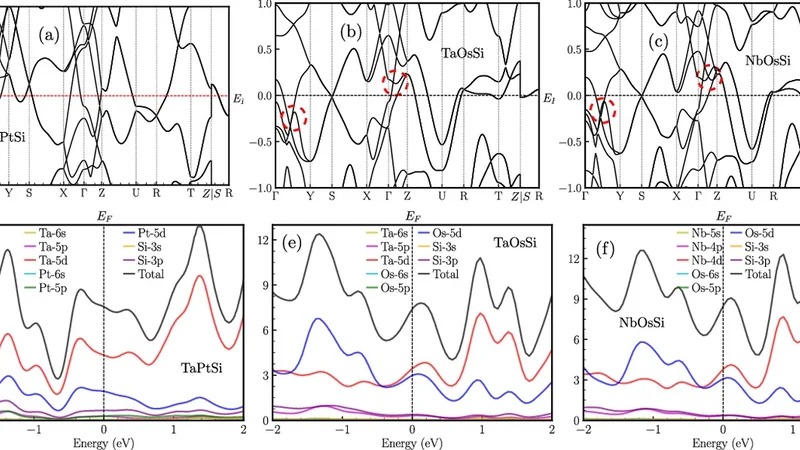
Nonsymmorphic crystalline symmetries provide a robust route to symmetry-protected electronic topology, yet their role in stabilizing intrinsic topological superconductivity remains largely unexplored. Here, we report \ch{TaPtSi} as a new member of the superconducting nonsymmorphic silicide family, characterized via AC transport, magnetization, heat capacity, and muon spin rotation/relaxation ($μ$SR) measurements. Zero field $μ$SR reveals spontaneous internal magnetic fields below $T_{\rm c}$, establishing time reversal symmetry breaking in \ch{TaPtSi}. First principles calculations on \ch{TaPtSi} and its isostructural nonsymmorphic superconducting analogues reveal the presence of symmetry-protected hourglass dispersions. The “necks” of these dispersions form Dirac nodal rings and chains that reside near or intersect the Fermi level. Guided by Ginzburg Landau symmetry analysis, we identify an internally antisymmetric non unitary triplet pairing state as the unique ground state consistent with the experimental phenomenology. Based on Bogoliubov de Gennes calculations, we further demonstrate that this state supports Majorana surface modes, establishing its intrinsically topological nature. These results reveal a systematic route by which nonsymmorphic symmetry drives the interplay between hourglass Dirac chain topology and unconventional triplet pairing, positioning equiatomic silicides as a unified materials platform for intrinsic topological superconductivity.
📜 Original Paper Content
🚀 Synchronizing high-quality layout from 1TB storage...