Optimization-based Unfolding in High-Energy Physics
In High-Energy Physics, unfolding is the process of reconstructing true distributions of physical observables from detector-distorted measurements. Starting from its reformulation as a regularized qua
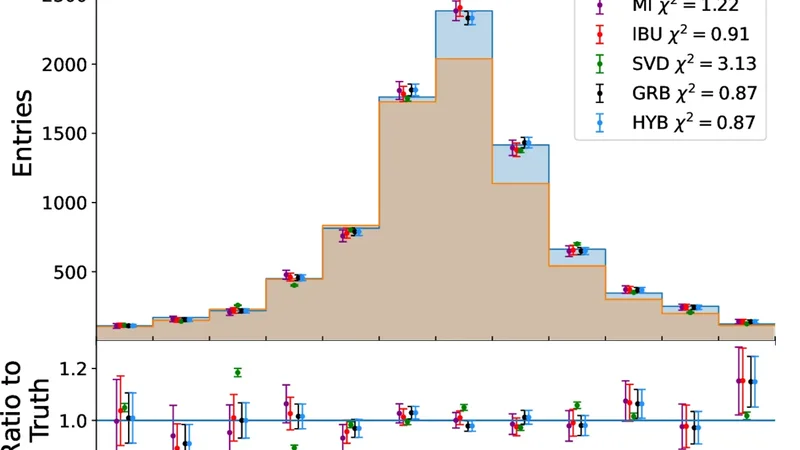
In High-Energy Physics, unfolding is the process of reconstructing true distributions of physical observables from detector-distorted measurements. Starting from its reformulation as a regularized quadratic optimization, we develop a framework to tackle this problem using both classical and quantum-compatible methods. In particular, we derive a Quadratic Unconstrained Binary Optimization (QUBO) representation of the unfolding objective, allowing direct implementation on quantum annealing and hybrid quantum-classical solvers. The proposed approach is implemented in QUnfold, an open-source Python package integrating classical mixed-integer solvers and D-Wave’s hybrid quantum solver. We benchmark the method against widely used unfolding techniques in RooUnfold, including response Matrix Inversion, Iterative Bayesian Unfolding, and Singular Value Decomposition unfolding, using synthetic dataset with controlled distortion effects. Our results demonstrate that the optimization-based approach achieves competitive reconstruction accuracy across multiple distributions while naturally accommodating regularization within the objective function. This work establishes a unified optimization perspective on unfolding and provides a practical pathway for exploring quantum-enhanced methods in experimental HEP data analysis.
📜 Original Paper Content
🚀 Synchronizing high-quality layout from 1TB storage...