Light-enhanced dipolar interactions between exciton polaritons
We consider the scenario of excitons in a semiconductor bilayer that are strongly coupled to cavity photons, leading to the formation of dipolar exciton polaritons (dipolaritons). Using a realistic pseudopotential for the dipolar interactions, we exactly determine the scattering between dipolaritons, accounting for the hybridization between interlayer and intralayer excitons. Similar to conventional non-dipolar polaritons, we find that the light-matter coupling enhances the interactions between dipolaritons by forcing excitons to scatter at energies that would otherwise be forbidden in ordinary exciton-exciton collisions. However, we show that this light enhancement is larger for long-range dipolar interactions than for short-range intralayer interactions, and is sensitive to the (non-uniform) dielectric environment of the bilayer. Crucially, we find that the largest dipolariton interactions are achieved for transition metal dichalcogenide bilayers in vacuum. Our results thus reveal the optimal dipolariton setup for realizing strong photon correlations.
💡 Research Summary
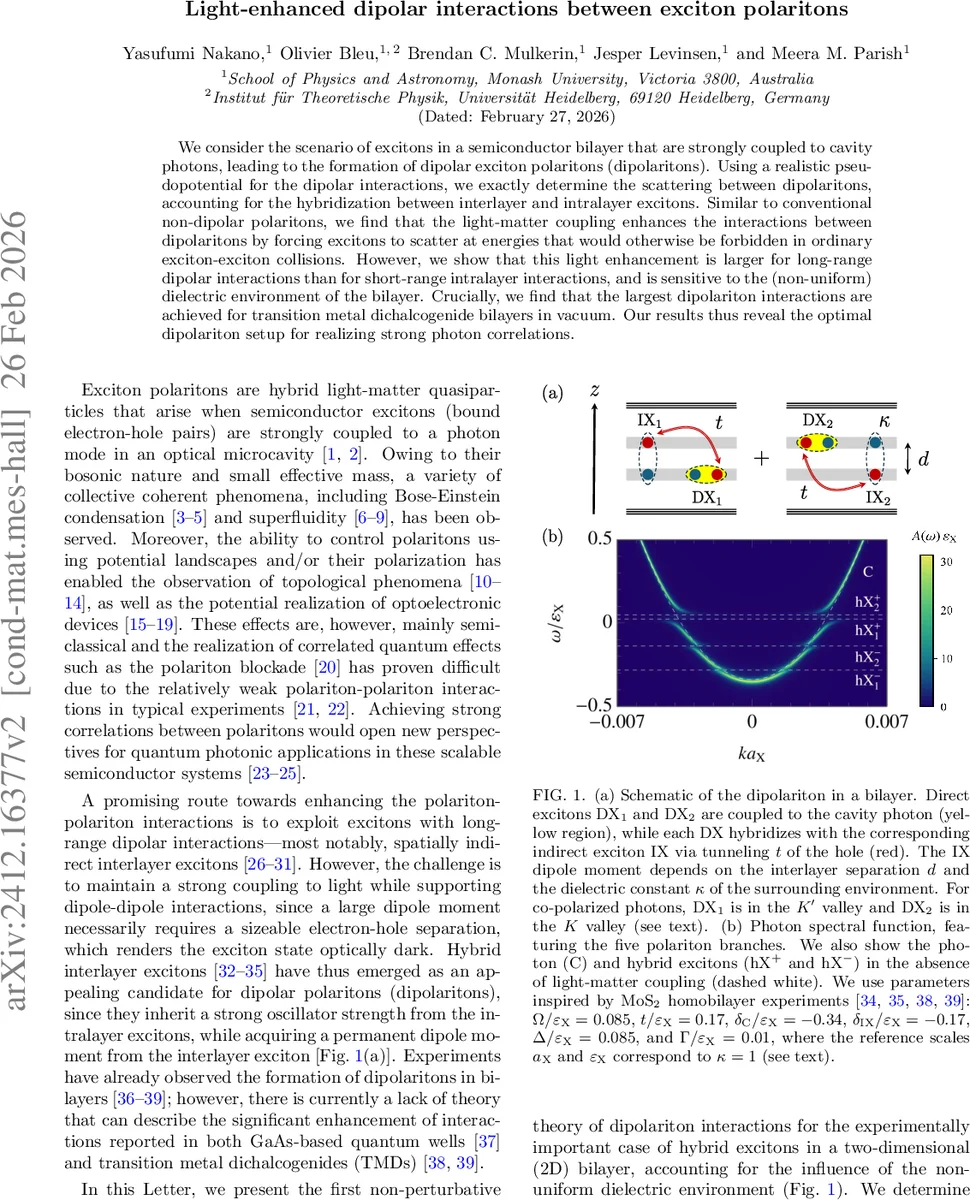
In this work the authors present a comprehensive, non‑perturbative theory of interactions between dipolar exciton‑polaritons (“dipolaritons”) in a semiconductor bilayer embedded in an optical microcavity. The system consists of two spatially separated quantum wells (or monolayers) that host direct excitons (DX) in each layer and indirect excitons (IX) formed by an electron in one layer and a hole in the other. The DXs couple strongly to the cavity photon with a Rabi splitting Ω, while the IXs are hybridized with the corresponding DXs through hole tunnelling of amplitude t. An out‑of‑plane electric field produces a Stark shift Δ that controls the relative DX‑IX detuning and, consequently, the dipole moment of the IX (p∝d/κ, where d is the inter‑layer separation and κ the surrounding dielectric constant).
The authors construct realistic effective interaction potentials for the underlying excitons. Direct‑direct (DX‑DX) and direct‑indirect (DX‑IX) interactions are modeled as short‑range soft‑core potentials, whereas the indirect‑indirect (IX‑IX) interaction contains a long‑range 1/r³ dipolar tail together with a short‑range repulsive core. The parameters of these pseudopotentials are fixed by matching the Born approximation to fully microscopic Ryto‑Keldysh calculations that include the dielectric screening length ρ₀=2πχ₂D/κ (χ₂D is the 2D polarizability). Two dielectric environments are examined: vacuum (κ=1) and hexagonal‑BN encapsulation (κ≈3.76). The latter reduces the dipole moment and therefore the strength of the long‑range part of the IX‑IX potential.
To obtain the two‑body scattering amplitude the authors solve the Lippmann‑Schwinger equation for the six possible two‑exciton channels (two DXs, two IXs, and two mixed DX‑IX states) while projecting onto the s‑wave sector relevant for low‑momentum polaritons. The key object is the T‑matrix, Eq. (9), which contains the full Born series summed to infinite order. Importantly, the light‑matter coupling allows excitons to scatter at energies that are “off‑shell” (negative collision energy) with respect to the bare two‑particle continuum. Figure 2(b) shows that for both DX‑DX and IX‑IX channels the T‑matrix grows dramatically as the collision energy becomes more negative, and the growth is especially pronounced for the dipolar IX‑IX channel. This off‑shell enhancement is absent in standard perturbative treatments and is the central mechanism by which the cavity photon amplifies polariton‑polariton interactions.
The polariton eigenstates are obtained by diagonalizing the non‑interacting Hamiltonian (1). The resulting five polariton branches (four bright, one mostly excitonic) are expressed through Hopfield coefficients C, X, and Y that give the photon, DX, and IX fractions of each mode. The lower polariton (LP) branch is of primary interest because it can acquire a sizable IX component when the Stark shift Δ is comparable to Ω. The authors compute the LP‑LP interaction constant g_LL as a function of photon detuning δC, IX‑DX detuning δIX, and the ratio Δ/Ω. The results (Fig. 3) reveal several trends:
- Dielectric dependence: In vacuum (κ=1) the LP‑LP interaction is roughly 2–3 times larger than in hBN‑encapsulated samples, reflecting the stronger dipole moment of the IX.
- Stark‑shift control: Increasing Δ (i.e., applying a stronger electric field) reduces the IX fraction in the LP and consequently lowers g_LL. The maximal interaction occurs near Δ≈0, where the IX and DX are nearly resonant and both contribute.
- Off‑shell enhancement: The interaction constant follows the off‑shell T‑matrix behavior, confirming that the cavity forces excitons to scatter at energies where the two‑body scattering amplitude is maximal.
- Comparison to conventional polaritons: When the IX is pushed far out of resonance (δIX→+∞), the system reduces to ordinary non‑dipolar polaritons, and g_LL drops to the well‑known weak values.
Using realistic MoS₂ homobilayer parameters (Ω/εX≈0.085, t/εX≈0.17, δC/εX≈−0.34, δIX/εX≈−0.17, d/a0≈6, ρ0/a0≈40), the authors find that the LP‑LP interaction can be enhanced by a factor of 5–10 compared with conventional polaritons. This enhancement is sufficient to bring the interaction energy into the regime where photon blockade and other strongly correlated photonic phenomena become observable in planar semiconductor microcavities.
The paper concludes that the combination of (i) a strong light‑matter coupling, (ii) a sizable dipolar component of the lower polariton, and (iii) a low‑dielectric environment (vacuum) yields the optimal platform for realizing strong photon‑photon correlations. The authors suggest that TMD bilayers, especially MoS₂, are prime candidates because they support robust excitons with large binding energies, ensuring that the effective exciton‑exciton potentials remain valid even when the cavity modifies the scattering energy. Future directions include exploring temperature effects, disorder, multi‑polariton processes, and the impact of higher‑order cavity modes, but the present work establishes a solid theoretical foundation for dipolariton‑based quantum nonlinear optics.
Comments & Academic Discussion
Loading comments...
Leave a Comment