Infinite grids in digraphs
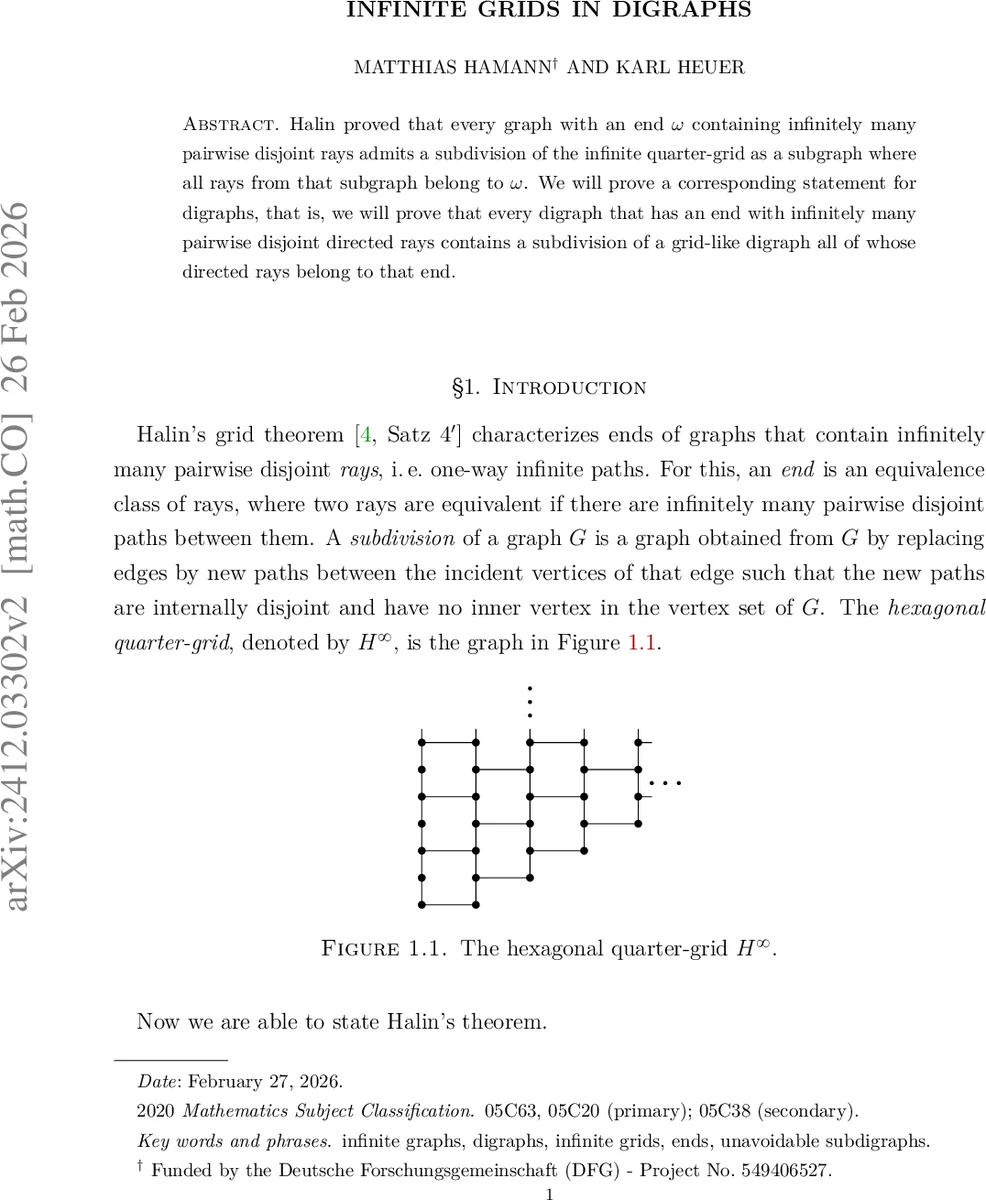
Halin proved that every graph with an end $ω$ containing infinitely many pairwise disjoint rays admits a subdivision of the infinite quarter-grid as a subgraph where all rays from that subgraph belong to $ω$. We will prove a corresponding statement for digraphs, that is, we will prove that every digraph that has an end with infinitely many pairwise disjoint directed rays contains a subdivision of a grid-like digraph all of whose directed rays belong to that end.
💡 Research Summary
The paper extends Halin’s classic grid theorem from undirected graphs to directed graphs (digraphs). Halin showed that any graph containing an end ω with infinitely many pairwise‑disjoint rays must contain a subdivision of the infinite quarter‑grid, with all rays of the subdivision belonging to ω. The authors prove an analogous statement for digraphs: if a digraph D has an end ω that contains infinitely many pairwise‑disjoint directed rays (or anti‑rays), then D contains a subdivision of the bidirected quarter‑grid (or its reverse) in which every directed ray lies in ω.
The authors begin by redefining ends for digraphs. A ray is a one‑way infinite directed path whose edges all point toward infinity; an anti‑ray points away from infinity. Two rays are equivalent if there are infinitely many pairwise‑disjoint paths joining them, and the equivalence classes are the ends. The “in‑degree” of an end is the maximum number of pairwise‑disjoint anti‑rays it contains, while the “out‑degree” is the maximum number of pairwise‑disjoint rays. An end is called thick if it contains infinitely many disjoint rays, otherwise it is thin.
A substantial part of the paper is devoted to a structural theorem for finite strongly connected digraphs (Theorem 3.4). It states that for any prescribed integers n and k there exists N such that every strong digraph on at least N vertices contains one of three configurations: (1) a directed cycle on at least n vertices, (2) an n‑narrow semi‑chain of k directed cycles (each intersecting only its immediate predecessor and successor), or (3) an n‑short p_{m,1}‑system of dipaths with m ≥ k−1. This result is a directed analogue of the well‑known fact that large enough connected graphs contain either a long path or a high‑degree vertex, and it serves as the finite “building block” for the infinite constructions.
Using Theorem 3.4, the authors analyse a thick end ω. They extract an infinite sequence of finite strong subdigraphs, each providing either a long dipath or a short p‑system. By carefully linking these substructures along the rays that represent ω, they construct a subdivision of the bidirected quarter‑grid (Figure 1.2) or its reverse. The construction ensures that every directed ray of the grid lies in ω, thereby generalising Halin’s theorem to the directed setting.
Beyond the main theorem (Theorem 1.2), the paper offers a finer classification of ends (Theorem 4.2). Depending on the auxiliary digraphs that appear on the rays of a given end, the end falls into one of three types, each guaranteeing a subdivision of a different grid‑like digraph: (i) the bidirected quarter‑grid, (ii) a cyclically directed quarter‑grid (ascending or descending), or (iii) a complete ray digraph. This mirrors a similar classification for undirected graphs by Diestel and Kühn.
The authors also treat thin ends. Theorem 5.1 shows that even when an end contains only finitely many pairwise‑disjoint rays, one can still find a grid‑like structure (though smaller) using the p_{m,1}‑systems from Theorem 3.4. Section 6 discusses the variant where rays are required to be edge‑disjoint rather than vertex‑disjoint, and outlines open problems.
In comparison with earlier work, Zuther proved a weaker version where only a “grid‑like” digraph with oriented horizontal and vertical edges was guaranteed; the present paper strengthens this by obtaining the fully bidirected quarter‑grid. Reich independently obtained a similar result with a slightly different definition of the bidirected grid; the two notions are shown to be equivalent up to subdivision.
Overall, the paper makes a significant contribution to infinite digraph theory. It provides a clean, self‑contained proof of a directed grid theorem, introduces a powerful finite structural lemma (Theorem 3.4), and gives a comprehensive classification of ends in terms of the grid‑like subdigraphs they contain. The techniques blend classic combinatorial tools (Menger’s theorem, pigeon‑hole principle) with novel constructions tailored to directed settings, opening avenues for further research on infinite directed minors, connectivity, and the structure of ends in digraphs.
Comments & Academic Discussion
Loading comments...
Leave a Comment