Anomalous cosmic rays within the inner heliosphere: Observations of helium by the High Energy Telescope onboard Solar Orbiter
Radial gradients of cosmic rays are key parameters for understanding the transport of particles in space. Solar Orbiter, launched on 2020 February 10, approaches the Sun approximately every half year,
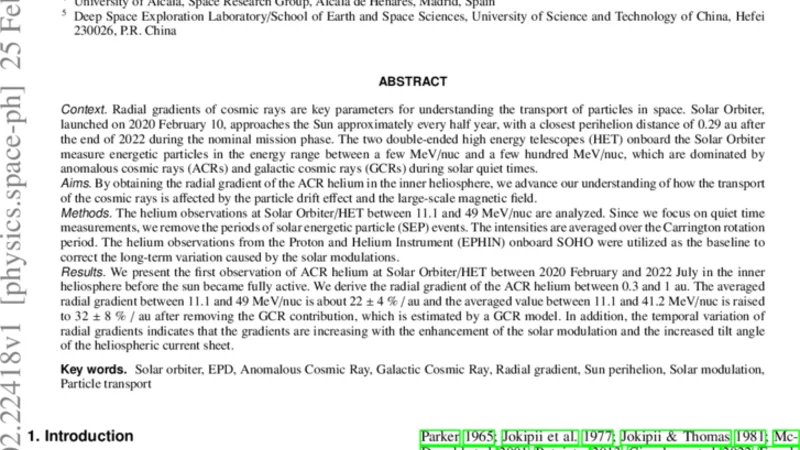
Radial gradients of cosmic rays are key parameters for understanding the transport of particles in space. Solar Orbiter, launched on 2020 February 10, approaches the Sun approximately every half year, with a closest perihelion distance of 0.29 au after the end of 2022 during the nominal mission phase. The two double-ended high energy telescopes(HET)onboard the Solar Orbiter measure energetic particles in the energy range between a few MeV/nuc and a few hundred MeV/nuc, which are dominated by anomalous cosmic rays (ACRs) and galactic cosmic rays (GCRs) during solar quiet times. By obtaining the radial gradient of the ACR helium in the inner heliosphere, we advance our understanding of how the transport of the cosmic rays is affected by the particle drift effect and the large-scale magnetic field. The helium observations at Solar Orbiter/HET between 11.1 and 49 MeV/nuc are analyzed. Since we focus on quiet time measurements, we remove the periods of solar energetic particle (SEP) events. The intensities are averaged over the Carrington rotation period. The helium observations from the Proton and Helium Instrument(EPHIN)onboard SOHO were utilized as the baseline to correct the long-term variation caused by the solar modulations. We present the first observation of ACR helium at Solar Orbiter/HET between 2020 February and 2022 July in the inner heliosphere before the sun became fully active. We derive the radial gradient of the ACR helium between 0.3 and 1 au. The averaged radial gradient between 11.1 and 49MeV/nuc is about 22$\pm$4%/au and the averaged value between 11.1 and 41.2MeV/nuc is raised to 32$\pm$8%/au after removing the GCR contribution, which is estimated by a GCR model. In addition, the temporal variation of radial gradients indicates that the gradients are increasing with the enhancement of the solar modulation and the increased tilt angle of the heliospheric current sheet.
💡 Research Summary
This paper presents the first systematic measurement of anomalous cosmic‑ray (ACR) helium in the inner heliosphere using the High Energy Telescope (HET) on board Solar Orbiter. The authors analyse data collected between February 2020 and July 2022, when the spacecraft repeatedly approached the Sun to distances as small as 0.29 au, covering the radial range 0.3–1 au. The focus is on quiet‑time intervals; periods affected by solar energetic particle (SEP) events are identified and removed using GOES and Solar Orbiter SEP monitors. The remaining HET helium fluxes (11.1–49 MeV nucleon⁻¹) are then averaged over Carrington rotations (≈27 days) to suppress short‑term fluctuations.
To correct for the long‑term solar modulation that affects all cosmic‑ray species, the authors use helium measurements from the Proton‑and‑Helium Instrument (EPHIN) on SOHO as a reference. By cross‑calibrating the HET and EPHIN responses, they construct a baseline that isolates the heliocentric radial dependence of the ACR component. The galactic cosmic‑ray (GCR) contribution, which becomes non‑negligible at the higher end of the energy band, is estimated with a contemporary GCR model (Badhwar‑O’Neill 2020). Subtracting this modeled GCR flux yields a “pure” ACR helium spectrum.
The key results are radial gradients expressed as percent change per astronomical unit. For the full 11.1–49 MeV nucleon⁻¹ interval, the average gradient is 22 ± 4 % au⁻¹. When the GCR contribution is removed and the narrower 11.1–41.2 MeV nucleon⁻¹ range is considered, the gradient rises to 32 ± 8 % au⁻¹. These values are consistent with theoretical expectations that ACR intensities increase sharply toward the Sun due to particle drift and the large‑scale heliospheric magnetic field configuration.
Temporal analysis shows that the gradients are not static: they increase as solar modulation strengthens and as the tilt angle of the heliospheric current sheet (HCS) grows. The authors interpret this behaviour as a manifestation of drift‑driven transport; a larger HCS tilt modifies the drift paths, allowing more ACRs to reach the inner heliosphere and thereby steepening the radial profile. The trend persists throughout the observation window, which spans the transition from a relatively quiet Sun to the early phases of the current solar cycle.
In the discussion, the authors compare their inner‑heliosphere measurements with earlier observations from Voyager, Ulysses, and ACE, which sampled ACRs at ≥1 au. The higher gradients measured by Solar Orbiter confirm that the ACR intensity profile is steeper inside 1 au than previously inferred from outer‑heliosphere data alone. They also highlight the importance of rigorous data handling—SEP removal, Carrington averaging, cross‑instrument calibration, and GCR modeling—to isolate the ACR signal.
The paper concludes that Solar Orbiter/HET provides a valuable new window on ACR transport physics. The derived gradients support drift‑dominated models and demonstrate the sensitivity of ACR radial profiles to the evolving heliospheric magnetic geometry. Future work is proposed: extending the analysis into the solar maximum phase, incorporating other ACR species (e.g., O, Fe) to test charge‑to‑mass dependence, and coupling the observations with three‑dimensional magnetohydrodynamic simulations to quantify the role of the HCS tilt and solar wind turbulence. Such efforts will improve our ability to predict space‑radiation environments, which is essential for satellite operations and crewed deep‑space missions.
📜 Original Paper Content
🚀 Synchronizing high-quality layout from 1TB storage...