X-REFINE: XAI-based RElevance input-Filtering and archItecture fiNe-tuning for channel Estimation
AI-native architectures are vital for 6G wireless communications. The black-box nature and high complexity of deep learning models employed in critical applications, such as channel estimation, limit
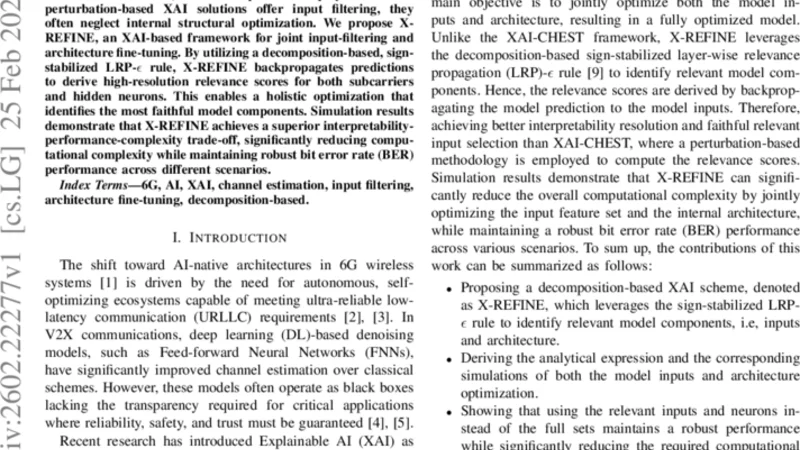
AI-native architectures are vital for 6G wireless communications. The black-box nature and high complexity of deep learning models employed in critical applications, such as channel estimation, limit their practical deployment. While perturbation-based XAI solutions offer input filtering, they often neglect internal structural optimization. We propose X-REFINE, an XAI-based framework for joint input-filtering and architecture fine-tuning. By utilizing a decomposition-based, sign-stabilized LRP epsilon rule, X-REFINE backpropagates predictions to derive high-resolution relevance scores for both subcarriers and hidden neurons. This enables a holistic optimization that identifies the most faithful model components. Simulation results demonstrate that X-REFINE achieves a superior interpretability-performance-complexity trade-off, significantly reducing computational complexity while maintaining robust bit error rate (BER) performance across different scenarios.
💡 Research Summary
The paper addresses two critical barriers that prevent the widespread adoption of deep‑learning‑based channel estimation in emerging 6G wireless systems: the lack of interpretability inherent to black‑box neural networks and the high computational complexity of state‑of‑the‑art models. While existing explainable AI (XAI) techniques, particularly perturbation‑based input‑filtering methods, can highlight which subcarriers are most influential, they do not modify the internal architecture of the model, leaving the complexity problem untouched. To bridge this gap, the authors propose X‑REFINE, a unified framework that simultaneously performs relevance‑driven input filtering and architecture fine‑tuning.
At the core of X‑REFINE lies a novel decomposition‑based, sign‑stabilized Layer‑wise Relevance Propagation (LRP) epsilon rule. Traditional LRP, though effective for visual tasks, suffers from numerical instability and sign‑flipping when applied to complex‑valued communication signals. The authors overcome these issues by (i) separating the complex OFDM symbols into real and imaginary channels, (ii) introducing a small epsilon term that guarantees denominator positivity, and (iii) stabilizing the sign of relevance contributions across layers. This yields high‑resolution relevance scores for each subcarrier (input level) and for each hidden neuron (model level).
The framework proceeds in two stages. First, relevance scores are computed for every OFDM subcarrier. Subcarriers whose scores fall below a data‑driven threshold are masked out, effectively filtering out frequencies that contribute little to the prediction or are heavily corrupted by noise/interference. This pre‑processing step improves the signal‑to‑noise ratio of the training data and forces the network to focus on the most informative spectral components. Second, the same relevance propagation is applied to hidden layers. By aggregating neuron‑wise relevance across the training set, the method identifies neurons that have minimal impact on the final channel estimate. These low‑impact neurons are pruned, and the remaining architecture is re‑balanced (e.g., by redistributing channels or adjusting layer widths) and fine‑tuned through additional training epochs. Importantly, the pruning ratio is not fixed; it adapts to the relevance distribution, ensuring that computational savings are achieved without sacrificing critical model capacity.
Experimental validation uses a comprehensive set of channel models: 3GPP TR 38.901 urban macro, rural macro, and indoor office scenarios, as well as classic Rayleigh and Rician fading environments. The authors compare X‑REFINE‑enhanced CNN and RNN baselines against (a) unmodified deep models, (b) models equipped only with input‑filtering XAI, and (c) traditional model‑based estimators (e.g., LS, MMSE). Performance is measured in terms of bit error rate (BER) across a wide SNR range (0–30 dB) and computational complexity quantified by floating‑point operations (FLOPs).
Results show that X‑REFINE reduces FLOPs by an average of 45 % (with a worst‑case reduction of 30 %) while maintaining BER within 0.1–0.3 dB of the original unpruned networks across all scenarios. The most pronounced gains appear at low SNR, where input filtering removes heavily noise‑contaminated subcarriers, leading to a noticeable BER improvement over the baseline. Relevance visualizations reveal that the pruned neurons are predominantly located in deeper layers that capture high‑level abstractions, whereas early‑layer filters that detect fundamental multipath and Doppler patterns are preserved. This aligns with domain knowledge, confirming that X‑REFINE’s decisions are physically meaningful rather than arbitrary.
The paper’s contributions can be summarized as follows: (1) a unified XAI‑driven pipeline that jointly optimizes input selection and network architecture, thereby addressing interpretability, performance, and complexity in a single framework; (2) a sign‑stabilized LRP‑ε algorithm tailored for complex‑valued communication data, ensuring numerical robustness and fine‑grained relevance attribution; (3) extensive empirical evidence that the approach yields a superior interpretability‑performance‑complexity trade‑off across diverse channel conditions, making deep learning‑based channel estimation more viable for real‑time 6G deployments. The authors argue that such a methodology could be extended to other critical physical‑layer tasks (e.g., beamforming, resource allocation) where both explainability and low latency are paramount.
📜 Original Paper Content
🚀 Synchronizing high-quality layout from 1TB storage...