Beyond Single-Shot Fidelity: Chernoff-Based Throughput Optimization in Superconducting Qubit Readout
Single-shot fidelity is the standard benchmark for superconducting qubit readout, but it does not directly minimize the total wall-clock time required to certify a quantum state. We develop an informa
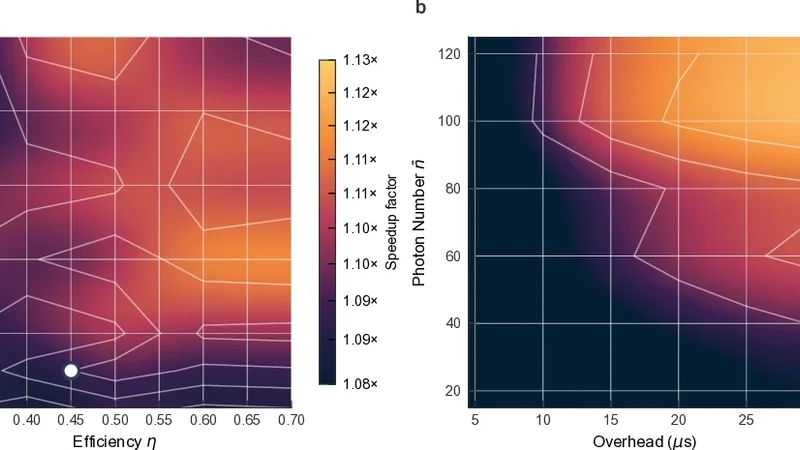
Single-shot fidelity is the standard benchmark for superconducting qubit readout, but it does not directly minimize the total wall-clock time required to certify a quantum state. We develop an information-theoretic description of dispersive readout by treating the measurement record as a stochastic communication channel. Within a trajectory model that incorporates T1 relaxation with full cavity memory, we compute the classical Chernoff information governing the multi-shot error exponent. We find a consistent separation between the integration time that maximizes single-shot fidelity and the time that minimizes total certification time. For representative transmon parameters and hardware overheads, the throughput-optimal integration window is longer than the fidelity-optimal one, yielding certification speedups of approximately 9 to 11 percent, with the gain saturating near 1.13x in the high-readout-power and high-overhead regime. Comparing the extracted classical information to the unit-efficiency Gaussian Chernoff benchmark defines an information-extraction efficiency metric. Typical dispersive schemes are limited to about 45 percent capture at short integration times by detection efficiency, decreasing to approximately 12 percent at a throughput-optimal integration time of about 1.22 microseconds due to T1-induced trajectory smearing. This formulation connects readout calibration to the operational objective of minimizing certification time in high-throughput superconducting processors.
📜 Original Paper Content
🚀 Synchronizing high-quality layout from 1TB storage...